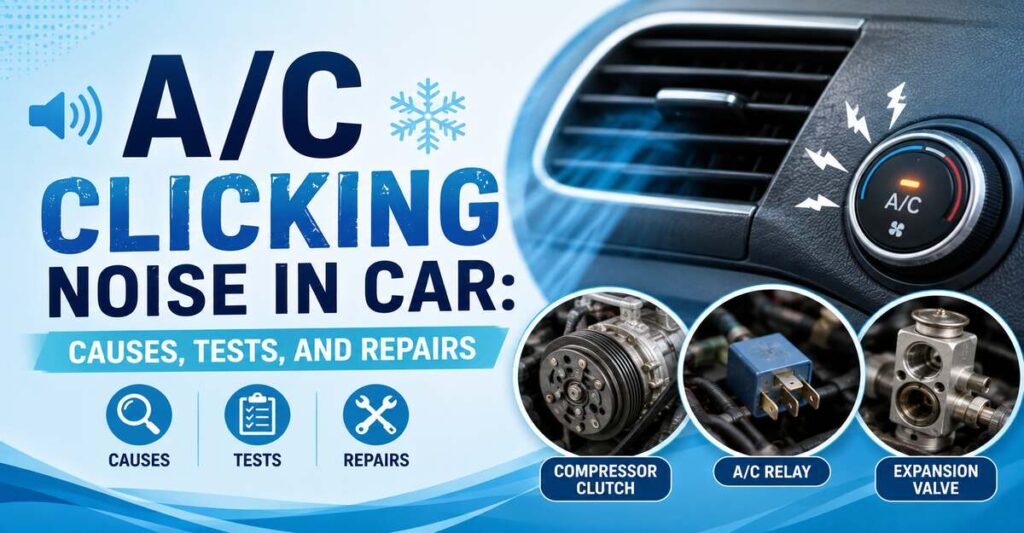
An A/C clicking noise in a car usually comes from an HVAC door actuator behind the dashboard, debris in the blower fan, an electrical relay, compressor cycling, or a worn compressor-related component. One brief click when the compressor engages can be normal, but repeated clicking, poor cooling, burning smells, belt noise, or metallic clattering requires diagnosis.
Key Facts at a Glance
- Clicking behind the dashboard after changing temperature or vent settings usually points to an HVAC door actuator.
- Ticking that speeds up with the cabin fan usually comes from blower debris, a damaged fan cage, or a worn blower motor.
- One clean under-hood click when the A/C engages may be normal on vehicles with a compressor clutch.
- Repeated compressor engagement every few seconds can result from abnormal refrigerant pressure, sensor faults, electrical problems, or operating conditions.
- Loud metallic clattering near the compressor is more urgent than a plastic dashboard click.
- Refrigerant loss indicates a leak and should not be treated as a routine fluid top-off.
What Does an A/C Clicking Noise Mean?
An automotive A/C clicking noise means that a mechanical or electrical part is engaging, slipping, cycling, striking another object, or reaching a position it cannot maintain. The location and timing of the sound usually provide more diagnostic value than its loudness.
The most common categories are:
- Dashboard clicking: HVAC actuator gears or air-door mechanisms.
- Fan-related ticking: Debris, a warped blower cage, or motor wear.
- Electrical clicking: Relays, control modules, or unstable voltage.
- Under-hood engagement clicks: Compressor clutch operation on applicable vehicles.
- Metallic clatter: Clutch, pulley, bearing, belt-drive, or compressor damage.
A sound should not automatically be blamed on the compressor. Dashboard actuators, blower assemblies, relays, belt tensioners, and adjacent accessories can all sound as though they are coming from the A/C system.
Is a Single Click When the A/C Starts Normal?
A single crisp click can be normal when the magnetic compressor clutch engages on a conventional belt-driven system. The clutch connects the spinning pulley to the compressor shaft when cooling is requested.
The sound is more likely normal when all four conditions are present:
- It occurs once when the A/C is switched on.
- It may occur occasionally as the compressor cycles.
- Cooling remains consistent.
- There is no grinding, squealing, rattling, or rapid repetition.
DENSO defines the magnetic clutch as the part that engages and disengages the compressor from the engine. However, not every modern compressor operates this way. Some variable-displacement compressors remain mechanically driven and regulate output internally, while many hybrid and electric vehicles use high-voltage electric compressors without an external clutch.
Where Is the Clicking Coming From?
The first diagnostic step is to divide the vehicle into two sound zones: the passenger compartment and the engine compartment. Perform the test while parked, with the parking brake applied and hands kept away from belts, fans, pulleys, and other moving parts.
| Sound location | Most likely causes | Useful confirmation test |
| Behind the glove box | Recirculation actuator, blower debris, blower motor | Change recirculation mode, then vary fan speed |
| Center dashboard | Blend-door or mode-door actuator | Change temperature and vent direction |
| Driver or passenger footwell | Lower actuator, blower assembly, duct obstruction | Compare fan speeds and climate zones |
| Fuse or relay box | A/C relay or electrical control cycling | Listen for matching compressor operation |
| Compressor area | Clutch, pulley bearing, compressor, pressure cycling | Compare A/C on versus off |
| Serpentine-belt area | Tensioner, idler, pulley, accessory bearing | Determine whether noise continues with A/C off |
| EV front compartment | Electric compressor or cooling-system component | Professional scan and isolation are usually required |
Sound travels through plastic ducts, metal brackets, refrigerant lines, and the vehicle body. A click that appears to come from the center dashboard may originate near the glove box, while a compressor-area sound may actually come from an idler pulley.
Why Is the Clicking Behind the Dashboard?
Repeated plastic clicking behind the dashboard most often indicates an HVAC actuator or the air door it controls. An actuator contains a small electric motor and reduction gears that rotate blend, mode, or recirculation doors.
Ford has documented vehicles in which clicking occurred when the temperature setting reached full heat or full cool, with replacement of the affected blend-door actuator specified as the repair. This supports using temperature-change testing to identify actuator-related noise, although the exact procedure and affected component vary by model.
Which HVAC Actuator Could Be Clicking?
Blend-Door Actuator
The blend-door actuator controls how much air passes through or around the heater core. A failure may produce clicking with an incorrect temperature, uneven temperatures, or one climate zone stuck hot or cold.
Mode-Door Actuator
The mode-door actuator directs air toward the windshield, dashboard vents, or footwell. A failure may cause clicking when changing vent modes or leave airflow stuck in one position.
Recirculation-Door Actuator
The recirculation actuator changes between outside air and recirculated cabin air. It is commonly positioned behind or near the glove box, so its clicking can be confused with blower debris.
Dual-Zone Temperature Actuator
Dual-zone systems may contain separate driver-side and passenger-side actuators. One side can cool normally while the other remains warm, even though both receive the same dashboard command.
What Does a Bad Actuator Sound Like?
A damaged actuator commonly produces a hollow plastic click, pop, or ratcheting sound lasting several seconds after:
- Starting the vehicle
- Turning the ignition off
- Changing the temperature
- Selecting defrost
- Switching vent modes
- Pressing the recirculation button
The noise may stop after 5 to 30 seconds because the control module stops driving the motor after the expected movement period. That duration is a clue, not a universal specification.
Why Does the Clicking Change With Fan Speed?
Clicking that becomes faster as blower speed increases usually comes from the blower fan assembly. The blower motor rotates a cylindrical fan cage, so anything contacting the cage produces a speed-dependent tick.
Likely causes include:
- Leaves or pine needles below the cabin filter
- A receipt, label, or piece of insulation in the intake
- A broken or warped blower-fan blade
- Excessive blower-motor shaft movement
- A loose blower housing
- A cabin filter installed incorrectly
- Rodent nesting material in a stored vehicle
A dirty cabin filter does not normally click by itself. It can reduce airflow and allow deformation if severely restricted, while a missing, damaged, or poorly seated filter can allow debris to reach the fan.
How Can You Test the Blower?
- Set the temperature control to a fixed position.
- Leave the A/C compressor off if the vehicle permits fan-only operation.
- Increase fan speed one level at a time.
- Listen for a matching increase in ticking frequency.
- Switch between outside-air and recirculation modes.
A noise tied directly to fan rpm points toward the blower area rather than the refrigerant circuit.
Why Does the A/C Click Every Few Seconds?
Repeated under-hood clicks every few seconds often indicate that a relay or compressor clutch is switching on and off. Possible causes include abnormal refrigerant pressure, pressure-sensor input, evaporator-temperature control, electrical resistance, excessive engine temperature, condenser-airflow problems, or normal cycling under light cooling demand.
Low refrigerant is one possible cause, but cycling frequency alone does not prove that the system needs refrigerant. Ambient temperature, humidity, engine speed, control strategy, cabin temperature, fan speed, and compressor design all affect operation.
Does Low Refrigerant Cause Clicking?
Low refrigerant can cause repeated engagement and disengagement on some clutch-equipped systems because pressure may fall below the control system’s permitted range. Low refrigerant also reduces oil circulation, which can increase compressor wear.
However, refrigerant does not normally disappear through ordinary consumption. A low charge suggests leakage from a hose, seal, condenser, evaporator, service port, or another component. A correct repair identifies the leak, confirms the specified refrigerant, evacuates the system when required, and charges the exact mass listed on the vehicle label.
The EPA notes that technicians cannot reliably determine the existing refrigerant quantity merely by looking at the system. It also maintains specific servicing and refrigerant requirements for motor-vehicle A/C systems.
Could the A/C Relay Be Clicking?
An A/C relay normally clicks when its internal contacts open or close. Rapid relay clicking can result from unstable control signals, low system voltage, a weak ground, excessive coil resistance, damaged contacts, or a control module repeatedly cancelling the compressor request.
A relay should not be replaced solely because it makes one click. Diagnosis should confirm whether the commanded component activates at the same moment and whether power, ground, and control signals remain stable.
How Do You Recognize Compressor Clutch Trouble?
A worn compressor clutch may click, chatter, scrape, or engage inconsistently near the front of the compressor. Symptoms can include intermittent cooling, visible clutch slippage, heat discoloration, a burning smell, or engagement failure when the engine compartment becomes hot.
Potential clutch-area faults include:
- Excessive or incorrect clutch air gap
- Worn friction surfaces
- A weak electromagnetic coil
- Loose mounting hardware
- Damaged clutch bearings
- Oil contamination
- Low supply voltage
- Excessive compressor resistance
Clutch service requires model-specific measurements and procedures. Some compressors allow separate clutch replacement, while others are serviced as complete assemblies.
What Does Internal Compressor Damage Sound Like?
Internal compressor damage is more likely to produce harsh metallic clacking, knocking, grinding, or growling than a light plastic click. The noise generally appears when compressor load is requested and may be accompanied by poor cooling, belt vibration, abnormal pressure, or debris in the refrigerant circuit.
DENSO’s compressor troubleshooting information separates abnormal compressor noise from magnetic-clutch noise, reinforcing the need to identify the noisy assembly before replacing the entire compressor.
Turn the A/C off and arrange prompt inspection when the sound is loud, metallic, continuous, or associated with:
- Smoke or a burning-rubber smell
- Serpentine-belt movement
- Pulley wobble
- Engine overheating
- Sudden loss of cooling
- A seized or intermittently locking pulley
- Blown fuses
- Visible refrigerant oil around a component
A failing compressor can contaminate the refrigerant circuit with metal particles, but not every noisy compressor has reached that stage. The system must be inspected before contamination is assumed.
Could the Belt Drive Be Mistaken for A/C Noise?
A belt tensioner, idler pulley, alternator bearing, water pump, or compressor pulley bearing can become louder when the A/C adds load to the engine. The timing makes the sound appear A/C-related even when the compressor’s internal mechanism is not the source.
A technician may isolate belt-driven components with a stethoscope, chassis-ear equipment, belt inspection, pulley runout checks, or a brief model-approved belt-off test. Reaching into a running belt drive or using improvised listening tools near rotating parts is unsafe.
Can the A/C Click When the Compressor Is Off?
Yes. The cabin blower, HVAC actuators, relays, and control modules can operate independently of active compressor cooling. Dashboard clicking during heat, defrost, recirculation, or startup may therefore have nothing to do with refrigerant or the compressor.
Defrost mode may automatically request the compressor in some vehicles to dehumidify the air. As a result, a driver can hear clutch operation even when the climate controls do not display a conventional A/C setting.
Why Does the Dashboard Click After the Car Is Turned Off?
Post-shutdown clicking usually results from an HVAC actuator performing a parking, recalibration, or air-door movement. A few soft movements may be normal, but repeated ratcheting from the same location suggests worn gears, a binding door, lost position feedback, or incorrect calibration.
Other after-shutdown sounds can come from cooling fans, emissions equipment, relays, thermal contraction, or EV battery-temperature systems. Timing, location, and duration must be considered together.
Do EVs and Hybrids Have the Same A/C Clicking Causes?
Electric and hybrid vehicles can still develop blower, actuator, air-door, relay, and debris-related clicks, but many use a high-voltage electric compressor rather than an engine-driven clutch compressor. The compressor may operate while the gasoline engine is off.
Delphi advises checking EV and hybrid systems for clicking, buzzing, or grinding from the compressor or blower motor and notes that diagnostic systems can help identify HVAC faults. High-voltage compressor circuits require vehicle-specific safety procedures and should not be opened or tested casually.
An EV compressor may also use electrically insulating oil specified for that system. Incorrect oil, contaminated equipment, or unsuitable refrigerant service can damage components and create electrical hazards.
How Can You Diagnose the Noise Safely?
The following sequence separates common causes without opening the refrigerant circuit.
Step 1: Record the Conditions
Note whether the noise occurs:
- At startup
- Only with A/C selected
- With heat or defrost
- At idle or while driving
- On a cold or hot engine
- At one fan speed
- During a temperature or vent change
- For a fixed number of seconds
- In one climate zone only
A short phone recording can help a technician identify rhythm and duration, provided the recording is made from a safe position.
Step 2: Test Fan Speed
Operate the blower from low to high. A click that accelerates with fan speed strongly indicates blower debris, fan damage, or motor wear.
Step 3: Test the Air Doors
Move the temperature gradually from cold to hot. Then switch among dashboard vents, floor, defrost, outside air, and recirculation.
A click triggered by one command identifies the relevant door circuit more accurately than a general dashboard noise complaint.
Step 4: Compare A/C On and Off
Keep the blower setting unchanged and toggle the cooling request. A noise that begins only when compressor operation is requested shifts attention toward the relay, clutch, compressor, condenser fan, or belt drive.
Step 5: Check Cooling Performance
Measure whether the system cools consistently and whether both sides of a dual-zone system deliver similar temperatures. Uneven left-right temperature commonly points toward air-door control, while weak cooling from every vent may involve refrigerant, airflow, compressor, condenser, or sensor problems.
Step 6: Inspect Accessible Items
With the vehicle switched off, inspect:
- Cabin-filter condition and installation
- Visible debris near the blower intake
- Loose trim or glove-box components
- Fuses listed in the owner’s manual
- Visible belt damage
- Electrical connectors for obvious heat damage
Do not disconnect high-voltage components, pierce wires, bypass pressure switches, or release refrigerant.
Step 7: Scan the HVAC Module
A capable scan tool may retrieve HVAC-specific diagnostic trouble codes, actuator-position data, pressure-sensor readings, commanded compressor states, and calibration functions. A basic engine-code reader may not communicate with the climate-control module.
Codes identify the circuit or detected condition, not automatically the failed part. Wiring, connectors, binding doors, module software, and mechanical faults can produce similar actuator codes.
Quick Symptom Comparison
| Symptom | Most probable area | Urgency |
| One click when cooling starts | Normal clutch engagement on applicable vehicles | Low if performance is normal |
| Plastic ratcheting after changing temperature | Blend-door actuator or door | Moderate |
| Clicking when changing vent direction | Mode-door actuator or door | Moderate |
| Glove-box clicking when pressing recirculation | Recirculation actuator | Moderate |
| Ticking that increases with fan speed | Blower debris, fan cage, or motor | Low to moderate |
| Relay-box clicks every few seconds | Control cycling or electrical issue | Moderate |
| Compressor clicks with intermittent cooling | Clutch, voltage, pressure, or sensor issue | Moderate to high |
| Loud metallic clatter under the hood | Pulley, clutch, belt drive, or compressor | High |
| Clicking with smoke or belt smell | Seizing component or belt damage | Immediate inspection |
| Clicking in an EV front compartment | Electric compressor or thermal component | Professional diagnosis |
Can You Drive With an A/C Clicking Noise?
Driving is usually possible when the noise is a brief dashboard actuator click and no safety-related system is affected. The cabin temperature or vent position may remain incorrect, but the engine is not normally endangered by a stripped plastic actuator gear.
Stop using the A/C and seek prompt inspection when the clicking is under the hood and accompanied by metallic noise, belt vibration, burning odor, overheating, electrical failure, or a visibly unstable pulley. A seized accessory or damaged belt can affect charging, steering assistance on some vehicles, or engine cooling.
Practical Urgency Scale
Green: Observe and Schedule
- One clean engagement click
- Cooling and airflow remain normal
- No warning lights or smells
- No increasing noise
Amber: Diagnose Soon
- Repeated dashboard ratcheting
- Inconsistent vent direction
- One side stuck hot or cold
- Fan-speed-related ticking
- Rapid relay or clutch cycling
- Cooling that becomes intermittent
Red: Turn the A/C Off
- Loud metallic knocking
- Grinding or squealing
- Burning smell or smoke
- Pulley wobble
- Belt damage
- Engine-temperature warning
- Electrical arcing or repeated fuse failure
How Much Does A/C Clicking Repair Cost?
Typical United States repair costs range from almost nothing for removing accessible blower debris to more than $2,000 when compressor failure contaminates the system. Vehicle design, labor rates, refrigerant type, parts availability, and dashboard access create wide variation.
| Repair | Typical shop range | Typical labor time |
| Basic noise diagnosis | $100 to $220 | 0.5 to 1.5 hours |
| Remove blower debris | $80 to $200 | 0.5 to 1.0 hour |
| Replace cabin filter | $40 to $120 | 0.2 to 0.5 hour |
| Replace blower motor | $200 to $650 | 0.5 to 2.5 hours |
| Replace accessible HVAC actuator | $180 to $450 | 1 to 2.5 hours |
| Replace difficult actuator | $450 to $1,200+ | 3 to 8+ hours |
| Electrical relay or wiring repair | $120 to $500+ | 0.5 to 3 hours |
| Leak diagnosis and correct recharge | $200 to $500+ | 1 to 3 hours |
| Compressor or clutch repair | $700 to $1,800+ | 3 to 7 hours |
| Contaminated-system repair | $1,500 to $3,000+ | Varies widely |
These are planning ranges, not quotations. R-1234yf service is often more expensive than R-134a service because the refrigerant, equipment, fittings, and service procedures differ.
Can You Replace a Blend-Door Actuator Yourself?
An accessible blend-door actuator can be a moderate DIY repair, but there is no universal replacement sequence. Some actuators sit behind the glove box, while others require console, steering-column, or dashboard removal.
Before You Start
- Typical time: 45 minutes to several hours
- Difficulty: Moderate, highly vehicle-dependent
- Typical part cost: $25 to $150
- Tools: Trim tools, suitable sockets, screwdrivers, inspection light
- Required information: Exact actuator location, part number, removal procedure, and calibration instructions
Step 1: Confirm the Fault Location
Operate one climate setting at a time and place a hand near each accessible actuator housing. The failed actuator often produces a distinct vibration synchronized with the clicking.
Success checkpoint: One command repeatedly triggers noise at one actuator location.
Common mistake: Replacing the most accessible actuator without identifying whether it controls temperature, mode, or recirculation.
Step 2: Follow the Vehicle’s Power-Down Procedure
Switch off the ignition and follow the manufacturer’s battery-disconnection instructions when required. Some vehicles need memory-saving, window initialization, steering-angle relearning, or high-voltage precautions.
Success checkpoint: The climate-control circuit cannot move unexpectedly during removal.
Common mistake: Assuming every vehicle requires the same battery procedure.
Step 3: Remove Trim Without Forcing It
Use the service procedure to remove the glove box, knee panel, console trim, or other access panel. Store fasteners by location.
Success checkpoint: The actuator and connector are visible without cracked trim or stretched wiring.
Common mistake: Pulling hidden clips in the wrong direction.
Step 4: Disconnect and Remove the Actuator
Release the electrical connector and remove the mounting screws with the correct tool. Observe the actuator shaft and door position before lifting the unit away.
Success checkpoint: The old actuator comes off without damaging the HVAC case or door shaft.
Common mistake: Forcing a binding air door with pliers.
Step 5: Check the Air Door
Move the exposed door only as the manufacturer permits. A door that binds, jams, or has excessive free movement can destroy a replacement actuator.
Success checkpoint: The door moves through its permitted range without cracking or severe resistance.
Common mistake: Treating every click as stripped actuator gears when the door itself is damaged.
Step 6: Install the Correct Actuator
Match the electrical connector, mounting pattern, function, and indexed shaft position. Do not energize an unmounted actuator unless the service procedure specifically instructs it.
Ford has warned in at least one model-specific bulletin that energizing an actuator before installation can cause mispositioning and loss of correct orientation.
Success checkpoint: The actuator seats flat without using the screws to pull it into alignment.
Common mistake: Ordering by appearance rather than VIN, position, and climate-control configuration.
Step 7: Perform the Specified Calibration
Calibration may occur automatically after a timed ignition cycle, through a fuse or battery reset, through a sequence of climate-control buttons, or with a scan tool. Use the procedure for the exact model.
Success checkpoint: The actuator completes its sweep without clicking, and the commanded temperature or vent mode works correctly.
Common mistake: Applying a generic 60-second calibration instruction to every vehicle.
Why DIY Refrigerant Charging Is Often Misleading
A single low-side gauge cannot determine total charge mass, identify air or moisture contamination, prove condenser airflow, or confirm that the correct refrigerant and oil are present. Adding refrigerant until a gauge enters a colored zone can overcharge the system or hide a leak.
The EPA identifies R-134a and R-1234yf as distinct motor-vehicle refrigerants with specific use and safety requirements. R-1234yf systems include unique fittings and additional safety provisions under SAE J639 because the refrigerant is mildly flammable.
Never substitute an unapproved hydrocarbon product for the refrigerant listed on the vehicle label. The EPA specifically warns that hydrocarbon products are sometimes marketed as replacements for R-134a or R-1234yf and addresses their safety risks separately.
Common Diagnostic Mistakes
Assuming Every Dashboard Click Is a Blend Door
Recirculation and mode actuators can produce almost identical noises. The triggering control must be identified before ordering parts.
Assuming Rapid Cycling Always Means Low Refrigerant
Pressure-sensor faults, condenser-fan failure, wiring issues, evaporator-temperature control, ambient conditions, and control strategy can all change cycling behavior.
Replacing the Compressor Before Isolating the Clutch
A noisy clutch bearing, pulley, belt tensioner, or adjacent accessory can imitate internal compressor damage.
Ignoring the Cabin Filter Area
Blower debris is inexpensive to correct but can sound severe from inside the cabin. Inspect the filter and intake before authorizing dashboard disassembly.
Installing an Actuator Without Checking Door Movement
A binding or broken door can immediately overload the new actuator and cause a repeat failure.
Using a Universal Calibration Method
Calibration varies by manufacturer, model, control module, and actuator position. The repair is not complete until the door travels correctly and the fault codes remain cleared.
Expert Diagnostic Insights
Rhythm Is More Useful Than Volume
A loud hollow dashboard click may come from a small plastic gear, while a quieter metallic tick synchronized with compressor rotation may indicate a more expensive fault. Frequency, trigger, and location should be documented before loudness.
Temperature-Dependent Failure Suggests Clearance or Resistance
A clutch that operates cold but fails after the engine compartment heats up may have an excessive air gap or a temperature-sensitive coil. An actuator that clicks only in very cold weather may have stiff door seals, contracted plastic, or increased grease resistance.
Cooling Performance Separates Airflow From Refrigeration Faults
Cold air with weak or noisy airflow points toward the filter, blower, or door position. Strong airflow that remains warm points more toward compressor output, refrigerant flow, condenser performance, or temperature control.
A New Actuator Does Not Repair a Broken Door
Actuator replacement solves motor, gear, or feedback failure. It does not repair a cracked shaft, warped door, damaged cam, obstructed duct, or deformed HVAC housing.
How Can Future A/C Clicking Be Prevented?
Preventive maintenance cannot eliminate every actuator or compressor failure, but it can reduce debris-related and load-related problems.
- Replace the cabin filter at the vehicle’s specified interval.
- Keep leaves and debris away from the windshield-cowl intake.
- Investigate weak cooling before the compressor operates under poor conditions for months.
- Repair belt squeal, pulley wobble, and tensioner movement promptly.
- Use only the refrigerant and lubricant specified on the under-hood label.
- Exercise temperature, mode, and recirculation doors periodically instead of leaving them in one position for years.
- Avoid forcing vents or climate doors manually.
- Have unusual noises recorded and diagnosed before they become continuous.
Frequently Asked Questions
Can a bad blend-door actuator stop the A/C from cooling?
A bad blend-door actuator can make the vents blow warm even when the refrigerant system is producing cold air. The actuator may leave the blend door positioned toward the heater core, producing the impression of a weak A/C system. Vent-temperature comparison and actuator testing help separate an air-mixing fault from a refrigerant fault.
Why does my car click only when I use defrost?
Defrost can command one or more mode doors and may automatically activate the compressor to remove moisture from cabin air. Clicking during defrost can therefore come from a mode-door actuator, compressor clutch, relay, or another commanded component. Testing vent modes and listening to the dashboard and engine compartment separately narrows the source.
Will a bad cabin filter make the A/C click?
A dirty filter rarely clicks directly. A damaged, missing, or incorrectly installed filter can allow leaves and other debris into the blower fan, creating a repetitive tick that changes with fan speed. Severe restriction may also reduce airflow and increase blower noise, but the filter itself usually produces rushing or whistling rather than clicking.
Why does the clicking disappear after 20 seconds?
An HVAC actuator may click only while the control module commands it toward a requested position. Stripped gears or a blocked door prevent it from reaching the expected endpoint, so it ratchets until the command stops. A consistent short duration after startup or a setting change strongly supports an actuator or door-position fault.
Can an A/C compressor click without being damaged?
Yes. A clutch-equipped compressor can make a clean click during normal engagement, and a nearby relay can click at the same time. Compressor damage is more likely when the sound becomes metallic, continuous, irregular, or accompanied by poor cooling, belt vibration, grinding, oil leakage, or a burning smell.
Why does only one side of the car click or blow warm?
Dual-zone systems often use separate temperature actuators for the driver and passenger sides. A failed actuator, damaged door, lost calibration, wiring fault, or temperature-sensor issue can leave one zone warm while the other cools normally. Scanning the HVAC module and commanding each actuator separately can identify the affected side.
The Bottom Line
An A/C clicking noise in a car is most commonly traced by matching the sound to its location and trigger. Dashboard clicking after a climate-setting change suggests an actuator, fan-speed-related ticking suggests blower trouble, repeated under-hood cycling requires pressure and electrical diagnosis, and metallic clatter near the belt drive requires prompt attention.
One engagement click may be normal. Repetitive plastic ratcheting is usually inconvenient rather than immediately dangerous, while grinding, smoke, pulley wobble, belt movement, or a burning smell means the A/C should be switched off until the vehicle is inspected.