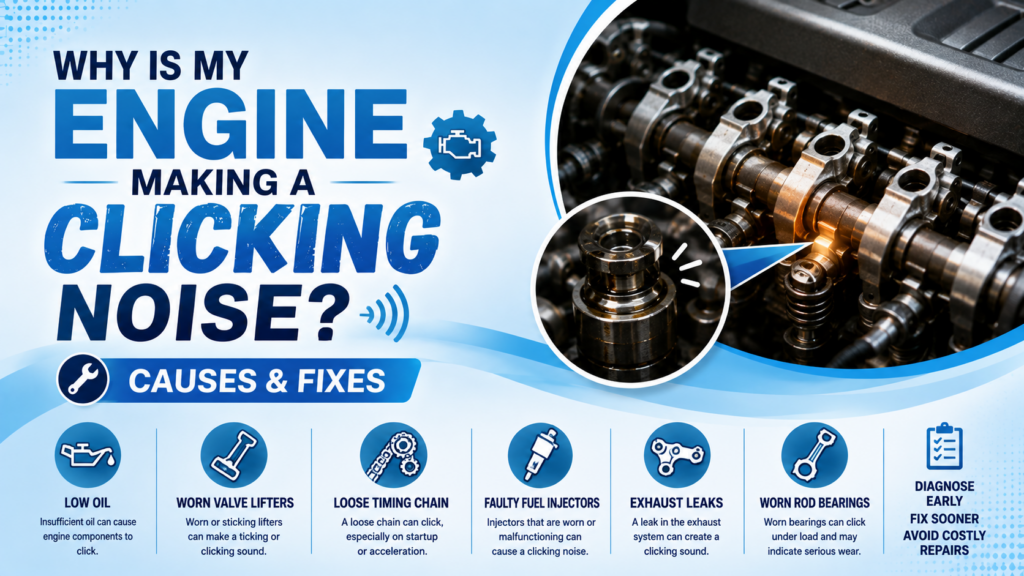
An engine making a clicking noise typically indicates valvetrain clearance issues, exhaust manifold leaks, normal direct fuel injection actuation, or severe connecting rod bearing wear. The specific location, temperature dependence, and rhythm of the sound dictate whether the vehicle requires immediate shutdown, minor maintenance, or simply normal operation.
Key Facts / At a Glance
- Direct fuel injection creates a rapid, sewing-machine-like click operating at 1,500 to 3,000 PSI, which is entirely normal.
- Hydraulic lifter tick stems from microscopic valvetrain gaps (0.1 mm to 0.5 mm) caused by low oil pressure or sludge buildup.
- Exhaust manifold leaks produce a ticking sound that typically fades after 5 to 10 minutes as metal components expand with engine heat.
- Rod knock presents as a deep, metallic clatter from the oil pan and indicates catastrophic bearing failure requiring immediate engine shutdown.
- Stethoscope diagnostics remain the most accurate way to isolate acoustic frequencies to the top, side, or bottom of the engine block.
What Mechanism Causes an Engine to Click?
Internal combustion engines rely on precise synchronization, lubrication, and tight tolerances. A repetitive, rhythmic clicking noise is generated when one of these three physical mechanisms occurs within the engine bay.
First, excessive mechanical clearance allows metal parts to strike each other. When hydraulic lifters fail to maintain zero lash against the camshaft, the cam lobe slaps the lifter instead of rolling smoothly, creating an impact tick. Second, escaping high-pressure gas generates an acoustic snap. A microscopic breach in an exhaust manifold gasket forces a pulse of exhaust gas out during each cylinder stroke, perfectly mimicking a mechanical click. Third, rapid component actuation causes rhythmic snapping. Solenoids, fuel injectors, and purge valves physically open and close in milliseconds under immense pressure, producing a distinct, high-pitched mechanical sound.
Primary Causes of Engine Clicking Noises
Identifying the specific failure point requires matching the auditory profile to the engine’s subsystems. The following are the definitive sources of internal and external engine clicking.
Hydraulic Lifter Tick (Valvetrain Gap)
Hydraulic lifters, or lash adjusters, utilize pressurized engine oil to eliminate clearance between the camshaft and the engine valves. When oil level drops, viscosity breaks down, or sludge clogs the lifter’s internal check valve, the lifter collapses slightly. This introduces a gap of 0.1 mm to 0.5 mm (0.004 to 0.020 inches). As the camshaft rotates, it strikes the collapsed lifter aggressively, producing a sharp, rapid, metallic tap from the top of the engine (valve cover).
Exhaust Manifold Leak (Escaping Gas)
The exhaust manifold bolts directly to the cylinder head to route scorching combustion gases out of the engine. Extreme thermal cycling over thousands of miles can warp the manifold flange, snap the mounting studs, or burn a hole through the gasket. The resulting breach allows high-pressure exhaust pulses to escape, sounding exactly like a valvetrain tick. This condition generally poses a low to medium threat to the engine, though it introduces hazardous fumes into the cabin.
Direct Fuel Injector Actuation (Normal Operation)
Modern engines utilize Direct Injection (DI) to maximize fuel economy and power. Unlike older port injectors, DI injectors spray fuel directly into the combustion chamber against extreme compression. To achieve this, the mechanical solenoids inside the injectors operate at immense fuel pressures ranging from 1,500 PSI to over 3,000 PSI (100 to 200+ bar). The forceful, rapid opening and closing of these solenoids creates a highly rhythmic, sewing-machine-like clicking that is completely normal and harmless.
Rod Knock (Severe Bearing Wear)
Connecting rod bearings sit between the crankshaft and the piston connecting rods, floating on a micro-thin layer of pressurized oil. If the engine experiences oil starvation, this protective film disappears, and the soft bearing material rapidly wears away. The connecting rod then violently rattles against the crankshaft with every stroke. While often described as a deep knock, early-stage bearing failure sounds like a heavy, hollow clicking from the bottom of the engine (oil pan). This requires immediate engine shutdown to prevent a catastrophic rod ejection.
Spark Plug Arcing and EVAP Purge Valves
Secondary systems frequently mimic internal engine failure. An EVAP (Evaporative Emission Control) purge valve rapidly cycles open and closed to route fuel vapors into the intake manifold, emitting a distinct plastic ticking sound. Alternatively, a cracked spark plug insulator or degraded ignition wire allows high-voltage electricity to arc directly to the engine block. This electrical spark creates a rhythmic, sharp snapping noise that synchronizes with the engine RPM.
How Can You Diagnose the Source of the Sound?
Professional automotive technicians utilize a methodical isolation sequence to prevent misdiagnosis. Follow these diagnostic steps to pinpoint the exact failure mechanism.
Step 1: Safety and Oil Level Verification
Pull the vehicle over safely, shut down the engine, and remove the oil dipstick. Critically low oil starves hydraulic lifters and rod bearings instantly, triggering extreme valvetrain noise. If the oil registers below the “MIN” line, top it off with the manufacturer-specified viscosity and retest. If the oil resembles a milky brown milkshake, coolant has breached the engine block, and the vehicle must be towed.
Step 2: Temperature Fluctuation Test
Start the engine from a completely cold state and monitor the clicking noise as the coolant temperature rises to the operating range (usually 190°F to 210°F). Exhaust manifold leaks typically exhibit their loudest tick when cold, then fade or vanish entirely after 5 to 10 minutes. The extreme heat causes the metal manifold to expand, temporarily sealing the gasket breach. Conversely, rod knock generally worsens as the engine warms because the engine oil thins out, offering less cushioning to the worn bearings.
Step 3: Acoustic Mapping with a Mechanics Stethoscope
A mechanic’s stethoscope is required to trace the exact geographic origin of the click. Touch the metal probe to specific engine zones while the vehicle idles.
- Valve Cover (Top): Amplifies valvetrain wear, lifter tick, or injector pulse.
- Exhaust Manifold (Side): Amplifies escaping gas pulses. (Expert alternative: carefully hover a piece of standard printer paper near the manifold; escaping exhaust gas will physically flutter the paper).
- Oil Pan (Bottom): Amplifies deep, destructive bearing impacts.
Step 4: The RPM Synchronization Test
Place the transmission in park or neutral and gently depress the accelerator. If the ticking frequency increases in perfect synchronization with the engine’s RPM, the source is directly tied to the internal rotational mass (valvetrain, pistons, or exhaust cycles). If the sound remains constant regardless of engine speed, it is likely an electrical accessory or an EVAP purge solenoid.
Diagnostic Matrix: Danger Levels and Sound Profiles
Use this comparison table to evaluate the acoustic signature of your engine against specific mechanical failures.
| Cause Type | Sound Profile | Primary Location | Temperature Behavior | Danger Level |
| Direct Fuel Injector | High-pitched, rhythmic click | Top of engine (Fuel Rail) | Constant, cold or hot | None (Normal operation) |
| EVAP Purge Valve | Hollow, plastic rapid clicking | Engine bay firewall / intake | Intermittent, computer controlled | None (Normal operation) |
| Exhaust Manifold Leak | Sharp, metallic “puff” | Side of engine (Manifold) | Loudest cold; fades when hot | Low-Medium (Fumes hazard) |
| Hydraulic Lifter Tick | Clear, metallic rhythmic tap | Top of engine (Valve Cover) | Often loud cold; may ease | Medium (Accelerates wear) |
| Rod Knock | Deep, metallic hollow clatter | Bottom of engine (Oil Pan) | Gets louder as oil warms/thins | Critical (Catastrophic failure) |
How Much Does It Cost to Fix Engine Ticking?
Repair costs vary drastically based on the diagnostic root cause, ranging from simple fluid corrections to complete engine replacements.
- Low Oil or Incorrect Viscosity: Adding oil or utilizing a specialized detergent additive (like Liqui Moly Pro-Line) costs between $30 and $100. This typically takes 30 minutes to resolve simple lifter sludge.
- Exhaust Manifold Gasket Replacement: Standard gasket replacement costs $150 to $400. However, if heat-fatigued bolts snap inside the cylinder head during extraction, machining labor pushes the total cost up to $1,500. This requires 3 to 6 hours of labor.
- Hydraulic Lifter Replacement: Replacing lifters requires removing the intake manifold, valve covers, and often the timing chain and camshafts. Costs range from $400 on simple inline-4 engines to $1,200+ on complex dual-overhead-cam V8 engines.
- Rod Knock / Bearing Failure: Worn rod bearings require a complete lower-end rebuild or a total engine swap. Expect costs between $2,500 and $7,000, requiring a vehicle downtime of 4 to 7 days.
Critical Mistakes to Avoid During Diagnosis
Misinterpreting engine sounds frequently leads to unnecessary component replacement or catastrophic engine destruction.
Expert Insight: The most common mistake drivers make is switching to a much heavier oil (e.g., 20W-50) to quiet a ticking lifter. While this thick oil muffles the sound, it fails to flow through the microscopic screens of modern Variable Valve Timing (VVT) solenoids. This starves the top end of the engine, turning a minor lifter tick into a $3,000 camshaft and VVT failure.
Do not ignore a sound simply because it disappears when the engine gets warm. An exhaust leak that quiets down at operating temperature indicates a structural crack or gasket failure that is actively deteriorating. Furthermore, never throw expensive parts at a clicking noise without mapping it. Replacing alternators, starter motors, or water pumps based on a vague clicking sound wastes money; always verify the source with a stethoscope first.
Frequently Asked Questions
Why does my car click rapidly but the engine will not turn over?
This indicates an electrical failure, not an internal engine malfunction. A rapid clicking upon turning the key is the starter solenoid engaging and disengaging because the battery lacks the amperage to crank the engine. Check for heavily corroded battery terminals or a dying 12V battery.
Does my engine click only when turning the steering wheel?
If the clicking only occurs while the vehicle is in motion and turning sharply, the engine is functioning perfectly. This sound is the hallmark of a failing outer Constant Velocity (CV) joint on the front axle, requiring axle replacement.
Why does my AC compressor make a loud single click?
A single, loud click that occurs periodically while the engine is running is the electromagnetic clutch on the air conditioning compressor engaging. This is completely normal operation as the system cycles the refrigerant to maintain cabin temperature.
Can using a cheap oil filter cause lifter tick?
Yes. Cheap, aftermarket oil filters often lack a high-quality anti-drainback valve. When you shut the engine off, all the oil drains out of the top of the engine back into the pan. Upon cold start, the engine experiences a “dry start,” causing loud lifter tick for 2 to 4 seconds until oil pressure is restored.