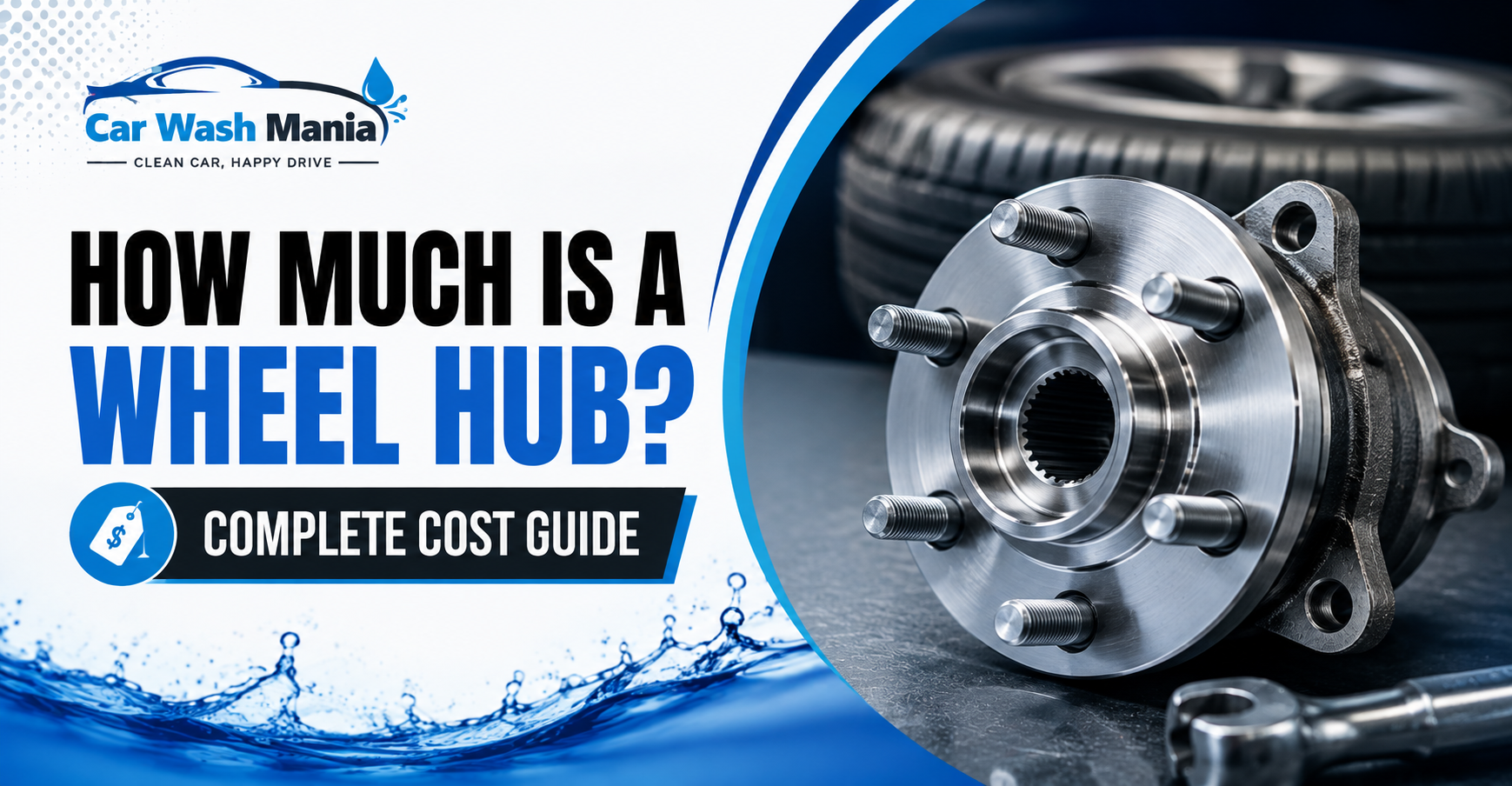
A wheel hub or hub assembly typically costs $50–$450 for the part alone, while professional replacement commonly totals $350–$900 per wheel in the United States. A complex luxury, electric, four-wheel-drive, or severely rusted vehicle can cost $1,000 or more per wheel after labor and related parts are included.
Key Facts at a Glance
- A typical aftermarket wheel-hub assembly costs $80–$300 per wheel.
- Premium aftermarket and original-equipment hubs commonly cost $200–$600 or more.
- Professional wheel-hub replacement generally costs $350–$900 per wheel.
- Most bolt-on hub assemblies require approximately one to two labor hours, excluding corrosion delays.
- Press-in wheel bearings may have cheaper parts but higher labor costs than bolt-on hub assemblies.
- A correct estimate requires the vehicle year, make, model, drivetrain, axle position, and ABS configuration.
How Much Is a Wheel Hub Without Labor?
A wheel hub generally costs $50–$450 without labor, although some original-equipment and specialized assemblies exceed $600. The actual price depends on whether the listing contains a bare hub, a bearing, a bolt-on hub-and-bearing assembly, an ABS sensor, mounting hardware, or a complete rear spindle assembly.
Current retail examples demonstrate how broad the range can be. AutoZone listings include wheel-bearing and hub assemblies priced from roughly $68 to $300, while the retailer describes basic wheel bearings as commonly costing $50–$150 and complete hub assemblies as frequently costing $200 or more.
| Part category | Typical price per wheel | What the price usually includes |
|---|---|---|
| Economy aftermarket bearing | $30–$100 | Bearing only; seals or hardware may be separate |
| Premium press-in bearing | $75–$200 | Higher-grade bearing, sometimes with a snap ring |
| Economy bolt-on hub assembly | $50–$150 | Hub and sealed bearing; sensor quality varies |
| Mid-grade hub assembly | $120–$300 | Hub, bearing, and usually an ABS encoder or sensor |
| Premium aftermarket assembly | $200–$450 | Higher-grade seals, steel, sensor, and warranty |
| OEM hub assembly | $250–$600+ | Vehicle-manufacturer-branded exact-fit assembly |
| Specialty or heavy-duty unit | $350–$800+ | Large truck, performance, EV, or unusual design |
These ranges describe one wheel position. Replacing two hubs normally doubles the part quantity, although labor efficiencies may reduce the second side’s labor charge slightly.
How Much Does Wheel-Hub Replacement Cost With Labor?
Professional wheel-hub assembly replacement commonly costs $350–$900 per wheel, including parts and labor. RepairPal’s 2026 national estimate places average wheel-hub assembly replacement at approximately $511–$664, consisting of about $343–$418 in parts and $168–$246 in labor, before taxes, fees, location adjustments, or related repairs.
| Expense | Common range per wheel |
|---|---|
| Diagnostic inspection | $0–$180 |
| Hub or bearing | $50–$600+ |
| Labor | $150–$500 |
| Axle nut, seals, bolts, or clips | $10–$100 |
| Alignment, when required | $90–$200 |
| Typical installed total | $350–$900 |
| Complex or premium-vehicle total | $900–$1,500+ |
A quote above $900 is not automatically excessive. OEM parts, dealership labor rates, extensive corrosion, press-in bearing work, damaged axles, seized fasteners, or suspension disassembly can justify a four-figure repair.
A low quote also needs scrutiny. An estimate may omit diagnostics, a replacement axle nut, ABS-related components, taxes, shop supplies, warranty coverage, or labor required to remove a rust-seized assembly.
What Is a Wheel Hub?
A wheel hub is the rotating mounting structure that connects a vehicle’s wheel and brake rotor or drum to the suspension and axle system. The wheel studs or threaded bolt holes are part of the hub, while the wheel bearing allows the hub and attached wheel to rotate with low friction.
The terms wheel hub, wheel bearing, and hub assembly are often used interchangeably in repair estimates, but they are not always identical:
- The hub carries the wheel studs or wheel-bolt holes.
- The wheel bearing supports rotation while carrying vehicle and cornering loads.
- A hub assembly combines the hub and bearing in one replaceable unit.
- The steering knuckle is the non-rotating suspension component into which the bearing or hub assembly fits.
- The CV axle passes through the hub on many driven wheels and transfers engine or motor torque.
Many modern hub-bearing units also contain an ABS impulse ring, magnetic encoder, or wheel-speed sensor. SKF notes that hub products may be supplied with ABS impulse rings and sensors because wheel-speed information supports braking and stability systems.
Why Do Wheel-Hub Prices Vary So Much?
Wheel-hub prices vary because the phrase can describe several mechanically different products. Vehicle load, hub size, bearing design, sensor technology, manufacturer, drivetrain, production date, and included hardware can each change the price.
Vehicle Size and Load Capacity
A compact car generally uses a smaller, lighter hub than a full-size pickup or heavy SUV. Towing, high axle loads, wide tires, and large wheel offsets place greater radial and cornering loads on the bearing, requiring larger rolling elements, stronger races, and more substantial mounting structures.
However, vehicle size is not the only factor. A small luxury crossover with a proprietary sensor-equipped assembly can have a more expensive hub than a basic rear-wheel-drive truck.
ABS and Wheel-Speed Sensor Design
A hub with an integrated wheel-speed sensor generally costs more than a purely mechanical unit. Sensor compatibility is critical because the vehicle’s anti-lock brakes, traction control, stability control, all-wheel-drive logic, and driver-assistance systems may depend on accurate wheel-speed data.
Some assemblies include the external sensor and wire. Others contain only a magnetic encoder ring that works with a reusable sensor mounted in the knuckle. A visually similar but electronically incompatible hub may fit physically while producing an ABS fault.
OEM Versus Aftermarket Parts
An OEM hub is sold under the vehicle manufacturer’s parts system and is intended to match the original specification. OEM pricing is usually higher because of branding, supply-chain structure, exact application validation, and dealership markup.
Aftermarket quality ranges from low-cost economy products to premium assemblies from established bearing manufacturers. A premium aftermarket part can provide an effective balance between price and durability, but the lowest online price should not be treated as proof that two hubs are equivalent.
Front, Rear, Driven, and Non-Driven Wheels
A front hub is not always more expensive than a rear hub. Cost is determined more accurately by whether the wheel is driven, whether the bearing is bolt-on or press-in, whether the parking brake is integrated, and how much disassembly is required.
A driven hub normally requires removal of a large axle nut and separation from a CV axle. A non-driven rear assembly may be simpler, but some rear designs combine the hub with a spindle, parking-brake hardware, or sensor equipment that raises the price.
Corrosion and Vehicle Location
Road salt and moisture can seize the hub into the steering knuckle even after every fastener has been removed. The technician may need a hub puller, slide hammer, air hammer, heat, cutting tools, or additional disassembly.
Corrosion often increases labor more than the part price. A one-hour flat-rate procedure can become a multi-hour physical extraction job when the assembly and knuckle have effectively bonded together.
Is a Wheel Hub the Same as a Wheel Bearing?
A wheel hub is not technically the same component as a wheel bearing, although many modern vehicles combine them into one sealed hub assembly. The distinction matters because a $70 bearing may require more labor to install than a $200 bolt-on assembly.
Bolt-On Hub Assemblies
A bolt-on hub assembly contains the hub flange and sealed bearing as a preassembled unit. It is normally attached to the steering knuckle with three or four bolts and may include an ABS sensor or encoder.
Bolt-on assemblies cost more as parts but usually reduce installation time. They cannot normally be disassembled, adjusted, cleaned, or re-greased; internal bearing or sensor failure requires replacement of the complete unit.
Press-In Bearings
A press-in bearing is installed separately inside the steering knuckle. The hub flange may be reused unless it is worn, distorted, or damaged during removal.
Press-in designs require correct support fixtures and controlled force. Pressure must be applied to the appropriate bearing race: pressing through the wrong race transfers force through the rolling elements and can damage a new bearing before the vehicle leaves the workshop.
Serviceable Tapered Bearings
Some older vehicles, trailers, and truck applications use serviceable tapered roller bearings. These may be cleaned, inspected, packed with grease, adjusted, and fitted with new seals rather than replaced as an entire hub unit.
A serviceable bearing job cannot be priced accurately from a generic hub-assembly estimate because the required parts and labor sequence are different.
How Much Is a Front Wheel Hub?
A front wheel-hub replacement usually costs $350–$950 per wheel, but the front position alone does not establish the price. Driven front hubs may require axle-nut removal, CV-axle separation, sensor disconnection, brake removal, and extraction from a corroded steering knuckle.
Front press-in bearings can produce high labor charges even when the bearing itself is inexpensive. The technician may need to remove the knuckle, separate suspension joints, use a hydraulic press, and perform an alignment afterward.
A bolt-on front assembly on a rust-free vehicle may be quicker and cheaper overall than a press-in rear bearing. Quotes should therefore identify the actual design rather than relying only on “front” or “rear” terminology.
How Much Is a Rear Wheel Hub?
A rear wheel hub commonly costs $300–$850 installed per wheel. A simple non-driven bolt-on rear hub may sit near the lower end, while all-wheel-drive, independent-suspension, parking-brake-integrated, or luxury applications can cost substantially more.
Rear hubs can also be confused with complete bearing carriers, spindle assemblies, or axle-shaft bearings. The mechanic should identify which component is defective before ordering parts.
On some vehicles, the rear hub is positioned behind internal drum-style parking-brake shoes. Corroded or broken parking-brake hardware can add parts and labor even though it did not cause the original bearing noise.
How Much Do OEM and Aftermarket Wheel Hubs Cost?
Aftermarket wheel hubs commonly cost $50–$450, while OEM assemblies frequently cost $250–$600 or more. The better choice depends on vehicle sensitivity, expected ownership period, labor difficulty, warranty terms, and the reliability of the specific manufacturer.
| Part option | Typical cost | Best suited to | Main limitation |
|---|---|---|---|
| Economy aftermarket | $50–$150 | Low-use or low-value vehicles | Greater variation in seals, sensors, and service life |
| Mid-grade aftermarket | $120–$300 | Typical daily-driver repair | Quality still depends on manufacturer |
| Premium aftermarket | $200–$450 | Long-term ownership and difficult labor | Higher initial cost |
| OEM | $250–$600+ | Sensor-sensitive, luxury, or warranty-focused vehicles | Highest purchase price |
| Used assembly | $30–$150 | Rare or discontinued applications only | Unknown wear and limited warranty |
A used bearing or hub assembly is usually a poor economy. Bearing life cannot be reliably determined by appearance, and the labor required to install a used part can exceed the amount saved.
Practitioner Rule of Thumb
The harder the hub is to replace, the less sense it makes to buy the cheapest available part. Saving $80 on a deeply pressed or corrosion-prone bearing is a weak trade when repeating the labor could cost $400–$700.
Another Counterintuitive Point
The most expensive part is not automatically the best part. Exact application, ABS compatibility, seal quality, storage condition, manufacturer traceability, and warranty support matter more than a high list price.
How Long Does Wheel-Hub Replacement Take?
A bolt-on wheel-hub assembly generally requires one to two labor hours per wheel, while a press-in bearing or severely corroded assembly may require two to four hours or more. ClickMechanic reports that front wheel-bearing replacement often takes around one hour but can range from under one hour to two hours, with rear jobs also varying by design.
| Repair situation | Typical workshop time |
|---|---|
| Accessible bolt-on rear hub | 0.8–1.5 hours |
| Bolt-on front driven hub | 1.0–2.0 hours |
| Press-in bearing with on-car tools | 1.5–3.0 hours |
| Knuckle removal and hydraulic press | 2.0–4.0 hours |
| Heavy corrosion or damaged hardware | 3.0–6.0+ hours |
Labor guides provide standardized times, not guarantees of clock time. Parts availability, technician workload, diagnostic steps, corrosion, and required alignment can keep the vehicle at the shop longer than the billed mechanical labor.
What Else Can Increase the Final Bill?
The final wheel-hub bill can exceed the advertised replacement price when the repair exposes damaged hardware or related components. The most common additions are axle nuts, seals, retaining rings, sensor wiring, brake shields, wheel studs, CV axles, brake parts, and alignment.
Axle Nuts and Single-Use Hardware
Many manufacturers specify replacement of the axle nut because it is staked, distorted, or designed for one-time use. Reusing an old nut may prevent accurate clamping force or allow the nut to loosen.
New mounting bolts, snap rings, cotter pins, and seals may also be required. A thorough quote should identify whether this hardware is included.
ABS Diagnosis
An illuminated ABS light does not prove the hub is mechanically worn. The fault may originate in the wheel-speed sensor, wiring harness, connector, tone ring, encoder, air gap, or control module.
A diagnostic scan and signal test may add cost but can prevent replacement of a mechanically sound hub.
Brake or Axle Damage
A loose bearing can allow rotor movement, alter brake-pad contact, damage a seal, or create heat. Severe looseness can also affect the CV axle, hub splines, steering knuckle, and wheel-speed sensor.
Related damage is more likely when the vehicle has been driven for an extended period after loud grinding, wheel wobble, or substantial looseness begins.
Alignment
A bolt-on hub replacement often does not require alignment because the suspension-adjustment points remain untouched. Alignment becomes more reasonable when the steering knuckle, strut bolts, control arm, tie-rod end, or other position-setting components are disconnected.
Should Both Wheel Hubs Be Replaced Together?
Both wheel hubs do not normally need to be replaced together merely because one has failed. Unlike brake pads, wheel hubs do not require paired replacement to maintain equal friction or braking force.
Paired replacement can still make sense when:
- Both sides produce noise or measurable play.
- Both hubs have similar high mileage and identical exposure.
- The second side already shows roughness during inspection.
- Labor overlap materially reduces the second repair’s cost.
- The vehicle is being prepared for extended travel or demanding service.
Replacing a quiet, tight, correctly functioning hub as a routine rule can waste money. The decision should be based on condition, history, access, and failure consequences rather than symmetry alone.
What Symptoms Suggest a Wheel Hub Is Failing?
A failing wheel hub commonly causes a humming, growling, rumbling, or grinding noise that changes with road speed. Other symptoms include wheel looseness, steering vibration, uneven brake behavior, ABS or traction-control warnings, and abnormal heat near the hub.
AutoZone identifies grinding noise, uneven tire wear, steering vibration, and an illuminated ABS light among common hub-failure signs.
Noise That Changes During Turns
Bearing noise may become louder when vehicle weight shifts onto the damaged side during a gradual turn. However, cabin acoustics and chassis vibration can make the apparent side misleading.
A noise that increases during a left turn does not, by itself, prove which bearing has failed. A technician should combine the road test with lifted-wheel inspection, vibration comparison, scan data, and other checks.
Wheel Play
Noticeable movement at the wheel can indicate a severely worn bearing, but the absence of play does not prove the bearing is healthy. A bearing race can become pitted and noisy while remaining tight.
Ball joints, tie-rod ends, control-arm bushings, and loose fasteners can also create movement. The observer must identify which joint is moving rather than attributing all wheel looseness to the hub.
ABS or Traction-Control Lights
An integrated sensor or magnetic encoder can fail before the bearing becomes noisy. Conversely, a worn bearing can alter the sensor air gap or contaminate the signal, causing intermittent warning lights.
Scan-tool data should be used to compare wheel-speed signals. Replacing a hub solely because an ABS light is present is diagnosis by assumption.
Can Other Problems Sound Like a Bad Wheel Hub?
Several problems can mimic wheel-bearing noise, including cupped tires, aggressive tread patterns, brake contact, differential bearings, CV joints, and transmission or transfer-case faults. Correct diagnosis is essential because replacing a hub will not change noise generated elsewhere.
Tire noise often changes with pavement texture and may move after tire rotation. Wheel-bearing noise usually follows wheel speed and may react to cornering load, but no single road-test behavior is conclusive.
A clicking noise during tight acceleration turns points more strongly toward an outer CV joint than a wheel bearing. A scraping noise synchronized with wheel rotation may come from a bent brake shield, embedded debris, or damaged brake hardware.
Is It Safe to Drive With a Bad Wheel Hub?
Driving with a confirmed bad wheel hub is not considered safe because progressive bearing damage can affect wheel control, braking, ABS operation, and component retention. The urgency increases sharply when the wheel has measurable play, grinding, heat, erratic steering, or visible wobble.
A faint new hum requires prompt diagnosis, not panic. A loud grind, strong vibration, loose wheel, burning smell, or unstable handling warrants stopping the vehicle and arranging professional inspection or towing.
The limitation is that symptoms alone cannot establish remaining service life. A noisy bearing might continue functioning for some distance, but no reliable mileage countdown can be assigned without inspection.
Can a Bad Hub Damage Other Parts?
A worn hub can damage tires, brake components, wheel-speed sensors, seals, CV-axle splines, and the steering knuckle if looseness or heat becomes severe. The longer substantial movement continues, the greater the chance that a straightforward hub repair becomes a multi-component repair.
Bearing movement can make the brake rotor run out of alignment, causing inconsistent pad contact or pulsation. Excess heat can degrade grease and seals, while a damaged sensor signal can disable or limit ABS and stability-control functions.
Prompt repair is therefore financially important as well as safety-related.
Can You Replace a Wheel Hub at Home?
An experienced DIY mechanic can replace some bolt-on hub assemblies at home, but safe lifting equipment, a torque wrench, axle-nut tooling, brake knowledge, and vehicle-specific service information are essential. Press-in bearings, severe corrosion, and sensor-sensitive designs are better suited to a properly equipped workshop.
A typical bolt-on job may require:
- Wheel chocks, a floor jack, and correctly rated jack stands.
- Lug, brake-caliper, hub-bolt, and axle-nut sockets.
- A breaker bar and calibrated torque wrench.
- A hub puller, slide hammer, or other extraction tool.
- Rust-cleaning tools and approved corrosion protection.
- Vehicle-specific torque values and fastener-replacement instructions.
- A scan tool when ABS faults require confirmation.
The key limitation of DIY savings is comeback risk. Incorrect bearing support, axle-nut torque, sensor routing, brake assembly, or vehicle support can create a more expensive and potentially dangerous failure.
How Is a Wheel Hub Professionally Replaced?
Professional replacement involves confirming the failed position, safely supporting the vehicle, removing the wheel and brake components, disconnecting the ABS equipment, removing any axle nut, extracting the hub or bearing, cleaning and inspecting the mating surfaces, and tightening all fasteners to specification.
The exact process varies by vehicle. A typical bolt-on sequence is:
- Confirm the noise, looseness, temperature difference, or sensor fault.
- Record diagnostic codes and wheel-speed data when relevant.
- Raise and support the vehicle at approved lifting points.
- Remove the wheel, brake caliper, caliper bracket, and rotor.
- Support the caliper without loading the brake hose.
- Disconnect the wheel-speed sensor harness.
- Remove the axle nut on a driven hub.
- Remove the rear hub-mounting bolts.
- Extract the hub from the steering knuckle.
- Clean rust from the mounting face without removing structural material.
- Inspect the knuckle, axle splines, brake shield, and wiring.
- Install the new hub and required one-time hardware.
- Torque the mounting bolts and axle nut to vehicle specification.
- Reassemble the brakes and wheel.
- Clear faults, verify live sensor data, and road-test the vehicle.
Installation torque is a design value, not a suggestion. Excessive or insufficient axle-nut preload can shorten bearing life.
What Installation Mistakes Cause Early Hub Failure?
The most common causes of early failure are incorrect axle-nut torque, impact-tool final tightening, improper pressing force, contaminated mounting surfaces, sensor damage, and low-quality parts. A hub can fail early even when the original diagnosis was correct.
Using an Impact Tool for Final Torque
An impact wrench can be useful for removal, but final tightening should follow the manufacturer’s approved procedure. Uncontrolled torque can distort components, overload the bearing, damage threads, or produce incorrect preload.
Pressing Through the Wrong Bearing Race
When installing a bearing into a knuckle, force should be supported through the outer race. When pressing a hub into an installed bearing, the inner race must be supported.
Applying force through the rolling elements can create microscopic dents called brinelling. The new bearing may then hum immediately or fail after limited mileage.
Installing a Magnetic Encoder Backward
Some press-in bearings have a magnetic encoder on only one side. Installing that side away from the wheel-speed sensor can produce an ABS fault even though the bearing is mechanically installed.
The encoder should be identified before pressing because the bearing may be damaged if removed and reversed.
Failing to Clean the Knuckle
Rust scale can prevent a bolt-on hub from sitting flush. Misalignment can affect sensor air gap, rotor position, fastener load, and bearing durability.
The surface should be cleaned without grinding away enough metal to alter the fit.
Reusing Damaged Hardware
A stretched, staked, corroded, or cross-threaded axle nut cannot be assumed to provide correct clamping force. Hardware replacement should follow the manufacturer’s service instructions.
How Can You Tell Whether a Repair Quote Is Fair?
A fair wheel-hub quote identifies the exact wheel position, part brand, part number or quality level, labor hours, hardware, diagnostic charges, warranty, taxes, and possible corrosion-related additions. A single unexplained total does not provide enough information for comparison.
Ask the shop these questions:
- Is the estimate for a bearing, bare hub, or complete hub assembly?
- Is the part economy aftermarket, premium aftermarket, or OEM?
- Does the assembly include the ABS sensor or encoder?
- Are the axle nut, seal, bolts, and retaining hardware included?
- How many labor hours are being charged?
- Is an alignment included, and why is it required?
- What part and labor warranty applies?
- Could corrosion or knuckle damage change the estimate?
- Were the bearing noise and ABS fault independently confirmed?
- Does the estimate cover one wheel or both wheels?
Compare equivalent estimates. An OEM quote with a three-year parts-and-labor warranty is not directly comparable to an economy part with a short parts-only warranty.
When Is a $1,000 Wheel-Hub Quote Reasonable?
A $1,000 quote may be reasonable for a luxury vehicle, EV, large 4WD truck, OEM-only application, press-in design, dealership repair, or severely corroded assembly. The price becomes more credible when it includes diagnostic work, expensive sensor equipment, related hardware, alignment, and a strong labor warranty.
For context, RepairPal lists approximately $616–$724 for a Lexus NX300 hub-assembly replacement and $536–$676 for a Chevrolet Silverado 1500 before taxes, location adjustments, and related work.
A $1,000 estimate deserves clarification when it covers an accessible economy-car bolt-on hub with a low-cost aftermarket part and no related damage. The correct response is to request the itemized labor, part manufacturer, warranty, and included operations—not to reject the total based solely on a generic internet average.
Which Wheel Hub Should You Buy?
A premium aftermarket hub from an established bearing manufacturer is generally the best value for a daily-driven vehicle that will be kept for several years. OEM is preferable when the application is electronically sensitive, aftermarket fitment history is poor, warranty preservation matters, or repeating the labor would be especially costly.
Choose an economy hub only when the vehicle’s value, expected remaining use, repair access, and warranty make the shorter-risk horizon acceptable. A cheap hub is not a good bargain for a vehicle used for towing, high annual mileage, long-distance travel, commercial service, or difficult winter-road conditions.
Verify all of the following before ordering:
- Model year, make, model, and trim
- VIN or production date
- Front or rear axle
- Left, right, or interchangeable position
- Front-, rear-, all-, or four-wheel drive
- Wheel bolt pattern and stud count
- ABS and traction-control configuration
- Sensor connector shape and wire length
- Axle spline count where applicable
- Included mounting hardware
- Manufacturer and seller warranty
Frequently Asked Questions
How much does it cost to replace two wheel hubs?
Replacing two wheel hubs commonly costs $700–$1,800, depending on the vehicle, part quality, labor rate, and hub design. The parts are normally doubled, but the shop may save setup and diagnostic time by completing both sides during one visit. Two premium OEM assemblies on a luxury or heavy-duty vehicle can exceed $2,000.
Can I replace only the noisy wheel hub?
Yes. A noisy or loose wheel hub can usually be replaced by itself when the opposite hub is quiet, tight, and producing a normal sensor signal. Hubs are not routinely replaced in pairs like brake pads. The opposite side should still be inspected because similar mileage and exposure can produce closely timed failures.
Does a new wheel hub include the wheel bearing?
A complete hub assembly normally includes the wheel bearing, but a product described only as a “hub” may not. Press-in applications often sell the bearing and hub separately. Check the product photograph, description, part number, ABS provisions, hardware list, and vehicle fitment before comparing prices.
Will wheel-hub replacement fix an ABS light?
Wheel-hub replacement fixes an ABS light only when the fault originates in the hub’s sensor, encoder, bearing movement, or related signal. Damaged wiring, connectors, control modules, mismatched tires, or another wheel sensor can produce the same warning. Diagnostic codes and live wheel-speed data should identify the failed circuit before parts are replaced.
Does a wheel hub come with new wheel studs?
Many complete hub assemblies include preinstalled wheel studs, but not every hub does. Vehicles that use wheel bolts may instead have threaded holes in the flange. Product details should confirm the stud count, bolt pattern, thread specification, and whether replacement lug nuts or wheel bolts are required.
How long should a new wheel hub last?
A quality wheel hub can often remain serviceable for 80,000–150,000 miles or longer, but no fixed replacement interval applies universally. Vehicle load, impacts, water intrusion, road salt, tire size, wheel offset, towing, installation torque, seal quality, and part manufacturing determine actual life more strongly than mileage alone.
The Bottom Line
For drivers asking how much is a wheel hub, the most useful starting estimate is $50–$450 for the part or $350–$900 per wheel professionally installed. Current national estimates place many complete hub-assembly repairs near $511–$664, but OEM components, press-in designs, corrosion, ABS integration, and premium vehicles can push the cost above $1,000.
The fairest quote is not necessarily the lowest total. It is the quote that correctly identifies the failed component, uses an appropriate-quality exact-fit part, includes required hardware, follows manufacturer torque procedures, and provides meaningful parts-and-labor warranty coverage.


