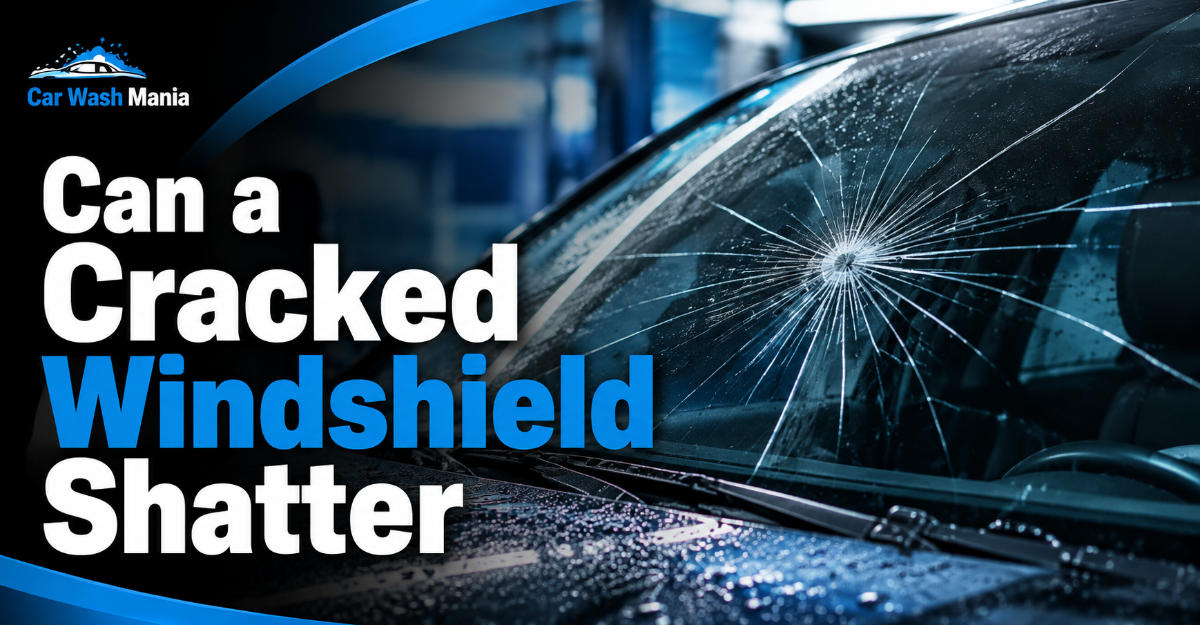
A cracked windshield can spread, spiderweb, buckle, or fracture almost completely, but a modern laminated front windshield normally does not explode into loose, sharp pieces. Its plastic interlayer is designed to retain broken glass; however, severe damage can still obstruct vision, weaken the bonded windshield system, and reduce dependable protection in another collision.
Key Facts at a Glance
- A laminated front windshield can fracture extensively without scattering like ordinary window glass.
- The plastic interlayer holds most broken fragments together but does not make the windshield indestructible.
- Edge cracks, spreading cracks, poor visibility, glass movement, and multiple impact points require urgent professional assessment.
- Sudden temperature differences, potholes, body flex, another impact, and door slamming can extend existing damage.
- A windshield may remain physically in place while no longer providing reliable visibility, sealing, stiffness, or crash performance.
- Windshield replacement may require camera or sensor calibration when the vehicle manufacturer specifies it.
What Happens When a Cracked Windshield “Shatters”?
A cracked windshield usually develops a dense network of fractures while remaining bonded to its internal plastic layer. Drivers often describe this as shattering, although the more accurate failure is extensive cracking or spiderwebbing rather than the release of thousands of loose glass cubes.
A front windshield is generally made from laminated safety glass: an outer glass layer, a flexible plastic interlayer—commonly polyvinyl butyral—and an inner glass layer. The interlayer helps retain fragments, limits penetration, and reduces the likelihood of occupants being struck by flying pieces or ejected through the opening.
Lamination does not guarantee that every fragment will remain perfectly flat. Small particles may detach around an impact point, damaged glass may sag or move, and severely compromised sections can bend inward or outward. The critical distinction is that a windshield generally stays together as a damaged sheet instead of disintegrating like tempered side-window glass.
Is Laminated Windshield Glass Shatterproof?
No. Laminated windshield glass is fragment-retaining, not shatterproof. Both glass layers can break while the plastic interlayer continues holding the damaged assembly together.
A heavily fractured windshield may still fail in several meaningful ways:
- Visibility can be lost through dense cracking, glare, haze, or optical distortion.
- The glass may flex, bow, vibrate, or separate from the interlayer.
- Water can enter between layers and create cloudy areas.
- The perimeter bond may become compromised.
- Another stone impact or collision may penetrate the weakened area.
- Windshield-mounted cameras may lose a clear or correctly aligned view.
- The windshield may no longer perform as its manufacturer intended during airbag deployment or roof loading.
“Still attached” therefore does not mean “still safe.”
Why Does a Windshield Stay Together After Breaking?
The plastic interlayer stretches and retains fractured glass after impact. Instead of allowing the two brittle glass plies to separate freely, the interlayer distributes some of the load and keeps many fragments adhered to the sheet.
This construction serves several purposes:
- It reduces fragment projection into the passenger compartment.
- It limits the size of the opening created by an impact.
- It helps prevent occupant ejection.
- It preserves partial weather protection after breakage.
- It allows the damaged windshield to remain bonded to the vehicle until replacement.
Federal glazing requirements address the performance of automotive glass, while other vehicle standards concern windshield mounting, roof-crush performance, and windshield-zone intrusion. These standards show why the windshield must be considered part of a complete installed system rather than only a transparent panel.
Can a Windshield Crack Suddenly Spread?
Yes. A stable-looking crack can extend within seconds when additional stress reaches its tip. Crack growth is difficult to predict because it depends on glass thickness, crack depth, location, temperature, body movement, previous impacts, and manufacturing stress.
The sharp end of a crack concentrates force into a very small area. A minor load that would not damage intact glass may therefore extend an existing fracture.
Common triggers for sudden crack growth
- Driving into a pothole
- Crossing a steep driveway entrance
- Striking a curb
- Slamming a door
- Twisting the body on uneven ground
- Running the defroster at high heat on very cold glass
- Directing maximum air conditioning onto sun-heated glass
- Receiving another stone impact
- Scraping ice aggressively
- Using a high-pressure car wash
- Allowing ice to form within an open chip or crack
A crack may also spread without an obvious event because residual stress, changing temperature, or ordinary vehicle movement can be enough to continue the fracture.
Can Heat or Cold Make the Crack Worse?
Yes. Uneven temperature across the windshield can make existing damage spread because different areas of the glass expand or contract at different rates.
The greatest risk comes from a rapid temperature differential, not simply from hot or cold weather. Examples include pouring hot water on an icy windshield, blasting a hot defroster onto frozen glass, or directing very cold air at a windshield that has been heated by direct sun.
Safer temperature-control practices
- Start the vehicle’s climate system at a moderate setting.
- Warm or cool the cabin gradually.
- Avoid aiming a concentrated vent directly at the crack.
- Use a soft scraper rather than hot water to remove ice.
- Park in shade when practical.
- Do not apply a heat gun, torch, or hair dryer to the damage.
Gradual conditioning cannot repair the glass, but it reduces avoidable thermal stress while you arrange service.
Can Potholes or Door Slamming Break It Further?
Yes. Potholes, speed bumps, rough roads, steep ramps, and forceful door closing can transfer movement into a weakened windshield.
Vehicle bodies are not perfectly rigid. Normal flex is accommodated by intact glass and its adhesive bond, but a crack creates a stress concentration that can react to relatively small movement. Edge damage is particularly concerning because forces are transmitted around the glass perimeter where the windshield is bonded to the body.
Door slamming can also produce a brief pressure pulse inside a closed cabin. It will not automatically destroy a cracked windshield, but it is an unnecessary load on already weakened glass.
Does Rain Make a Windshield Crack Worse?
Ordinary rain does not normally make laminated glass instantly break, but moisture can contaminate repairable damage and contribute to deterioration. Freezing water is more concerning because expansion inside open damage can enlarge the fracture.
Water and dirt inside a chip make a clear resin repair more difficult. Windshield washer fluid, wax, soap, road oil, and fine debris may also remain visible after repair because resin cannot remove every contaminant.
A fresh chip may be protected temporarily with a small piece of clean, clear tape placed gently over the outer surface. Do not press forcefully, use opaque tape in the driver’s viewing area, or treat tape as a structural repair.
Which Windshield Cracks Are Most Dangerous?
Damage is most urgent when it affects visibility, begins at an edge, penetrates more than one layer, spreads actively, crosses a camera area, or allows the glass to move.
| Damage condition | Why it matters | Recommended action |
|---|---|---|
| Crack blocking the driver’s view | Distortion and glare can hide vehicles, pedestrians, signs, or traffic signals | Avoid driving; arrange prompt service |
| Edge crack | Perimeter damage affects a highly stressed, bonded area | Replacement is commonly recommended |
| Rapidly spreading crack | Indicates active propagation under small loads | Park the vehicle and obtain urgent assessment |
| Multiple connected cracks | Leaves isolated pieces with reduced stiffness | Replacement is usually required |
| Damage over an ADAS camera | May obstruct or distort the camera’s view | Follow manufacturer repair, replacement, and calibration procedures |
| Inner-layer crack | Located close to occupants and may indicate a strong interior impact | Professional inspection is required |
| Both layers fractured | The interlayer may be the primary material holding the area together | Do not rely on the windshield for continued driving |
| Visible bubbling or clouding | May indicate interlayer separation or moisture intrusion | Replacement is commonly required |
| Glass lifting from the frame | Suggests a bonding or corrosion problem | Do not drive until professionally assessed |
| Small central chip | May be repairable before contamination or spreading | Arrange repair as soon as practical |
| Long stable crack | May exceed the shop’s repair capability or local standard | Obtain a repair-versus-replacement assessment |
Damage size alone is not enough to decide. Location, depth, number of impact points, contamination, sensor position, local regulations, insurer rules, technician equipment, and vehicle-manufacturer instructions also matter.
How Can You Tell Which Glass Layer Is Cracked?
A visual and touch inspection may suggest which surface is damaged, but a technician should confirm the diagnosis. Never run a bare finger along broken glass.
Use the following low-risk inspection:
- Park safely and switch off the vehicle.
- Examine the damage from inside and outside under soft lighting.
- Look for an impact pit on the exterior surface.
- Hold a card near the glass and compare the apparent depth of the crack.
- Gently pass a dry cotton swab across the area instead of using your fingertip.
- Stop if the glass moves, flakes, bows, or makes cracking sounds.
An exterior impact usually leaves a pit that catches the cotton fibers. An inner-layer crack may feel smooth outside but rough inside. Reflections can make depth difficult to judge, so the test is only preliminary.
Is It Safe to Drive With a Small Windshield Crack?
A small, stable crack outside the driver’s view may permit a short, cautious trip to a repair facility, but no visual inspection can guarantee that it will remain stable. The safest decision depends on its location, depth, movement, visibility effects, weather, route, and vehicle systems.
Lower-risk conditions
A brief direct trip may be reasonable when all of the following are true:
- The damage is small and has not grown.
- It is away from the perimeter.
- It does not interfere with the driver’s view.
- The windshield remains firmly bonded.
- No glass is falling or moving.
- No warning lights or camera errors are present.
- Weather and road conditions are mild.
- A professional appointment has already been arranged.
Conditions that make driving unsafe
Do not continue driving when:
- The windshield is bowing, sagging, or vibrating.
- Cracks are spreading while the vehicle is stationary.
- Visibility is obstructed or badly distorted.
- Loose fragments are present.
- The damage reaches several edges.
- The glass has separated from its frame.
- The windshield leaks heavily near electrical components.
- A collision or large object caused widespread damage.
- The driver-assistance system displays a fault that affects safe operation.
- Local law prohibits the damage.
When uncertain, use mobile glass service or have the vehicle transported rather than testing whether the crack will hold.
Can a Cracked Windshield Collapse Inward?
It is possible but uncommon during normal driving. Severe impact damage, poor bonding, corrosion around the frame, previous incorrect installation, a rollover, or another collision can cause a damaged windshield to detach or deform inward.
Laminated construction lowers the chance of the entire panel falling into the cabin. However, a windshield with extensive cracking should not be treated as a dependable barrier merely because the plastic layer is still intact.
A crack accompanied by wind noise, water leakage, visible perimeter movement, loose molding, or a gap between the glass and body requires urgent inspection. Problems affecting the glass-to-body seal can weaken the installed system.
Does a Cracked Windshield Weaken the Vehicle?
A windshield crack can reduce the performance of the installed glass-and-adhesive system, especially when damage reaches the edge or is combined with a weak bond. The actual effect varies by vehicle design, crack pattern, installation, and collision direction.
Windshields contribute to several safety functions:
- Maintaining an enclosed occupant compartment
- Supporting correct passenger-airbag interaction in some designs
- Reducing occupant ejection
- Sharing loads through the body opening
- Providing a clear optical path for cameras and sensors
- Resisting penetration by road debris
Claims that every windshield provides exactly “45% of structural integrity in a frontal collision” or “60% in a rollover” should not be treated as universal engineering values. Vehicle structures differ, and a credible percentage would require a model-specific test method and source. The defensible conclusion is that windshield glazing, bonding, body design, airbags, and roof structure work as a system.
Can a Long Windshield Crack Be Repaired?
Some specialist equipment can repair selected long cracks, but many long cracks are replaced because of their location, contamination, complexity, legal visibility effects, or reduced cosmetic outcome. There is no single universal length at which repair becomes technically impossible.
A technician will examine:
- Total crack length
- Distance from the edge
- Number of crack tips
- Whether the crack branches
- Whether both layers are damaged
- Amount of dirt or moisture inside
- Proximity to the driver’s critical viewing area
- Proximity to a camera, rain sensor, antenna, or head-up display
- Previous DIY repair attempts
- Shop standards, insurer requirements, and applicable law
A successful resin repair is intended to stop or reduce crack propagation and improve appearance. It does not make the glass optically identical to new glass, and a faint mark usually remains.
Can an Edge Crack Be Repaired?
Edge cracks are less favorable repair candidates because the perimeter is highly stressed and forms part of the bonded interface between the windshield and the vehicle. Many shops recommend replacement when a crack begins at, reaches, or lies very close to an edge.
The visible edge is not the only relevant boundary. Part of the windshield extends beneath trim and molding, so damage that appears several centimeters from the visible perimeter may still be close to the actual glass edge.
An edge crack should receive a professional assessment even when it is short. Delaying service may turn a limited fracture into a crack that crosses the entire windshield.
Can a Windshield Crack Be Stopped Temporarily?
You can reduce avoidable stress and contamination, but you cannot make a structural crack safe with household products.
Temporary precautions
- Cover a fresh exterior chip lightly with clean, clear tape.
- Keep the vehicle dry when practical.
- Avoid automatic and high-pressure car washes.
- Close doors gently.
- Avoid rough roads and high speeds.
- Adjust cabin temperature gradually.
- Do not scrape directly over the damage.
- Arrange professional service promptly.
Products and methods to avoid
Do not apply superglue, nail polish, silicone, epoxy, petroleum products, opaque tape, or household glass adhesive. Do not drill the crack, strike its tip, push on the glass, or attempt to force liquid into it.
A retail resin kit may improve a simple, clean chip when used correctly, but DIY repair has important limitations. Poor resin placement can trap air, contaminate the break, obscure visibility, or prevent a technician from performing a better repair later.
Can You Use a Car Wash With a Cracked Windshield?
A high-pressure or automatic car wash should be avoided until the windshield is assessed. Water jets, temperature changes, rotating brushes, body movement on the conveyor, and pressure against seals can enlarge damage or reveal a weak bond.
A gentle hand wash is less stressful, but keep water pressure low and do not direct a hose or pressure washer at the crack or windshield edge. Do not press hard while cleaning the glass.
The purpose is not to keep all moisture away indefinitely. It is to avoid additional stress and prevent contaminants from entering damage that may still be repairable.
When Should the Windshield Be Repaired or Replaced?
Repair is generally favored for limited, clean damage that does not compromise critical areas. Replacement is favored when the damage affects visibility, the perimeter, multiple layers, the bond, sensors, or a large portion of the windshield.
| Factor | Repair may be possible | Replacement is more likely |
|---|---|---|
| Damage pattern | Simple chip or limited crack | Branched, crushed, or multiple connected breaks |
| Location | Central area away from critical vision | Edge, driver’s view, camera area, or mounting zone |
| Depth | Outer layer only | Inner layer, both layers, or interlayer damage |
| Contamination | Fresh, dry, and clean | Dirty, cloudy, wax-filled, or previously treated |
| Glass stability | Firm and stationary | Flexing, bowing, separating, or shedding particles |
| Optical result | Minor residual mark acceptable | Distortion would remain unsafe or distracting |
| Vehicle requirements | Manufacturer permits repair | Manufacturer requires replacement for that location |
| Legal requirements | Damage remains within local limits | Crack violates inspection or visibility rules |
The technician should explain why the proposed procedure is appropriate rather than relying only on a generic coin-size rule.
How Long Do Repair and Replacement Take?
A straightforward chip repair commonly takes less than an hour, while replacement and associated procedures may require several hours. The vehicle should not be driven until the installer’s specified safe drive-away time has passed.
Typical planning ranges are:
- Chip or limited crack repair: approximately 30–60 minutes
- Windshield removal and installation: approximately 1–2 hours
- ADAS calibration: commonly one hour or more, depending on the vehicle and calibration method
- Adhesive cure or safe drive-away period: determined by the adhesive, humidity, temperature, airbag configuration, and installer’s procedure
Safelite states that calibration often takes at least an hour, but make, model, equipment, and required static or dynamic procedures affect the actual appointment.
“Installation complete” is not the same as “safe to drive.” Follow the exact release time written by the installer.
Does Replacement Require ADAS Calibration?
Windshield replacement requires ADAS calibration when the vehicle manufacturer’s procedure calls for it. Many vehicles position forward-facing cameras, rain sensors, light sensors, or other equipment on or behind the windshield.
Calibration may be:
- Static: Performed while stationary using targets placed at exact distances and heights.
- Dynamic: Performed while driving under specified road, speed, weather, and lane-marking conditions.
- Combination: Requires both static and dynamic procedures.
The Auto Glass Safety Council states that components interacting with windshield-based ADAS must be correctly recalibrated so systems can make accurate measurements. Calibration should use appropriate equipment and follow vehicle-manufacturer specifications.
Avoid the claim that every one-millimeter error automatically produces a specific number of car lengths of stopping error. The real consequence depends on camera geometry, software, speed, target distance, system design, and the nature of the misalignment.
Is OEM Glass Required?
OEM-branded glass is not universally required, but it may be required or strongly recommended for particular vehicles, camera systems, head-up displays, coatings, or manufacturer procedures. The correct choice is the glass that meets applicable safety requirements and the vehicle’s fit, optical, electronic, and calibration specifications.
OEM glass
OEM glass carries the vehicle manufacturer’s branding or is supplied through its authorized channel. It normally matches the original configuration, including tint, acoustic layers, frit patterns, brackets, coatings, and sensor areas.
Original-equipment-equivalent glass
Equivalent glass may be produced to closely match the original specifications without carrying the automaker’s logo. Quality and exact configuration must be verified for the individual part, not assumed from the label alone.
Aftermarket glass
Aftermarket glass can be a practical option, particularly for older vehicles without complex camera or display systems. The installer must still confirm correct curvature, thickness, optics, sensor brackets, antenna features, acoustic properties, and regulatory markings.
Some manufacturers issue model-specific glass requirements. For example, AGSC has reported an OEM-glass requirement for certain Subaru models equipped with EyeSight, demonstrating why vehicle-specific instructions take priority over a universal recommendation.
How Much Does Windshield Service Cost?
The cost can range from a relatively inexpensive chip repair to a four-figure replacement involving specialized glass and calibration. A reliable price cannot be established from crack size alone.
The quote may include:
- Glass part and availability
- Moldings, clips, and trim
- Urethane adhesive
- Labor
- Mobile-service fees
- Corrosion treatment
- Camera calibration
- Diagnostic scans
- Rain or light-sensor setup
- Head-up display glass
- Acoustic or infrared-reflective layers
- Embedded antennas or heating elements
- Taxes and disposal charges
Insurance treatment also varies by policy, deductible, jurisdiction, cause of loss, and whether separate glass coverage applies. Confirm coverage with the insurer before authorizing work, but do not delay an urgent safety repair solely while waiting for a coverage decision.
What Should You Do Immediately After a Crack Appears?
Protect visibility, reduce stress, document the damage, and schedule an assessment.
- Slow down smoothly. Avoid sudden braking or steering.
- Check visibility. Pull over safely if the crack blocks your view.
- Photograph the damage. Capture its size, location, and impact point.
- Mark its extent indirectly. Photograph it beside a ruler; do not write on or press the glass.
- Keep the temperature gradual. Avoid maximum defrost or air conditioning.
- Protect a fresh chip. Apply clean, clear tape lightly if doing so will not obstruct vision.
- Contact a qualified shop. Describe the location, approximate size, vehicle year, camera systems, and whether the crack is growing.
- Recheck before moving. Do not drive if the glass is flexing, separating, or spreading rapidly.
Common Mistakes That Make Windshield Damage Worse
Delaying a repairable chip
A fresh chip may be clean and limited enough for resin repair. After weeks of rain, washer fluid, wax, and road dirt, the cosmetic result becomes less predictable, and the fracture may spread.
Pouring hot water on frozen glass
Hot water creates a sudden temperature difference and may extend the crack. Use gradual defrosting and a proper ice scraper instead.
Testing the crack by pressing it
Finger pressure can force the glass layers to flex and propagate the fracture. Inspect visually without pushing on the damaged area.
Using a pressure washer
A concentrated jet adds mechanical force and may drive water or contaminants into the damage. Keep high-pressure equipment away from cracked glass and its perimeter.
Assuming all glass is identical
A replacement may need acoustic lamination, infrared coating, a heated area, an antenna, HUD-compatible optics, or a specific camera bracket. Matching only the vehicle’s year and model may be insufficient.
Skipping installation checks
After replacement, confirm that the glass is centered, trim is secure, the interior is clean, the vehicle has no new wind noise or leaks, and any required calibration report has been provided.
Expert Insights From Real-World Damage Patterns
A short edge crack can be more concerning than a longer central crack
Length is only one variable. A short crack touching the perimeter may react more strongly to body movement and can involve the bonded edge, while a longer central crack may remain visually stable for a period. Both require assessment, but the shorter crack is not automatically safer.
A repaired chip does not disappear completely
Repair resin improves clarity and reduces propagation risk, but it does not reverse fractured glass. A faint outline, reflection, or impact mark commonly remains. Promising an invisible result creates unrealistic expectations.
The installer matters as much as the glass brand
Correct preparation, primer use, adhesive selection, bead geometry, environmental control, placement, cure time, and calibration determine whether the finished system performs correctly. The AGSC replacement standard addresses procedures, technician knowledge, and product performance because windshield safety depends on the full installation process.
The Bottom Line
Can a cracked windshield shatter? Yes, it can fracture extensively, spiderweb, buckle, or partially separate, but a laminated front windshield normally remains attached to its plastic interlayer instead of exploding into loose shards. That retention should not be mistaken for safety: spreading, edge, vision-obstructing, multi-layer, sensor-area, or unstable damage needs urgent professional attention.
Repair a clean, limited chip before contamination and crack growth reduce the available options. Replace the windshield when its visibility, bonding, structural function, sensor compatibility, or glass stability can no longer be restored reliably.
Frequently Asked Questions
Will a cracked windshield break at highway speed?
Highway speed can add wind load, vibration, road impacts, and body movement, any of which may extend an existing crack. The windshield will not necessarily collapse, but the consequences of sudden spreading are greater at speed because visibility may deteriorate quickly. Avoid unnecessary highway driving until the damage is assessed.
Can a windshield break overnight while parked?
A crack can spread while the vehicle is parked because of falling temperature, direct morning sunlight, ice formation, residual glass stress, or body movement on uneven ground. Overnight growth does not prove that someone struck the vehicle. Photographing the crack when first noticed makes later changes easier to document.
Can clear nail polish stop a windshield crack?
Clear nail polish is not a suitable structural repair. It does not reproduce professional resin injection, vacuum removal, crack filling, pressure control, or ultraviolet curing. It may also contaminate the fracture and reduce the quality of a later repair. Use only gentle temporary protection, then obtain professional service.
Can you drive in rain with a cracked windshield?
Light rain does not automatically make a cracked windshield collapse, but poor wiper performance, glare, fogging, leakage, and reduced visibility can make driving unsafe. Avoid driving when water distorts the view, the crack is spreading, the seal leaks heavily, or the damage lies in the driver’s viewing area.
Will a cracked windshield pass a vehicle inspection?
Inspection results depend on the jurisdiction and may consider crack location, size, number, visibility, wiper-swept area, glass security, and prohibited damage zones. A crack that appears minor may still fail if it obstructs the driver’s view. Check the current rules applying where the vehicle is registered.
Can a windshield crack again after repair?
Yes. A repaired chip or crack can remain visible and may be damaged again by another impact. Proper repair is intended to stabilize the existing fracture, not make the area identical to unbroken factory glass. New spreading, clouding, movement, or impact damage requires another professional assessment.


