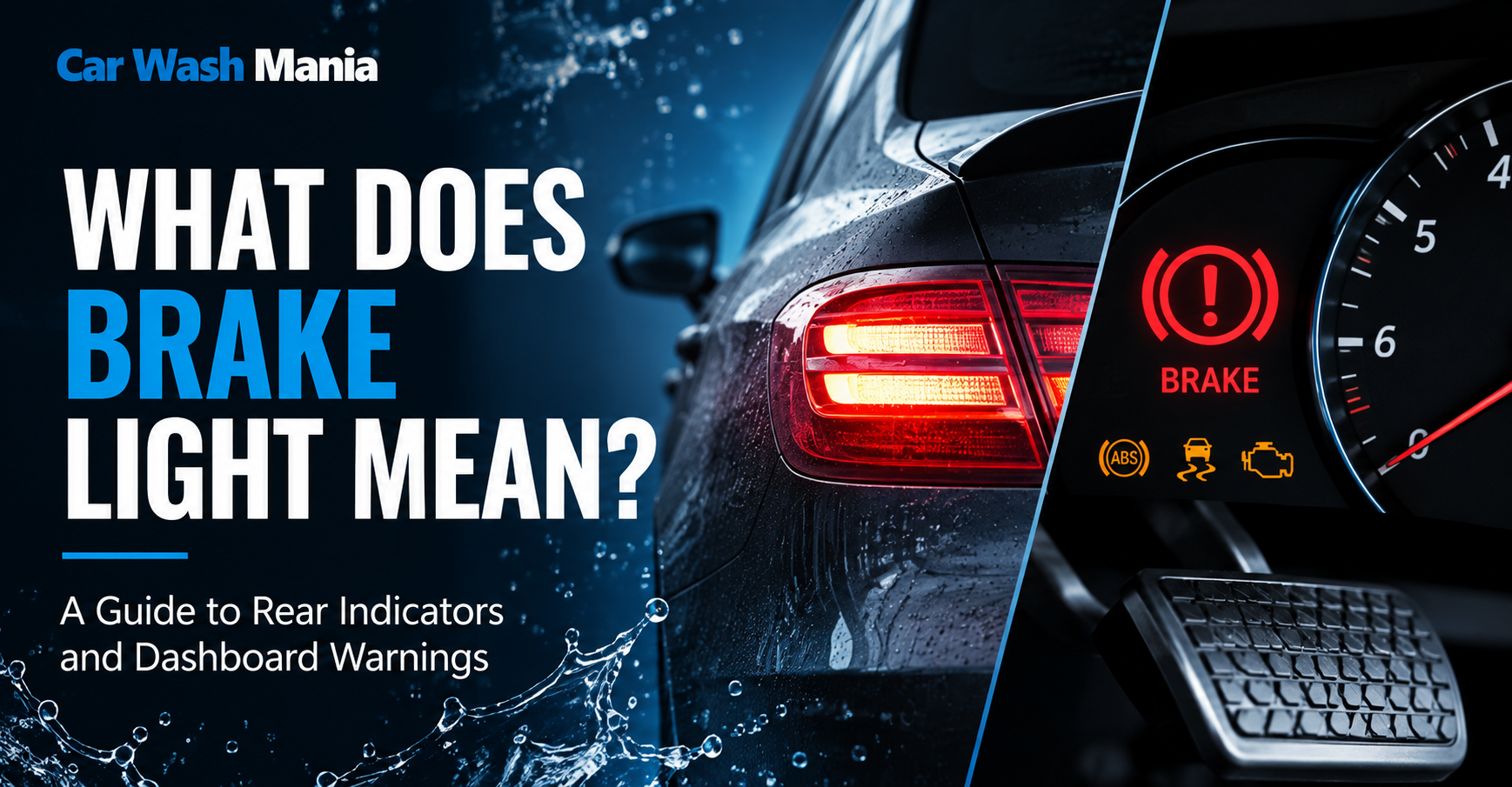
A brake light refers to either the rear-facing red illumination device that activates when a driver applies the brakes to signal trailing vehicles, or the red dashboard warning symbol indicating an engaged parking brake, low brake fluid, or a critical hydraulic system failure. Both serve as vital automotive safety mechanisms.
Key Facts / At a Glance
- Rear Circuit: Exterior brake lights operate on a 12-volt DC closed-loop circuit, typically outputting 200 to 400 lumens per side.
- Response Times: Traditional incandescent bulbs require roughly 250 milliseconds to illuminate, whereas modern LED units trigger in under 1 millisecond.
- Dashboard Warning: A red “BRAKE” text or symbol on your dashboard primarily indicates an engaged parking brake, dangerously low brake fluid, or severely worn brake pads.
- Legal Mandates: The Center High-Mounted Stop Lamp (CHMSL) has been legally required on all passenger vehicles in North America since 1986 and Europe since 1998.
- Repair Costs: Replacing a standard halogen brake bulb takes 5 to 15 minutes and costs between CHF 5 and CHF 20 for parts.
What Does the Dashboard “BRAKE” Light Mean?
The red dashboard “BRAKE” light means your vehicle’s braking system requires immediate attention, most commonly due to an engaged parking brake or low brake fluid. Because the English query “what does brake light mean” often refers to this dashboard symbol rather than the rear exterior lights, it is critical to diagnose this warning immediately.
Automakers use this single red indicator (often an exclamation mark inside a circle, or the word “BRAKE”) to signal three distinct conditions:
- Engaged Parking Brake: The most common trigger. A mechanical switch on the handbrake or an electronic parking brake sensor keeps the circuit closed until fully released.
- Low Brake Fluid: A float sensor inside the brake fluid reservoir detects when hydraulic fluid drops below the minimum safe threshold, often due to a leak in the brake lines or severely worn brake pads.
- Hydraulic Pressure Loss: In dual-circuit master cylinders, a pressure differential switch will trigger the warning light if one half of the braking system loses pressure.
If this dashboard light remains illuminated after you have fully disengaged the parking brake, the vehicle is unsafe to drive until the fluid levels and hydraulic pressure are professionally inspected.
What Does a Rear Brake Light Do?
A rear brake light is a safety illumination device located at the back of a vehicle that automatically activates when the braking hardware is engaged, signaling to trailing drivers that the vehicle is slowing down or stopping.
How the Brake Light Circuit Works
Rear brake lights operate on a closed-loop electrical circuit controlled directly by the vehicle’s braking hardware.
- Pedal Engagement: The driver depresses the brake pedal.
- Switch Activation: The mechanical movement closes a brake light switch (or pressure sensor) located under the dashboard near the pedal arm.
- Signal Transmission: Closing the switch completes an electrical circuit, sending 12-volt DC power from the battery or fuse box through the wiring harness to the rear of the vehicle. In modern vehicles, this signal passes through a centralized Body Control Module (BCM).
- Illumination: Power reaches the bulb filaments or LED diodes, causing them to glow instantly.
- Circuit Disconnection: When the driver releases the brake pedal, the switch opens, breaking the circuit and turning the lights off.
How Do EV Regenerative Braking Lights Work?
Electric vehicles (EVs) introduce an exception to the mechanical switch mechanism. Because EVs slow down rapidly using regenerative motor braking when the driver lifts off the accelerator, the brake pedal is not depressed. To maintain safety, the Body Control Module uses an internal decelerometer. When the vehicle detects a deceleration rate exceeding a specific threshold (typically 1.3 m/s²), the BCM automatically triggers the rear brake lights without any physical pedal engagement.
Which Types of Brake Lights Are Standard?
Automotive manufacturers utilize three distinct formats of brake lighting, separated by bulb technology and physical placement on the vehicle chassis.
- Halogen/Incandescent Bulbs: The traditional automotive standard. These utilize a tungsten filament suspended inside a gas-filled glass bulb. They naturally glow a bright orange-red but rely on the red plastic lens of the taillight housing to output the legally compliant color.
- LED (Light Emitting Diodes): The modern automotive standard. LEDs utilize semiconductors to emit monochromatic red light directly. They generate virtually zero heat and outlast the mechanical components of the vehicle.
- CHMSL (Center High-Mounted Stop Lamp): Universally known as the “third brake light.” Positioned higher than the side brake lights (usually integrated into the rear window, spoiler, or trunk lip), the CHMSL provides a direct line of sight for drivers multiple cars back, significantly reducing rear-end chain-reaction collisions.
Halogen vs. LED Brake Lights: How Do They Compare?
LED brake lights are objectively superior to halogen bulbs in safety and longevity, but they present significant drawbacks in repairability and upfront replacement costs.
| Feature | Halogen / Incandescent | LED (Light Emitting Diode) | Winner |
| Response Time | ~250 milliseconds | < 1 millisecond | LED (Provides trailing drivers 5+ extra meters of stopping distance at highway speeds). |
| Power Draw | 21 Watts to 27 Watts | 1 Watt to 5 Watts | LED (Draws up to 80% less power from the alternator). |
| Brightness | 200 – 400 Lumens | 250 – 500 Lumens | Tie (Both are strictly regulated to prevent blinding trailing drivers). |
| Lifespan | ~1,000 to 2,000 hours | 30,000+ hours | LED (Designed to last the lifetime of the vehicle chassis). |
| Replacement Cost | Very low upfront cost | High initial replacement cost | Halogen (Tool-free replacements cost pocket change). |
| Repairability | Simple bulb swap | Often requires replacing the entire sealed housing | Halogen (Integrated LEDs cannot be soldered individually by consumers). |
What Are the Typical Prices and Repair Timeframes?
Repairing a brake light ranges from a five-minute DIY task to a multi-hour dealership appointment, depending entirely on the vehicle’s lighting technology.
- DIY Halogen Bulb Replacement: Costs CHF 5 to CHF 20 for parts. Takes 5 to 15 minutes. Requires no specialized tools; simply pull back the trunk liner, twist the socket, and swap the bulb.
- Professional Bulb Replacement: Costs CHF 30 to CHF 80, which includes the physical bulb and a minor labor fee from a mechanic or quick-lube station. Takes roughly 15 minutes.
- Brake Light Switch Replacement: Costs CHF 20 to CHF 60 for the physical switch, plus CHF 50 to CHF 100 in labor. Takes 30 to 60 minutes. The technician must access the footwell, disconnect the wiring harness, and calibrate the new switch against the pedal arm.
- Complete LED Assembly Replacement: Costs CHF 150 to CHF 600+ per side. Takes 1 to 2 hours. Because modern LED housings are often sealed units to prevent moisture intrusion, a single failed diode usually requires replacing the entire quarter-panel taillight assembly.
How Do You Troubleshoot Common Brake Light Failures?
Diagnosing a failed brake light requires isolating the electrical circuit from the front of the vehicle to the rear.
Problem: Both brake lights are out, but the dim running tail lights work.
Check the brake light fuse in the engine bay or cabin fuse box first. If the fuse is intact, the brake light switch under the pedal has likely failed. Because the running lights (tail lights) operate on a completely separate circuit from the brake lights, their functionality confirms the rear wiring harness is generally intact.
Problem: Only one side is out.
Replace that specific bulb. The circuit is successfully receiving 12V power from the switch, but the individual tungsten filament inside that specific bulb is broken.
Problem: The brake lights stay on permanently.
Check the brake pedal stop pad. This is a small rubber or plastic bumper that physically presses against the brake switch when the pedal is resting. Over time, cabin heat degrades this plastic. If it crumbles and falls out, the switch remains permanently open, keeping the brake lights stuck on even when the car is turned off, which will drain the battery overnight.
Problem: Lights work intermittently or dim randomly.
Clean the bulb sockets. Intermittent dimming is almost always caused by a corroded bulb socket or a loose ground wire bolted to the chassis near the rear light housing.
What Mistakes Should You Avoid When Maintaining Brake Lights?
Maintaining your vehicle’s safety indicators is straightforward, but minor installation errors can trigger electrical faults or legal citations.
- Installing the Wrong Bulb Type: The most common DIY mistake is buying single-filament bulbs (e.g., standard 1156) instead of dual-filament bulbs (e.g., standard 1157 or 7443). Dual-filament bulbs feature two separate wires inside the glass: a low-wattage filament for the continuous running tail lights, and a high-wattage filament for the brake lights. Jamming a single-filament bulb into a dual socket will cause electrical shorts.
- Touching Halogen Bulbs with Bare Hands: Skin oils leave a microscopic residue on the quartz glass. When the bulb heats up to operating temperature, these oil deposits create localized hot spots, causing the glass to blister, shatter, or burn out prematurely. Always use latex gloves or a clean paper towel.
- Ignoring a Single Blown Bulb: Driving with even one broken brake light severely increases rear-end collision risks and is a ticketable traffic offense in nearly all global jurisdictions.
- Installing Unapproved Flashing Modules: Modifying main side brake lights to “hyper-flash” continuously is illegal in many regions. While some jurisdictions permit a brief, automated 4-flash sequence on the CHMSL (third brake light) to grab attention during panic braking, alternating or continuous strobe modules violate Department of Transportation (DOT) and Economic Commission for Europe (ECE) regulations.
- Using Cheap LED Drop-ins on CAN-bus Vehicles: If you upgrade an older halogen car with aftermarket LED bulbs, the new LEDs draw so little power (1W vs 21W) that the vehicle’s CAN-bus computer assumes the bulb is dead and throws a dashboard error code. You must purchase “CAN-bus compatible” LEDs that feature built-in resistors to mimic the electrical load of a standard halogen.
Frequently Asked Questions
What is the difference between a tail light and a brake light?
A tail light remains illuminated at a low brightness continuously whenever the vehicle’s headlights or parking lights are on, ensuring nighttime visibility. A brake light illuminates at a significantly higher brightness (usually utilizing a thicker filament or more power) only when the brake pedal is actively depressed.
Can I drive with one brake light out?
No. Driving with a broken brake light is a safety hazard and a traffic violation. Law enforcement can issue citations for defective equipment. Furthermore, if the CHMSL (third brake light) fails, your vehicle will automatically fail its annual or biennial safety inspection.
Why does my brake light stay on when the car is off?
This is typically caused by a failed brake pedal stop pad (a small plastic bumper that depresses the electrical switch) or a jammed brake light switch under the dashboard. It must be fixed immediately, or the lights will completely drain the vehicle’s battery.
Do I need to disconnect the battery to change a brake light bulb?
While highly recommended when working on automotive electrical systems to prevent accidental shorts, it is not strictly required for a simple rear bulb swap in older vehicles, provided the ignition is fully off and the keys are removed from the vehicle.
What fuse controls the brake lights?
The specific fuse varies by manufacturer, but it is typically a 10-amp or 15-amp fuse labeled “STOP,” “BRK,” or “STOP LP” located either in the under-hood fuse box or the secondary fuse panel inside the driver’s side footwell. Consult your owner’s manual for the exact schematic location.


