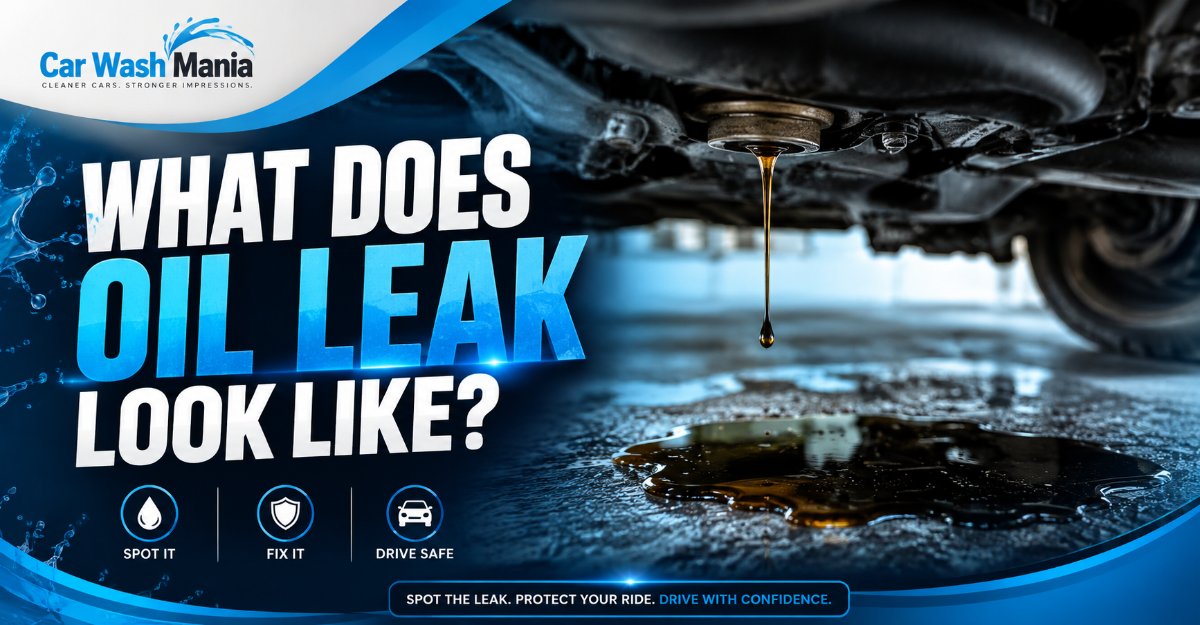
An engine oil leak looks like a shiny, greasy puddle or stain ranging from light amber to dark brown or black, typically located directly underneath the vehicle’s engine block. The fluid feels slippery and thick between your fingers, often carrying a heavy, mechanical, or mildly burnt chemical scent.
Key Facts / At a Glance:
- Color scale: Fresh engine oil is translucent amber; aging oil turns dark brown; heavily degraded oil appears opaque black.
- Viscosity: Engine oil leaves a permanent slick residue on your fingers that requires soap to wash off, unlike water or coolant.
- Severity threshold: Losing more than 1 quart of oil every 1,000 miles requires immediate mechanical intervention to prevent catastrophic metal-on-metal engine failure.
- False alarms: Clear, odorless water dripping near the passenger side is normal air conditioning condensation, not an oil leak.
- Hidden cause: A blocked Positive Crankcase Ventilation (PCV) valve frequently causes healthy gaskets to blow out due to trapped internal engine pressure.
How Can You Identify Different Automotive Fluid Leaks?
You can identify an automotive fluid leak by evaluating its color, tactile viscosity, scent, and pooling location under the chassis. Vehicles rely on a half-dozen distinct chemical fluids, and diagnosing an issue begins with ruling out non-engine oils.
| Oil / Fluid Type | Visual Appearance | Texture & Scent | Common Leak Location |
| Engine Oil | Light amber (new) to dark brown/black (used) | Slippery, thick, heavy mechanical/chemical smell | Directly under the engine block or front axle |
| Transmission Fluid | Bright red/pink (new) to dark red/brown (aged) | Slick, thin to medium viscosity, sharp or burnt smell | Near the center or front-middle of the car |
| Gear Oil (Differential) | Dark brown to black | Extremely thick, viscous, strong pungent sulfur smell | Rear axle (RWD/AWD) or front transaxle |
| Power Steering Fluid | Clear, amber, or pinkish-red | Oily but thin, faint chemical smell | Front of the vehicle, near the fluid reservoir or rack |
| Coolant (Antifreeze) | Bright green, orange, pink, or yellow | Thin, watery, distinctly sweet syrup smell | Front of engine, under the radiator or water pump |
| Brake Fluid | Clear to pale yellow | Very slick, highly corrosive, fishy or castor oil scent | Near the wheels (calipers) or directly under the firewall |
Expert Insight: Conduct the “finger rub test.” Pinch a drop of the leaked fluid between your thumb and index finger. Engine oil will retain a consistent, slippery film that prevents your skin from touching. Coolant will feel slightly slimy but watery, and brake fluid will feel hyper-slick and quickly irritate the skin.
Where Do Engine Oil Leaks Usually Come From?
Engine oil leaks usually originate from degraded rubber, silicone, or cork gaskets that seal the mating surfaces between solid metal engine components. Gravity and aerodynamic airflow drag the leaking oil downward and backward, often making the leak appear larger or further back than its actual source.
Valve Cover Gaskets
The valve cover gasket seals the top of the engine block. When this fails, wet oil pools around the cylinder head or seeps into the spark plug wells. This is a low-to-moderate severity issue, but if oil floods the spark plug tubes, it disrupts the electrical sequence and causes engine misfires.
Oil Pan Gaskets
The oil pan gasket seals the reservoir at the absolute bottom of the engine. A leak here looks like fresh drips forming on the structural bolts at the lowest point of the engine bay. This is a moderate severity, standard wear-and-tear failure. Because the pan sits at the bottom, oil rarely sprays upward, keeping the mess localized to the lower undercarriage.
Rear Main Seals
The rear main seal wraps around the rear of the crankshaft. When it degrades, oil drips explicitly from the bell housing junction—the exact line where the engine block meets the transmission. This is a high-severity leak. The part itself is inexpensive, but reaching it requires completely removing the transmission, making it highly labor-intensive.
Oil Filters and Drain Plugs
Oil weeping directly from the cylindrical oil filter threads or the lowest drain bolt typically indicates a botched oil change rather than component failure. This low-severity leak is almost always caused by a cross-threaded filter, an under-torqued bolt, or a missing copper crush washer.
Why Does Engine Oil Leak in the First Place?
Engine oil leaks occur because the synthetic and rubber sealing components degrade under continuous thermal cycling and high internal fluid pressure. Engine oil operates under high pressure to lubricate moving parts, and breaking containment requires a predictable chain of failures.
- Thermal and Mechanical Stress: Engines continuously cycle between ambient temperatures when parked and extreme operating heat (over 90°C / 195°F). This constant expansion and contraction stresses sealing materials.
- Material Degradation: Over 70,000 to 100,000 miles, rubber gaskets, silicone sealants, and O-rings dry out, shrink, and become brittle. Synthetic oils, which have smaller, more uniform molecular structures than conventional oils, will easily slip through micro-cracks that thicker conventional oils might plug.
- Pressure Breakthrough: The mechanical oil pump generates 30 to 60 PSI of internal pressure during normal driving. This hydraulic force pushes hot oil through any weakened seal.
- Crankcase Over-pressurization: If the PCV (Positive Crankcase Ventilation) valve clogs, blow-by gases from the combustion chamber cannot escape. This builds massive internal air pressure, literally blowing oil past perfectly healthy gaskets.
How Much Does It Cost to Fix an Oil Leak?
Fixing an oil leak costs anywhere from CHF 35 for a simple drain plug replacement to over CHF 1,200 for a complex rear main seal replacement. The primary cost driver in leak repair is almost always labor, not the parts themselves.
| Leak Repair Type | Average Part Cost | Average Labor Cost | Total Estimated Price | Time to Repair |
| Oil Drain Plug / Filter | CHF 5 – CHF 25 | CHF 30 – CHF 60 | CHF 35 – CHF 85 | 15 – 30 minutes |
| Valve Cover Gasket | CHF 20 – CHF 60 | CHF 120 – CHF 300 | CHF 140 – CHF 360 | 1 – 3 hours |
| Oil Pan Gasket | CHF 30 – CHF 80 | CHF 200 – CHF 500 | CHF 230 – CHF 580 | 2 – 5 hours |
| Rear Main Seal | CHF 25 – CHF 70 | CHF 600 – CHF 1,200 | CHF 625 – CHF 1,270 | 6 – 10+ hours |
Note: Dealership labor rates typically range from CHF 150 to CHF 220 per hour, while independent specialists average CHF 100 to CHF 150 per hour. Choosing an independent shop for a 10-hour rear main seal job saves substantial money.
How Do You Find the Exact Source of an Oil Leak?
You find the exact source of an oil leak by stripping away the accumulated grime and using fluorescent dyes to track fresh oil paths. Because driving at 60 mph sprays leaked oil everywhere, visual inspection of a dirty engine rarely reveals the true origin point.
- Verify the Dipstick Level: Before running the engine for diagnostics, check the oil level. If it is below the “MIN” marker, add oil immediately. Running diagnostics on a dry engine will destroy the internal bearings.
- Degrease the Engine Bay: Spray a foaming, non-chlorinated engine degreaser over the suspected areas. Let it sit for 10 minutes, then rinse gently with a low-pressure hose. Avoid using high-pressure power washers, which force water into sensitive electrical connectors.
- The Cardboard Test: Once the engine is clean and dry, park the vehicle over a large sheet of clean, white cardboard overnight. In the morning, map the exact position of the drips relative to the engine layout above it.
- The UV Dye Test: For weeping leaks that do not hit the ground, pour an automotive UV oil leak detection dye into the engine oil filler neck. Drive the car for 15 to 30 minutes. Park in a dark garage and shine a UV blacklight over the engine block. The fresh leak source will glow neon yellow or green.
What Are the Most Common Leak Diagnosis Mistakes?
The most common leak diagnosis mistake is confusing normal air conditioning condensation with an automotive fluid failure. Understanding failure modes prevents unnecessary repairs and catastrophic secondary damage.
- Misdiagnosing A/C Water: A puddle of perfectly clear, odorless, non-slippery fluid under the passenger side floorboard is harmless condensation draining from the Air Conditioning evaporator core.
- Over-tightening Gasket Bolts: When DIY mechanics see a leaking gasket, their instinct is to tighten the bolts harder. Because components like valve covers are made of thin aluminum or plastic, excessive torque warps the cover or completely crushes the rubber gasket, making the leak permanently worse. Always use a torque wrench set to exact manufacturer specifications.
- Relying Solely on “Stop-Leak” Additives: Pour-in chemical additives work by introducing solvents that aggressively swell rubber seals. This is a short-term band-aid. If overused, these thick additives can sludge up and block the microscopic oil passages that lubricate the engine’s valvetrain.
- Ignoring the PCV Valve: Replacing a blown valve cover gasket without checking the PCV valve is a guarantee that the new gasket will fail within weeks. Always replace the CHF 15 PCV valve when addressing any upper engine oil leak.
What Should Different Drivers Do About Oil Leaks?
Different drivers must handle oil leaks based on vehicle value, driving intensity, and the specific failure point. Not all leaks require immediate four-figure repairs.
- The High-Mileage / Everyday Commuter: If a 15-year-old car develops a slow “weep” (the metal is wet, but fluid never drips onto the driveway), simply monitor the dipstick weekly. If a rear main seal begins to actively drip on an older vehicle, the CHF 1,200 labor cost may exceed the car’s actual value. In this scenario, switching to a “High-Mileage” motor oil blend containing gentle seal conditioners is the most economically sound strategy.
- The High-Performance / Track Driver: Track drivers must never tolerate even microscopic oil seeps. High sustained RPMs and extreme engine bay temperatures accelerate leaks instantly. An oil leak dripping onto a 600°C exhaust manifold poses an immediate vehicle fire risk. When replacing gaskets, upgrade to premium, high-temperature Multi-Layer Steel (MLS) or heavy-duty silicone variants.
- The DIY / Budget Owner: Minor valve cover or oil pan seeps are excellent entry-level repair jobs requiring only basic socket sets. However, you must meticulously clean the mating surfaces with a plastic scraper and brake cleaner before installing the new gasket; any residual oil will ruin the new seal.
Frequently Asked Questions (FAQ)
Can you drive a car with an oil leak?
You can drive a car with a minor oil leak as long as the fluid remains above the minimum line on the dipstick and the oil is not dripping onto hot exhaust components (which causes smoke and fire risks). Check the fluid level before every trip.
Does a burning smell always mean an oil leak?
No, but it is the most common cause. A heavy, burning chemical smell usually indicates engine oil dripping onto the hot exhaust pipe. However, a sweet burning smell points to leaking coolant, and a sharp, acrid smell often indicates a slipping clutch or dragging brakes.
Why is my car leaking oil only when parked?
When the engine turns off, the internal oil pump stops, and gravity pulls the remaining oil down into the oil pan. As the engine block cools, metal components contract slightly, which can open up gaps in failing rubber seals, allowing the pooled oil to escape and drip onto the ground.
Will thicker oil stop an engine leak?
Moving one step up in viscosity (e.g., from 5W-20 to 10W-30) can slow down a minor leak by making it harder for the fluid to pass through microscopic cracks. However, this will not stop a severe gasket blowout, and using oil that is too thick can damage your oil pump and valvetrain.


