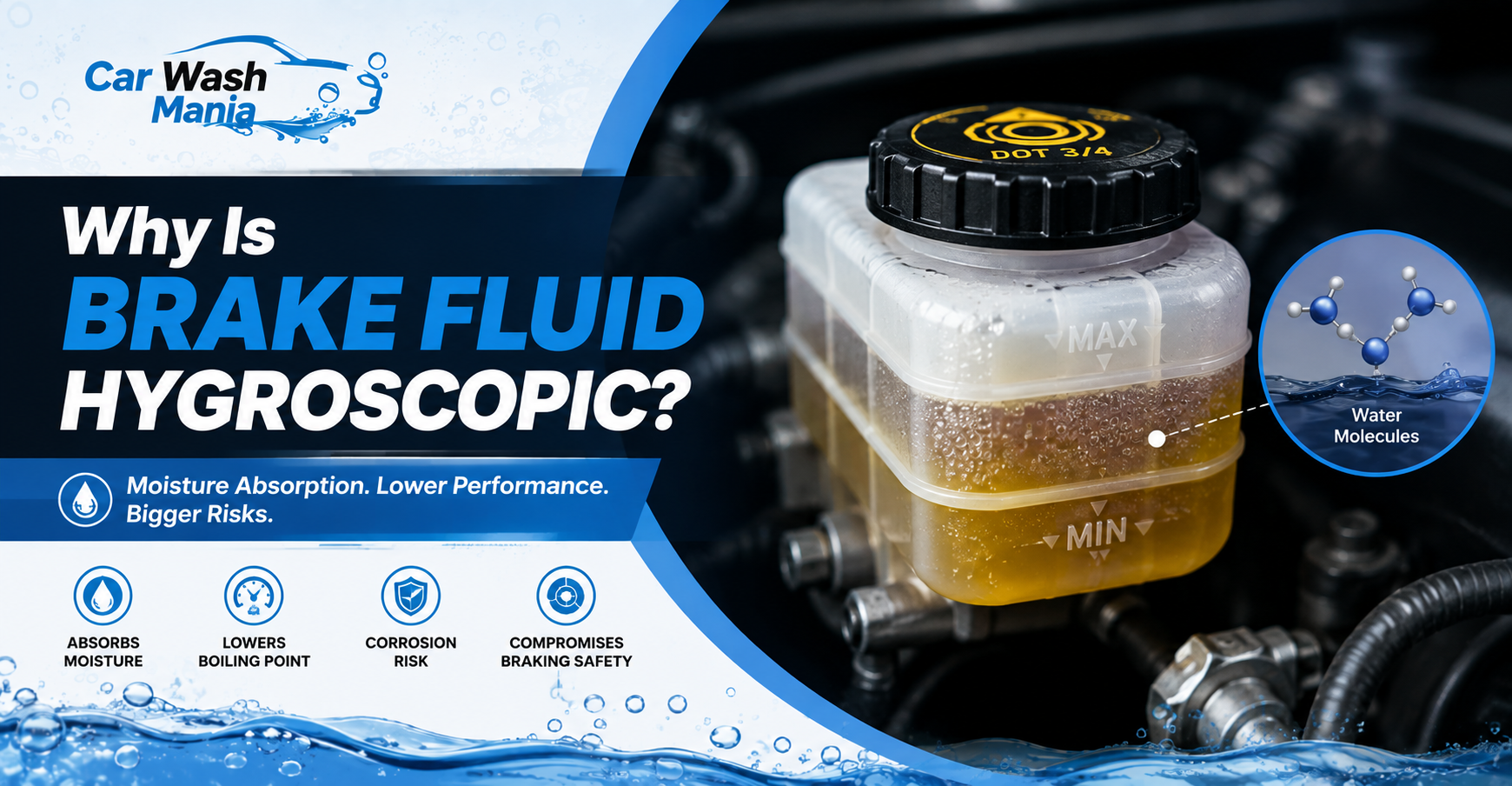
Brake fluid is hygroscopic because most road vehicles use glycol ether-based fluid whose polar oxygen-containing molecules attract, hydrogen-bond with, and dissolve water. Keeping moisture distributed through the hydraulic fluid reduces the chance of free water collecting in isolated pockets, but the absorbed water gradually lowers the fluid’s boiling point and increases corrosion risk.
Key Facts at a Glance
- DOT 3, DOT 4, and DOT 5.1 brake fluids are normally glycol-based and hygroscopic.
- Silicone-based DOT 5 brake fluid does not absorb water into a uniform solution in the same way.
- Hygroscopic brake fluid does not pull water through metal brake pipes; moisture enters through venting, permeation, imperfect seals, and service exposure.
- Water contamination lowers brake fluid’s boiling point because water boils at a much lower temperature than fresh brake fluid.
- The federal minimum wet boiling points are 140°C for DOT 3, 155°C for DOT 4, and 180°C for DOT 5 and DOT 5.1.
- Brake fluid color cannot reliably reveal its water percentage or boiling point.
What Does Hygroscopic Mean?
A hygroscopic substance attracts and takes up moisture from its surrounding environment. In brake fluid, absorbed water normally dissolves into the glycol-based liquid rather than remaining as a separate visible layer.
“Hygroscopic” is sometimes confused with “hydrophilic.” A hydrophilic material has an affinity for water, while a hygroscopic material takes moisture from the surrounding atmosphere or environment. Glycol brake fluid exhibits both relevant behaviors: it has a molecular affinity for water and can accumulate environmental moisture over time.
Hygroscopic does not mean that brake fluid instantly fills with water whenever the reservoir is opened. Moisture accumulation is gradual and depends on humidity, temperature cycling, system design, hose condition, seal integrity, maintenance practices, and time.
Why Is Brake Fluid Hygroscopic at the Molecular Level?
Glycol-based brake fluid is hygroscopic because glycol ethers, polyglycols, glycol ether borates, and related compounds contain polar oxygen atoms that interact strongly with polar water molecules. Hydrogen bonding and other dipole interactions allow water to mix through the fluid at a molecular level.
A simplified representation is:
Brake-fluid oxygen ··· H—O—H
                    hydrogen bond
Water has an uneven electrical charge distribution. Its oxygen end carries a partial negative charge, while its hydrogen ends carry partial positive charges. Oxygen atoms in glycol-based brake-fluid molecules can participate in hydrogen-bonding interactions with water, making the two liquids mutually soluble.
The chemistry is more complex than saying every brake-fluid molecule ends in one exposed hydroxyl group. Commercial brake fluid is a formulated mixture containing base solvents, lubricants, corrosion inhibitors, antioxidants, stabilizers, and sometimes borate esters. Its overall polarity and molecular structure—not one isolated functional group—produce its water affinity.
Is Hygroscopicity an Intentional Safety Feature?
Hygroscopicity is useful in a hydraulic brake system because it allows small amounts of incoming moisture to remain dispersed instead of forming isolated water droplets. Engineers formulate glycol-based brake fluids around this behavior, although hygroscopicity is also an inherent consequence of the polar solvent chemistry needed for fluidity, lubrication, seal compatibility, and temperature performance.
Free water would create several concentrated hazards:
- Localized boiling: A water pocket near a hot caliper could begin forming vapor at a much lower temperature than the surrounding brake fluid.
- Localized corrosion: Water collecting at a low point could directly attack steel, iron, aluminum, or other internal surfaces.
- Freezing risk: A concentrated water pocket could freeze in sufficiently cold conditions.
- Uneven hydraulic behavior: Separate phases can produce inconsistent performance throughout the system.
Glycol fluid does not eliminate these hazards permanently. It spreads the moisture more uniformly, buying predictable performance while the fluid’s corrosion inhibitors and boiling-point reserve remain adequate.
The Counterintuitive Engineering Trade-Off
A fluid that absorbs water may sound inferior to one that repels it. In a frequently used road vehicle, however, distributing a small amount of unavoidable moisture can be safer than allowing that moisture to settle at the calipers or other low points.
The limitation is that hygroscopic fluid sacrifices boiling-point performance progressively. It therefore requires inspection or periodic replacement instead of being treated as a lifetime fluid.
How Does Water Enter a Closed Brake System?
Water enters a hydraulic brake system gradually because the system is not perfectly isolated from its environment. The most important routes are reservoir pressure equalization, exposure during servicing, permeation through flexible materials, and aging seals.
Reservoir Venting
The brake-fluid reservoir must accommodate fluid-level movement as brake pads wear and as temperature changes expand or contract the fluid. Many reservoir caps use a diaphragm and vent arrangement that reduces direct exposure but does not create an absolute, permanent vapor barrier.
Repeated heating and cooling can promote moisture exchange at vulnerable interfaces. A damaged cap, distorted diaphragm, or missing seal increases the opportunity for humid air to reach the fluid.
Flexible Hoses and Elastomer Components
Water vapor can gradually permeate some elastomeric materials even when liquid fluid does not visibly leak through them. Flexible brake hoses, seals, and boots are engineered to minimize this process, but age, heat, material condition, and construction affect the rate.
Moisture does not normally pass through intact steel brake lines. Corroded lines, leaking unions, worn seals, or damaged components create separate contamination and safety problems that require repair.
Maintenance Exposure
Opening the reservoir, using a previously opened bottle, leaving a cap loose, or bleeding the system in a humid or dirty environment exposes brake fluid directly to atmospheric moisture.
Fresh fluid should be poured from a clean, tightly sealed container. Fluid removed during bleeding must never be returned to the bottle or reservoir because it may contain water, dirt, corrosion products, or incompatible material.
What Happens After Brake Fluid Absorbs Water?
Absorbed water lowers the fluid’s boiling point, consumes corrosion-inhibitor capacity, changes chemical stability, and can contribute to internal corrosion. The first effect may be invisible because contaminated fluid can still transmit hydraulic pressure normally during mild driving.
The consequences become more important as contamination, component temperature, and braking demand increase.
The Boiling Point Falls
Fresh brake fluid has a high dry boiling point. Water has a normal atmospheric boiling point of approximately 100°C, so adding water to the fluid reduces the mixture’s thermal margin.
Brake calipers can become extremely hot during:
- Long mountain descents
- Repeated high-speed braking
- Heavy towing
- Track driving
- A dragging or seized brake
- Aggressive stop-and-go use
When contaminated fluid becomes hot enough, part of the liquid can form vapor. Liquid is effectively incompressible for hydraulic-brake purposes, but vapor compresses readily. Pedal movement then compresses the vapor instead of transferring all force to the caliper pistons.
This condition is commonly called vapor lock or fluid-induced brake fade. The pedal may feel soft, travel farther than normal, or lose effectiveness while the system is hot.
Internal Corrosion Becomes More Likely
Brake-fluid formulations contain corrosion inhibitors, and FMVSS No. 116 includes corrosion-performance tests using several metals. Those protections are finite and formulation-dependent.
Moisture, oxygen, heat, depleted additives, and contamination can promote corrosion in:
- Master-cylinder bores
- Caliper pistons and bores
- Wheel cylinders
- Steel brake lines
- ABS or ESC hydraulic modulators
- Valves and small internal passages
Modern ABS and electronic stability-control units contain narrow passages and rapidly operating valves. Contaminated fluid can therefore create expensive problems even before a driver notices dramatic brake fade.
Low-Temperature and Viscosity Performance Can Change
Brake fluid must remain sufficiently fluid at low temperatures so that ABS and stability-control valves can cycle rapidly. Water, oxidation products, mixed fluids, sediment, and degraded additives can affect low-temperature behavior.
A fluid meeting the correct DOT category is not automatically correct for every vehicle. Some manufacturers specify DOT 4 low-viscosity fluid, often marked DOT 4 LV, Class 6, or with an automaker-specific approval. Using a thicker fluid may impair cold-weather response even when its boiling point appears adequate.
Which Brake Fluids Are Hygroscopic?
DOT 3, DOT 4, and DOT 5.1 are normally glycol-based, water-miscible, and hygroscopic. DOT 5 silicone brake fluid belongs to a different chemical family and must not be confused with DOT 5.1.
The current U.S. regulation treats DOT 5 as a performance grade with two labeling distinctions: “DOT 5 SILICONE BASE” and “DOT 5.1 NON-SILICONE BASE.” The similar numbers do not mean the fluids are chemically interchangeable in every application.
| Brake-fluid class | Typical chemistry | Water behavior | Minimum dry boiling point | Minimum wet boiling point |
|---|---|---|---|---|
| DOT 3 | Glycol ethers and polyglycols | Hygroscopic and water-miscible | 205°C / 401°F | 140°C / 284°F |
| DOT 4 | Glycol ethers, often with borate esters | Hygroscopic and water-miscible | 230°C / 446°F | 155°C / 311°F |
| DOT 5.1 | Non-silicone glycol/borate formulation | Hygroscopic and water-miscible | 260°C / 500°F | 180°C / 356°F |
| DOT 5 | Silicone-based brake fluid | Does not dissolve water uniformly | 260°C / 500°F | 180°C / 356°F |
These figures are minimum regulatory values, not the exact performance of every product. A manufacturer may sell fluid with boiling points above the applicable minimum, and the container must identify the product’s minimum wet boiling point.
FMVSS No. 116 currently sets minimum equilibrium reflux boiling points of 205°C for DOT 3, 230°C for DOT 4, and 260°C for DOT 5. Its corresponding minimum wet values are 140°C, 155°C, and 180°C. DOT 5.1 is labeled as a non-silicone form of the DOT 5 performance grade.
What Does “Wet Boiling Point” Actually Mean?
Wet boiling point is a standardized laboratory value representing brake fluid after controlled humidification—not simply the temperature of fluid taken from any vehicle with an assumed three-percent moisture reading.
Under FMVSS No. 116, test fluid is conditioned in a controlled procedure using a reference fluid. The reference fluid is monitored until it reaches 3.70% ±0.05% water by weight; the conditioned test fluid is then sealed, cooled, and tested for its equilibrium reflux boiling point.
This distinction matters for three reasons:
- A “wet” specification is a repeatable comparison benchmark.
- It is not a universal declaration that every fluid fails at exactly 3% or 3.7% water.
- A vehicle sample’s measured water percentage does not reveal its exact boiling point without considering the product formulation and condition.
The regulatory wet values represent minimum performance. NHTSA has also clarified that a DOT 4 container should display the minimum wet boiling point of the actual fluid in the container, not merely repeat the category minimum of 311°F.
Does DOT 4 Absorb Water More Slowly Than DOT 3?
DOT 4 cannot universally be said to absorb moisture more slowly than DOT 3. Moisture uptake depends on the complete formulation, additive package, storage conditions, system design, climate, and exposure—not solely on the DOT number.
Many DOT 4 formulations use borate esters to improve wet boiling-point performance. Borate chemistry can interact with water and help preserve boiling performance, but this does not establish one universal absorption-rate ranking for every DOT 3, DOT 4, and DOT 5.1 product.
A higher DOT grade primarily identifies required performance characteristics such as boiling point and viscosity limits. It should not be interpreted as a guaranteed service-life ranking.
Expert Rule of Thumb
Choose brake fluid by the vehicle manufacturer’s specification and required approval, not by selecting the highest number on the shelf. A high-boiling racing fluid may have a shorter recommended service life, unsuitable low-temperature viscosity, or no required automaker approval.
Is Silicone DOT 5 Better Because It Is Not Hygroscopic?
Silicone DOT 5 is not automatically better. It avoids dissolving moisture into a uniform solution, but water that enters the system can remain separate, collect at low points, and cause localized corrosion or boiling.
Silicone fluid also has different aeration, compressibility, bleeding, and compatibility characteristics. It is used in selected military, collector, and specialty applications, but it is not a universal upgrade for a glycol-based road-car system.
Important Corrections to Common DOT 5 Claims
Claim: “DOT 5’s boiling point remains high indefinitely.”
This is misleading. Fluid can still become contaminated, aerated, chemically altered, or affected by separate water pockets. Hydraulic systems and seals also age independently of the fluid’s bulk water solubility.
Claim: “DOT 5 is completely non-corrosive.”
No brake-fluid choice makes the entire hydraulic system immune to corrosion. Separate water, contaminants, incompatible residues, damaged protective surfaces, and deteriorated components can still cause corrosion.
Claim: “DOT 5 always causes complete ABS failure.”
This is too absolute. Silicone fluid is generally unsuitable for systems not designed or approved for it, particularly because rapid valve operation can aggravate aeration and pedal-quality problems. The correct rule is to use only the fluid specified by the vehicle manufacturer.
Can DOT 5 Replace DOT 3 or DOT 4?
DOT 5 silicone should not be poured into a glycol-based system as a casual replacement. A proper conversion can require complete disassembly, cleaning, inspection, seal assessment, and removal of old fluid and contamination.
Mixing silicone and glycol fluids may produce unpredictable phase behavior, aeration, residual pockets, seal issues, and poor braking performance. The common claim that the mixture always turns instantly into gummy sludge is not a reliable universal description, but the conversion is still unsafe without an approved engineering procedure.
DOT 5.1 is chemically closer to DOT 3 and DOT 4 than to DOT 5 silicone. However, physical miscibility does not override the vehicle manufacturer’s viscosity, additive, and approval requirements.
How Fast Does Brake Fluid Absorb Moisture?
There is no single defensible annual moisture-absorption rate for every vehicle. Rates such as “1% per year” may describe selected observations or test conditions, but they should not be treated as a universal law.
Moisture accumulation varies with:
- Ambient humidity
- Temperature cycling
- Vehicle age
- Reservoir-cap and diaphragm condition
- Hose construction
- Seal condition
- Brake-fluid formulation
- Frequency of reservoir opening
- Storage conditions
- Previous maintenance quality
A frequently driven vehicle in a humid coastal climate may not age like a low-mileage vehicle stored in a dry, climate-controlled garage. Conversely, low mileage does not guarantee fresh fluid because moisture accumulation and additive aging are time-dependent.
How Can You Tell Whether Brake Fluid Contains Too Much Water?
The most meaningful assessment combines service history, manufacturer requirements, system condition, and an appropriate test method. Color alone cannot determine moisture percentage or boiling point.
Brake-Fluid Testing Methods
| Test method | What it estimates | Main limitation |
|---|---|---|
| Conductivity pen | Electrical response associated with water and formulation | Calibration may not suit every fluid chemistry |
| Capacitance tester | Dielectric-property change | Results depend on fluid type and device quality |
| Refractometer | Optical property related to composition | Requires calibration and careful interpretation |
| Boiling-point tester | Actual or estimated thermal performance | Equipment quality, sample handling, and contamination affect accuracy |
| Laboratory water analysis | Water content by a controlled method | More costly and rarely practical for routine service |
Low-cost electronic pens can be useful screening tools, but they are not interchangeable laboratory instruments. Conductivity depends on additives as well as water, so a device calibrated for one fluid family may misread another.
Why Color Is Not a Moisture Test
Fresh DOT 3, DOT 4, and DOT 5.1 fluids are generally colorless to amber under FMVSS No. 116, while DOT 5 silicone is purple.
Darkening can indicate oxidation, heat exposure, dissolved rubber compounds, metal particles, or general age. However:
- Clear fluid can contain significant moisture.
- Dark fluid may not have reached a critical water percentage.
- Two brands may begin with different shades.
- Reservoir fluid may not represent fluid trapped near the calipers.
Color is a reason to investigate, not a quantitative water measurement.
Does Wet Brake Fluid Cause a Spongy Pedal?
Moisture-contaminated brake fluid can cause a soft or fading pedal if the fluid becomes hot enough to generate vapor. At normal temperatures, dissolved water alone does not necessarily make the pedal noticeably spongy.
A consistently soft pedal can also result from:
- Air trapped in the hydraulic circuit
- An external fluid leak
- Internal master-cylinder bypass
- Flexible-hose expansion
- Incorrect bleeding procedure
- ABS modulator air
- Excessive mechanical clearance
- Caliper or wheel-cylinder faults
A pedal that becomes soft during prolonged braking but recovers after cooling is consistent with fluid boiling, although the brakes still require a complete inspection. A pedal that sinks, changes suddenly, or accompanies a warning light or fluid loss should be treated as a safety-critical fault rather than diagnosed by fluid replacement alone.
Should Brake Fluid Be Replaced Every Two Years?
Brake fluid should be replaced according to the vehicle manufacturer’s schedule, measured condition, and operating environment. Two years is a common recommendation for some manufacturers, but it is not a universal standard for every model.
Intervals may be specified by:
- Elapsed time
- Mileage
- Test results
- Severe-service conditions
- Motorsport use
- A combination of these factors
Track vehicles may receive fresh high-boiling fluid before events or at short intervals because thermal margin is critical. Some road vehicles have longer schedules, while others specify periodic replacement regardless of mileage.
The owner’s manual or official service information takes priority over a generic internet interval.
Does Topping Up Remove Moisture?
Adding fresh fluid to the reservoir does not remove contaminated fluid from the lines, calipers, master cylinder, or ABS hydraulic unit. It only dilutes a portion of the reservoir contents.
A falling reservoir level may reflect normal brake-pad wear, but it can also indicate a leak. Continually topping up without inspecting the braking system can conceal a dangerous fault.
A proper fluid replacement moves fresh fluid through the hydraulic circuits until old fluid and contamination are displaced. Some vehicles require a scan tool or manufacturer-specific procedure to cycle ABS valves during bleeding.
How Should Open Brake Fluid Be Stored?
Brake fluid should remain in its original, clean, tightly resealed container and should be exposed to ambient air for as little time as practical. The federal standard requires qualifying containers to have a resealable closure and an inner seal impervious to the packaged fluid.
Do not use fluid that:
- Came from an unknown container
- Was stored with a loose or damaged cap
- Contains visible debris
- May have contacted petroleum products
- Was collected during bleeding
- Cannot be positively identified by specification
- Has been stored contrary to the manufacturer’s instructions
There is no universal rule that every opened bottle becomes unusable at precisely three or six months. Container size, remaining air volume, closure quality, humidity, handling, and product instructions all matter. For brake work, a small fresh container is often more sensible than relying on an old partly filled bottle.
What Maintenance Mistakes Accelerate Contamination?
The most damaging maintenance errors expose the fluid to air, dirt, petroleum products, or an incompatible fluid.
- Leaving the reservoir or bottle open: Direct atmospheric exposure accelerates moisture uptake.
- Wiping components with an oily rag: Petroleum contamination can damage seals and compromise braking.
- Using a dirty funnel or syringe: Even small particles can interfere with ABS valves and seals.
- Returning bled fluid to the reservoir: Removed fluid may contain water, debris, and corrosion products.
- Choosing fluid only by DOT number: The vehicle may require a particular viscosity or manufacturer approval.
- Assuming dark fluid proves moisture: Appearance and water content are different measurements.
- Shaking the bottle before bleeding: Agitation can entrain air, making a clean bleed more difficult.
- Opening bleeder screws carelessly: Corroded screws can break, leak, or draw air around their threads.
- Ignoring the service procedure: Some electronic brake systems require diagnostic-tool commands or a defined sequence.
Federal brake-fluid labeling specifically warns users to follow the vehicle manufacturer’s recommendations and keep brake fluid clean and dry because contamination can cause brake failure or expensive repairs.
Can Hygroscopic Brake Fluid Prevent All Water Damage?
Hygroscopic brake fluid cannot prevent all water-related damage. It distributes limited moisture and works with corrosion inhibitors, but those protections decline as the fluid ages, heats, oxidizes, and accumulates contaminants.
It also cannot repair:
- A leaking caliper
- A rusted brake pipe
- A damaged reservoir cap
- Swollen petroleum-contaminated seals
- Air trapped in the system
- A faulty master cylinder
- An internally corroded ABS modulator
This is the central limitation of the chemistry: water miscibility manages contamination more predictably, but it does not make contamination harmless.
Why Hygroscopic Fluid Remains the Standard Choice
Glycol-based hygroscopic brake fluid remains the standard choice for most modern road vehicles because it combines high boiling performance, low-temperature flow, lubricity, rubber compatibility, and controlled water distribution. DOT 3, DOT 4, and DOT 5.1 formulations can also be engineered for the rapid valve operation used in ABS, traction-control, and stability-control systems.
The engineering choice is not “water absorption is good” in isolation. The system-level judgment is that a serviceable fluid that distributes unavoidable moisture is preferable for most road vehicles to a hydrophobic fluid that may leave water separated in vulnerable locations.
Frequently Asked Questions
Is brake fluid hygroscopic or hydroscopic?
The correct technical term is hygroscopic, meaning the fluid attracts and takes up moisture from its surroundings. “Hydroscopic” is commonly used by mistake. Most DOT 3, DOT 4, and DOT 5.1 brake fluids are hygroscopic because their glycol-based ingredients interact strongly with water molecules.
Can brake fluid absorb water through a plastic bottle?
Moisture exposure is most significant after a bottle has been opened, particularly when the cap is loose or the container has a large humid air space. Packaging materials and closures are selected to resist the fluid and environmental permeation, but no opened container should be treated as an indefinite moisture-proof storage system.
Does brake fluid absorb water while a car is parked?
Yes. Moisture accumulation is driven by time, environmental exposure, material permeation, and temperature cycling, not only by mileage. A rarely driven vehicle can therefore have aged or moisture-contaminated fluid even when its odometer has changed very little.
Can water in brake fluid freeze?
Sufficient water contamination can impair low-temperature behavior, and isolated free water presents a greater freezing risk than water uniformly dissolved in glycol fluid. The exact freezing behavior depends on concentration and formulation, so a vehicle should be maintained to its specified fluid condition rather than relying on a single freezing-point number.
Is DOT 5.1 silicone brake fluid?
No. DOT 5.1 is a non-silicone, normally glycol-based fluid and is hygroscopic. DOT 5 without the “.1” designation is commonly silicone-based. Confusing the two can lead to an inappropriate fluid choice, so the full label and vehicle specification must be checked.
Will flushing brake fluid fix a soft pedal?
A correct flush and bleed can fix a soft pedal caused by degraded fluid, vapor, or trapped air, but it cannot repair leaks, a bypassing master cylinder, expanding hoses, damaged calipers, or mechanical faults. A persistently soft, sinking, or suddenly changed brake pedal requires a complete brake-system inspection.
The Bottom Line
Why is brake fluid hygroscopic? Glycol-based brake fluid is hygroscopic because its polar molecular structure attracts, hydrogen-bonds with, and dissolves water. That characteristic keeps limited moisture distributed rather than concentrated in dangerous pockets, but it also lowers boiling performance and increases corrosion risk over time making correct fluid selection, clean handling, testing, and manufacturer-specified replacement essential.


