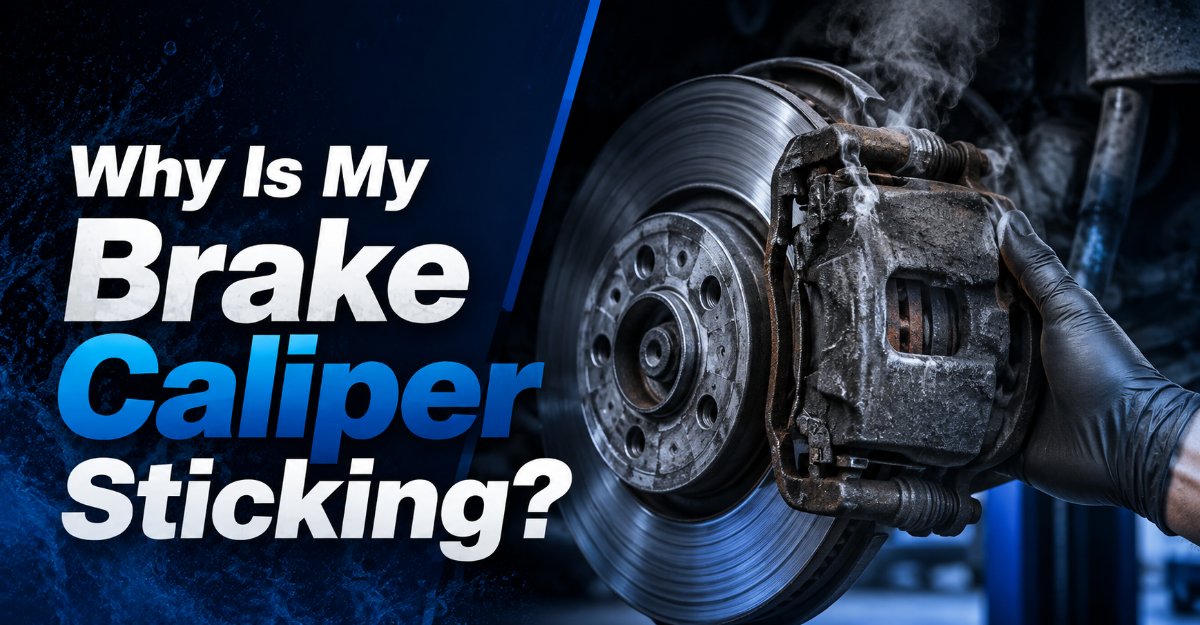
A sticking brake caliper is usually caused by seized slide pins due to torn dust boots, a rusted or swollen caliper piston, or a collapsed internal brake hose acting as a one-way valve. This mechanical or hydraulic failure traps the brake pad against the rotor, generating excessive heat and pulling the vehicle to one side.
Key Facts / At a Glance
- Clearance Tolerance: A properly functioning caliper retracts the pad just 0.1 mm to 0.15 mm away from the rotor when the pedal is released.
- Thermal Danger: Sticking calipers can push local rotor temperatures past 300°C, easily boiling DOT 3 (205°C limit) or DOT 4 (230°C limit) brake fluid.
- Lifespan: Calipers typically last 120,000 km to 160,000 km, but require fluid flushes every 2 years or 40,000 km to prevent internal corrosion.
- Primary Culprit: On daily commuter vehicles, 90% of sticking issues stem from floating caliper slide pins losing lubrication or suffering water ingress.
How Does a Brake Caliper Work?
A brake caliper works by converting hydraulic fluid pressure from the master cylinder into mechanical clamping force. When you depress the brake pedal, pressurized brake fluid travels through steel lines and flexible rubber hoses into the caliper body. This fluid forces a piston outward, driving the inner brake pad against the spinning brake rotor to slow the vehicle via friction.
Understanding the caliper’s return mechanism is critical to understanding why it sticks. Unlike drum brakes, disc brake calipers do not use mechanical return springs.
The Role of the Square-Cut Seal
The piston relies entirely on a square-section rubber seal seated inside the caliper bore. When brake fluid pressure rises, this rubber seal deforms and stretches outward slightly. When you release the brake pedal, the fluid pressure drops. The rubber seal naturally flexes back to its original square shape, pulling the piston back with it by a fraction of a millimeter. This micro-retraction is the only mechanism removing the clamping force.
Caliper Architecture and Vulnerabilities
Different caliper designs fail in entirely different ways. Identifying your caliper type dictates your diagnostic approach.
| Caliper Type | Mechanism | Primary Failure Point | Vulnerability Level | Pros vs. Cons |
| Floating (Sliding) Caliper | 1-2 pistons on the inboard side; the entire body slides on greased metal pins to clamp the outboard pad. | Slide pins seize from torn rubber dust boots and washed-out lubrication. | High (Standard on 90% of passenger cars) | Pros: Cheap, lightweight. Cons: Uneven pad wear, high corrosion risk. |
| Fixed Caliper | Stationary body bolted to the knuckle; uses opposing pistons (2 to 8) on both sides of the rotor. | Piston seizure due to internal corrosion or square seal hardening. | Medium (Found on sports cars and heavy trucks) | Pros: Superior clamping force, even wear. Cons: Expensive, requires exact rotor alignment. |
| EPB Caliper (Electronic) | Integrates a motorized actuator on the back of the caliper to mechanically drive the piston for the parking brake. | Motor failure or mechanical destruction if retracted without a diagnostic scan tool. | High (Modern vehicles) | Pros: Auto-hold features, weight savings. Cons: Impossible to service without specialized OBD2 software. |
Why Do Brake Calipers Stick?
Brake calipers stick due to a breakdown in either the mechanical sliding components or the hydraulic fluid return path. The failure almost always stems from moisture intrusion, severe thermal cycling, or degraded brake fluid.
Cause 1: Seized Caliper Slide Pins
Seized slide pins are the leading cause of a dragging floating caliper. The slide pins are protected by small rubber dust boots. Exposure to road salt, ozone, and extreme heat cycles causes these boots to tear or perish. Once the barrier fails, water washes away the high-temperature silicone grease and oxidizes the bare steel pins. Rust occupies more volume than raw steel, effectively wedging the pin inside its bore and locking the caliper in the applied position.
Cause 2: Corroded or Swollen Caliper Pistons
Piston failure occurs when the main piston becomes permanently wedged against the caliper cylinder walls. The mechanism depends on the piston material:
- Steel Pistons: If the external rubber dust boot tears, water pits and rusts the outer chrome plating of the steel piston. When this rusted section attempts to retract past the internal square seal, it binds.
- Phenolic Pistons: Many modern vehicles use phenolic resin (plastic/composite) pistons to prevent heat transfer to the fluid. While they do not rust, extreme heat causes phenolic material to swell and crack, eventually wedging tightly inside the metal bore.
Cause 3: Collapsed Flexible Brake Hoses
A collapsed rubber brake hose creates a one-way check valve that traps fluid inside the caliper. Over years of use, the inner Teflon or rubber lining of the flexible hose breaks down and delaminates. High pressure from the master cylinder (often exceeding 1,000 PSI) forces fluid past the flap to apply the brakes. However, the low-pressure return flow cannot push past the collapsed lining, leaving the piston fully extended even when your foot is off the pedal.
Cause 4: Hardened Square-Cut Piston Seals
Hardened internal seals lose their elasticity, preventing the micro-retraction necessary to free the rotor. Constant exposure to braking temperatures exceeding 300°C bakes the internal square-cut rubber seal. Furthermore, brake fluid is hygroscopic (absorbs water). If the fluid is not flushed every two years, the moisture-laden fluid chemically degrades the seal, turning it from a pliable rubber ring into hard, brittle plastic.
What Are the Symptoms of a Sticking Caliper?
You can identify a sticking caliper through specific tactile, visual, and auditory cues long before total failure occurs.
- Steering Pull: The vehicle violently darts or pulls to one side when braking, or gently drifts to one side while coasting.
- Intense Radiant Heat: The affected wheel emits a strong burning smell (like burnt carpet or sulfur) and radiates noticeable heat compared to the opposite wheel.
- Uneven Pad Wear: Upon inspection, the inboard brake pad is worn down to the metal backing plate, while the outboard pad still has 80% of its friction material remaining (classic slide pin failure).
- Spongy Brake Pedal: The trapped pad superheats the rotor, transferring heat into the caliper and boiling the brake fluid. This introduces compressible gas bubbles into the hydraulic lines, causing the pedal to sink to the floor.
How to Diagnose a Sticking Brake Caliper
Diagnosing a sticking caliper requires isolating the mechanical hardware from the hydraulic system. Use this sequential testing method to locate the exact point of failure.
Step 1: The Wheel Spin Test
Lift the vehicle and support it safely on jack stands. Put the transmission in neutral and spin the affected wheel by hand. If the wheel spins freely, the issue is intermittent or related to wheel bearings. If the wheel is locked or offers heavy, grinding resistance, you have confirmed brake drag. Proceed to Step 2.
Step 2: The Bleeder Valve Release Test
Safely open the caliper bleeder valve using a properly sized line wrench (usually 8mm or 10mm). Have a rag ready to catch the fluid.
- If fluid shoots out under pressure and the wheel instantly spins freely: The caliper is mechanically sound. The issue is a hydraulic restriction upstream. You likely have a collapsed flexible brake hose, or in rarer cases, a stuck valve inside the ABS modulator block.
- If a few drops of fluid drip out but the wheel remains completely locked: The hydraulic system is depressurized, meaning the failure is entirely mechanical. The caliper itself is seized. Proceed to Step 3.
Step 3: The Slide Pin vs. Piston Movement Test
Remove the two caliper mounting bolts and attempt to pivot or slide the caliper assembly on its bracket.
- If the caliper is frozen solid on the bracket: Your slide pins are seized. The caliper body is fine, but the bracket and pins require extraction, wire-brushing, and heavy lubrication.
- If the caliper moves smoothly on the pins but the piston will not compress: The internal piston is seized. You will not be able to push it back into its bore using a C-clamp or dedicated compression tool. The caliper must be rebuilt or replaced.
What Are the Typical Repair Costs?
Repair costs vary heavily depending on the failure point and whether you rebuild or replace components. All estimates represent standard industry averages for commuter passenger vehicles, including parts and labor.
- Slide Pin Service (Clean & Lubricate): $80 – $150 per axle. Takes roughly 45 to 60 minutes.
- Brake Hose Replacement: $150 – $250 per side. Includes bleeding the hydraulic system.
- Single Caliper Replacement: $250 – $500. Remanufactured aftermarket calipers sit on the lower end, while OEM replacements push $500.
- Complete Axle Overhaul: $600 – $1,200. Because a sticking caliper usually destroys the pad and warps the rotor, professional shops highly recommend replacing the caliper, pads, and rotors across the entire axle to maintain symmetric braking dynamics.
Common Mistakes to Avoid When Fixing a Caliper
Attempting a brake repair without understanding the chemical and mechanical tolerances often leads to catastrophic system failure.
- Using Petroleum-Based Lubricants: Applying standard chassis grease, anti-seize compound, or WD-40 to slide pins will cause the rubber dust boots to swell to twice their size, disintegrate, and lock the pins within weeks. Always use dedicated, high-temperature silicone or ceramic brake grease.
- Forcing Dirty Fluid Backwards: Forcing a seized piston back into its bore pushes old, moisture-laden, rust-filled fluid upstream directly into the expensive ABS hydraulic control unit. Always open the bleeder valve when compressing a piston.
- Hanging the Caliper by the Hose: Letting a heavy metal caliper dangle by its flexible rubber line causes invisible structural micro-tears in the inner Teflon lining. This directly causes the “collapsed hose” issue months down the road. Support the caliper using a heavy mechanic’s wire or a bungee cord.
- Replacing Only One Side’s Friction Materials: If a sticking caliper ruins the brake pads on the left side, you must replace the pads and rotors on both the left and right sides. Replacing only one side creates a friction imbalance that will violently pull the steering wheel during panic stops.
Frequently Asked Questions
Is it safe to drive with a sticking brake caliper?
No, driving with a sticking caliper is highly dangerous. The constant friction generates extreme heat that can boil your brake fluid (causing total brake loss), warp the rotor, or in severe cases, cause the tire or wheel bearing grease to catch fire.
Will a sticking caliper throw a check engine light?
A sticking mechanical caliper will not trigger a check engine light. However, if the heat boils the fluid or destroys the ABS wheel speed sensor located near the rotor, it will trigger an ABS or Traction Control warning light on the dashboard.
Can you unstick a brake caliper without replacing it?
You can unstick a caliper if the issue is strictly seized slide pins. Removing the pins, cleaning the rust with a wire wheel, and applying fresh silicone grease will restore function. However, if the main piston is seized due to internal rust or a torn boot, the caliper must be fully rebuilt or replaced.
How often should I change my brake fluid to prevent sticking?
Automotive engineers mandate flushing the brake fluid every 2 years or 40,000 km, regardless of mileage. Brake fluid absorbs moisture from the atmosphere; once the water content exceeds 3%, internal corrosion of the caliper piston and ABS pump accelerates rapidly.
Why does my caliper only stick when it gets hot?
Heat causes metal and rubber to expand. If a phenolic piston is swollen, or if the slide pin tolerances are extremely tight due to mild rust, the ambient cold clearance might be sufficient. Once braking friction generates heat, the components expand and wedge themselves into the tight bores, causing the brake to drag.


