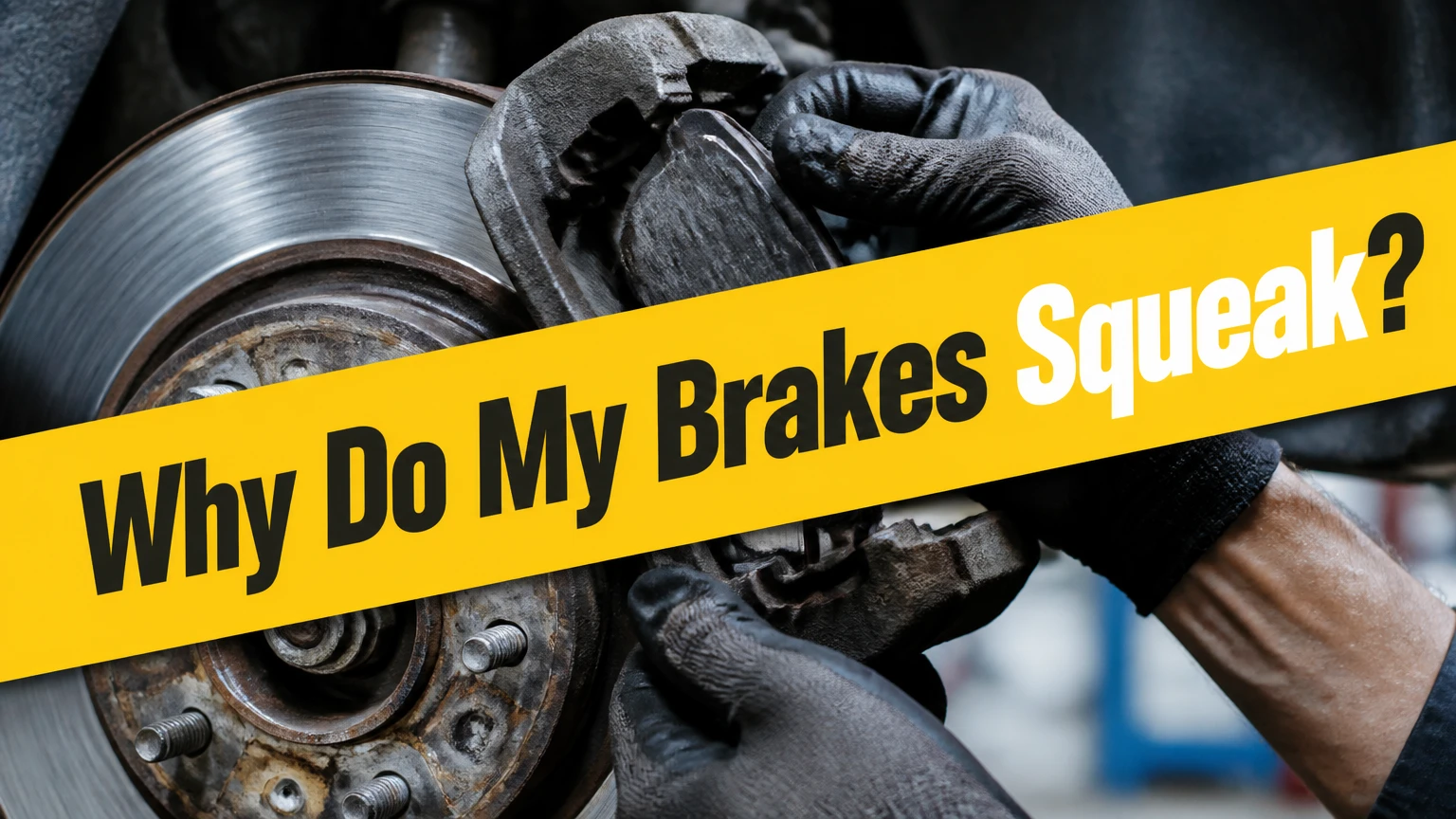
Brakes squeak primarily because high-frequency vibrations develop between the brake pads and the iron rotor during braking. These friction-induced vibrations resonate through the brake caliper assembly at audible frequencies. Common causes range from normal overnight surface rust and high-performance pad compounds to worn wear indicators, unlubricated contact points, and glazed friction material.
At a Glance
- Mechanical wear indicators trigger an intentional metal squeak when brake pad thickness drops to 2 millimeters.
- Atmospheric humidity above 70% creates overnight flash rust on rotors, causing temporary morning squeaking that clears after 3 to 5 stops.
- Overheating brake pads past 350°C (660°F) crystallizes the friction resin, creating a permanently glazed, noisy surface.
- Never apply WD-40 or general lubricants to brake friction surfaces, as doing so destroys stopping power and causes immediate brake failure.
- Eliminating squeaking on new brakes requires 1,000 to 1,500 kilometers of gradual bedding or applying high-temperature ceramic grease to caliper slide pins and pad backing plates.
What Physical Mechanism Causes Brake Noise?
Brake squeaking occurs when kinetic energy converts into high-frequency acoustic vibration through stick-slip friction between the brake pad and the rotating iron rotor. As the brake caliper presses friction material against the spinning rotor, microscopic irregularities on both surfaces grab and release rapidly. This rapid cycle creates harmonic vibrations that travel through the pad backing plate and caliper housing, radiating sound waves into the air like a speaker cone.
The acoustic tone produced depends on the vibration frequency:
- Low-Frequency Groan (under 300 Hz): Caused by structural vibration in the suspension or caliper bracket during light pressure.
- High-Frequency Squeal (1,000 Hz to 12,000 Hz): Produced by pad-to-rotor surface friction instability or missing anti-rattle shims.
- Ultra-High Ultrasonic Squeak (above 12,000 Hz): Triggered by micro-vibrations across glazed friction surfaces or unlubricated pad contact ears.
At What Pad Thickness Do Wear Indicators Start Squeaking?
Mechanical wear indicators begin producing a high-pitched squeak when brake pad friction material wears down to exactly 2 millimeters (0.078 inches). Standard new automotive brake pads contain 10 millimeters to 12 millimeters of usable friction compound. The wear indicator—a hardened spring-steel clip attached to the pad backing plate—is positioned precisely 2 millimeters above the bare metal base.
New Brake Pad (10mm - 12mm)   [====================] Safe
Warning Threshold (3mm - 4mm) [======              ] Schedule Service
Wear Clip Contact (2mm)       [==|                 ] Loud Squeak / Inspect Now
Fully Depleted (0mm)          [|                   ] Severe Rotor Damage / Grind
When pad thickness drops to 2 millimeters, the steel clip scrapes against the spinning iron rotor edge during pedal application, generating a continuous warning tone. If drivers ignore this 2-millimeter alert, the friction material wears away entirely to 0 millimeters, causing the steel backing plate to grind directly into the iron rotor face.
Why Do Brakes Squeak in the Morning or High Humidity?
Brakes squeak in the morning because raw cast-iron brake rotors react with atmospheric moisture to form a microscopic layer of ferric oxide (flash rust) overnight. When relative humidity exceeds 70%, ambient moisture and morning dew oxidize the exposed rotor face within two to four hours of parking.
High Humidity (70%+) ---> Flash Rust on Rotor ---> First 3-5 Brake Stops ---> Rust Scraped Off ---> Squeak Disappears
During the first 3 to 5 brake applications, the brake pads scrape off this abrasive oxide dust. This cleaning process creates a dry, raspy squeaking or crunching sound. Morning flash rust squeal is harmless and stops completely once the friction material polishes the bare rotor steel clean.
Why Do Brand-New Brakes Squeak During the Break-In Period?
Brand-new brake pads and rotors squeak because they require a 1,000 to 1,500 kilometer (600 to 900 mile) break-in window to establish an even layer of friction material on the steel rotor face. Unbedded pads make uneven surface contact with raw rotor steel, generating unstable friction harmonics under light braking.
New brake installations also squeak due to three specific preparation oversights:
- Uncleaned Storage Oil: Factory rotors ship coated in petroleum anti-rust oil or Geomet protective coating; failing to clean rotors with solvent brake cleaner contaminates new pad material.
- Thermal Shock Glazing: Subjecting fresh pads to hard emergency stops before completing break-in melts pad binding resins into a glass-like sheet.
- Improper Pad Transfer: Incomplete bedding leaves patchy compound spots across the rotor, causing rhythmic high-pitched squeaking.
How Do You Bed In New Brake Pads to Stop Squeaking?
Properly bedding in new brake pads requires a controlled sequence of moderate accelerations and hard decelerations to transfer a smooth micro-layer of pad friction material onto the raw rotor surface.
1.Find a Safe, Clear Roadway:Select a flat, traffic-free paved road with clear visibility.
Accelerate the vehicle up to 60 km/h (35 mph). Ensure no trailing traffic is behind your vehicle before applying the brakes.
2.Perform Moderate Decelerations:Do not bring the vehicle to a complete standstill.
Apply moderate to firm brake pressure to slow the vehicle down from 60 km/h to 15 km/h (10 mph). Immediately release the brake pedal once speed drops.
3.Repeat the Deceleration Cycle:Perform 4 to 5 consecutive slowdowns.
Accelerate back to 60 km/h and repeat firm braking down to 15 km/h. Keep the vehicle moving between runs to prevent hot pad material from sticking in one spot on the rotor.
4.Perform Highway-Speed Decelerations:Increase speed to establish full operating temperature.
Accelerate to 90 km/h (55 mph) and brake hard down to 20 km/h (12 mph). Repeat this higher-speed cycle 3 to 4 times until you smell mild friction resin heating up.
5.Cool Down the Brake Assembly:Drive 5 minutes without touching the brake pedal.
Drive at cruising speed for 5 to 10 minutes using minimal braking to let airflow cool the rotors evenly, completing the material transfer process.
Do High-Performance Brake Compounds Squeak More Than Ceramic?
High-performance semi-metallic and carbon-ceramic brake compounds squeak significantly more than standard ceramic pads because they contain heavy metallic fibers and require high operating temperatures to function quietly.
| Brake Compound | Metallic Content | Noise Level | Ideal Operating Temp | Key Characteristics |
| Premium Ceramic | < 1% Metal (Clay/Glass) | Ultra-Quiet | 0°C to 300°C | Low dust, quiet cold stops, gentle on rotors |
| Semi-Metallic | 30% to 65% (Steel/Copper) | Moderate Squeak | 100°C to 450°C | Excellent cold bite, durable, higher rotor wear |
| Track/Carbon-Ceramic | Hard Matrix Composites | High Squeal | 200°C to 800°C+ | Zero brake fade at high heat, loud cold squeal |
Semi-metallic pads use steel wool, iron, and graphite strands that bite aggressively into cast iron. At cold ambient temperatures, these hard metallic fibers vibrate against the rotor face, producing cold brake squeal that subsides only after the friction assembly reaches operating temperature.
Why Do Brakes Squeak Only When Backing Up in Reverse?
Brakes squeak specifically in reverse because brake pads wear into a subtle directional angle matching forward wheel rotation. Reversing forces the brake pads against their established mechanical wear pattern.
Forward Direction: Pad rests in bracket ---> Normal angled wear pattern ---> Quiet operation
Reverse Direction: Pad shifts in bracket ---> Rides high edge of wear ridge ---> High-frequency squeak
When shifting into reverse, the spinning rotor drags the brake pad backward inside the caliper bracket. This force pushes the pad against the small ridge of un-worn material along its edge, shifting the pad micro-millimeters out of alignment. The resulting edge-contact vibration creates a loud reverse squeal that disappears as soon as forward motion resumes.
Why Do Brakes Squeak After Replacing Pads and Rotors?
Brand-new pads and rotors squeak when technicians fail to address caliper bracket contact points, vibration dampers, or mechanical runout during installation. Installing new components onto dirty or unlubricated hardware transfers friction vibrations directly into the vehicle’s hub.
| Overlooked Component | Mechanical Failure | Squeak Mechanism | Repair Solution |
| Anti-Rattle Shims | Missing or corroded rubber/metal backing plates | Vibrations pass unabsorbed into caliper piston | Install new rubberized stainless shims |
| Caliper Slide Pins | Dried or contaminated grease | Caliper twists, applying uneven pad pressure | Clean pins; apply silicone brake grease |
| Pad Support Ears | Dry metal-to-metal bracket contact points | Pad chatter vibrates bracket directly | Apply ceramic grease to abutment clips |
| Rotor Runout | Lateral warping over 0.05 mm (0.002 in) | Rotor hits pads rhythmically each revolution | Index rotor or clean rust from wheel hub |
How Do You Tell the Difference Between Brake Squeaking and Grinding?
Differentiating between brake squeaking and brake grinding relies on evaluating tone pitch, mechanical feel through the brake pedal, and component impact.
SQUEAK / SQUEAL (High-Pitch)              GRIND (Low-Pitch Harsh Metallic)
Tone: 1,000 Hz - 10,000 Hz whistle         Tone: Low rasp / harsh crunch
Cause: Vibration, rust, wear clip          Cause: 0mm pad left; iron-on-iron contact
Pedal Feel: Smooth pedal resistance        Pedal Feel: Rough vibration / pulsing pedal
Action: Inspect within 500 km              Action: STOP DRIVING IMMEDIATELY
A squeak or squeal produces a high-pitched tone caused by superficial surface vibration, moisture, or a 2-millimeter metal wear clip. The brake pedal remains firm and smooth.
A grind produces a coarse, low-pitched metallic crunch accompanied by vibration felt through the pedal and steering wheel. Grinding confirms the friction material is entirely worn away (0 millimeters), forcing the steel pad backing plate directly into the iron rotor face. Grinding severely lengthens stopping distances and destroys the rotor.
Is It Safe to Drive With Squeaking Brakes?
Driving with squeaking brakes is safe if the noise is temporary and caused by morning moisture, dirt, or cold high-performance compounds. It becomes unsafe when the squeaking is continuous, lasts for multiple days, or transitions into metallic grinding.
- Safe to Drive: Squeaking occurs during the first 3 to 5 stops on damp mornings, during initial break-in of new pads, or lightly on heavy semi-metallic track brakes.
- Inspect Within 500 km: Squeaking occurs consistently every time the pedal is pressed, indicating pad thickness has hit the 2-millimeter wear clip threshold or pads are glazed.
- Unsafe (Do Not Drive): Squeaking turns into a harsh metallic grind, the brake pedal feels spongy, or the vehicle pulls to one side under braking.
Can You Spray WD-40 or Oil on Squeaking Brakes?
Never spray WD-40, penetrating oil, motor oil, or general silicones onto brake pads or rotor surfaces. Standard petroleum lubricants eliminate friction, soaking into the porous compound and causing total loss of braking ability.
[WD-40 Applied to Rotor] ---> [Pad Soaks Up Petroleum] ---> [Zero Friction Coefficient] ---> [Brake Failure]
To lubricate brakes safely without ruining friction material, follow these strict application rules:
- Approved Lubricant: Use only pure silicone brake lubricant or high-temperature synthetic ceramic brake grease rated to 1,000°C (1,832°F).
- Backing Plate Only: Apply ceramic grease strictly to the metal back of the brake pad where it touches the caliper piston and outboard fingers.
- Abutment Points: Apply a thin film of grease to the metal ears of the pad where they slide inside the caliper bracket clips. Keep grease completely away from the friction face and rotor disk.
How Can You Stop Brake Squeak Without Replacing the Pads?
You can stop brake squeak on pads that still have healthy friction material (above 4 millimeters) by addressing glazing and hardware vibration.
1.Remove the Brake Pads and Inspect Material:Ensure remaining compound thickness exceeds 4 millimeters.
Unbolt the caliper, slide out the brake pads, and measure friction thickness using a pad gauge.
2.De-Glaze the Pad Friction Face:Remove hardened, glassy resin from overheating.
Lay a sheet of 120-grit sandpaper flat on a workbench. Rub the friction side of the brake pad in a figure-eight motion until the smooth, shiny surface turns matte gray.
3.Scuff the Rotor Surface:Break up mirror-smooth rotor glazing.
Scuff both sides of the iron rotor with 120-grit emery cloth or a rotary conditioning disc to recreate a light cross-hatch pattern on the metal.
4.Clean and Lubricate Hardware:Isolate pad vibration from the caliper housing.
Scrape rust off the caliper bracket abutment clips using a wire brush. Apply synthetic ceramic brake grease to the bracket clips, slide pins, and the back of the pad shims.
How Much Does It Cost to Fix Squeaking Brakes?
Fixing squeaking brakes costs between $20 and $900 depending on whether the noise requires simple lubrication, pad replacement, or full rotor and caliper overhaul.
| Repair Scope | DIY Cost (Parts Only) | Professional Shop Cost | Inclusions |
| Noise De-Glaze & Service | $15 – $30 | $100 – $180 | Hardware cleaning, ceramic lube, pad scuffing |
| Brake Pad Replacement | $40 – $100 per axle | $180 – $350 per axle | New ceramic/semi-metallic pads, new shims, lube |
| Pads & Rotor Replacement | $150 – $350 per axle | $400 – $750 per axle | New pads, new iron rotors, hardware kit, labor |
| Full Overhaul (With Calipers) | $300 – $550 per axle | $600 – $1,100 per axle | Pads, rotors, remanufactured calipers, fluid flush |
The Bottom Line
Brake squeaking stems from high-frequency acoustic friction between pads and rotors, caused by harmless factors like overnight morning humidity or critical issues like pad thickness dropping to 2 millimeters. If your brakes squeak only during morning stops or during a 1,000-kilometer break-in window, the condition is normal and self-correcting. Persistent squeaking requires scuffing glazed pads with sandpaper, greasing caliper contact points with synthetic ceramic lubricant, or replacing depleted friction pads before metal-to-metal grinding ruins the rotors.


