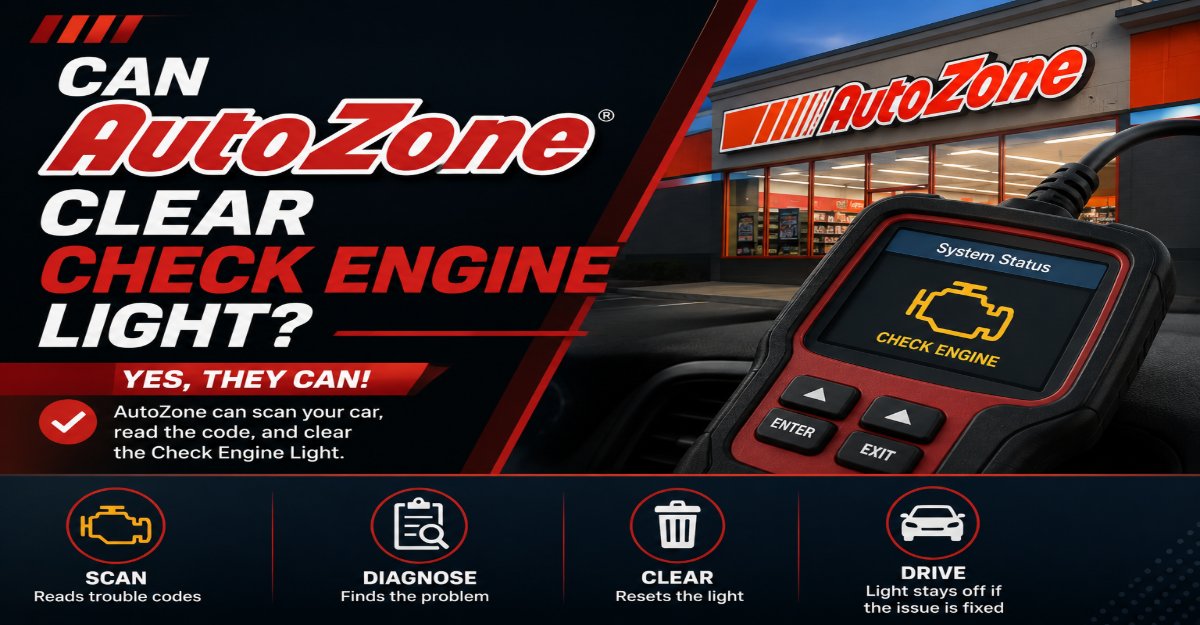
AutoZone employees cannot clear your check engine light due to strict corporate policies, federal EPA mandates, and state environmental regulations. While AutoZone provides a free OBD-II code scanning service via their Fix Finder system, store representatives are strictly prohibited from erasing diagnostic trouble codes (DTCs) from your vehicle’s engine control unit. To turn off the light, you must repair the underlying fault, complete a natural drive cycle, or erase the codes using your own OBD-II scanner.
Key Facts at a Glance
- AutoZone Code Clearing Policy: Store employees are contractually and legally barred from pressing the erase button on diagnostic tools.
- Free Fix Finder Service: AutoZone scans your vehicle for free and prints a diagnostic report identifying stored error codes.
- Legal Reason for Restriction: Clearing codes resets emissions readiness monitors, violating Clean Air Act enforcement standards in jurisdictions like California.
- Automatic Reset: Fixing the root problem (such as tightening a loose gas cap) turns the light off naturally after 50 to 100 miles of driving.
- Self-Service Alternatives: Drivers can clear their own codes by purchasing an entry-level OBD-II scanner ($20 to $50) or performing a manual battery disconnect on older vehicles.
Why Are AutoZone Employees Prohibited from Clearing Check Engine Lights?
AutoZone employees are prohibited from clearing check engine lights because erasing diagnostic codes resets the vehicle’s emissions readiness monitors, creating legal liability under environmental protection laws. Under federal Clean Air Act enforcement policies and regulations enforced by agencies like the California Air Resources Board (CARB), wiping fault codes without performing a verified repair can be interpreted as tampering with emissions control systems.
VEHICLE ENGINE FAULT & CODE SCAN PROCESS
When an OBD-II scanner erases stored trouble codes from the Engine Control Unit (ECU), it simultaneously wipes the operational history of the vehicle’s emissions readiness monitors. These monitors track critical components including the catalytic converter, evaporative emissions (EVAP) system, oxygen sensors, and exhaust gas recirculation (EGR) valves.
If retail employees cleared codes for customers, drivers could bypass state emissions inspections temporarily by turning off the warning light right before a test. To avoid severe civil penalties, corporate liability, and regulatory fines, national auto parts chains strictly enforce a zero-tolerance policy against staff clearing codes.
How Does the AutoZone Fix Finder Service Work?
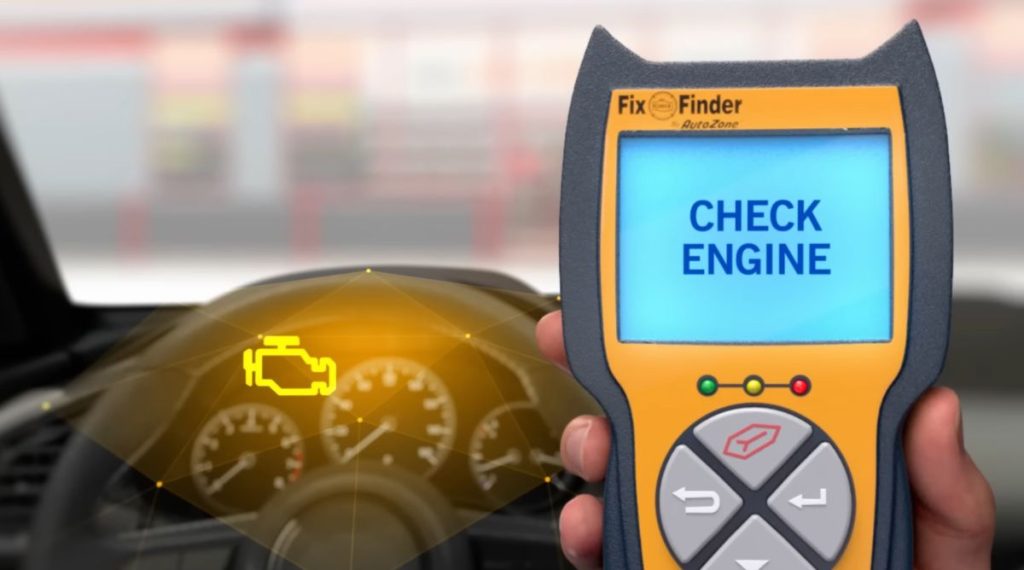
AutoZone Fix Finder works by connecting a handheld OBD-II diagnostic scanner to your vehicle’s onboard computer to extract active, pending, and historic Diagnostic Trouble Codes. The service translates numeric codes into plain-language diagnostic summaries using a proprietary database compiled from millions of verified technician repairs.
The scanning device communicates with your car’s Engine Control Unit through a standard 16-pin Data Link Connector (DLC). Once the tool retrieves the alphanumeric trouble codes (such as P0300 or P0420), it cross-references those numbers with specific vehicle year, make, model, and engine size configurations.
The system then outputs a comprehensive Fix Finder report. This report details:
- The specific Diagnostic Trouble Codes (DTCs) triggered.
- Plain-English definitions of each code.
- Most probable causes ranked by statistical frequency.
- Recommended replacement parts or corrective procedures.
- Severity levels indicating whether the vehicle is safe to drive short distances.
What Is the Step-by-Step Process for Getting a Free Scan at AutoZone?
Getting a free check engine light scan at AutoZone requires visiting a retail location and either receiving assistance from an employee or using a loaner tool. The entire procedure takes under five minutes and requires no appointment or purchase.
AUTOZONE CODE SCAN PROCESS
Option 1: The Employee-Assisted Scan
- Request a Scan: Walk up to the retail customer service desk and request a free Fix Finder scan.
- Accompany the Specialist: An employee will walk to your parked vehicle carrying the Fix Finder scan tool.
- Locate the Port: The specialist locates the Data Link Connector, typically situated beneath the driver-side dashboard near the steering column or hood release.
- Initiate Communication: The specialist plugs in the 16-pin connector and instructs you to turn the ignition key to the “ON/RUN” position without starting the engine.
- Process Data: The scan tool retrieves the data stream within five to ten seconds.
- Retrieve Printed Summary: The associate plugs the scanner into their in-store console to print or email your personalized health report.
Option 2: The Self-Service Loaner Tool
- Borrow the Scanner: In some locations or high-volume hours, the store associate hands you a loaner scan tool after taking your driver’s license or phone number.
- Plug into DLC: Firmly insert the scanner cable into your vehicle’s 16-pin diagnostic port.
- Turn Key to RUN: Turn your ignition key to the “ON” position so your dashboard lights illuminate, but leave the engine off.
- Execute Scan: Press the “Scan” or “Read” button on the handheld interface and wait for the screen to display “Complete” or “Success”.
- Hand Back Device: Disconnect the tool, turn off your ignition, and return the scanner inside.
Note regarding self-service loaners: If you hand-hold a generic loaner scanner while it is plugged into your car, the device itself may technically possess an “Erase” button. However, AutoZone associates are trained never to instruct or encourage customers to press erase on store-owned hardware.
Will a Check Engine Light Turn Off Automatically After Fixing the Problem?
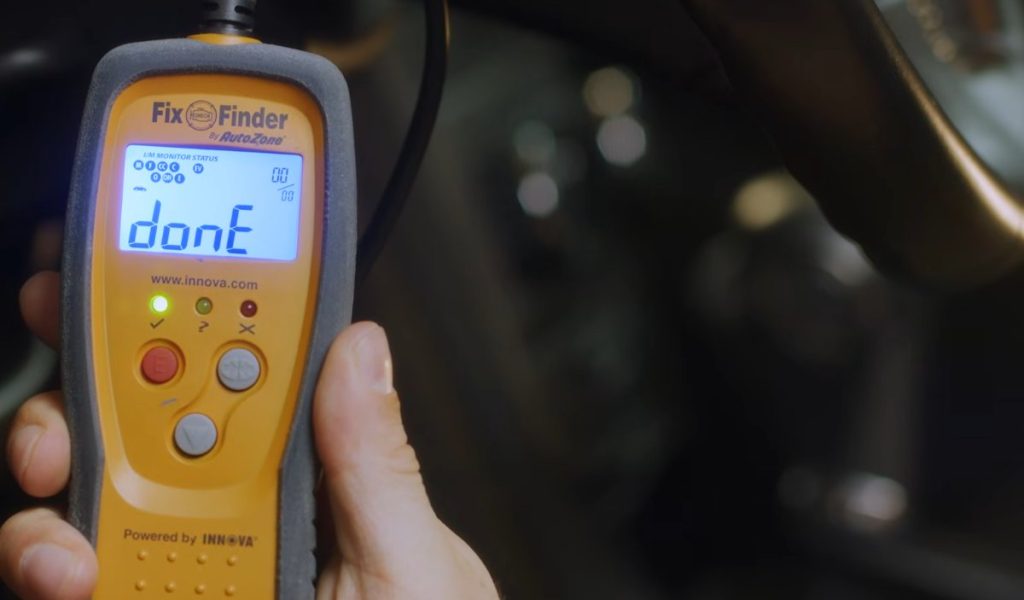
A check engine light will turn off automatically after you fix the problem, provided the Engine Control Unit completes the required drive cycles and verifies that the fault is resolved. Depending on the specific system involved, auto-clearing typically takes between 50 to 100 miles of driving.
The ECU continuously monitors engine and emissions parameters. When a fault occurs, the computer records a “hard code” and turns on the dashboard light. Once the physical issue is repaired (for instance, replacing a damaged gas cap or installing a new oxygen sensor), the ECU does not extinguish the light instantly.
Instead, it transitions the code into a “pending” or “history” state. The ECU requires the vehicle to complete multiple successful operating cycles without detecting the fault. Once the self-diagnostic checks pass repeatedly, the ECU turns off the light automatically and eventually clears the historic code from memory.
How Do You Clear a Check Engine Light Yourself Using an OBD-II Scanner?
You can clear a check engine light yourself using a personal OBD-II scanner by plugging the device into your diagnostic port, reading the codes, and selecting the erase command. Modern standalone code readers range from basic $20 handheld units to smartphone-enabled Bluetooth dongles.
OBD-II CODE CLEARING PROCESS
Success Checkpoint
When the erasure command succeeds, the check engine light on your instrument cluster will extinguish immediately upon starting the engine. If the light stays illuminated or turns back on within seconds, an active hard fault is present, or you attempted to clear a “Permanent Diagnostic Trouble Code” (PDTC) that requires physical drive-cycle verification under modern OBD-II protocols.
Does Disconnecting the Car Battery Safely Clear a Check Engine Light?
Disconnecting the negative car battery terminal for 10 to 15 minutes can clear a check engine light on older vehicles by draining power from the ECU’s volatile random-access memory (RAM). However, this method is not recommended for modern vehicles due to severe secondary side effects on electronic control systems.
BATTERY DISCONNECTION EFFECTS
When you disconnect the battery, you do not fix the underlying mechanical issue. Furthermore, on vehicles manufactured after 2005, interrupting constant power triggers several unwanted operational issues:
- Loss of ECU Adaptive Memory: The computer loses stored fuel trim profiles, idle speed adjustments, and throttle body position calibrations. This often causes rough idling, stalling, or poor gas mileage for 50+ miles.
- Transmission Shift Calibration Reset: Adaptive automatic transmission parameters wipe out, causing harsh or delayed gear shifting until the module re-learns driving habits.
- Security and Infotainment Lockouts: Theft-deterrent audio systems may enter anti-theft lockout mode, requiring a dealer security PIN to restore radio and navigation functionality.
- Emissions Reset Failure: All readiness monitors drop to “Not Ready” status, preventing you from passing an emissions test.
Why Does Clearing Codes Cause an Immediate Smog Inspection Failure?
Clearing diagnostic codes causes an immediate smog inspection failure because erasing memory wipes all OBD-II readiness monitor flags, setting their internal status from “Ready” to “Not Ready” or “Incomplete”. State inspection stations require these monitors to be fully set before a vehicle can pass.
READINESS MONITOR FAILURE PATH
When an emissions testing computer connects to your vehicle, it reads both active fault codes and the status of internal readiness monitors. If you erase a code right before driving into an inspection center, the check engine light may be off, but the inspector’s equipment detects that the ECU has not evaluated the emissions system through required driving conditions.
States adhering to strict environmental standards (such as California, New York, and Texas) trigger an automatic test failure if more than one non-continuous monitor displays an incomplete status.
What Is an OBD-II Drive Cycle and How Does It Reset Monitors?
An OBD-II drive cycle is a specific sequence of driving conditions designed to force the vehicle’s engine control module to run its internal diagnostic tests on emissions systems. Completing a drive cycle changes readiness monitor statuses from “Not Ready” to “Ready”.
While exact drive cycles vary by manufacturer, a standard universal drive cycle requires the following steps:
- Cold Soak: Allow the vehicle to sit overnight (or at least 8 hours) so engine coolant and ambient air temperatures match within 4 degrees Fahrenheit.
- Cold Start & Warm-up: Start the engine from cold and let it idle smoothly for 2 to 3 minutes with the rear defroster and air conditioner running.
- City Acceleration: Accelerate smoothly to 35 mph and maintain steady speed for 5 minutes.
- Highway Cruise: Merge onto a highway, accelerate smoothly to 55 mph, and hold a constant speed for 15 to 20 minutes using light throttle pressure (do not use cruise control).
- Deceleration Coasting: Take your foot off the accelerator and allow the vehicle to coast down to 20 mph without pressing the brake pedal or depressing the clutch.
- Stop & Idle: Stop the vehicle and let it idle in gear (or neutral for manual transmissions) for 2 minutes.
Comparative Matrix: Code Diagnostic & Clearing Methods
| Diagnostic Method | Cost | Code Clearing Ability | Time Required | Primary Advantage | Major Limitation / Risk |
|---|---|---|---|---|---|
| AutoZone Fix Finder | $0 (Free) | No (Employee restricted) | 2–5 minutes | Includes technician-verified repair reports | Cannot clear the light for you |
| Personal OBD-II Scanner | $20–$150 | Yes (Full manual control) | Immediate | On-demand scanning and code wiping | Upfront tool investment required |
| Natural Drive Cycle | $0 (Fuel cost) | Yes (Automatic upon repair) | 50–100 miles | Guarantees emissions readiness monitors set | Takes several days of specific driving |
| Battery Disconnection | $0 | Yes (Resets volatile memory) | 15 minutes | Requires no diagnostic tools | Erases radio codes, idle, and shift settings |
| Professional Mechanic | $75–$200 | Yes (Post-repair clearing) | 1–2 hours | Complete electrical and live-data diagnostic | High diagnostic fee |
Why Shouldn’t You Buy Replacement Parts Based Solely on a Diagnostic Code?
You should not buy replacement parts based solely on a diagnostic trouble code because a code identifies an operational symptom within a circuit, not necessarily a failed physical part. Replacing parts suggested by a raw code often leads to wasted money without fixing the root cause.
Diagnostic Trouble Code: P0171 (System Too Lean)
Money wasted on good part.
Problem resolved permanently.
A inexperienced vehicle owner might see “Oxygen Sensor” on an auto parts printout and immediately purchase a new $100 O2 sensor. However, P0171 simply means the engine control module detected too much air or too little fuel in the combustion ratio.
The actual root cause of a P0171 code could be:
- A $5 cracked rubber intake vacuum hose leaking unmetered air.
- A dirty Mass Air Flow (MAF) sensor requiring a $10 spray cleaner.
- A clogged fuel filter or failing fuel pump delivering low pressure.
- A torn intake manifold gasket.
Replacing the oxygen sensor in this scenario does not resolve the vacuum leak, and the check engine light will illuminate again within a few miles of driving. A trouble code should always serve as a starting point for systematic diagnosis, not a direct purchasing list.
What Should You Do If Your Check Engine Light Is Flashing Versus Steady?
If your check engine light is flashing, you must pull over safely and turn off the engine immediately because a flashing light indicates a severe engine misfire that will destroy your catalytic converter. If the light is steady, you can safely continue driving to a repair facility or parts store.
CHECK ENGINE LIGHT ILLUMINATED
Steady Light Protocol
A solid amber warning light indicates an emissions fault or component malfunction that is non-critical in the short term. The vehicle’s ECU has switched to backup operating maps to protect the drivetrain. You can safely drive to AutoZone for a free scan or schedule an appointment with a technician.
Flashing Light Protocol
A blinking light signifies an active, severe cylinder misfire. During an active misfire, unburned raw gasoline enters the exhaust system and flows directly into the red-hot catalytic converter. The raw fuel ignites inside the honeycomb structure, causing internal temperatures to surge past 1,800 degrees Fahrenheit. This melts the precious metal core within minutes, causing thousands of dollars in catalytic converter damage.
Frequently Asked Questions
Does AutoZone charge any money for a check engine light scan?
AutoZone does not charge any money for a check engine light scan. Their Fix Finder service is completely free of charge, requires no credit card or store purchase, and includes a complimentary printed diagnostic report.
Can Advance Auto Parts or O’Reilly Auto Parts clear my check engine light?
Neither Advance Auto Parts nor O’Reilly Auto Parts employees can clear your check engine light. All major national auto retail chains enforce identical corporate policies restricting staff from erasing codes to comply with federal Clean Air Act guidelines.
How much does an independent mechanic charge to clear a code?
An independent mechanic typically charges between $75 and $200 for a diagnostic evaluation, which includes reading live data, identifying root causes, and clearing codes post-repair. Most certified repair shops will not clear codes without performing the necessary repairs first due to professional liability.
Will my check engine light come back on if I clear it without fixing the car?
Your check engine light will come back on if you clear it without fixing the car. As soon as the ECU runs its self-diagnostic checks during a drive cycle and detects the unaddressed fault again, it will trigger the warning light.
The Bottom Line
AutoZone is an exceptional, zero-cost starting point for identifying diagnostic trouble codes through their free Fix Finder service. However, due to strict environmental laws and corporate risk policies, store associates cannot push the button to clear your light.
To turn off the light permanently, perform the necessary physical repair and allow your car’s computer to complete a natural drive cycle, or use a personal OBD-II scanner to reset the module manually once repairs are complete.


