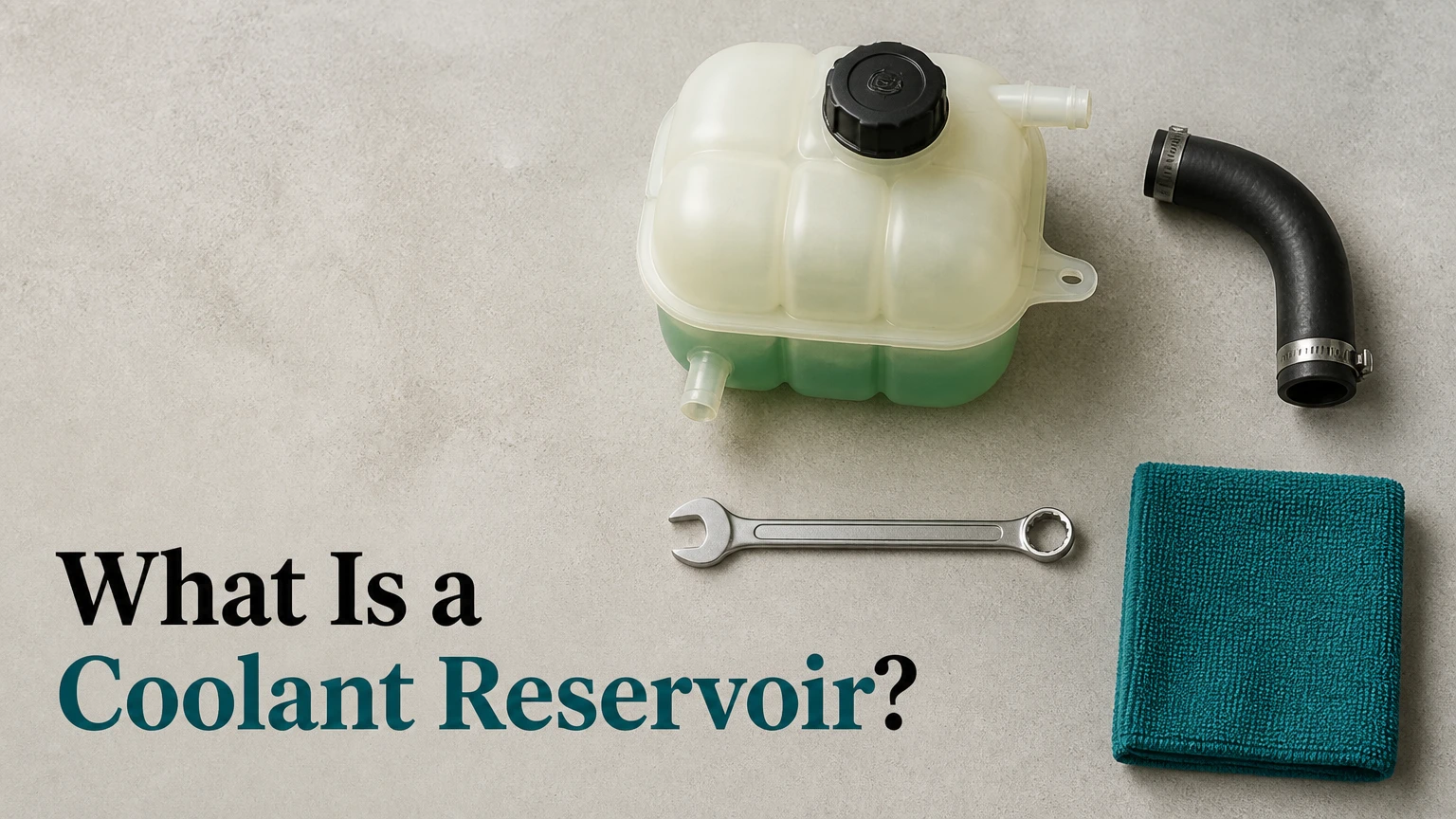
A coolant reservoir is an engine bay storage tank that holds excess antifreeze, regulates cooling system pressure, and absorbs the thermal expansion and contraction of engine fluid. Made of heat-resistant translucent plastic, it maintains consistent hydraulic pressure and prevents air pockets from entering the radiator as temperatures cycle between ambient and peak operating levels.
At a Glance
- The coolant reservoir stores expanding antifreeze fluid as engine temperatures rise up to 220°F (104°C).
- Standard passenger vehicle reservoirs hold between 1.0 and 3.5 quarts (0.95 to 3.3 liters) of coolant.
- Non-pressurized overflow tanks rely on radiator cap vacuum siphoning, whereas pressurized degas bottles operate under 14 to 22 PSI.
- Tanks must remain 15% to 30% empty when cold to leave sufficient space for thermal expansion.
- Mixing incompatible coolant chemistries like Organic Acid Technology (OAT) and Inorganic Acid Technology (IAT) forms clogging sludge inside the tank.
Translucent coolant reservoir showing MIN and MAX level indicators.. Source: JJ Gouin / Getty Images
How Does a Coolant Expansion Tank Work?
A coolant expansion tank functions through thermodynamic expansion and fluid displacement. As the engine runs, combustion heat raises the liquid coolant temperature to between 195°F and 220°F (90°C to 104°C). Water and ethylene glycol expand when heated, increasing liquid volume inside the sealed engine passages and radiator.
In a conventional non-pressurized system, this thermal expansion pushes fluid past the spring-loaded valve of the radiator cap, directing excess coolant through an overflow hose into the bottom of the reservoir. Once the engine shuts down and cools back to ambient temperature, the contracting fluid inside the radiator creates a internal vacuum. This low pressure draws liquid from the reservoir tank back into the radiator, keeping the system fully primed and free of air pockets.
In contrast, a pressurized expansion tank (degas bottle) stays actively tied to the primary cooling loop. Fluid moves continuously through the upper portion of the tank during vehicle operation, venting trapped air bubbles directly from the cylinder head into the reservoir air pocket.
What Is the Difference Between an Overflow Tank and a Degas Bottle?
The core difference between an overflow tank and a degas bottle is active operating pressure. An overflow tank is a passive catch container, whereas a degas bottle is a fully pressurized hydraulic component of the cooling system.
| Feature | Non-Pressurized Overflow Tank | Pressurized Degas Bottle |
|---|---|---|
| System Pressure | Atmospheric pressure (0 PSI inside tank) | Active system pressure (14 to 22 PSI) |
| Cap Type | Simple snap-on or non-sealing cap | High-pressure rated valve cap |
| Fluid Circulation | Intermittent (only during thermal expansion/cooling) | Continuous active flow through upper lines |
| Primary Location | Common in Asian and older domestic vehicles | Common in European vehicles and modern turbo engines |
| Safety Risk Hot | Low pressure risk at tank, high at radiator cap | Extreme boiling hazard if opened hot |
Non-pressurized overflow tanks collect displaced liquid when the radiator cap pressure threshold is exceeded. The tank itself experiences no structural pressure.
Pressurized degas bottles maintain identical internal pressure to the radiator and engine block, usually between 14 and 22 Pounds per Square Inch (PSI). By keeping the liquid under pressure, the degas bottle raises the boiling point of 50/50 antifreeze to approximately 265°F (129°C), preventing vapor pockets around high-temperature engine zones.
A heavy-duty pressurized degas bottle mounted in an engine bay.. Source: VMP Performance
Why Do Modern Vehicles Have Multiple Coolant Reservoirs?
Modern vehicles feature multiple coolant reservoirs because contemporary powertrains separate thermal management into isolated high-temperature and low-temperature fluid loops. A single coolant mixture circulating at 210°F cannot cool sensitive electronic components that fail above 140°F.
Engineers implement distinct reservoirs to support these independent thermal circuits:
- Primary Combustion Engine Circuit: Operates at 195°F to 220°F to optimize fuel economy and engine block temperature.
- Hybrid Inverter and Battery Circuit: Operates at lower temperatures (typically under 140°F) to protect high-voltage electronics from heat degradation.
- Turbocharger Intercooler Circuit: Maintains separate fluid loops to cool compressed intake air before it enters the cylinders.
Mixing fluids across these isolated circuits or ignoring a secondary reservoir can lead to inverter failure, battery degradation, or turbocharger damage. Each circuit requires precise, manufacturer-specified fluid types and filling procedures.
What Are the Normal Operating Pressure and Capacity Specs of a Reservoir?
Standard passenger vehicle coolant reservoirs hold between 1.0 and 3.5 quarts (0.95 to 3.3 liters) of fluid, while the total engine cooling system typically holds 6 to 14 quarts.
The physical tank is intentionally sized to remain 15% to 30% empty when the engine is cold. This empty volume provides the mandatory air pocket required for liquid volume expansion at operating temperature.
Operating pressure specs depend heavily on the system design:
- Non-Pressurized Systems: 0 PSI in the tank; radiator cap opens between 13 and 16 PSI.
- Pressurized Degas Systems: 14 to 22 PSI inside the tank, regulated by a pressure relief cap.
- Temperature Specs: Designed to withstand continuous thermal cycling from ambient winter conditions up to short spikes of 230°F (110°C).
How High Should the Fluid Level Be in a Coolant Reservoir When Cold?
When the engine is completely cold, the fluid level in the coolant reservoir should rest exactly aligned with the COLD FULL or MIN line marked on the exterior plastic housing.
Follow this three-step verification process to ensure proper filling:
- Park on Level Ground: Ensure the vehicle is parked on a flat surface so the fluid level reads accurately against the molded exterior markers.
- Inspect the Translucent Tank: Locate the molded “COLD FILL”, “FULL COLD”, or “MIN/MAX” indicator lines on the side of the plastic container.
- Adjust Fluid Volume: If the fluid rests below the “MIN” mark, add a pre-mixed 50/50 antifreeze solution until the liquid level aligns with the cold mark.
Do not fill the reservoir to the top rim when the engine is cold. Filling the container past the maximum line leaves no space for expanding hot liquid, which forces hot coolant to vent onto the ground or rupture the tank seams once operating temperatures are reached.
Can You Open a Coolant Reservoir When the Engine Is Hot?
No, you should never open a pressurized coolant reservoir or degas bottle while the engine is hot.
Under operating conditions, the cooling system holds fluid between 14 and 22 PSI, which raises the boiling point of the liquid well above 212°F (100°C). Removing the cap from a hot, pressurized reservoir releases this pressure instantly. The rapid pressure drop causes superheated liquid inside the tank to boil immediately, violently venting scalding fluid and steam.
If your vehicle uses a non-pressurized overflow tank with a loose snap-cap, opening the plastic cap itself carries minimal pressure danger. However, the radiator cap connected to that system remains under full pressure and must never be removed until the engine has cooled completely for at least 45 minutes.
Can You Use Pure Water to Fill a Coolant Reservoir?
No, you should not use pure water to top off a coolant reservoir except in an absolute emergency.
Pure tap water lacks essential chemical properties required for modern engine survival. Distilled water may be mixed 50/50 with concentrated antifreeze, but pouring 100% pure water directly into the reservoir causes three distinct systemic problems:
- Boiling Point Reduction: Pure water boils at 212°F (100°C) at atmospheric pressure, whereas a standard 50/50 antifreeze mixture under pressure boils above 265°F (129°C). Pure water leads to localized steam pockets and engine overheating.
- Freezing Hazards: Pure water expands by roughly 9% when freezing at 32°F (0°C). Frozen water inside the reservoir, radiator, or engine block will crack the plastic tank and rupture metal engine passages.
- Corrosion and Mineral Pitting: Tap water contains minerals like calcium and magnesium that form scale deposits along internal cooling passages. Furthermore, water without anti-corrosion additives corrodes aluminum cylinder heads and destroys water pump seals.
Why Is My Coolant Reservoir Full but the Radiator Is Empty?
A coolant reservoir remains full while the radiator starves of fluid when the vacuum return mechanism fails during the engine cooling cycle.
When an engine shuts down and cools, contracting fluid inside the engine block must create a tight vacuum seal to siphon liquid from the reservoir back into the radiator. If air enters the vacuum loop, the siphon breaks, leaving liquid trapped inside the plastic tank while the radiator dries out.
Common mechanical causes for this failure include:
- Faulty Radiator Cap: A worn rubber gasket or stuck return valve on the radiator cap allows outside air to enter instead of drawing liquid from the reservoir.
- Cracked Overflow Hose: A tiny pinhole crack in the thin hose connecting the radiator neck to the bottom of the reservoir breaks the vacuum seal.
- Clogged Hose Passage: Debris or gelled coolant sediment at the bottom of the tank blocks liquid flow through the siphon tube.
Why Is There Brown Sludge or Oil Inside the Coolant Reservoir?
The presence of brown sludge or a milky oil emulsion inside the coolant reservoir indicates oil-to-coolant cross-contamination or extreme chemical degradation.
Milky brown sludge in a reservoir indicates oil cross-contamination.. Source: Birdlkportfolio / Getty Images
Diagnostic causes for contaminated reservoir fluid fall into three main categories:
- Failed Head Gasket: High-pressure oil passages or combustion chambers leak oil directly into adjacent cooling channels, whipping the oil and coolant into a light-brown, chocolate-milkshake consistency.
- Ruptured Transmission or Engine Oil Cooler: Modern vehicles route transmission fluid through an internal cooler inside the radiator. Internal failure permits high-pressure transmission oil to mix directly into engine coolant.
- Incompatible Coolant Reaction: Mixing incompatible chemical families forms a thick, gel-like mud at the bottom of the reservoir that restricts system flow.
What Causes a Coolant Reservoir to Overflow or Spit Liquid?
A coolant reservoir overflows or violently vents liquid when trapped air expands rapidly inside the cooling channels or when system pressure exceeds the cap rating.
Key triggers for reservoir overflow include:
- Trapped Air Pockets: Incorrect filling without purging air creates trapped bubbles in the engine block. As air expands much faster and wider than liquid when heated, it violently pushes liquid out of the block and into the reservoir.
- Stuck Thermostat: A thermostat stuck in the closed position prevents hot fluid from entering the radiator, forcing the superheated liquid to boil and purge into the expansion tank.
- Blown Head Gasket Combustion Leak: High-pressure combustion gas (exceeding 100 PSI) leaks into the cooling channels, pressurizing the system and displacing liquid directly into the reservoir.
- Defective Pressure Cap: A weakened spring in the reservoir cap vents pressure below its rated threshold (e.g., venting at 8 PSI instead of 16 PSI), causing premature boiling and fluid ejection.
Why Is the Coolant Level Dropping Without Visible Leaks Under the Car?
When coolant levels drop continuously without leaving puddles on the driveway, the fluid is escaping through internal engine consumption or evaporating through hot pinhole leaks.
Primary mechanisms for invisible coolant loss include:
- Internal Head Gasket Leakage: Coolant enters the combustion chamber through a breached gasket seal, burning off alongside fuel and exiting the exhaust pipe as white, sweet-smelling steam.
- Cracked Cylinder Head or Engine Block: Micro-cracks expand under engine heat, allowing tiny amounts of coolant to enter combustion chambers or burn on hot exhaust manifolds before liquid droplets reach the ground.
- Evaporative Pinholes in Degas Tanks: Micro-fractures along plastic tank mold seams vent pressurized steam rather than liquid. The steam evaporates instantly, leaving crusty white or colored fluid residue around the crack without making wet spots beneath the vehicle.
What Happens If You Mix Green and Orange Coolant in the Reservoir?
Mixing traditional green Inorganic Acid Technology (IAT) coolant with orange Organic Acid Technology (OAT) coolant causes a destructive chemical reaction that turns liquid antifreeze into a thick, gelatinous sludge.
IAT coolants rely on silicates to coat metal surfaces instantly, whereas OAT coolants use organic acids to provide long-term corrosion protection. When mixed, silicates precipitate out of solution rapidly, forming insoluble chemical gels.
This gel coats internal reservoir walls, clogs fine radiator passages, and restricts heater core channels. The resulting blockage starves the engine of fluid circulation, damages water pump impellers, and causes catastrophic engine overheating.
Is It Safe to Drive With a Leaking Coolant Reservoir?
No, driving with a leaking or cracked coolant reservoir is unsafe and risks immediate engine overheating.
If your vehicle utilizes a pressurized degas tank, a crack destroys the system’s ability to maintain hydraulic pressure. Loss of pressure drops the boiling point of your coolant back down to unpressurized levels, causing the engine to overheat within miles.
If your vehicle uses a non-pressurized overflow tank, you may drive a short distance to a service station in an emergency, provided the radiator itself remains completely full. However, because the engine cannot siphon fluid during cooling cycles, running with a cracked overflow tank will lead to air contamination and fluid starvation over subsequent drive cycles.
How Much Does It Cost to Replace a Damaged Coolant Reservoir?
Replacing a damaged coolant reservoir typically costs between $120 and $400 for parts and labor combined at a professional repair facility.
Cost factors depend on vehicle brand and tank design:
- Standard Non-Pressurized Tank: $30 to $80 for parts; total installed repair cost ranges from $100 to $180.
- Pressurized European/OEM Degas Bottle: $90 to $250 for parts; total installed repair cost ranges from $200 to $450.
- Coolant Flush and Refill: Adding fresh manufacturer-approved fluid adds roughly $80 to $150 to total labor and material expenses.
Labor times generally range between 0.5 and 1.5 hours, making reservoir replacement one of the most cost-effective preventative repairs in automotive maintenance.
The Bottom Line
A coolant reservoir regulates system pressure, stores thermal expansion volume, and keeps air bubbles out of critical engine cooling channels. Maintaining correct fluid levels at the cold fill line prevents vacuum siphon failures, overheating, and component damage. Always address brown sludge, boiling overflows, or rapid fluid loss immediately to protect internal engine components from catastrophic failure.


