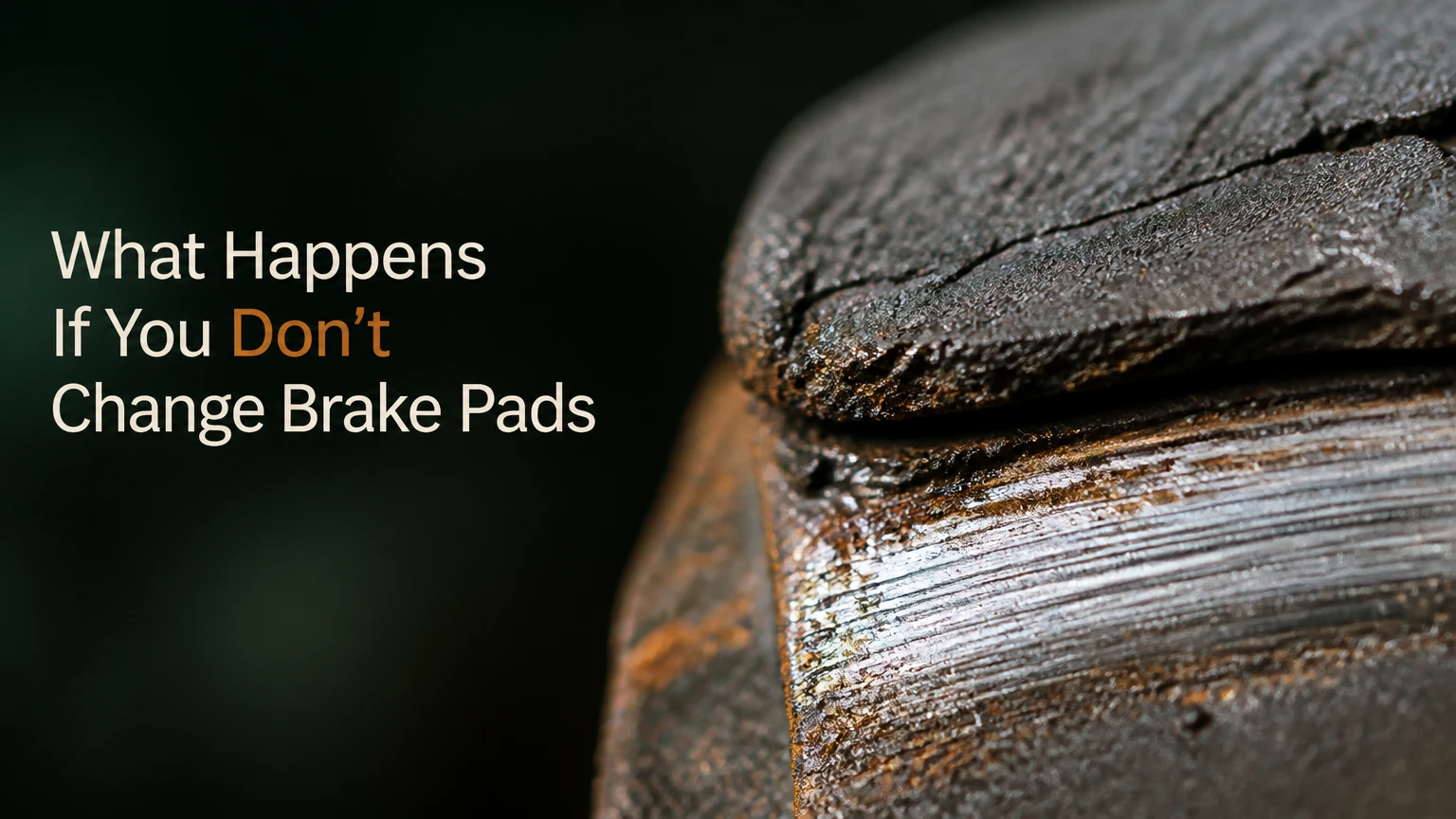
If you do not change worn brake pads, the friction material wears completely away, exposing the steel backing plate. This bare metal grinds directly against the spinning rotor, causing severe disc gouging, extreme heat buildup, caliper piston seizure, hydraulic fluid boiling, and catastrophic failure of vehicle stopping power.
At a Glance: Key Impacts of Neglected Brake Pads
- Financial Escalation: Delaying replacement turns a $150 to $300 pad service into a $1,500 to $3,000 complete hydraulic overhaul.
- Stopping Distance Loss: Operating pads below 2 mm increases total stopping distance by 20% to 30% under standard load conditions.
- Thermal System Failure: Metal-on-metal friction raises brake fluid temperatures above 200°C (392°F), triggering soft pedals and total brake fade.
- Hidden Wear Risk: Seized caliper slide pins can wear inner pads down to bare steel while outer pads display normal thickness.
- Immediate Action Threshold: Hearing a metallic grinding sound means structural rotor destruction is occurring; driving must cease immediately.
How Do Worn Brake Pads Destroy Your Braking System?
Failing to replace brake pads triggers a cascading mechanical breakdown throughout the entire wheel well and hydraulic assembly. Brake pads function by pressing sacrificial friction material (ceramic, semi-metallic, or organic) against a cast-iron rotor to generate deceleration through kinetic friction. When that sacrificial layer is exhausted, the steel backing plate contacts the rotor disc.
This metal-on-metal contact creates severe mechanical friction, rapidly gouging deep circular grooves into the rotor face. The friction generates intense heat, often exceeding 500°C (932°F) at the contact patch. This heat transfers directly into the brake caliper and caliper piston. Extreme thermal expansion causes internal rubber seals to degrade and tear, resulting in hydraulic brake fluid leaks or permanent caliper piston seizure.
Simultaneously, superheated brake fluid absorbed into the hydraulic lines can reach its boiling point. When fluid boils, it creates gas bubbles inside sealed lines. Because gas compresses while liquid does not, the driver loses hydraulic pressure, causing the brake pedal to collapse to the floor without slowing the vehicle.
What Is the Brake Pad Wear Timeline by Millimeter Thickness?
Brake pad life is measured precisely in millimeters of remaining friction material, dictates specific mechanical risk tiers, and guides required service timing.
| Thickness Range | Wear Status Classification | Mechanical Condition & Operational Risk | Recommended Action |
| 12 mm to 4 mm | Safe Operating Zone | Normal pad thickness. Maximum heat dissipation and full stopping power available. | Routine inspection every 5,000 to 10,000 miles. |
| 3 mm to 2 mm | Replacement Threshold Zone | Mechanical wear indicator tab contacts rotor. High-pitched squealing noise begins. | Schedule replacement service within 500 miles. |
| 1 mm to 0 mm | High Danger Zone | Friction material exhausted. Steel backing plate begins touching rotor disc face. | Replace immediately. Stopping distance increases by 20% to 30%. |
| Below 0 mm | Structural Component Destruction | Metal-on-metal grinding. Rotor face gouged within 50 miles; brake fluid overheats. | Do not drive. Tow vehicle to service facility. |
New friction material typically measures between 10 mm and 12 mm. Once friction material decreases to 3 mm, structural strength degrades rapidly under heavy braking loads. Driving on pads measuring below 2 mm creates extreme risk of the remaining friction block fracturing completely off the steel backing plate.
How Much Does Repair Cost Escalate When Brake Pad Replacement Is Delayed?
Delaying routine brake pad replacement increases repair costs by up to ten times because severe mechanical wear damages adjacent structural components.
+-----------------------------------------------------------------------+
|                       REPAIR COST ESCALATION                          |
+-----------------------------------------------------------------------+
| [Tier 1] Brake Pads Only (Routine Maintenance)                        |
| Cost: $150 - $300 per axle                                            |
+-----------------------------------------------------------------------+
                                   |
                                   v  (Continued driving with bare metal)
+-----------------------------------------------------------------------+
| [Tier 2] Pads + Rotors (Rotors Gouged / Warped)                       |
| Cost: $400 - $900 per axle                                            |
+-----------------------------------------------------------------------+
                                   |
                                   v  (Thermal transfer & pin seizure)
+-----------------------------------------------------------------------+
| [Tier 3] Pads + Rotors + Calipers (Full Axle Assembly)                |
| Cost: $800 - $1,500+ per axle                                         |
+-----------------------------------------------------------------------+
                                   |
                                   v  (Boiled fluid, seal destruction)
+-----------------------------------------------------------------------+
| [Tier 4] Complete System (Master Cylinder + ABS Module Overhaul)      |
| Cost: $1,500 - $3,000+                                                |
+-----------------------------------------------------------------------+
Simple, timely replacement of worn brake pads is basic maintenance. Neglecting this maintenance damages rotors, calipers, and hydraulic modules:
- Pads Only Service: Replacing pads at 3 mm costs between $150 and $300 per axle.
- Pads and Rotors Service: Driving down to bare steel gouges the rotor surface beyond the minimum thickness specification required for resurfacing. Rotor replacement adds $250 to $600, bringing total service costs to $400 to $900 per axle.
- Caliper Assembly Replacement: Extended metal-on-metal friction generates extreme heat that melts caliper seals and causes internal pistons to lock. Replacing seized calipers pushes total costs to $800 to $1,500 per axle.
- Complete Hydraulic System Repair: Overheated fluid pushes degraded rubber fragments and metal debris backward into the system, damaging master cylinder seals and Anti-lock Braking System (ABS) hydraulic control modules. Repairing damaged ABS units and master cylinders ranges from $1,500 to over $3,000.
How Many Miles Can You Drive Once Your Brakes Start Grinding?
You can drive zero miles safely once a metallic grinding noise begins. A harsh grinding sound indicates that sacrificial friction material is entirely gone and the steel backing plate is directly destroying the brake rotor face.
Continuing to drive even 10 to 20 miles with grinding brakes creates severe safety hazards. Deep grooves cut into the rotor weaken its structural integrity, increasing the risk of the cast-iron disc shattering under sudden emergency braking. Furthermore, metal-on-metal contact drastically reduces the coefficient of friction, increasing stopping distances and creating unpredictable steering behavior. Vehicles experiencing active brake grinding should be driven only at very low speeds directly to a repair shop, or preferably transported using a flatbed tow truck.
Can You Just Change Brake Pads Without Replacing the Rotors?
You can replace brake pads without replacing rotors only if the rotor surface remains smooth, flat, and above the manufacturer’s minimum thickness threshold. If pads have worn down to bare metal, simple pad replacement without rotor service is mechanically unsafe.
       UNEVEN ROTOR SURFACE                       NEW BRAKE PAD FITMENT
   +---------------------------+              +---------------------------+
   |   /\    /\     /\    /\   |              |   =====================   |  <-- Flat New Pad
   |  /  \  /  \   /  \  /  \  |              |   /\    /\     /\    /\   |  <-- Contact only
   +---------------------------+              +---------------------------+      on high peaks
        Gouged Rotor Surface                      (Up to 50% contact loss)
Installing new, flat brake pads over gouged or warped rotors severely limits initial braking power. Key consequences include:
- Reduced Contact Patch: Contact area between the pad and rotor drops by up to 50% because the flat pad touches only the high ridges of the damaged disc.
- Accelerated Wear: The rough, grooved surface acts like a file, shaving away the brand-new pad material within a few thousand miles.
- Persistent Vibration: Thermal warping in old rotors transfers directly into the brake pedal as a violent pulsation during deceleration.
Rotors must either be turned on a brake lathe to restore a flat surface or fully replaced when installing new pads.
Why Does Your Car Pull to One Side When Applying the Brakes?
A vehicle pulling to one side during deceleration indicates asymmetric braking force, most commonly caused by a seized caliper piston or rusted caliper slide pins on one wheel.
When a caliper seizes on the left side, for example, its pads cannot press effectively against the rotor face. When the driver depresses the brake pedal, only the right wheel applies deceleration force. This sudden imbalance causes the vehicle to pull strongly toward the operational side (the right). Alternatively, a binding caliper pin may prevent the pad on one side from releasing, causing continuous dragging, rapid single-sided pad degradation, elevated tire wear, and reduced fuel efficiency.
What Causes a Spongy or Soft Brake Pedal During Pad Failure?
A spongy brake pedal occurs when compressible gases or air pockets enter the hydraulic lines, usually caused by severe thermal breakdown from worn brake pads.
Standard System:   [ Pedal ] === (Hydraulic Fluid) ===> [ Caliper Clamps ] (Solid Stop)
Overheated System: [ Pedal ] === (Fluid + Gas Bubbles) => [ Gas Compresses ] (Spongy Pedal)
When brake pads wear down below 1 mm, the lack of thermal insulation allows heat from metal-on-metal friction to flow directly into the caliper piston and hydraulic fluid. Modern DOT 3 and DOT 4 brake fluids absorb water over time, lowering their boiling point. Extreme friction heat boils this moisture, converting liquid fluid into steam bubbles.
Because gases compress under pressure while liquids do not, pedal force goes toward squeezing gas bubbles flat rather than moving the caliper piston. This results in a soft, sinking pedal feeling and sudden loss of braking power.
What Happens If Only the Inner Brake Pad Wears Down to Metal?
Uneven inner brake pad wear occurs when caliper slide pins rust or seize, forcing the hydraulic piston to press the inner pad continuously against the rotor while the outer pad sits motionless.
Visual inspections conducted through wheel spokes often check only the outer pad, which may show a safe 6 mm of material. Meanwhile, the hidden inner pad can wear completely to bare steel at 0 mm, actively destroying the inner rotor face and generating high friction heat without showing obvious external visual warning signs.
  SEIZED SLIDE PIN UNEVEN WEAR MECHANISM
  +-------------------------------------------------------------+
  | Outer Pad (Visible through wheel): 6 mm material remaining  |
  | ROTOR DISC                                                  |
  | Inner Pad (Hidden behind caliper): 0 mm (Bare steel gouging)|
  +-------------------------------------------------------------+
  Cause: Stuck floating caliper pins prevent equal clamping distribution.
To prevent unexpected brake failure, complete inspections must evaluate both inner and outer pad thickness on every wheel.
How Does Road Salt Cause Brake Pads to Fracture Before Wearing Out?
In colder regions where salt and liquid chemical de-icers are applied to roads, corrosion can build up between the steel backing plate and the friction material puck, a process known as rust jacking.
       RUST JACKING FAILURE MECHANISM
  +---------------------------------------+
  | Friction Puck Material                |
  |<--- Rust Layer Expands (Rust Jacking) |
  | Steel Backing Plate                   |
  +---------------------------------------+
  Result: Separation, fracture, and detachment of friction puck.
As iron oxide forms beneath the friction material, its expansion exerts intense upward pressure against the bond layer. This force eventually cracks the friction puck away from the backing plate. The friction material can then shatter or drop out of the caliper frame completely, causing immediate loss of stopping power even if the friction layer originally had several millimeters of wear remaining.
Why Do Electric Vehicle Brakes Fail Even If the Friction Material Looks Full?
Electric vehicles (EVs) and hybrid cars use regenerative braking via electric drive motors for most routine deceleration. Because mechanical brakes are used less frequently, EV brake pads can physically last over 100,000 miles, but they often fail from environmental corrosion rather than physical wear.
Because mechanical brakes are rarely engaged hard enough to clear rust and moisture off the rotors, salt and dirt build up on caliper slides and rotor surfaces. This leads to:
- Caliper Binding: Slide pins seize in place from lack of movement, causing pads to drag continuously or lock up.
- Surface Oxidation: Rust flakes build up on rotor faces, causing uneven friction distribution and severe braking vibration.
- Friction De-bonding: Moisture sitting along stagnant pad edges rots structural adhesives, causing pad separation.
EV and hybrid manufacturers mandate periodic physical teardown, cleaning, and lubrication of mechanical brake hardware regardless of remaining pad thickness.
Why Do Worn Brake Pads Fail Silently Without Making a Squealing Sound?
Relying exclusively on a high-pitched squeal to warn of brake wear can lead to unexpected brake failure, as several modern braking configurations do not produce audible warnings.
                      AUDIBLE WARNING SILENT FAILURES
  +-----------------------------------+-----------------------------------+
  | Mechanical Indicator Tab          | Failure Scenario (No Sound)       |
  +-----------------------------------+-----------------------------------+
  | Small spring-steel tab touches    | - Tab snaps off from rust         |
  | rotor at 2 mm to create squeal.   | - Ceramic pad formulations        |
  |                                   | - Bypassed electronic sensors     |
  |                                   | - Rapid heavy-towing wear         |
  +-----------------------------------+-----------------------------------+
Primary reasons worn brakes fail without making warning squeals include:
- Broken Indicator Tabs: The spring-steel tab designed to scrape against the rotor at 2 mm can snap off due to corrosion or improper installation.
- Bypassed Electronic Sensors: Many European luxury vehicles use electronic wear loops clipped into the pad. If a technician bypasses or fails to install a replacement wiring harness during prior service, no dashboard alert or sound will occur as pads wear to bare metal.
- High-Performance Formulations: Carbon-ceramic and high-end track pads do not use metal acoustic wear tabs. These materials require measurement with precision micrometers, as visual checks alone cannot confirm structural density.
Does Driving With Worn Brake Pads Damage Your Tires or Suspension?
Driving with severely worn brake pads causes secondary damage to suspension components and tires through extreme thermal radiation and altered dynamic force distribution.
Excessive heat from metal-on-metal grinding transfers through the wheel hub, degrading grease inside wheel bearings and leading to premature bearing failure. Prolonged high heat can also damage outer CV-joint rubber boots, causing grease leaks and joint failure. Furthermore, erratic wheel lockup caused by binding pads or seized calipers creates severe flat spots on tire treads, requiring early tire replacement.
How Do You Check Brake Pad Thickness Without Removing the Wheel?
You can estimate brake pad thickness without removing the wheel by inspecting the pad assembly through the wheel spokes using a flashlight and a manual measuring tool.
               ON-VEHICLE VISUAL INSPECTION
    Wheel Spoke Space
          |
          v
   +--------------+  <-- Caliper Body
   |  [===]       |  <-- Steel Backing Plate (approx. 5 mm thick)
   |  [======]    |  <-- Friction Puck (Compare to backing plate)
   +--------------+
   ROTOR DISC FACE
To visually inspect your brake pads:
- Park on a Level Surface: Turn off the engine, engage the parking brake, and allow the brakes to cool completely.
- Locate the Caliper: Look through the wheel spokes to locate the main brake caliper assembly mounted over the circular rotor.
- Inspect the Friction Puck: Find where the pad presses against the smooth rotor surface. Identify both the outer steel backing plate (about 5 mm thick) and the inner friction puck material.
- Compare Thickness: Use the 5 mm backing plate as a visual reference guide. If remaining friction material is equal to or thinner than the steel plate, schedule a replacement service soon. If it is less than half the thickness of the backing plate (under 2.5 mm), replace the pads immediately.
How Does Brake Pad Material Affect What Happens When Pads Wear Out?
Different brake pad material compositions produce distinct failure modes, wear rates, and operational characteristics when nearing the end of their service life.
  PAD MATERIAL COMPARISON AT FAILURE
  +-------------------+-----------------------+-----------------------+
  | Material Type     | Acoustic Warning      | Degradation Mode      |
  +-------------------+-----------------------+-----------------------+
  | Organic / NAO     | Quiet near end        | Rapid thermal fade    |
  | Semi-Metallic     | Loud metallic screech | Severe rotor scoring  |
  | Ceramic           | Low noise / Silent    | Micro-cracking / Dust |
  +-------------------+-----------------------+-----------------------+
- Organic / Non-Asbestos Organic (NAO): Made from soft materials bonded with resin, these pads wear quickly and quietly. When worn past their limit, they fade rapidly without severe rotor gouging, but stopping distances increase quickly under heavy use.
- Semi-Metallic Pads: Composed of 30% to 65% steel or copper wire, these pads conduct heat effectively. When worn to the backing plate, they produce an immediate, harsh screeching noise and can gouge soft iron rotors within a few miles.
- Ceramic Pads: Composed of dense ceramic compounds mixed with copper fibers, these pads wear slowly and produce minimal noise. When exhausted, they tend to chip or develop micro-cracks under high heat rather than making loud scraping sounds, making regular visual measurement essential.
Is It Safe to Drive With Worn Brake Pads While Towing or Hauling?
It is unsafe to drive with worn brake pads while towing trailers or carrying heavy payloads. Extra weight increases the vehicle’s kinetic energy, placing severe stress on the braking system.
When hauling heavy loads, brake pad friction material wears down significantly faster. Pads measuring 4 mm that might normally last 5,000 miles in a light commuter car can degrade to bare metal within 500 miles under towing conditions. Heavy loads also generate higher operating temperatures, accelerating brake fluid boiling and bringing on thermal fade much earlier in a drive. Always replace brake pads showing 4 mm or less of remaining material before embarking on trips involving heavy cargo or towing.
The Bottom Line
Ignoring worn brake pads rapidly transforms a routine $150 maintenance replacement into an expensive, dangerous cascade of mechanical failures costing over $1,500. Operating pads below 2 mm damages rotors, seizes calipers, and boils hydraulic brake fluid, directly endangering vehicle occupants and other drivers.
Always replace brake pads before friction material wears below 3 mm, conduct thorough inspections on both inner and outer pads, and never drive a vehicle that produces a metallic grinding noise. Maintaining healthy brake pads preserves stopping power, protects adjacent suspension components, and keeps repair costs manageable over your vehicle’s lifespan.


