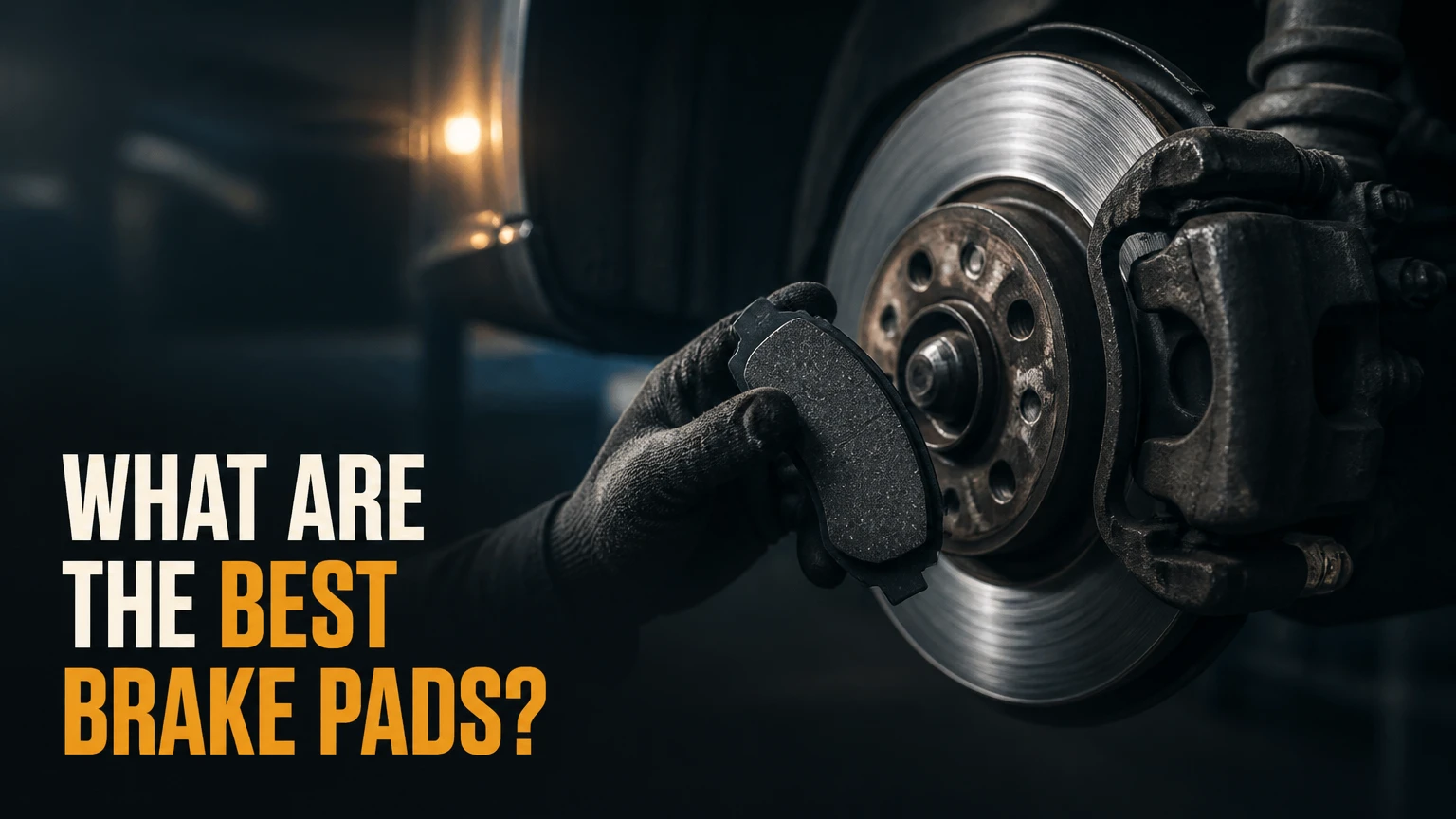
Ceramic brake pads are the best overall choice for daily commuting due to their minimal dust, quiet operation, and long service life. However, no single brake pad fits every vehicle, as high-performance sports cars and heavy-duty towing trucks require semi-metallic pads to handle extreme heat and prevent brake fade.
At a Glance
- Daily Drivers: Ceramic brake pads offer low noise, light grey dust, and high longevity between 60,000 and 100,000 kilometers.
- Towing & Track: Semi-metallic brake pads provide a higher friction coefficient ($\mu = 0.38 – 0.50+$) and heat resistance up to 700°C.
- Budget Choice: Organic (NAO) pads deliver smooth, soft stopping power at low temperatures but wear out faster (30,000 to 50,000 kilometers).
- Friction Standard: Always check the printed DOT edge code on the pad backing plate; an “FF” or “GG” rating ensures optimal stopping power.
- Rotor Prep: Installing new pads on grooved, unresurfaced rotors reduces the active contact patch below 50% and causes premature glazing.
What Are the Key Differences Between Ceramic, Semi-Metallic, and Organic Pads?
Brake pad materials are divided into three primary categories based on their chemical composition, friction coefficients, operating temperature limits, and wear characteristics. Selecting the proper material depends on vehicle weight, ambient climate, and performance expectations.
| Metric / Feature | Ceramic Brake Pads | Semi-Metallic Brake Pads | Non-Asbestos Organic (NAO) Pads |
| Primary Composition | Dense ceramic fibers, non-ferrous filler materials, bonding agents | 30% to 65% steel wool, copper, iron powder, graphite | Plant fibers, rubber, glass, carbon compounds, resin |
| Optimal Temp Range | 38°C to 538°C | 0°C to 700°C+ | 0°C to 350°C |
| Friction Coefficient ($\mu$) | 0.33 to 0.40 (Stable across daily temperatures) | 0.38 to 0.50+ (Rises as temperature increases) | 0.25 to 0.35 (Fades rapidly under high heat) |
| Brake Dust Output | Very Low (Fine, light grey, non-adhesive dust) | High (Heavy, dark, metallic, corrosive dust) | Medium (Dark carbon dust, non-corrosive) |
| Average Lifespan | 60,000 to 100,000 km | 45,000 to 80,000 km | 30,000 to 50,000 km |
| Rotor Wear Impact | Extremely Low | High (Abrasive metallic contact) | Very Low |
| Cold Bite Performance | Moderate to High | Low to Moderate (Requires initial heat) | High |
Ceramic pads utilize synthetic ceramic compounds reinforced with copper or aluminum fibers to dissipate heat quietly. Semi-metallic pads rely on coarse metal filaments that offer structural strength under high clamping forces, though they generate more dust and rotor abrasion. Organic pads use softer resins, offering a quiet pedal feel at low speeds at the expense of high thermal tolerance.
Which Brake Pad Models Are Best for Daily Driving, Performance, and Towing?
The best brake pad models match specific driving demands through targeted friction formulas engineering. Benchmark options dominate specific market categories:
Akebono Ultra-Premium Ceramic
Akebono Ultra-Premium Ceramic is the top recommendation for daily commuters, luxury sedans, and light crossovers. Manufactured with precise OEM-level standards, these pads eliminate high-frequency squeal without requiring aggressive bedding processes. They produce light grey dust that does not stick to alloy wheels and maintain a stable friction coefficient ($\mu \approx 0.36$) under standard city and highway conditions.
Hawk Performance HPS 5.0
Hawk Performance HPS 5.0 is the best option for spirited driving, sports cars, and tuned vehicles. Using a specialized ferro-metallic compound, the HPS 5.0 raises the friction coefficient to approximately 0.45 while maintaining manageable pedal response when cold. This pad balances high thermal resistance with minimal rotor wear, making it suitable for aggressive street use without the extreme noise of dedicated race pads.
EBC Brakes Yellowstuff
EBC Brakes Yellowstuff is the premier choice for heavy trucks, towing applications, and track-day vehicles. Yellowstuff features a high-friction semi-metallic compound that works from cold while maintaining stability up to 800°C. When hauling heavy loads down mountain grades, this pad resists heat saturation and provides immediate biting power under heavy pedal force.
How Long Do Different Types of Brake Pads Last on Average?
Brake pads typically last between 30,000 and 100,000 kilometers, depending directly on material compound, driver behavior, and vehicle payload.
Ceramic Pads       : [========================================] 60,000 - 100,000 km
Semi-Metallic Pads : [==============================        ] 45,000 - 80,000 km
Organic (NAO) Pads : [====================                  ] 30,000 - 50,000 km
Ceramic pads deliver the highest service life, commonly lasting 60,000 to 100,000 kilometers under daily driving. Their low-abrasion contact mechanism creates minimal friction material loss over time.
Semi-metallic pads last between 45,000 and 80,000 kilometers. While the metallic fibers themselves resist wear, the high physical friction required to stop heavy vehicles gradually wears down both the pad and the metal rotor face.
Organic pads have the shortest lifespan, lasting 30,000 to 50,000 kilometers. Soft organic bonding resins break down quickly under friction-generated thermal stress, requiring more frequent replacements. Aggressive city driving, stop-and-go commuting, and towing reduce these estimates by 20% to 40%.
Why Do Ceramic Brake Pads Fail During Heavy Towing or Payload Hauling?
Ceramic brake pads fail during heavy towing because ceramic material acts as a thermal insulator rather than a conductor. When towing a heavy load (such as a 4,000 kg trailer) down a steep descent, friction generates continuous temperatures exceeding 600°C.
Because ceramic compounds do not transfer heat away from the friction interface, heat builds rapidly inside the pad and rotor surface. This extreme thermal buildup causes thermal binder breakdown within the pad, drastically reducing its friction coefficient ($\mu$ drops below 0.20).
Simultaneously, trapped surface heat transfers directly into the caliper pistons and brake fluid, causing the fluid to boil. Boiled brake fluid creates air bubbles in the hydraulic lines, resulting in a squishy brake pedal and catastrophic pedal loss. Heavy-duty semi-metallic pads are mandatory for towing because steel fibers conduct heat out of the brake assembly and into the airflow, preventing thermal runaway.
How Do Freezing Temperatures Below -20°C Affect Brake Pad Performance?
Freezing temperatures below -20°C reduce initial braking efficiency by altering pad surface mechanics and delaying initial friction generation. Semi-metallic track pads require an operating temperature window of at least 100°C to achieve full friction performance. On sub-zero highways, an aggressive semi-metallic pad remains cold, leading to long stopping distances on initial pedal application.
Cold Temperature Performance (-20°C Initial Bite)
--------------------------------------------------
Ceramic / Organic : [ High Initial Friction ] -> Instant stop
Semi-Metallic     : [ Requires Warm-Up      ] -> Delayed bite until heated
Conversely, daily-drive ceramic and high-tier organic pads maintain a stable cold friction coefficient right from freezing temperatures. Their organic and resin-bound matrices do not rely on pre-heated metallic transfer films to grab the rotor surface. For drivers in arctic climates, premium ceramics or winter-rated semi-metallic street pads ensure predictable stopping power during cold starts.
Can You Use Aggressive Track Brake Pads for Daily Commuting?
No, dedicated track brake pads should not be used for daily commuting due to severe noise, accelerated rotor wear, and compromised cold safety. Race pads (such as Hawk DTC or EBC Bluestuff) are designed to function within a high thermal window between 250°C and 800°C.
During typical city driving, track pads never reach these minimum operating temperatures. Cold race pads act like harsh abrasives against smooth steel rotors, grinding down the rotor surface rapidly and causing heavy wear within 10,000 kilometers.
Furthermore, race pads rely on a uniform transfer layer of friction material cooked onto the rotor face during high-temperature track sessions. Low-speed, stop-and-go traffic scrapes this transfer layer off, leading to brake squeal and inconsistent pedal feel.
Should Ceramic Brake Pads Be Paired with Slotted or Drilled Rotors?
Ceramic brake pads should generally be paired with smooth, blank rotors rather than slotted or drilled performance rotors. The sharp edges of slotted or cross-drilled chamfers act like abrasive edges against softer ceramic materials. This scraping action accelerates pad wear by up to 40% and generates low-frequency humming noises inside the cabin.
Rotor & Pad Material Compatibility
---------------------------------------------------------------
Blank (Smooth) Rotors   + Ceramic Pads       = Optimal / Smooth
Slotted / Drilled Rotors + Semi-Metallic Pads = Maximum Heat Release
Slotted / Drilled Rotors + Ceramic Pads       = High Wear Rate (Avoid)
Slotted and drilled rotors exist primarily to vent high-temperature gases, water vapor, and metallic dust generated by semi-metallic compounds during racing or heavy towing. Because ceramic pads do not generate heavy structural gassing at standard operating temperatures, performance rotors offer no functional gain for ceramics while shortening pad service life.
How Do You Select Front Versus Rear Brake Pad Compounds for Balanced Stopping?
Selecting front and rear brake pads requires matching compounds to the vehicle’s dynamic weight distribution and hydraulic brake bias. During hard braking, dynamic weight transfers forward, placing 60% to 80% of the stopping burden on the front axle assembly.
Brake Bias & Compound Balancing
---------------------------------------------------------------
Front Axle (70% Stopping Load) -> Higher Friction Compound (e.g., GG rated)
Rear Axle  (30% Stopping Load) -> Lower/Equal Friction Compound (e.g., FF rated)
- Front Axle: Install a higher friction compound (such as a GG-rated semi-metallic or high-friction ceramic) to handle elevated thermal loads and heavy kinetic energy conversion.
- Rear Axle: Install a compound with an equal or slightly lower friction coefficient (such as an FF-rated ceramic).
Never install a high-friction pad on the rear axle while leaving a low-friction pad on the front axle. Over-frictioning the rear brakes causes the rear anti-lock braking system (ABS) to engage prematurely, destabilizing the chassis during hard braking.
What Does the DOT Friction Edge Code on Brake Pads Mean?
The DOT edge code printed on a brake pad backing plate defines its hot and cold friction performance under SAE J661 testing standards. The code consists of two letters followed by alphanumeric manufacturer identifiers.
Example Code: AKEBONO FF 1224
              │───────│
              Cold   Hot
              Friction Code
The first letter represents the cold friction coefficient measured at 121°C (250°F). The second letter represents the hot friction coefficient measured at 315°C (600°F).
| Friction Code Letter | Coefficient of Friction (μ) Range | Typical Application Category |
| C | $\le 0.15$ | Utility trailer parking components |
| D | $0.15 \text{ to } 0.25$ | Rare low-friction industrial equipment |
| E | $0.25 \text{ to } 0.35$ | Economy / Budget organic daily driver pads |
| F | $0.35 \text{ to } 0.45$ | Standard OEM factory daily driver specification |
| G | $0.45 \text{ to } 0.55$ | High-performance street, heavy truck, towing |
| H | $> 0.55$ | Specialized track and full racing compounds |
An edge code marked FF indicates a consistent friction coefficient between 0.35 and 0.45 from cold to hot temperatures. A code marked FG provides moderate cold bite (0.35 to 0.45) with improved stopping power (0.45 to 0.55) once heated.
Why Do Brand New Brake Pads Squeak and How Do You Stop It?
Brand new brake pads squeak primarily due to high-frequency harmonic vibrations occurring between the pad backing plate, caliper hardware, and rotor surface. Common physical root causes include:
- Lack of High-Temperature Lubricant: Installing pads dry without applying silicone or ceramic anti-seize brake lubricant to metal contact points (pad ears, caliper slide pins, and behind anti-rattle shims) allows metal-to-metal vibration.
- Sticking Caliper Slide Pins: Corrosion or dry grease on slide pins prevents the caliper from centering properly, causing uneven pad contact against the rotor face.
- Glazed Surface Layer: Thermal shock or improper initial braking bakes resin binders onto the pad face, creating a glassy finish that squeals upon engagement.
Squeak Prevention Checklist
---------------------------------------------------------------
[x] Clean rust off caliper bracket hardware channels.
[x] Apply ceramic brake lube to pad ears and shim backs.
[x] Replace worn anti-rattle hardware clips.
[x] Bed in new pads using proper thermal cycling runs.
To stop brake squeak, disassemble the caliper hardware, clean all rust off sliding surfaces with a wire brush, apply high-temperature brake lubricant to the contact ears, and install new anti-rattle shims.
Do You Always Need to Turn or Replace Rotors When Changing Brake Pads?
Yes, rotors must be either resurfaced (turned on a brake lathe) or replaced during every brake pad change. Installing flat, rigid new pads onto an old, grooved rotor reduces actual friction surface contact to under 50%.
Pad-to-Rotor Contact Patch Profile
---------------------------------------------------------------
New Pad + Old Grooved Rotor  = [ | | | ] < 50% Contact Patch
New Pad + Resurfaced Rotor   = [=======] 100% Full Contact Patch
This reduced contact area forces the new pad to absorb full hydraulic clamping pressure over a limited area. This localized friction creates severe hot spots, causes rapid material glazing, and increases initial stopping distances.
If the rotor thickness measures above its cast minimum specification (stamped on the rotor edge) and exhibits no deep thermal cracking, resurface it on a lathe to establish a smooth finish. If the rotor is below minimum thickness or displays lateral runout exceeding 0.05 mm, install a new rotor.
What Is Brake Pad Glazing and How Can It Be Fixed?
Brake pad glazing is a structural condition where excessive thermal buildup melts the internal resin binders of the friction compound. These melted binders crystallize onto the surface of the pad, forming a smooth, mirror-like finish with a low friction coefficient. Symptoms include a hard brake pedal feel, significantly increased stopping distances, and high-pitched squealing.
Glazed Pad Surface          Restored Pad Surface
┌──────────────────┐        ┌──────────────────┐
│  Shiny / Glassy  │  ───>  │ Cross-Hatched    │
│  Low Friction    │  120G  │ Exposed Compound │
└──────────────────┘        └──────────────────┘
Lightly glazed pads can be repaired by removing them from the caliper and sanding the friction face. Place a sheet of 120-grit sandpaper flat on a level surface, then rub the pad face down in a figure-eight motion until the shiny layer is removed and fresh friction compound is visible. If thermal stress has cracked the friction material or penetrated deep into the compound, replace the pads immediately.
How Do You Properly Bed In New Brake Pads to Prevent Vibration and Glazing?
Bedding in brake pads establishes a uniform transfer layer of pad material onto the rotor face and gradually heat-cycles the friction compound. Follow this precise procedure on a clear road:
1.Initial Moderate Decelerations:Perform 5 to 6 slow-down runs.
Accelerate the vehicle to 60 km/h (35 mph). Apply moderate pedal pressure to decelerate down to 15 km/h (10 mph) without coming to a complete stop. Repeat this cycle 5 to 6 times with 30-second cooling intervals between runs.
2.High-Speed Thermal Cycles:Perform 3 to 4 firm decelerations.
Accelerate the vehicle to 90 km/h (55 mph). Apply firm pedal pressure (just short of ABS engagement) to decelerate quickly down to 20 km/h (15 mph). Repeat this 3 to 4 times to build heat within the friction material.
3.Thermal Cooldown Phase:Drive continuously without stopping.
Drive the vehicle for 10 to 15 minutes at highway speeds with minimal brake usage. This allows airflow to cool the pads and rotor structure evenly without trapping heat in one location.
Never hold the brake pedal down to a complete stop while the brakes are hot during bedding. Holding the pedal stationary clamped against a hot rotor transfers an uneven block of pad material onto one spot of the rotor, creating a high point that develops into pedal pulsation.
What Causes Brake Pedal Pulsation After Installing New Pads?
Brake pedal pulsation after installing new pads is caused by Disc Thickness Variation (DTV) or uneven friction material deposition across the rotor surface, rarely by a physically warped rotor. Physical rotor warpage requires extreme heat levels typically reserved for racing environments.
Uneven Material Transfer (Causes Pulsation)
---------------------------------------------------------------
[Rotor Surface] ====(Pad Material Deposit)==== [High Spot]
Result: Caliper piston pushes back into hydraulic line every turn.
Instead, pulsation develops when pad material deposits unevenly onto the rotor face during improper bedding or hot-holding events. As the rotor spins through the caliper, these high-pressure material deposits create varying friction grip levels against the pad face, pushing back into the hydraulic system and creating a pulse felt through the brake pedal.
Incorrect wheel lug nut torque torque specs can also distort the rotor hat, causing lateral runout exceeding 0.05 mm. Always tighten lug nuts in a star pattern using a calibrated torque wrench to manufacturer specifications.
The Bottom Line
Choosing the best brake pads requires matching the pad material to your vehicle weight and driving environment. Ceramic pads provide the cleanest, quietest experience for daily commuting, while semi-metallic compounds are required for towing heavy payloads and performance driving. Always resurface or replace your rotors during installation, and perform a complete thermal bedding procedure to ensure maximum stopping power and long service life.


