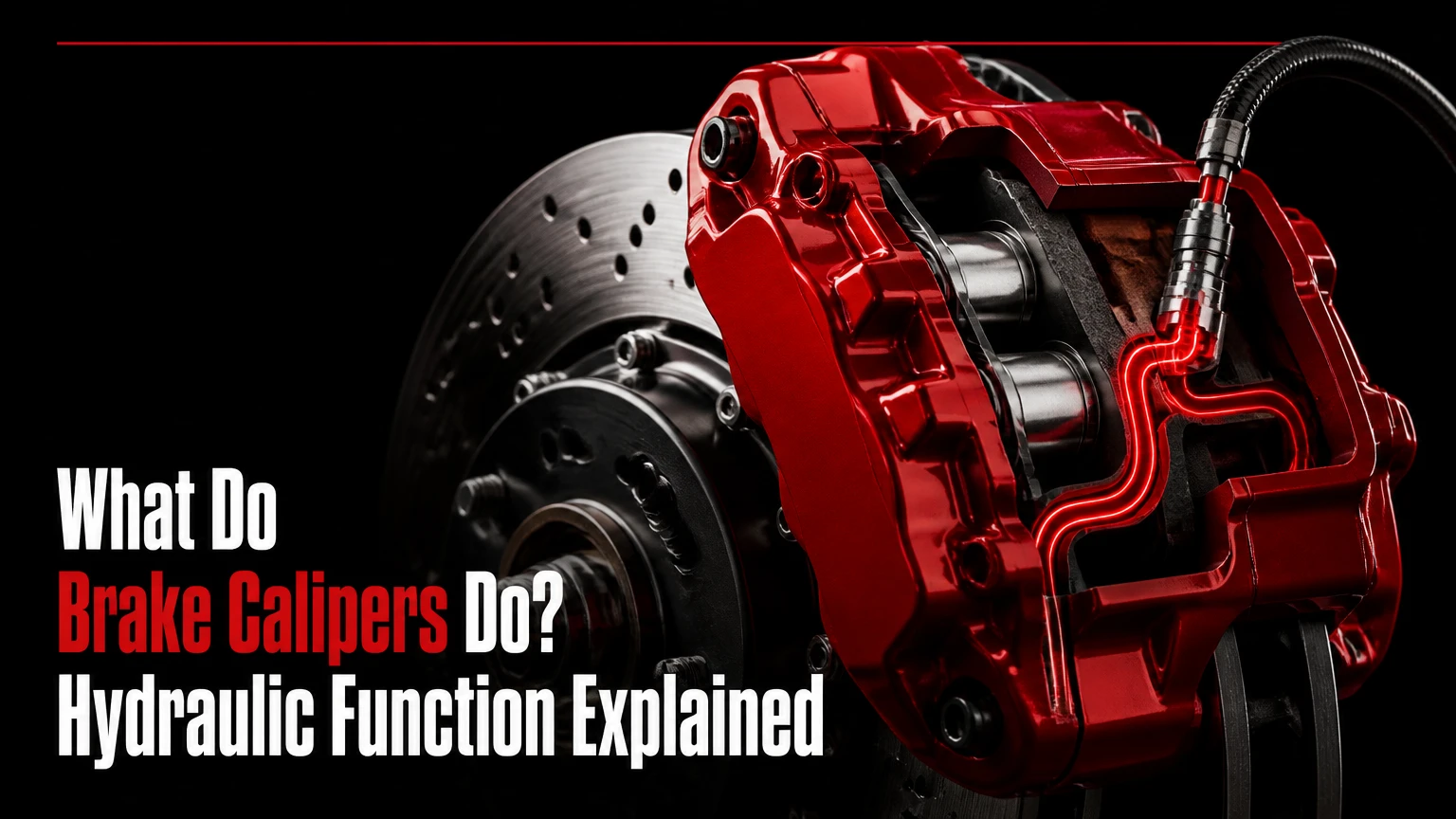
A brake caliper acts as the central clamping mechanism in a disc brake system to physically slow down and stop a vehicle. When the driver depresses the brake pedal, hydraulic fluid pressurizes internal caliper pistons, forcing inner and outer brake pads against the faces of a spinning brake rotor to convert kinetic energy into friction and thermal energy.
At a Glance
- Primary Function: Converts hydraulic fluid pressure into mechanical clamping force against the brake rotor.
- Operating Pressure: Operates between 300 and 800 PSI during normal stopping, spiking up to 2,000 PSI during emergency stops.
- Design Variants: Manufactured as either floating (sliding on guide pins) or fixed (opposing pistons mounted rigidly).
- Thermal Range: Standard cast-iron calipers withstand 350°C to 400°C (662°F to 752°F), while racing variants tolerate up to 800°C (1,472°F).
- Modern Features: Frequently integrate Electronic Parking Brake (EPB) motors or zero-drag retraction seals.
How Does a Brake Caliper Work Step-by-Step?
A brake caliper operates by transferring force through a closed hydraulic system, translating foot pressure on the brake pedal into direct friction against the vehicle wheels.
- Pedal Input: The driver depresses the brake pedal, pushing a rod into the brake master cylinder.
- Hydraulic Displacement: The master cylinder pushes brake fluid through hard metal lines and flexible rubber hoses toward each wheel.
- Piston Actuation: Fluid enters the fluid chamber behind the internal caliper piston, building hydraulic pressure that forces the piston outward.
- Initial Contact: The moving piston pushes the inner brake pad directly against the inner face of the spinning brake rotor.
- Clamping Action: In floating designs, equal and opposite reactive force pulls the outer caliper body inward, forcing the outer pad against the opposite side of the rotor. Fixed designs simultaneously extend opposing pistons from both sides.
- Friction and Energy Conversion: The brake pads grip the spinning rotor, converting the kinetic energy of the vehicle into thermal energy, which slows wheel rotation.
- System Release: When the driver releases the brake pedal, hydraulic pressure drops, and elastic square-cut rubber seals pull the pistons back fractions of a millimeter to disengage pad contact.
How Much Clamping Force and Hydraulic Pressure Do Calipers Generate?
Standard automotive brake calipers generate between 3,000 and 6,000 Newtons (670 to 1,350 lbs) of clamping force per wheel under routine stopping conditions. On high-performance sports cars or heavy duty trucks, multi-piston calipers generate over 10,000 Newtons (2,200+ lbs) of clamping force per wheel to handle extreme deceleration demands.
Hydraulic pressure inside the caliper fluid chamber ranges from 300 to 800 PSI during normal everyday city driving. Panic stops, sudden evasive maneuvers, or unassisted heavy manual braking can cause hydraulic pressure spikes between 1,200 and 2,000 PSI. The structural integrity of the caliper casting and its high-pressure fluid seals must withstand these momentary pressure surges without expanding or leaking.
What Operating Temperature Range Can Brake Calipers Withstand?
Standard passenger-vehicle cast-iron brake calipers safely tolerate continuous operating temperatures up to 350°C to 400°C (662°F to 752°F). Beyond this thermal threshold, internal rubber dust boots and piston seals begin to harden, crack, or melt, leading to hydraulic fluid leaks and mechanical seizure.
High-performance aluminum-alloy or carbon-ceramic brake systems designed for racing handle sustained operating environments exceeding 600°C to 800°C (1,112°F to 1,472°F). Racing calipers utilize ventilated titanium pistons and specialized high-boiling-point silicone or fluorocarbon seals to prevent structural deformation and stop brake fluid from boiling inside the fluid chamber.
What Is the Difference Between Floating and Fixed Calipers?
The primary operational difference between floating and fixed brake calipers lies in how they move relative to the brake rotor and how their internal pistons are positioned.
FLOATING CALIPER                          FIXED CALIPER
+-----------------------+                +-----------------------+
|  Single-side Pistons  |                |   Opposing Pistons    |
|   (Inner side only)   |                |  (Both sides of rotor)|
+-----------+-----------+                +-----------+-----------+
            |                                        |
            v                                        v
+-----------------------+                +-----------------------+
| Body Slides on Pins   |                | Caliper Body Rigid    |
| Pulls Outer Pad In    |                | No Sliding Movement   |
+-----------------------+                +-----------------------+
Floating calipers (also known as sliding calipers) feature one or two pistons located exclusively on the inboard side of the rotor. The caliper housing is mounted on slider pins or bushings, allowing the entire body to shift laterally. When the inboard piston extends, the housing slides in the opposite direction to pull the outboard pad against the rotor.
Fixed calipers remain stationary relative to the wheel hub, bolted directly to the suspension knuckle. They utilize opposing pistons split evenly on both sides of the rotor (ranging from 2, 4, 6, or 8 total pistons). When hydraulic pressure builds, pistons extend simultaneously from both sides, compressing the rotor evenly without relying on sliding pins.
| Feature / Attribute | Floating Caliper | Fixed Caliper |
| Piston Placement | Single side (inboard only) | Opposing sides (inboard and outboard) |
| Typical Piston Count | 1 to 2 pistons | 2, 4, 6, or 8 pistons |
| Mounting Style | Moves laterally on guide pins | Rigidly bolted to suspension knuckle |
| Manufacturing Cost | Lower (standard on commuter cars) | Higher (standard on sports and luxury cars) |
| Pedal Stiffness | Slight flexing occurs under heavy load | Firm, immediate, and consistent response |
| Maintenance Need | High (pins require regular lubrication) | Low (no slide pins to seize) |
How Do Electronic Parking Brakes (EPB) Change Caliper Function?
Electronic Parking Brake (EPB) systems replace traditional handbrake cables by attaching a small electric motor assembly directly to the rear brake caliper housing. When the driver engages the parking brake button, an electronic control unit signals this motor to turn a gear drive, driving a threaded ball-screw mechanism inside the piston cavity that mechanically forces the brake piston forward against the rotor.
Because the ball-screw mechanism mechanically locks the piston in place, technicians cannot compress the piston back into the housing using standard mechanical clamp tools during a brake pad replacement. The system requires an OBD-II diagnostic scanner or manual service mode command to electronically rewind the electric motor assembly back into its home position first. Forcing the piston manually without entering service mode permanently strips the internal drive gears.
Why Do EV and Hybrid Brake Calipers Fail Differently?
Electric vehicles (EVs) and hybrid cars cause brake calipers to fail prematurely from disuse rather than thermal wear, primarily because regenerative braking handles up to 90% of daily deceleration needs. When the driver presses the brake pedal in an EV, the electric motor acts as a generator to slow the vehicle and recharge the battery, keeping hydraulic brake calipers disengaged during routine stops.
Because EV calipers experience far fewer heating and cooling cycles, moisture, road salt, and dirt build up on the sliding guide pins and piston surfaces without burning off or being scrubbed clean by friction. This localized corrosion causes floating caliper pins to seize and rubber boots to crack, leading to severe brake drag, uneven pad wear, and stuck pistons long before the actual friction pad material wears down.
What Are Zero-Drag Calipers and How Do They Affect Pedal Feel?
Zero-drag calipers are specialized automotive calipers designed with high-resilience square-cut piston seals that retract the brake piston slightly farther back from the rotor face when pedal pressure drops. By creating a microscopic air gap between the pad and rotor, these calipers eliminate parasitic drag, which improves fuel economy by roughly 0.2 to 0.5 miles per gallon.
The primary trade-off of zero-drag calipers is a slight increase in initial brake pedal travel. Because the piston rests farther away from the rotor, the master cylinder must displace a larger volume of brake fluid to close the extra gap before friction material contacts the disc, making the initial pedal feel slightly softer compared to standard fixed or floating caliper configurations.
Why Does a Vehicle Pull to One Side When Braking?
When a vehicle pulls hard to one side during braking, the root cause is almost always an asymmetry in stopping power between the left and right front calipers, with the vehicle pulling toward the side that is generating more friction.
If a car pulls sharply to the right under braking, the right front caliper is working correctly while the left front caliper has failed due to a seized piston, frozen slide pins, or air in the hydraulic lines. The working right-side caliper grips the rotor and creates a pivoting force that turns the steering geometry toward the right.
       [Left Front Caliper]                   [Right Front Caliper]
       (SEIZED / NO FRICTION)                  (WORKING / HIGH FRICTION)
                |                                          |
                v                                          v
      No Stopping Power                      Applies Full Stopping Power
                \                                          /
                 \                                        /
                  =======> VEHICLE SEVERE PULL ====> [RIGHT]
Conversely, if a caliper is stuck in a permanently engaged state (dragging continuously), that wheel will build excessive heat and pull toward that side even when the driver is not touching the brake pedal.
Can a Collapsed Brake Hose Mimic a Stuck Caliper?
Yes, an internally collapsed rubber brake hose produces symptoms identical to a stuck caliper piston by acting as a hydraulic one-way check valve. Flexible brake hoses consist of multiple inner synthetic rubber layers. Over time, internal heat and chemical degradation can cause an inner layer to tear and form an internal flap.
When the driver applies the brakes, high hydraulic pressure from the master cylinder easily pushes past the torn flap to extend the caliper piston. However, when the driver releases the pedal, the low return pressure cannot open the torn flap from the inside. Trapped pressure holds the caliper piston against the rotor indefinitely, causing overheating and rapid pad destruction even though the mechanical caliper itself is fully functional.
How Do You Retract Rear Caliper Pistons Safely?
Safely retracting a rear caliper piston depends entirely on whether the vehicle uses a standard hydraulic caliper, a mechanical integrated parking brake, or an Electronic Parking Brake (EPB).
                      REAR CALIPER TYPE?
                              |
     +------------------------+------------------------+
     |                        |                        |
[Standard Hydraulic]   [Integrated Mechanical]       [EPB System]
     |                        |                        |
     v                        v                        v
Compress straight       Rotate AND compress       Enter Service Mode
back with C-Clamp       using piston cube tool    via OBD-II first
- Standard Front/Rear Calipers: Compress the piston straight back into the housing using a standard C-clamp or pad-spreading tool.
- Integrated Mechanical Rear Calipers: Requires a specialized caliper cube tool or pin adapter to rotate the piston clockwise while applying inward pressure. Attempting to compress these pistons straight back using a C-clamp destroys the internal ratcheting self-adjustment assembly.
- Electronic Parking Brake (EPB) Calipers: Put the vehicle into electronic brake service mode using a diagnostic scanner or dashboard menu command to retract the internal motor spindle before pushing or winding the piston back.
Should Brake Calipers Be Replaced in Pairs?
No, replacing brake calipers in pairs across an axle is not strictly mandatory if one caliper fails prematurely due to a isolated issue like a torn rubber boot or localized impact damage.
However, replacing calipers in pairs is strongly recommended if the failure is caused by age, high mileage, or contaminated brake fluid. Both calipers on the same axle experience identical thermal cycles, hydraulic pressures, and environmental exposure. When one unit fails from internal corrosion or seal degradation, the opposing caliper is usually near the end of its operational lifespan as well. Replacing only one side can create uneven braking response and premature wear on the newer component.
What Happens When a Caliper Guide Pin Seizes?
When a guide pin seizes on a floating brake caliper, the housing loses its ability to slide laterally across the bracket, preventing pressure from distributing evenly across both sides of the brake rotor.
- Inboard Pad Overuse: The inboard pad (directly in front of the hydraulic piston) receives all the applied force, wearing down at double its normal rate.
- Outboard Pad Disengagement: The outboard pad fails to grip the rotor effectively, significantly increasing total stopping distances.
- Tapered Pad Wear: The pads wear down at an angle rather than lying flat against the disc surface.
- Rotor Warping: Intense thermal stress becomes concentrated on a single side of the rotor face, causing localized heat spots, vibration, and rotor warping.
Can You Upgrade from Floating to Multi-Piston Fixed Calipers?
Yes, upgrading from factory floating calipers to multi-piston fixed calipers is a common modification, but it requires addressing three mechanical considerations to work correctly:
- Mounting Adapter Brackets: Fixed calipers bolt differently than floating units and require custom precision-machined steel or aluminum adapter brackets to align properly over the rotor centerline.
- Wheel Barrel Clearance: Multi-piston fixed calipers are significantly wider than stock floating calipers, requiring adequate spoke clearance and wheel offset to prevent structural contact.
- Master Cylinder Hydraulic Volume: Multi-piston calipers contain multiple piston cavities, demanding a larger total volume of brake fluid per stroke. Retaining a small factory master cylinder can result in excessive pedal travel, requiring an upgraded master cylinder with a larger internal bore size.
How Long Do Brake Calipers Last on Average?
Brake calipers are engineered to last between 75,000 and 100,000 miles (approximately 7 to 10 years of average driving) under typical operating conditions. Unlike brake pads and rotors, which are wear items designed for regular replacement, calipers are long-term structural components.
Their actual lifespan depends heavily on geography and maintenance habits. Vehicles driven in rust-belt regions exposed to winter road salt or marine salt air often experience pin and piston seizure around 50,000 to 60,000 miles. Conversely, flushing brake fluid every two years prevents internal moisture buildup, allowing calipers to operate reliably for over 150,000 miles without seal failure.
What Are the Early Symptoms of a Failing Brake Caliper?
Catching a failing brake caliper early prevents costly damage to surrounding suspension components and maintains overall vehicle safety.
- Vehicle Pulling to One Side: The car drifts left or right during braking, or pulls continuously while cruising due to pad drag.
- Abnormal Brake Pad Wear: The brake pads on one wheel show significantly less friction material remaining than the pads on the opposite wheel, or show diagonal pad tapering.
- Excessive Heat and Burning Smell: A pungent, chemical burning smell comes from a wheel hub after driving, caused by continuous pad friction against the rotor.
- High-Pitched Squeal or Dragging Noise: A metallic scraping or rubbing noise occurs while driving that changes tone or disappears when applying the brake pedal.
- Spongy or Low Brake Pedal: The pedal feels soft, sinks toward the floorboard, or requires pumping to build pressure, indicating an internal fluid leak past the piston seals.
- Visible Fluid Leaks: Wet, oily brake fluid residue coats the inner rim barrel, lower suspension arm, or inner tire sidewall.
How Much Does It Cost to Replace a Brake Caliper?
Replacing a single brake caliper generally costs between $250 and $550 for standard passenger vehicles at an independent repair shop or dealership service center.
- Parts Cost: An OEM or remanufactured aftermarket caliper assembly costs between $75 and $250. High-performance multi-piston fixed calipers range from $350 to over $1,000 per unit.
- Labor Cost: Professional labor charges typically run between $150 and $300 per caliper, which includes mounting the assembly, bleeding the hydraulic system to purge air, and testing the system.
- Additional Expenses: Replacing a caliper often requires installing new brake pads, replacing damaged rotors, or performing a full hydraulic system fluid flush, which can add $150 to $400 to the total repair invoice.
How Do You Unstick a Brake Caliper Temporarily?
Unsticking a stuck brake caliper on the side of the road is a temporary emergency measure to reach a repair facility safely, not a permanent repair.
To address a binding floating caliper, remove the wheel assembly and gently tap the caliper body using a rubber mallet to relieve pressure on the frozen slide pins or piston. Next, unbolt the caliper mounting bolts, pull the guide pins out, clean away surface rust with wire wool, apply high-temperature silicone brake grease, and reinsert the pins into their rubber boots.
If an internal piston seal has swelled or seized from heat and rust, physical greasing will not restore safe function; the entire caliper assembly must be replaced immediately.
The Bottom Line
Brake calipers are the central hydraulic-to-mechanical actuators in modern disc brake systems, responsible for converting hydraulic line pressure into clamping force across the brake rotor faces. Whether utilizing a floating single-piston setup or a multi-piston fixed configuration, their operation relies on clean hydraulic fluid, smooth sliding guide pins, and intact rubber seals. Recognizing early failure signs like vehicle pulling, uneven pad wear, or excess heat prevents catastrophic system failures and keeps your vehicle stopping safely.


