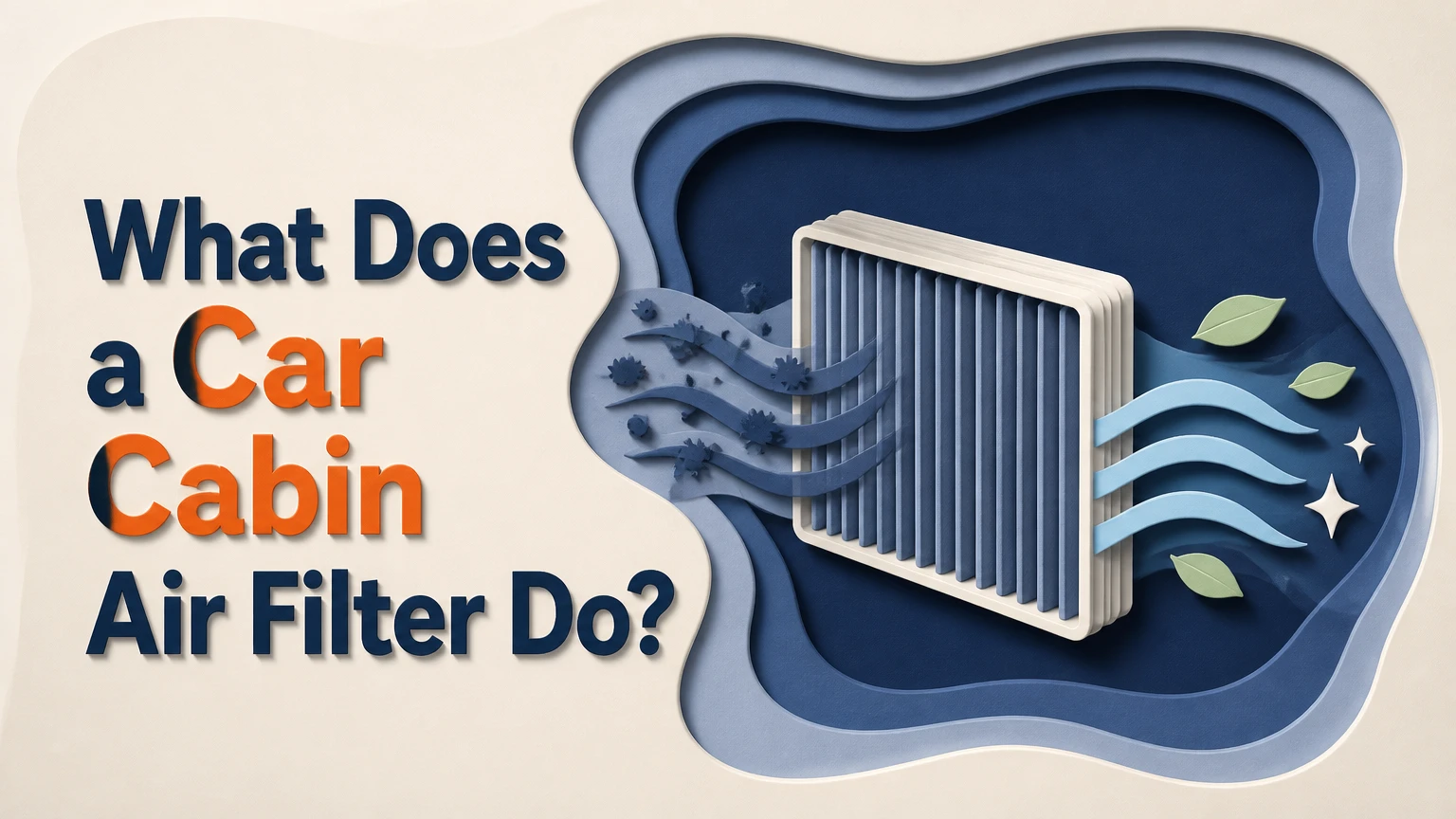
A car cabin air filter purifies the air entering a vehicle’s passenger compartment through the heating, ventilation, and air conditioning (HVAC) system. It traps airborne contaminants such as dust, pollen, smog, mold spores, and debris while protecting the HVAC blower motor and evaporator core from premature mechanical failure.
At a Glance
- Health Shield: Traps 90% to 99.97% of airborne allergens, soot, and dust before passengers breathe them in.
- Component Saver: Prevents organic debris from clogging the AC evaporator core, avoiding repairs that exceed $1,000.
- Airflow Volume: Filters process up to 540,000 liters of outside air per hour during standard driving conditions.
- Replacement Interval: Service every 12,000 to 15,000 miles or 12 months, whichever comes first.
- Gas Limitation: Standard paper filters trap solid particles but cannot stop hazardous gases like ozone or nitrogen dioxide without activated carbon.
Where Is a Cabin Air Filter Located in a Vehicle?
A cabin air filter is most commonly located directly behind the glove box on the passenger side of the dashboard. In a secondary set of vehicle designs, the filter resides inside the engine bay beneath the windshield wiper cowl or under the lower passenger-side dashboard footwell.
To access a filter behind the glove box, open the compartment, disconnect the lateral stop dampers or side squeeze tabs, and lower the box downward. Behind it sits a rectangular plastic housing cover with snap clips. Unclipping this door reveals the filter element inserted horizontally across the HVAC ducting.
On European vehicles such as certain BMW or Audi models, the filter housing may require removing three to four Torx screws beneath the cowl panel under the hood. Always consult your vehicle owner’s manual for exact clip locations to prevent snapping delicate plastic retention tabs during inspection.
How Does a Cabin Air Filter Protect Your HVAC System?
A cabin air filter protects a vehicle’s HVAC system by trapping incoming debris before air reaches the blower motor fan and air conditioning evaporator core. Blocking leaf litter, dirt, and pine needles keeps organic matter from decomposing inside the dark, humid evaporator housing.
When dirt passes through an unmanaged air intake, it coats the fins of the AC evaporator core. The evaporator operates by condensing moisture out of ambient air. When fine dust combines with condensation on the metal cooling fins, it forms a mud-like sludge that restricts heat transfer and breeds fungal spores.
Over time, this accumulation causes the blower motor to pull excess amperage to force air through the restriction. The increased electrical load leads to blown resistor blocks, melted wiring harnesses, or total blower motor burnout. Replacing a burnt blower motor costs between $250 and $600, while replacing a corroded, leaking evaporator core requires removing the entire dashboard, costing between $1,000 and $1,800 in labor alone.
What Particle Sizes Does a Cabin Air Filter Block?
A standard car cabin air filter blocks airborne particles between 5 and 100 microns with a 90% to 99% filtration efficiency rating. Upgraded High-Efficiency Particulate Air (HEPA) cabin filters capture 99.97% of ultra-fine particles down to 0.3 microns in diameter.
| Filter Category | Efficiency Rating | Micro-Particle Target (Microns) | Primary Contaminants Captured |
| Standard Cellulose/Synthetic | 90% to 99% | 5 to 100 µm | Coarse road dust, plant pollen, mold spores, leaf fragments |
| Activated Carbon Blend | 95% to 99% | 1 to 100 µm + Gas Adsorption | Dust, allergens, exhaust fumes, ozone, nitrogen dioxide |
| HEPA (High-Efficiency) | 99.97% | Down to 0.3 µm | Diesel soot, fine smoke particles, bacteria, microscopic viruses |
The hardest particle size to capture across non-HEPA filtration media sits around 0.3 microns (300 nanometers). Particles larger than 5 microns get trapped easily through direct interception by pleat fibers. Particles smaller than 0.1 micron move erratically via Brownian motion and adhere to fibers through electrostatic attraction. The 0.3-micron gap represents the Most Penetrating Particle Size (MPPS), where standard media efficiency dips significantly unless built with dense HEPA melt-blown polymer fibers.
How Does a Cabin Air Filter Differ From an Engine Air Filter?
A cabin air filter purifies the air that human occupants breathe inside the passenger compartment, whereas an engine air filter cleans the ambient intake air supplied to the engine combustion chamber. They are entirely separate components located in different parts of the vehicle.
                  +-------------------------------------------------+
                  |              FRESH OUTSIDE AIR                  |
                  +-----------------------+-------------------------+
                                          |
                   +----------------------+----------------------+
                   |                                             |
                   v                                             v
     +---------------------------+                 +---------------------------+
     |     ENGINE AIR FILTER     |                 |     CABIN AIR FILTER      |
     +-------------+-------------+                 +-------------+-------------+
                   |                                             |
                   v                                             v
     +---------------------------+                 +---------------------------+
     |   Engine Intakes & Cylinders  |                 |     HVAC Blower Motor     |
     +-------------+-------------+                 +-------------+-------------+
                   |                                             |
                   v                                             v
     +---------------------------+                 +---------------------------+
     | Combusts Fuel for Power   |                 | Protects Passenger Lungs  |
     +---------------------------+                 +---------------------------+
An engine air filter sits inside a plastic airbox under the hood connected directly to the intake manifold. Its primary task is preventing abrasive silica dust and dirt from entering cylinder walls, piston rings, and mass airflow (MAF) sensors. Damage to an engine air filter degrades fuel economy, causes engine misfires, and accelerates internal engine wear.
In contrast, a cabin air filter sits within the interior HVAC ducting (usually behind the glove compartment). It features thinner media designed to balance high particle capture with maximum volumetric airflow (up to 540,000 liters per hour) so the cabin fan can maintain driver climate comfort. Installing one in place of the other is impossible due to contrasting dimensions, frame designs, and housing seals.
Standard vs. HEPA vs. Activated Carbon: Which Filter Type Do You Need?
Select a standard filter for basic dust control, an activated carbon filter if you commute through dense traffic, or a HEPA filter if you suffer from severe asthma or respiratory allergies. The optimal choice depends on your daily driving environment and personal health needs.
- Standard Synthetic Media: Made from pleated non-woven polypropylene or cellulose. Best for drivers in low-pollution rural areas who only need protection against coarse dust, bugs, and tree pollen.
- Activated Carbon Filters: Layered with treated charcoal bits that adsorb volatile organic compounds (VOCs), unpleasant odors, sulfur dioxide, and toxic traffic gases like nitrogen dioxide. Recommended for urban commuters and highway drivers exposed to heavy diesel exhaust.
- HEPA Filters: Engineered with dense glass microfiber or electrostatically charged melt-blown layers. Ideal for allergy sufferers, asthmatics, or drivers living in regions prone to seasonal wildfire smoke, as they capture fine particulate matter ($PM_{2.5}$).
Be aware that true HEPA cabin filters create slightly higher static air resistance. If your vehicle HVAC system has a weak blower motor, a HEPA filter may marginally reduce maximum fan speed output on hot summer days.
How Often Should You Change a Car Cabin Air Filter?
You should change a car cabin air filter every 12,000 to 15,000 miles or once every 12 months, whichever threshold your vehicle reaches first. However, environmental conditions can force earlier replacement intervals.
If you regularly drive on unpaved dirt roads, commute through heavily congested urban traffic, or park under trees that drop pollen and pine needles, inspect the filter element every 6,000 miles. Dirt accumulation scales non-linearly; fine dust fills microscopic pore gaps long before the filter pleats look visibly black.
Time damages filters independently of mileage. Humidity trapped inside the filter media triggers fungal spore germination within six to nine months of continuous outdoor parking. Even if a vehicle logs only 3,000 miles in a year, an aged filter can harbor active mold colonies that taint cabin air quality.
What Happens When a Cabin Air Filter Becomes Clogged?
When a cabin air filter becomes clogged, air volume through the dashboard vents drops sharply, the HVAC fan motor emits high-pitched whining noises, windshield defrosters clear glass slowly, and bad odors linger in the cabin.
       CLOGGED CABIN AIR FILTER
                  │
                  ├── Restricted Airflow ──> Weak vent output & slow defrosting
                  │
                  ├── Overworked Fan Motor ──> Excessive amp draw & blower resistor failure
                  │
                  └── Trapped Moisture ──> Fungal growth & "dirty sock" odor
As dust blocks media pores, static pressure inside the HVAC housing surges. The blower motor struggles against this head pressure, drawing higher amperage from the electrical system. Prolonged strain overheats the blower motor resistor pack, causing fan speeds 1, 2, and 3 to stop working completely while leaving only the maximum setting operational.
Defrosting performance degrades significantly with a restricted filter. In winter, the system cannot push enough dry, heated air across the interior surface of the windshield, leaving water vapor to condense on the glass and impairing driver visibility.
Why Does Car AC Smell Like Vinegar or Mildew?
A car AC smells like vinegar or mildew because organic debris trapped in the cabin air filter pleats has combined with moisture to grow mold, mildew, and bacterial colonies.
During normal cooling operation, the AC evaporator core chills the incoming air, causing ambient humidity to condense on its metal surfaces. When you turn off the vehicle, this wet environment remains dark and warm. If the filter element contains pollen, organic dust, or dead insects, fungal spores thrive on the wet media, producing microbial volatile organic compounds (mVOCs) that smell like sour vinegar or damp socks.
If installing a fresh cabin air filter does not immediately eliminate the odor, mold spores have likely spread beyond the filter and colonized the face of the evaporator core itself. In this situation, apply an aerosol HVAC disinfectant foam directly into the condensate drain tube or central air intake vents to neutralize the evaporator core surface.
Is Recirculating AC Dangerous With an Old Cabin Air Filter?
Using recirculated AC continuously with an old cabin air filter is safe from a physical explosion standpoint, but it causes rapid carbon dioxide ($CO_2$) accumulation inside the cabin, leading to driver fatigue and impaired reaction times.
When you press the recirculation button, the HVAC door closes off fresh outside air and continuously passes the same interior air through the cabin filter. While this cools the car faster on hot days, standard cabin filters do not remove gaseous $CO_2$ exhaled by passengers.
In a sealed vehicle with four adult occupants running on recirculation mode, interior $CO_2$ concentrations can surge from a normal baseline of 400 ppm to over 2,500 ppm in under 20 minutes. Studies show that $CO_2$ levels exceeding 2,000 ppm impair spatial awareness, cause drowsiness, and slow decision-making response times. To stay safe, switch your AC setting to fresh outside air every 15 to 20 minutes on extended highway drives.
Which Direction Should the Arrow Point on a Cabin Air Filter?
The arrow printed on the side of a cabin air filter indicates the direction of airflow, not the physical top or bottom of the frame. The arrow must point in the exact direction that air flows through the housing, which is almost always downward toward the blower fan wheel.
                       AIR INTAKE (From windshield cowl)
                                      │
                                      │   Air flows DOWN
                                      v
                        ┌───────────────────────────┐
                        │ [ === CABIN FILTER === ]  │
                        │     AIR FLOW ARROW: ⬇    │
                        └───────────────────────────┘
                                      │
                                      v
                             BLOWER MOTOR FAN
Installing a filter upside down forces air against the flexible side of the pleats rather than the reinforced structural ribs. Under the high suction created by the blower motor, an inverted filter frame can buckle, create gap leaks along the housing edges, and allow unfiltered debris to pull directly into the fan wheel.
Before removing your old filter, turn the ignition key on and set the fan speed to low. Hold a small slip of paper inside the open filter slot to observe whether it gets sucked downward or pushed upward. Align the arrow on your new filter to match that movement.
Can You Clean or Vacuum a Cabin Air Filter Instead of Replacing It?
No, you cannot effectively clean or vacuum a disposable cabin air filter to restore its original performance. Vacuuming removes only large surface leaf fragments while leaving fine microscopic particles permanently embedded within the filter fibers.
 DISPOSABLE SYNTHETIC FILTER              REUSABLE / WASHABLE FILTER
┌────────────────────────────┐           ┌────────────────────────────┐
│ • Polypropylene/Cellulose  │           │ • K&N / Electrostatic Mesh │
│ • Damaged by suction/water │           │ • Engineered to be washed  │
│ • Static charge lost       │           │ • Requires oil/dry cycle   │
│ • REPLACE EVERY YEAR       │           │ • CLEAN EVERY 20,000 MILES │
└────────────────────────────┘           └────────────────────────────┘
Standard paper and synthetic filters rely on electrostatically charged fibers to trap fine particles down to 1 micron. Brushing, blowing compressed air, or vacuuming the pleats disrupts this electrostatic charge and tears fragile micro-fibers, dropping filtration efficiency toward zero.
Washing a standard paper filter with water causes cellulose fibers to swell, collapse, and dry into an airtight mass that suffocates your HVAC blower motor. Unless you purchased a specially designed, washable aftermarket filter explicitly labeled as reusable, always discard a dirty filter and install a fresh replacement.
How Much Does a Cabin Air Filter Replacement Cost?
A cabin air filter replacement costs between $15 and $30 if you purchase the part and perform the labor yourself, or between $50 and $110 if you have the service completed at an automotive dealership or repair shop.
| Service Option | Parts Cost | Labor Cost | Total Estimated Cost | Time Required |
| DIY Replacement | $12 – $30 | $0 | $12 – $30 | 5 to 15 Minutes |
| Independent Repair Shop | $20 – $40 | $30 – $40 | $50 – $80 | 15 to 30 Minutes |
| Dealership Service Center | $30 – $60 | $45 – $60 | $75 – $120+ | 30 to 60 Minutes |
The price variance depends largely on the filter media type and vehicle layout. Standard synthetic filters cost around $15, while activated carbon filters average $22 to $28, and OEM HEPA filters range from $35 to $50.
Labor costs at commercial shops range from $30 to $60 for what is usually a 10-minute job. However, on select luxury or imported vehicles where accessing the housing requires disassembling lower dashboard panels or pedal assemblies, labor charges may reflect up to 0.7 shop hours.
How Do You Change a Car Cabin Air Filter Step by Step?
Changing a car cabin air filter requires basic hand tools and takes less than 15 minutes for most modern vehicles.
1.Clear and Lower the Glove Box:Prerequisite: Empty contents to prevent spills.
Open the passenger-side glove compartment completely. Unhook the damper arm clip attached to the outer right edge, then squeeze the left and right interior side walls inward to release the retention stop tabs, allowing the glove box to drop toward the floorboards.
2.Remove the Filter Access Cover:Safety: Turn ignition off before opening HVAC ducting.
Locate the rectangular filter cover panel behind the lowered glove box. Depress the locking latches on the left and right sides of the cover frame simultaneously and pull the plastic door straight out.
3.Extract and Inspect the Old Filter Element:Observation: Check airflow direction arrow before extraction.
Slide the old filter element straight out of the housing slot. Note the direction of the printed airflow arrow on the frame edge. Check the pleats for leaf debris, dead insects, or mold contamination.
4.Clean the Filter Housing Base:Maintenance: Prevents old debris from dirtying the new filter.
Insert a vacuum nozzle or microfiber cloth into the housing track to remove loose dirt, seeds, or pine needles left behind in the bottom plenum before installing new media.
5.Insert the New Filter and Reassemble:Verification: Match airflow arrow orientation precisely.
Slide the replacement filter into the housing with its airflow arrow pointing in the same direction as the original (typically downward). Snap the plastic housing cover back into place, push the glove box upward past its stop tabs, and reattach the damper arm.
The Bottom Line
A car cabin air filter protects human health and vehicle machinery by stripping airborne contaminants out of the HVAC airstream before air reaches the passenger cabin. Replacing this inexpensive component every 12,000 to 15,000 miles prevents costly AC evaporator core failures, eliminates toxic mold odors, and maintains optimal defrosting power. Upgrades like activated carbon filters provide critical protection against urban traffic fumes, making regular filter maintenance one of the simplest, highest-return tasks in automotive care.


