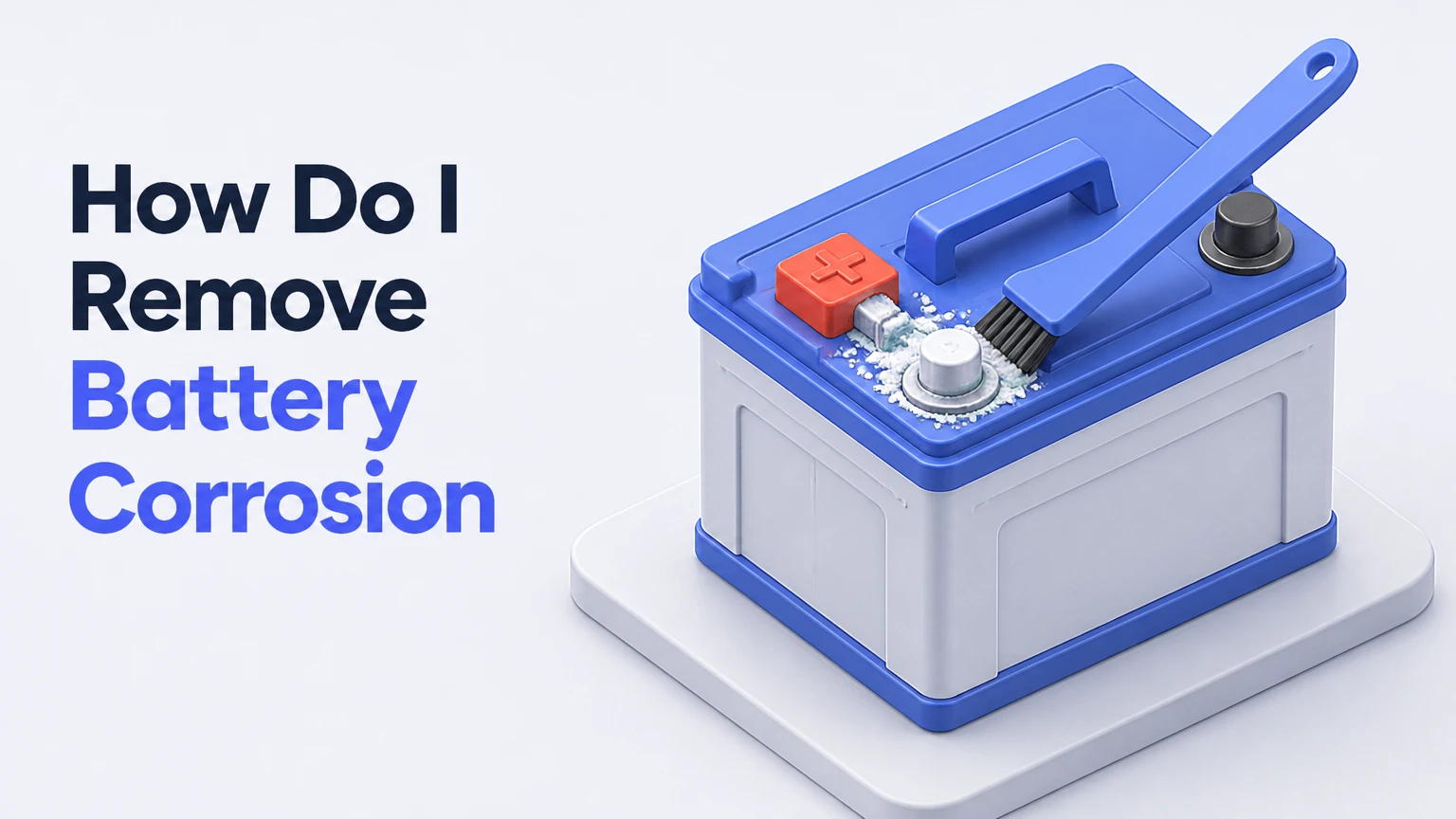
To remove battery corrosion, neutralize the chemical residue using a opposing agent based on the battery type. Neutralize caustic alkaline battery leaks (potassium hydroxide) with a mild acid like white vinegar. Neutralize acidic lead-acid car battery leaks (sulfuric acid residue) with a mild base like baking soda mixed with water. Scrub away the crust, dry thoroughly, and clean contacts to restore power.
At a Glance
- Alkaline battery leaks are strong bases (pH ~13.5) and require 5% acidity white vinegar or lemon juice to neutralize.
- Car battery corrosion consists of acidic copper sulfate or lead sulfate and requires 1 tablespoon of baking soda mixed into 1 cup of warm water.
- Always disconnect the negative (-) black car battery cable first, then the positive (+) red cable to prevent electrical short circuits.
- Bulging or leaking lithium-ion batteries must never contact liquids; isolate them immediately in a fire-safe container and take them to e-waste recycling.
- Circuit board corrosion should be cleaned with 99% isopropyl alcohol and an anti-static brush, never water-based household acids.
- Dielectric grease or petroleum jelly applied to clean terminals prevents future atmospheric oxidation and corrosion buildup.
What Causes Battery Corrosion, and How Do You Identify It?
Battery corrosion is caused by chemical off-gassing, moisture exposure, or structural seal failure, which allows internal electrolytes to leak and react with metal contacts and ambient air. The resulting buildup creates a resistive layer of crust or powder that blocks electrical current between the battery post and the device terminal.
       BATTERY CORROSION IDENTIFICATION & NEUTRALIZATION
┌───────────────────────────┬───────────────────────────┬───────────────────────────┐
│       BATTERY TYPE        │     CRUST APPEARANCE      │    NEUTRALIZING AGENT     │
├───────────────────────────┼───────────────────────────┼───────────────────────────┤
│ Alkaline (AA, AAA, C, D)  │ White, flaky or powdery   │ Mild Acid (Vinegar/Lemon) │
│ Lead-Acid (Car/Marine)    │ Blue, green, white crust  │ Mild Base (Baking Soda)   │
│ Lithium-Ion (Laptops/EVs) │ Swollen, wet liquid leak  │ DO NOT CLEAN (E-Waste)    │
└───────────────────────────┴───────────────────────────┴───────────────────────────┘
The physical appearance of corrosion varies by chemistry:
- Alkaline Batteries: Appears as a dull white, flaky, or powdery crust around the negative terminal or inside the battery compartment.
- Lead-Acid Car Batteries: Appears as a fluffy white, pale blue, or greenish residue creeping around the lead posts and terminal clamps.
- Rechargeable Nickel-Cadmium (NiCd) or Nickel-Metal Hydride (NiMH): Forms a fine white dust or hard grayish residue near the safety vent rims.
How Do You Clean Corroded Household Alkaline Batteries?
To clean corroded household alkaline batteries (AA, AAA, C, D, 9V), neutralize the caustic potassium hydroxide residue using a mild household acid. Potassium hydroxide is a potent base, so applying a mild acid breaks down the crystalline structure into harmless salt and water.
1.Put on Nitrile Gloves and Safety Glasses:
Protect skin and eyes from caustic chemical burns before opening the compartment.
2.Remove and Dispose of Leaking Batteries:
Extract the ruined batteries and place them directly into trash or recycling bins according to local ordinances.
3.Dip Cotton Swab in Acid Neutralizer:
Dip a cotton swab into pure lemon juice or white vinegar with 5% acidity. Dab the wet swab directly onto the white crusty contacts inside the device.
4.Observe Slight Effervescence:
Allow the acid to fizz slightly as it neutralizes the potassium hydroxide base.
5.Scrub Away Stubborn Crust:
Scrub the corroded metal contacts using an old toothbrush or a 0000 ultra-fine steel wool pad to restore shiny bare metal.
6.Wipe Dry and Air Out:
Wipe contacts thoroughly with a dry paper towel and allow the device to air dry for 30 minutes before inserting fresh batteries.
How Do You Safely Remove Lead-Acid Car Battery Terminal Corrosion?
To safely remove lead-acid car battery terminal corrosion, apply a neutralizing alkaline baking soda solution to break down acidic copper sulfate and lead sulfate deposits.
1.Wear Protective Gear:
Put on heavy-duty rubber gloves and wrap-around safety goggles to shield against residual sulfuric acid.
2.Prepare Neutralizing Solution:
Dissolve 1 tablespoon of baking soda into 1 cup (240 ml) of warm water in a small container.
3.Disconnect Battery Cables in Correct Order:
Disconnect the negative (-) black cable first, followed by the positive (+) red cable to prevent accidental short circuits.
4.Apply Solution to Terminals:
Pour the baking soda mixture over the corroded terminals or dab it liberally using a stiff brush.
5.Scrub Cable Clamps and Terminals:
Scrub both the lead posts and the inside of the cable clamps using a metal battery terminal brush until bare metal is exposed.
6.Rinse, Dry, and Apply Protection:
Rinse residual paste with a small amount of clean water, wipe dry with a microfiber cloth, apply a thin coat of dielectric grease, and reconnect cables positive (+) first, then negative (-).
What Exact Chemical Ratios and pH Levels Neutralize Battery Leaks?
Neutralizing battery leaks requires matching the pH of the neutralizing agent to the chemical property of the leaked electrolyte to bring the pH toward a safe, neutral 7.0 state. Using the wrong chemical agent creates an ineffective or overly reactive mess.
| Battery Chemistry | Leaked Electrolyte | Leaked pH Level | Correct Neutralizing Agent | Target Neutral pH |
| Alkaline | Potassium Hydroxide | ~13.5 (Strong Base) | 5% Acetic Acid (White Vinegar) | ~7.0 (Neutral Salt) |
| Lead-Acid | Sulfuric Acid Residue | ~1.0 (Strong Acid) | Sodium Bicarbonate (Baking Soda + Water) | ~7.0 (Neutral Salt) |
| NiCd / NiMH | Potassium Hydroxide | ~12.0 – 13.0 (Base) | Citric Acid / Lemon Juice | ~7.0 (Neutral Salt) |
When tightening car battery terminal bolts after cleaning, observe a torque limit of 10 to 15 lb-ft (13 to 20 Nm). Exceeding this torque crushes or fractures the soft lead battery posts, causing permanent internal plate disconnects. For electronic board contacts, never use steel wool coarser than 0000 gauge, as coarser grades strip ultra-thin protective gold or tin plating.
How Do You Handle Leaking Lithium-Ion or Rechargeable NiMH Batteries?
To handle leaking lithium-ion batteries, isolate the battery immediately without using liquid cleaners, as lithium reacts violently with water and moisture. To handle leaking NiMH or NiCd batteries, follow the alkaline neutralization protocol while taking precautions against airborne heavy metal dust.
Lithium-Ion (Laptops, Smartphones, Power Tools)
Lithium-ion cells do not undergo standard atmospheric oxidation; they swell, vent, or release organic solvents.
- Hazard: Contact with liquids can cause thermal runaway or combustion.
- Action: If a lithium cell is bulging, leaking clear fluid, or smelling metallic, do not apply vinegar, baking soda, or water. Place the entire device or battery into a fire-safe container filled with dry sand or kitty litter. Transport it directly to a dedicated hazardous e-waste facility.
Nickel-Cadmium (NiCd) and Nickel-Metal Hydride (NiMH)
NiCd leaks contain cadmium, a toxic heavy metal and known carcinogen.
- Hazard: Inhaling airborne dry residue during scrubbing presents respiratory risks.
- Action: Neutralize the leak using white vinegar. Wear an N95 respirator mask alongside nitrile gloves if the white crust has dried into a powdery state, preventing inhalation of microscopic cadmium or nickel dust particles.
How Do You Clean Corrosion From Delicate Circuit Boards and Electronics?
To clean battery corrosion from delicate printed circuit boards (PCBs), use 99% anhydrous isopropyl alcohol (IPA) rather than household vinegar or water. Water-based solutions can pool under surface-mount components, causing micro-shorts and long-term copper trace rot.
                  CIRCUIT BOARD CORROSION CLEANING PROTOCOL
┌──────────────────────────────┐     ┌──────────────────────────────┐
│  Apply 99% Isopropyl Alcohol │ ──> │ Scrub with ESD-Safe Brush    │
│  (Avoid Water/Vinegar Mixes) │     │ (Dissolves Corrosion Residue)│
└──────────────────────────────┘     └──────────────────────────────┘
                                                    │
                                                    ▼
┌──────────────────────────────┐     ┌──────────────────────────────┐
│ Restore Broken Traces with   │ <── │ Inspect Board for Copper     │
│ Conductive Pen if Required   │     │ Rot or Severed Traces        │
└──────────────────────────────┘     └──────────────────────────────┘
- Open the Casing: Disassemble the device housing to gain direct physical access to the circuit board.
- Apply 99% Isopropyl Alcohol: Saturate a soft-bristle anti-static ESD brush or cotton swab with 99% IPA. Avoid 70% rubbing alcohol, as its 30% water content promotes rust.
- Scrub Green Copper Crust Gently: Scrub the green or white oxidation off the board contacts and solder joints. The alcohol dissolves the salts and evaporates within minutes without leaving conductive moisture behind.
- Inspect Traces: Examine green copper traces for “copper rot” (blackened, broken traces). If a trace is severed, repair it using a fine-tip soldering iron and jumper wire, or bridge the gap with a conductive silver pen.
How Do You Restore Electronics When Corrosion Has Eaten the Metal Contact Spring?
To restore electronics when corrosion has eaten through the metal terminal spring, re-establish the electrical loop by building a conductive bridge or soldering a replacement contact.
Temporary Foil Bridge Method
If the spring or leaf terminal is partially eaten away but a stub remains:
- Clean all residual crust from the remaining stub using fine sandpaper.
- Fold a small strip of aluminum foil into a dense, thick square pad.
- Wedge the foil tightly between the battery pole and the remnants of the spring contact. The pressure forces contact, allowing electrical current to pass through.
Permanent Replacement Method
If the metal terminal has completely dissolved or broken off from the housing:
- Purchase a pack of universal nickel-plated battery spring contacts.
- Desolder the damaged wire or terminal stub from the circuit board using a soldering iron and desoldering braid.
- Solder a new nickel-plated spring terminal onto the connecting wire or board pad.
- Snap the new terminal into the plastic housing slot to restore factory functionality.
How Do You Loosen Frozen or Seized Car Battery Terminal Bolts?
To loosen frozen or seized car battery terminal bolts, apply penetrating oil and use controlled mechanical impact rather than raw wrench force, which can shear the lead post.
- Apply Penetrating Fluid: Spray a dedicated penetrating oil (such as PB Blaster or Liquid Wrench) directly onto the seized nut and bolt threads. Allow the oil to soak for 10 to 15 minutes to penetrate the galvanic oxidation bond between the steel bolt and lead clamp.
- Apply Light Mechanical Shock: Tap the top of the bolt gently with the handle of a screwdriver or a small wooden mallet. The vibration fractures the rigid crystalline structure of the corrosion within the threads.
- Hold Clamp and Turn Nut: Hold the body of the terminal clamp firmly with a pair of slip-joint pliers to prevent twisting force from transferring down into the fragile lead post inside the battery cover. Turn the nut counterclockwise using a six-point socket wrench.
- Spread the Clamp: If the bolt loosens but the clamp remains fused to the lead post, drive a flathead screwdriver into the clamp gap to open it slightly, then lift it free using a battery terminal puller.
Can You Use WD-40, Coca-Cola, or Rubbing Alcohol to Clean Battery Corrosion?
While alternative household chemicals are often suggested for removing battery corrosion, their effectiveness varies significantly based on their chemical properties.
| Household Liquid | Effective Neutralizer? | Safe for Final Protection? | Practical Verdict |
| WD-40 Multi-Use | No | Yes | Do not use for initial cleaning. WD-40 is a water displacer and lubricant, not an acid or base. It cannot neutralize alkaline or lead-acid crust. Spraying it onto dirty terminals seals in corrosion. Use vinegar or baking soda first, then apply a light film of WD-40 to prevent atmospheric oxidation. |
| Coca-Cola | Yes (Acidic) | No | Emergency use only. Coca-Cola contains phosphoric acid (pH ~2.6), which breaks down copper sulfate on car batteries. However, its high sugar content leaves behind a sticky residue that attracts dirt, pests, and moisture. If used, rinse the area completely with clean water afterward. |
| Rubbing Alcohol (70%) | No | No | Avoid on electronics. 70% isopropyl alcohol contains 30% water, which can corrode micro-components. Use 99% anhydrous isopropyl alcohol instead for electronics cleaning. |
Why Do Brand-New Batteries Corrode Inside Devices So Quickly?
Brand-new batteries corrode inside devices primarily due to mixed-battery usage, extreme thermal fluctuations, or extended storage under continuous micro-drain conditions.
              PRIMARY CAUSES OF EARLY BATTERY CORROSION
┌──────────────────────────────┐     ┌──────────────────────────────┐
│    Mixing Old & New Cells    │     │ Extended Storage Under Load  │
│(Forced Reverse Discharge)    │     │(Continuous Micro-Amperage)   │
└──────────────────────────────┘     └──────────────────────────────┘
                                  \   /
                                   \ /
                                    ▼
                     ┌──────────────────────────────┐
                     │ Internal Pressure Build-Up   │
                     │ Breaks Hydrogen Vent Seals   │
                     └──────────────────────────────┘
- Mixing Old and New Cells: Combining a fresh battery with a partially discharged cell causes the stronger battery to drive current through the weaker cell in reverse. This forced reverse discharge generates internal gas pressure, rupturing the cell’s safety seal and releasing potassium hydroxide electrolyte.
- Mixing Battery Chemistries: Mixing standard zinc-carbon batteries with high-drain alkaline batteries creates unbalanced voltage thresholds, triggering rapid overheating and seal rupture.
- Parasitic Drain During Storage: Leaving batteries inside unused electronics for months subjects them to a continuous micro-amperage draw. Over time, this deep discharge state generates hydrogen gas within the battery casing, causing structural seals to decay and leak.
Is Battery Corrosion Toxic, and What Safety Gear Is Required?
Battery corrosion is toxic and hazardous to human tissue, requiring specific protective measures based on the battery type involved.
Alkaline Corrosion
Contains potassium hydroxide, a caustic base.
- Risk: Causes chemical skin burns and serious eye irritation. Ingesting residual powder can injure the gastrointestinal tract.
- Required Gear: Nitrile or latex gloves, safety glasses. Wash hands thoroughly after handling.
Lead-Acid Car Battery Corrosion
Contains lead sulfate, lead oxide, and residual sulfuric acid.
- Risk: Sulfuric acid causes severe skin burns and permanent corneal damage upon eye contact. Lead compounds are bioaccumulative neurotoxins that enter the body via ingestion or dust inhalation.
- Required Gear: Heavy-duty rubber gloves, wrap-around splash goggles, and an N95 dust mask if scraping dry, powdery residue. Wash exposed skin and work clothing immediately after completing repairs.
How Do You Prevent Battery Corrosion From Returning?
To prevent battery corrosion from returning, seal metal terminals from environmental moisture and practice proper storage protocols.
                   BATTERY PREVENTATIVE MAINTENANCE
┌───────────────────────────┬───────────────────────────┬───────────────────────────┐
│     MAINTENANCE STEP      │       ACTION TAKEN        │      PRIMARY BENEFIT      │
├───────────────────────────┼───────────────────────────┼───────────────────────────┤
│ Dielectric Grease Layer   │ Barrier applied to posts  │ Blocks air and moisture   │
│ Felt Anti-Corrosion Washers│ Placed under car clamps   │ Traps acid gas seepage    │
│ Device Storage Protocol   │ Remove cells before storage│ Eliminates parasitic drain│
└───────────────────────────┴───────────────────────────┴───────────────────────────┘
- Apply Terminal Protection: On car batteries, clean lead posts completely and coat them with dielectric grease, petroleum jelly, or commercially available rubberized terminal spray before attaching the clamps.
- Install Anti-Corrosion Felt Washers: Slide felt washers impregnated with corrosion inhibitors over the car battery posts before tightening clamps. These washers neutralize acidic gas seepage before it contacts metal.
- Remove Batteries During Storage: Remove alkaline batteries from TV remotes, flashlights, or electronic gear if the devices will remain unused for longer than 30 days.
- Match Battery Chemistries: Always replace all batteries in a device simultaneously, using identical brands and chemistries from the same package.
The Bottom Line
Removing battery corrosion safely requires identifying the battery chemistry and applying the appropriate neutralizing agent: mild acids like white vinegar for alkaline cells, and mild bases like baking soda for lead-acid car terminals. Never use water-based solutions on delicate circuit boards—use 99% isopropyl alcohol instead. Protecting clean terminals with dielectric grease and storing unused devices without batteries will prevent future corrosion issues.


