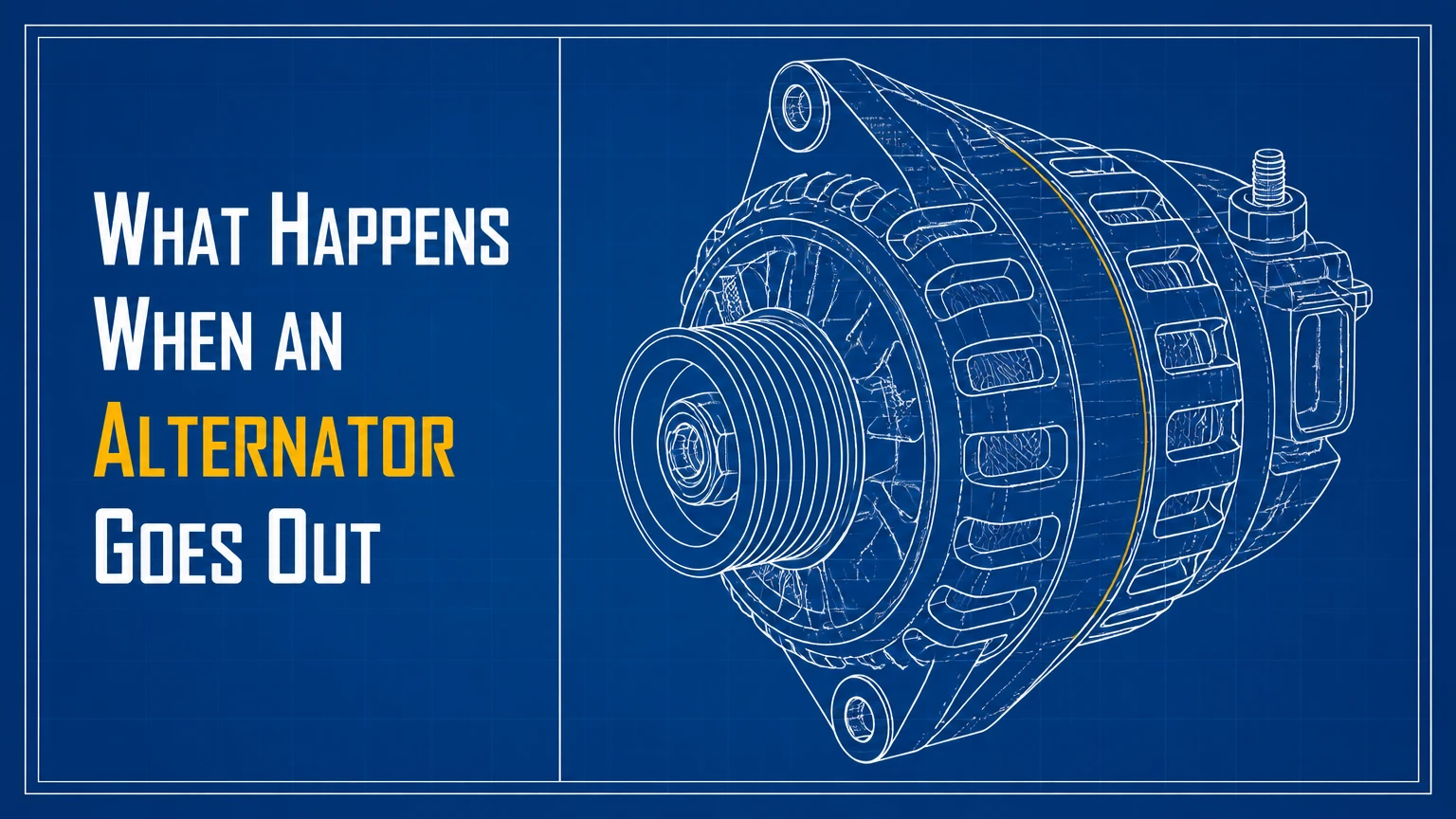
When an alternator goes out, a vehicle loses its primary source of electrical power, forcing the engine and onboard electronics to run exclusively on energy stored in the battery. Because the battery cannot sustain continuous electrical loads alone, the system voltage rapidly drops, triggering dashboard warning lights, dimming headlights, disabling critical electronics, and stalling the engine within 15 to 45 minutes.
At a Glance
- A healthy alternator maintains an operating charge between 13.8V and 14.7V while the engine runs.
- Once an alternator dies, a car typically runs for 20 to 40 minutes on battery power before stalling.
- Turning on headlights, heaters, or radio systems accelerates battery drain and shortens driving time.
- System voltage dropping below 9.0V cuts power to the electric fuel pump and spark plugs, shutting down the engine instantly.
- A failed internal voltage regulator can cause overcharging up to 19V, boiling battery acid and frying sensitive vehicle computers.
What Are the Warning Signs of a Failing Alternator?
The warning signs of a failing alternator progress from subtle electrical glitches to total powertrain shutdown as vehicle system voltage degrades. Recognizing these symptoms early prevents unexpected breakdowns on busy roads.
| Symptom | Underlying Mechanism | Severity Level |
| Battery Warning Light | Triggers when charging output drops below 13.5V or rises above 15.0V. | Initial Warning |
| Dim or Overly Bright Headlights | Fluctuating current supply or diode bridge breakdown causes erratic bulb output. | Moderate |
| Grumbling or Whining Noise | Worn internal bearings or a failing decoupler pulley creating mechanical friction. | Moderate |
| Growling or Burning Rubber Smell | Misaligned pulley dragging against the serpentine belt, generating extreme heat. | High |
| Erratic Instrument Cluster & Stalling | Voltage dropping below 10.5V, causing control modules to enter fault modes. | Critical |
As voltage drops, non-essential systems cut out first. The infotainment system, heated seats, and power windows shut down as the Engine Control Module (ECM) prioritizes power for ignition and fuel delivery systems.
How Long Can a Car Run After the Alternator Fails?
A vehicle can run for approximately 20 to 40 minutes on a fully charged battery after the alternator fails completely. The exact runtime depends on battery capacity, engine type, ambient temperature, and active electrical loads.
[Alternator Failure]
       │
       ▼
[Battery Voltage Drops Below 12.6V] (Dashboard Light Illuminates)
       │
       ▼
[Voltage Drops Below 10.5V] ───────► (Radio, Power Windows & ABS Disable)
       │
       ▼
[Voltage Drops Below 9.0V]  ───────► (Fuel Injection & Spark Plugs Die)
       │
       ▼
[Complete Engine Stall]
Under normal driving conditions, a standard car engine draws 10 to 20 amperes (A) just to run the fuel pump, ignition coils, and engine management sensors. Additional accessories significantly shorten your remaining travel time:
- Headlights (Low/High Beams): Adds 10A to 15A drain (cuts remaining time by 30%).
- HVAC Blower Fan (High Speed): Adds 15A to 20A drain (cuts remaining time by 40%).
- Rear Window Defroster: Adds 15A to 25A drain (cuts remaining time by 45%).
Driving at night with the heater blowing and headlights active reduces driver reaction time from 30 minutes down to less than 10 minutes before the engine dies completely.
Why Does an Alternator Failure Cause the Engine to Stall While Driving?
An alternator failure stalls an engine because modern internal combustion engines require continuous electrical energy to power the electric fuel pump, fuel injectors, and spark ignition system.
When an alternator stops generating electricity, the vehicle pulls power directly from the 12-volt lead-acid battery. As stored energy drains, system voltage plunges. When the voltage falls below roughly 9.0 volts, the coils inside electric fuel injectors can no longer generate the magnetic field required to pull their internal pintles open. Concurrently, ignition coils fail to charge adequately, producing weak or non-existent sparks across the spark plug gaps. Lacking both fuel pressure and ignition fire, combustion ceases instantly, causing the engine to stall regardless of vehicle speed.
What Is the Difference Between a Bad Battery and a Bad Alternator?
The core difference between a bad battery and a bad alternator lies in whether the vehicle fails to start or fails to stay running. A bad battery cannot hold a charge to crank the starter motor, whereas a bad alternator cannot generate electricity to power the vehicle while the engine runs.
                  ┌──────────────────────────────┐
                  │ Vehicle Electrical Fault     │
                  └──────────────┬───────────────┘
                                 │
                 Is the engine able to start?
                 ┌───────────────┴───────────────┐
                 │                               │
                 NO                              YES
                 │                               │
    Jump-start the vehicle.             Engine runs fine, but
    Does it keep running?              battery dies overnight?
    ┌────────────┴────────────┐                  │
    YES                       NO                 │
    │                         │                  ▼
    ▼                         ▼          [PARASITIC DRAIN OR
[BAD BATTERY]        [BAD ALTERNATOR]     FAILED BATTERY CELL]
- Bad Battery: The engine clicks or turns over slowly when turning the key. However, once jump-started, the car continues running smoothly because the functioning alternator supplies all necessary operational voltage.
- Bad Alternator: The car may start normally or accept a jump-start, but it dies shortly after the jumper cables are disconnected because the electrical system depletes the remaining battery voltage.
Can a Bad Alternator Ruin a New Battery?
Yes, a bad alternator will ruin a new battery, often within days or weeks, through mechanical sulfation or thermal distortion. Installing a fresh battery into a vehicle with a malfunctioning charging system exposes the battery to damaging operating conditions.
                       ┌─────────────────────────┐
                       │   FAILED ALTERNATOR     │
                       └────────────┬────────────┘
                                    │
           ┌────────────────────────┴────────────────────────┐
           │                                                 │
           ▼                                                 ▼
[UNDERCHARGING OUTPUT (<12.6V)]                   [OVERCHARGING OUTPUT (>15.0V)]
           │                                                 │
           ▼                                                 ▼
Deep Discharge Cycle                              Excessive Electrolyte Heating
           │                                                 │
           ▼                                                 ▼
Lead Sulfate Crystals Build Up                    Electrolyte Evaporation & Boiling
           │                                                 │
           ▼                                                 ▼
Permanent Capacity Loss (Sulfation)               Plates Warp & Short Internal Cells
           │                                                 │
           └────────────────────────┬────────────────────────┘
                                    │
                                    ▼
                      [BATTERY DESTROYED PERMANENTLY]
Undercharging forces a standard starting, lighting, and ignition (SLI) battery into a deep-discharge state. Lead-acid batteries are designed to deliver brief, high-amp bursts for starting, not prolonged deep cycles. Deep discharging causes hard lead sulfate crystals to coat the internal lead plates, permanently reducing energy storage capacity. Conversely, an alternator overcharging above 15.0 volts boils away the liquid electrolyte solution, exposing internal plates to oxidation and thermal warping.
Can You Jump-Start a Car with a Bad Alternator to Drive It Home?
Yes, you can jump-start a car with a bad alternator, but it will not keep running long enough to drive home safely unless home is only a few blocks away.
The jump-start process uses a booster vehicle or portable battery pack to supply the high amperage needed by the starter motor. However, as soon as the jumper cables are disconnected, the disabled vehicle operates purely on whatever surface charge was transferred to its internal battery. Within seconds to a few minutes, system voltage drops below the critical threshold, causing the vehicle to stall again in traffic. Operating a car in this manner risks sudden power steering loss, disabled power brakes, and dark lighting during night driving. Towing is the only safe solution.
What Causes an Alternator to Fail?
Alternators fail due to thermal wear, component fatigue, electrical shorts, or liquid contamination. Most automotive alternators have a functional lifespan of 100,000 to 150,000 miles.
1.Diode Bridge Breakdown:Most common electrical root cause.
The internal rectifier assembly contains semiconductor diodes that convert alternating current (AC) generated by the rotor into direct current (DC) used by the car. Constant heat cycling degrades these diodes over time, causing them to break open or short-circuit.
2.Carbon Brush and Slip Ring Wear:Mechanical friction wear point.
Spring-loaded carbon brushes ride against rotating copper slip rings to deliver field current to the rotor. After tens of thousands of rotor revolutions, these brushes wear down to non-contact lengths, stopping field current generation entirely.
3.Bearing Seizure:Audible mechanical failure mode.
Front and rear needle or ball bearings support the high-speed rotor shaft. Lubricant breakdown caused by excessive engine bay heat leads to bearing friction, high-pitched whining, belt slippage, and eventual shaft lockup.
4.Fluid Contamination:External environmental failure.
Engine oil leaks from valve cover gaskets or power steering fluid dripped onto the alternator housing coat internal windings and brushes. Fluid attraction captures dirt and metallic dust, creating short circuits and trapping heat.
Can a Bad Alternator Cause Overcharging Instead of a Dead Battery?
Yes, a bad alternator can cause extreme overcharging if its internal voltage regulator fails in a shorted or wide-open position. While most alternator failures lead to low voltage, a failed regulator allows maximum current to flow continuously from the rotor.
When a regulator fails open, output voltage spikes to between 16.0 volts and 19.0 volts. This excessive voltage overwhelms the vehicle electrical grid.
Risks of an Overcharging Alternator
- Boiling Battery Acid: Excessive voltage causes the electrolyte inside flooded batteries to boil, venting toxic hydrogen gas and creating a strong rotten-egg sulfur odor.
- Fried Electronic Control Units (ECUs): Sensitive engine, transmission, and body control modules contain delicate microcontrollers rated for maximum operational limits around 16.0 volts. Spikes above this threshold destroy sensitive board traces and microprocessors instantly.
- Blown Lighting and Relays: Bulbs burn out immediately, while electrical relays fuse closed due to extreme heat buildup.
Why Looks Can Be Deceiving: What Is an Overrunning Alternator Pulley Failure?
An Overrunning Alternator Pulley (OAP) failure occurs when the internal clutch mechanism inside a modern alternator pulley locks up or spins freely without turning the internal rotor.
Normal Operation:
[Engine Crankshaft Pulley] ──(Serpentine Belt)──► [OAP Pulley Outer Ring] ──(Internal Clutch Locked)──► [Rotor Shaft Spins & Generates Power]

Free-Spin Failure:
[Engine Crankshaft Pulley] ──(Serpentine Belt)──► [OAP Pulley Outer Ring] ──(Internal Clutch Slips)──► [Rotor Shaft Remains Stationary / Zero Power]
Modern high-efficiency engines use OAPs or Alternator Decoupler Pulleys (ADP) to cushion the alternator from rotational vibration during rapid engine deceleration. If the internal one-way roller clutch fails in a free-spin state, the serpentine belt turns the outer pulley normally, giving the visual appearance of a fully operational accessory belt drive. However, zero torque transfers to the inner rotor shaft. The alternator shaft stays stationary, yielding zero current generation despite a perfectly tensioned belt drive.
What Is Intermittent Thermal Alternator Failure?
Intermittent thermal alternator failure is a condition where the alternator functions correctly when the engine is cold, but stops charging once the engine bay reaches normal operating temperature.
This condition occurs because metal and copper components expand when heated. Inside the alternator diode bridge, hairline fractures can develop within internal solder joints or diode silicone chips. When cold, these cracks maintain physical contact, passing electrical current normally. As engine compartment temperatures rise above 180 degrees Fahrenheit, differential thermal expansion pulls the fractured joint apart, breaking the electrical connection. After the engine turns off and cools down, the metal contracts, restoring contact and masking the issue during brief shop tests.
How Does a Failed Alternator Diode Drain a Battery Overnight?
A failed alternator diode drains a battery overnight by allowing current to flow backward through the alternator circuit while the engine is turned off, a condition known as parasitic draw.
Normal Circuit (Engine OFF):
[12V Battery] ───X (Blocked by Good Rectifier Diodes) X───► [Alternator Windings]

Shorted Diode Circuit (Engine OFF):
[12V Battery] ───────────────► (Flows through Shorted Diode) ───────────────► [Alternator Stator Windings to Ground]
                                                                                       │
                                                                                       ▼
                                                                        [2.0A - 4.0A Parasitic Drain Overnight]
Under normal conditions, silicon diodes act as one-way electrical valves, allowing current to travel from the alternator to the battery, but preventing reverse flow. If a diode breaks down into a shorted state, it opens a continuous bridge between the positive battery terminal and the alternator’s grounded frame. Current flows continuously from the battery back into the stator coils even with the ignition key removed. This creates a parasitic current draw of 2 to 4 amperes, completely draining a healthy car battery in 4 to 8 hours.
Why Should You Never Disconnect the Battery Terminal to Test a Modern Alternator?
You should never disconnect the negative battery terminal while the engine is running on a modern vehicle because doing so removes the voltage dampening buffer provided by the battery, triggering destructive high-voltage spikes.
In older carburetored vehicles, unhooking the battery terminal was a common roadside test: if the engine kept running, the alternator was assumed good. On modern vehicles equipped with electronic control modules, the battery functions as a massive electrical capacitor that absorbs voltage fluctuations. Disconnecting the battery while the alternator field circuit is energized breaks the control feedback loop. The alternator voltage regulator responds by driving output up to 60 to 100 volts for several milliseconds. This load dump spike instantly fries delicate vehicle microprocessors, airbag control modules, and infotainment hardware, causing thousands of dollars in electrical damage.
How Do You Accurately Diagnose a Failing Alternator with a Multimeter?
To diagnose a failing alternator accurately, perform a three-stage voltage measurement test using a digital multimeter set to Direct Current Volts (DCV).
1.Measure Resting Battery Voltage:Base state test with engine OFF.
Touch the red multimeter probe to the positive (+) battery terminal and the black probe to the negative (-) terminal with the ignition off. A fully charged battery must read between 12.6V and 12.8V. If the reading is below 12.2V, charge the battery fully before proceeding.
2.Measure Engine Idle Charging Voltage:No-load operational test.
Start the engine and keep all accessories (lights, AC, radio) turned off. Measure voltage across the battery terminals. A healthy alternator charges between 13.8V and 14.7V. A reading below 13.5V indicates undercharging; a reading above 15.0V indicates dangerous overcharging.
3.Measure Loaded Charging Voltage:Full load operational test.
With the engine running at idle, turn on the high-beam headlights, cabin heater fan on high speed, and rear window defroster. Rev the engine smoothly to 2,000 RPM. Voltage should drop momentarily but stabilize between 13.6V and 14.4V. If voltage drops below 13.0V under load, the alternator rectifier bridge or internal regulator is failing.
What Else Can Mimic a Failed Alternator?
Corroded ground connections, high-resistance power cables, blown inline fuses, or low-quality replacement components often mimic the symptoms of a failed alternator.
- Corroded Block Ground Straps: The alternator ground path travels directly through its metal casing into the engine block, through a heavy copper ground strap, and back to the negative battery terminal. Corrosion at this ground connection creates high electrical resistance. The alternator generates voltage normally, but current cannot return to the battery.
- Blown High-Amp Inline Fuses: Many modern vehicles install a 100A to 250A fusible link in the primary charging wire between the alternator output stud and the battery. If this fuse blows, the alternator is disconnected from the charging system entirely.
- Dead-on-Arrival (DOA) Remanufactured Units: Roughly 10% to 15% of budget remanufactured alternators sold at retail auto parts stores fail quality control checks out of the box or within the first week of operation due to poorly rebuilt internal voltage regulators. Professional technicians bench-test new or rebuilt units prior to installation.
How Much Does It Cost to Replace a Failed Alternator?
The average cost to replace a failed alternator ranges between $350 and $900, including parts and labor. The final price varies based on vehicle make, engine layout, and component sourcing choices.
| Cost Component | Budget / Economy Vehicle | Mid-Tier / Standard Sedan | Luxury / European / Hybrid |
| Alternator Part Cost | $120 – $220 | $200 – $450 | $450 – $1,100 |
| Labor Hours Required | 1.0 – 2.0 Hours | 1.5 – 3.0 Hours | 3.0 – 6.0+ Hours |
| Labor Cost Estimate ($120/hr base) | $120 – $240 | $180 – $360 | $360 – $720+ |
| Total Replacement Cost | $240 – $460 | $380 – $810 | $810 – $1,820+ |
On accessible transverse four-cylinder engines, alternator replacement is straightforward and requires minimal component removal. Conversely, transverse V6 engines or high-performance European luxury vehicles often position the alternator deep within the engine bay, requiring front bumper removal, radiator service placement, or power steering line disconnection, driving up labor costs significantly.
The Bottom Line
When an alternator goes out, a vehicle transitions to finite battery power, leaving drivers with roughly 20 to 40 minutes of operating time before the engine stalls. Lowering electrical demand by turning off unnecessary lights, heaters, and accessories prolongs runtime to help reach a safe stopping area. Because charging system failure can involve overcharging spikes, diode parasitic drains, or simple wiring resistance, confirming alternator health with a digital multimeter before replacing parts saves both time and money.


