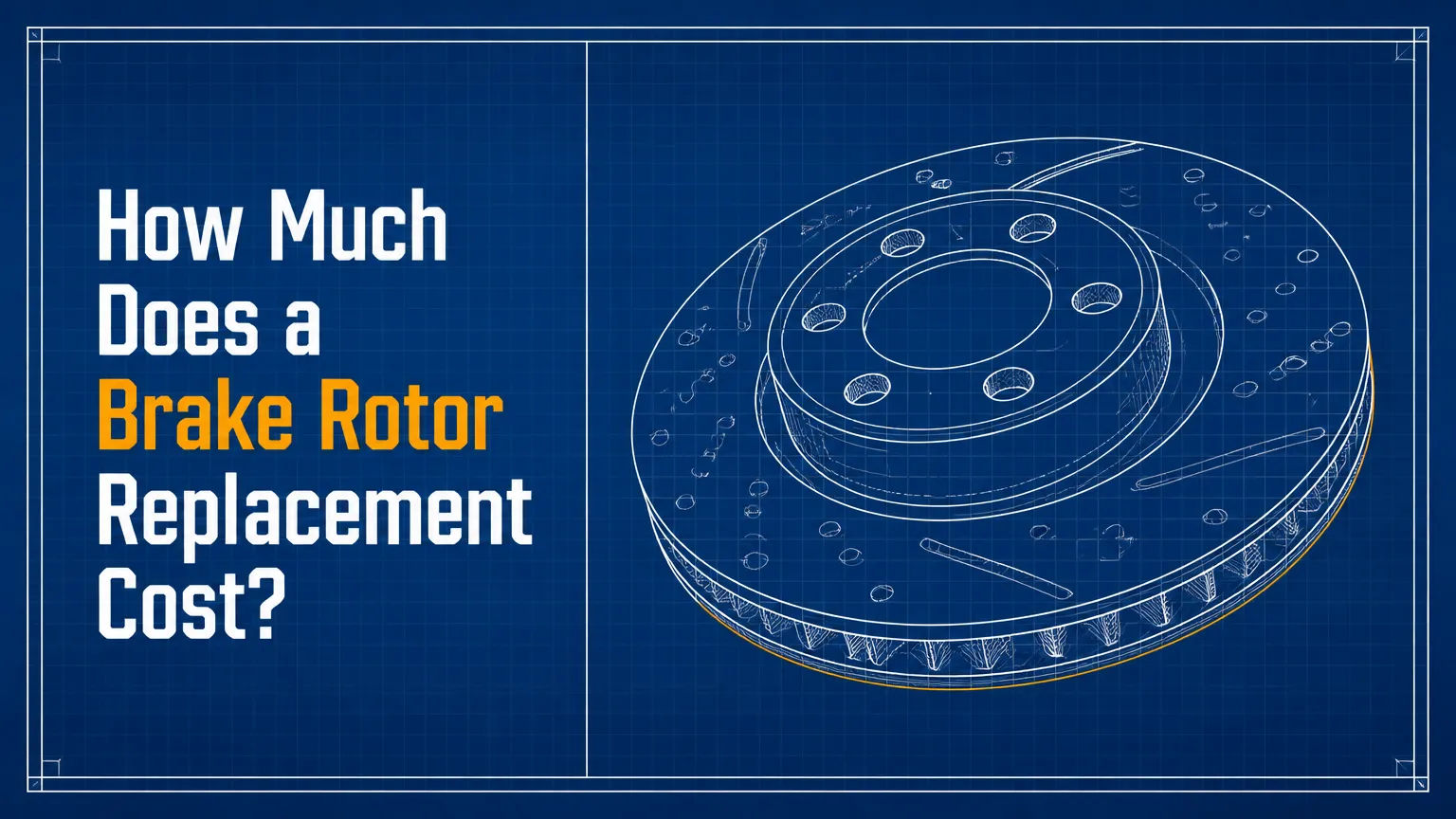
A professional brake rotor replacement costs between $450 and $800 per axle for standard passenger vehicles, which includes replacing both rotors and the corresponding set of brake pads. Replacing rotors across all four wheels costs between $900 and $1,600. DIY parts-only costs range from $95 to $225 per axle.
At a Glance: Brake Rotor Replacement Costs
- Average Axle Cost: $450 to $800 for independent shop or dealer replacement of 2 rotors and 1 pad set.
- Full Vehicle Cost: $900 to $1,600 for all four wheels across both axles.
- DIY Expense: $95 to $225 per axle for replacement parts and hardware.
- Labor Allocation: Mechanics bill 1.5 to 2.0 hours of labor per axle, with hourly rates ranging from $90 to $250.
- Luxury Exception: High-performance carbon-ceramic systems range from $5,000 to $15,000+ per axle.
What Is the Itemized Cost Breakdown for a Brake Rotor Job?
The total price of a brake rotor job combines two new rotors, one set of brake pads, and required labor hours. Replacing rotors without changing pads is bad practice, so reputable shops quote these items together.
| Expense Category | DIY (Parts Only) | Independent Shop | Dealership |
|---|---|---|---|
| Brake Rotors (2 Units) | $60 – $150 | $60 – $180 | $150 – $300 |
| Brake Pads (1 Axle Set) | $35 – $75 | $40 – $100 | $100 – $200 |
| Labor & Hardware | $0 | $150 – $300 | $250 – $450 |
| Total Price (Per Axle) | $95 – $225 | $250 – $580 | $500 – $950 |
Independent shops offer lower labor rates and use quality aftermarket components like Centric, Bosch, or Brembo OEM-equivalent parts. Dealerships charge premium rates for Original Equipment Manufacturer (OEM) parts directly from the vehicle maker.
How Do Dealership Labor Rates Compare to Independent Mechanics?
Independent repair shops charge between $90 and $160 per hour for labor, while franchise auto dealerships charge between $180 and $250 per hour.
A standard brake rotor replacement takes 1.5 to 2.0 labor hours per axle. On a standard vehicle, an independent shop charges $150 to $300 for labor per axle, whereas a dealership charges $250 to $450 for the exact same physical installation. Dealerships justify higher prices through specialized factory training, direct OEM parts warranties, and vehicle-specific diagnostic equipment. Independent shops typically source equivalent or higher-grade aftermarket rotors from manufacturers like Zimmermann or Raybestos at lower markups.
How Do Vehicle Type and Rotor Materials Drive Costs?
Vehicle weight, towing capability, and rotor material composition directly dictate replacement pricing. Larger vehicles require bigger rotors with higher manufacturing costs.
Base Sedan/Hatchback ($60 - $100 per rotor)
    └── Small, thin blank steel rotors requiring low material volume.

Full-Size Truck/SUV ($120 - $250 per rotor)
    └── Heavy-duty composite steel rotors built for heat dissipation.

Performance/Track Car ($150 - $400 per rotor)
    └── Cross-drilled or slotted rotors engineered to release gasses.

Exotic/Carbon-Ceramic ($2,500 - $7,500 per rotor)
    └── Carbon-fiber matrix composites built for extreme heat resistance.
Standard blank cast-iron rotors are the most affordable and reliable choice for daily commuting. Heavy full-size pickup trucks (like a Ford F-150 or Chevrolet Silverado) and three-row SUVs use thicker rotors with higher thermal capacity. Slotted and cross-drilled rotors cost more because they feature custom machining designed to vent gas, water, and brake dust under aggressive driving conditions.
How Much Does Replacement Cost for Luxury and Supercars?
Replacing brake rotors on luxury performance vehicles costs $1,500 to $3,500 per axle, while supercars with carbon-ceramic brake systems cost between $5,000 and $15,000+ per axle.
Specialty sub-brands (such as BMW M Series, Mercedes-AMG, and Porsche) utilize oversized, multi-piece floating rotors that isolate heat from the wheel hub. Parts alone for these vehicles run $400 to $900 per rotor.
Supercars with carbon-ceramic matrix rotors (found on select Ferrari, Lamborghini, or Porsche GT models) use silicon-carbide materials that do not rust or warp. While these carbon rotors last over 100,000 miles under normal driving, a single replacement rotor costs $3,000 to $7,000, creating five-figure repair bills when service becomes necessary.
Do You Always Have to Replace Rotors and Pads at the Same Time?
Yes, replacing brake pads and brake rotors at the same time is essential for safe operation and normal wear patterns. Installing new brake pads onto old rotors reduces stopping performance and accelerates pad wear.
As brake rotors age, they develop uneven micro-grooves, ridges, and heat spots that match the wear pattern of the old pads. Placing a flat, brand-new brake pad onto a grooved rotor face reduces the physical contact area by up to 50 percent until the pad slowly grinds down to match the damaged rotor surface. This poor contact creates loud brake squeal, pedal pulsation, and extended stopping distances. Most commercial repair shops decline to perform a “pad-only” installation due to the associated safety liability and high rate of customer returns.
Can You Resurface (“Turn”) Rotors Instead of Buying New Ones?
Yes, resurfacing brake rotors costs $20 to $50 per rotor, but it is only possible if the metal remains thicker than the manufacturer’s minimum discard specification.
Machining or turning a rotor involves placing it on a lathe to shear away surface imperfections, restore parallelism, and create a flat finish. Every brake rotor has a minimum safe thickness stamped directly onto its metal hub. If rust or wear has thinned the metal below this limit, lathe machining will make the rotor dangerously thin, leading to heat cracking or catastrophic failure.
Because modern aftermarket cast-iron rotors are inexpensive ($30 to $80 each for standard passenger cars), many repair shops recommend total replacement over machining. Installing fresh rotors guarantees full material thickness, optimal thermal capacity, and a clear manufacturer warranty.
How Do Captive Rotors and Rust-Belt Corrosion Increase Labor Bills?
Captive rotors and rusted hub connections add 1.0 to 3.0 additional labor hours to a standard brake job, increasing total repair costs by $100 to $450 per axle.
Standard floating rotors slide directly off the wheel studs once the brake caliper is detached. Captive (or “over-the-hub”) rotors are bolted behind the wheel hub assembly, requiring mechanics to pull the entire hub and press out wheel bearings just to access the rotor.
In geographical areas using winter road salt, iron rotors cold-weld directly onto the steel hub face via severe oxidation. Removing rusted-on rotors requires specialized pneumatic hammers, torches, or hub-pulling tools, which increases shop labor charges beyond the standard baseline quote.
Why Does an Electronic Parking Brake (EPB) Raise Rear Rotor Replacement Costs?
Replacing rear brake rotors on vehicles equipped with an Electronic Parking Brake (EPB) requires putting the braking system into a digital “Service Mode” using an OBD-II scan tool, which adds shop time or tool costs.
Modern rear calipers feature electric servo motors that screw the brake piston forward to lock the parking brake. If a technician or home mechanic uses a traditional mechanical C-clamp to push the piston back without retracting the internal motor digitally, the internal plastic gearing snaps. Replacing a broken electronic brake caliper adds $400 to $800 to the repair bill. Modern auto repair shops factor EPB scanner initialization and recalibration procedures into their baseline labor estimates.
What Happens if You Put New Pads on Old Rotors (“Pad Slap”)?
Performing a “pad slap”—installing new brake pads on old, un-serviced rotors—leads to noise, reduced stopping power, rapid pad wear, and potential steering wheel vibration.
Old brake rotors carry heat spots (localized deposits of cementite metal caused by extreme temperatures) and uneven thickness variations. Fresh brake pads installed on these surfaces cannot clamp flush against the metal face. The uneven surface causes the caliper to oscillate during application, transmitting vibrations into the vehicle chassis and brake pedal. The reduced friction area lowers initial stopping response, and heat builds up faster in worn rotors, leading to brake fade during repeated stops.
Why Does Your Car Vibrate or Pulsate When Applying the Brakes?
A vibrating brake pedal or shaking steering wheel during deceleration indicates Brake Rotor Thickness Variation (DTV), commonly referred to as a “warped rotor.”
True physical warping of thick iron rotors is rare. DTV occurs when uneven thermal expansion causes brake pad friction material to transfer unevenly onto the rotor face. As the pads cross these raised spots of friction material, the caliper piston is pushed back and forth rapidly, creating a hydraulic pulse in the brake pedal. Resolving DTV requires resurfacing the rotors on a lathe if sufficient metal thickness remains, or replacing the rotors entirely.
How Long Do Brake Rotors Last, and When Should They Be Replaced?
Brake rotors last between 30,000 and 70,000 miles under normal driving conditions, lasting about twice as long as a standard set of brake pads.
Heavy city stop-and-go driving, aggressive towing, mountain driving, and metallic brake pad compounds shorten rotor lifespan toward the 30,000-mile mark. Smooth highway commuting with organic or ceramic pads allows rotors to reach 70,000 miles or more.
Visual and Audible Signs Your Rotors Need Replacement
- Deep Circular Grooves: Visible lip or gouges on the rotor face deeper than 1.5 millimeters.
- Continuous High-Pitched Squeal: Caused by pad wear indicators scraping along a damaged rotor lip.
- Loud Metallic Grinding: Occurs when pad friction material is gone, causing steel-on-steel contact with the rotor.
- Blue Discoloration: Indicates extreme overheating that alters the metallurgical structure of the steel.
How Can You Tell if a Brake Rotor Is Too Thin to Use?
A brake rotor is too thin when its measured thickness falls below the “minimum discard specification” cast into the inner edge or hub face of the rotor body.
Mechanics measure rotor thickness across multiple points using a specialized digital micrometer or dial caliper. If the thinnest measurement matches or falls below the stamped minimum thickness limit (often measured in millimeters), the rotor must be discarded. Thinned rotors lose structural integrity and cannot absorb heat efficiently, causing brake fluid to boil and increasing the risk of the rotor cracking under heavy panic stops.
How Can You Safely Reduce Brake Rotor Replacement Costs?
You can reduce brake rotor costs by purchasing your own quality parts, performing basic DIY maintenance, or addressing brake noise before components sustain severe damage.
- Buy Aftermarket Parts Direct: Purchasing name-brand OEM-equivalent rotors (EBC, Brembo, Raybestos) online saves 30 to 50 percent compared to dealership parts markups.
- Perform DIY Replacement on Standard Axles: If your vehicle uses simple floating rotors and traditional mechanical parking brakes, basic hand tools and a jack allow you to complete the job for the cost of parts alone ($95 to $225).
- Avoid Steel-on-Steel Contact: Replacing worn brake pads before they wear down to their metal backing plates prevents gouging the rotors, allowing you to resurface them rather than buy new ones.
- Use Proper Wheel Torque Specs: Unevenly torquing wheel lug nuts using an impact wrench deforms the rotor hat, creating artificial runout and premature wear. Always use a calibrated torque wrench.
The Bottom Line
A professional brake rotor replacement costs $450 to $800 per axle for common passenger vehicles, with complete four-wheel service running from $900 to $1,600. Independent auto repair shops provide reliable service for $250 to $580 per axle, while dealership costs range from $500 to $950 due to higher labor rates and OEM parts markups. To maintain safe stopping distances and prevent noise, always replace brake rotors and pads together as a matched set per axle.


