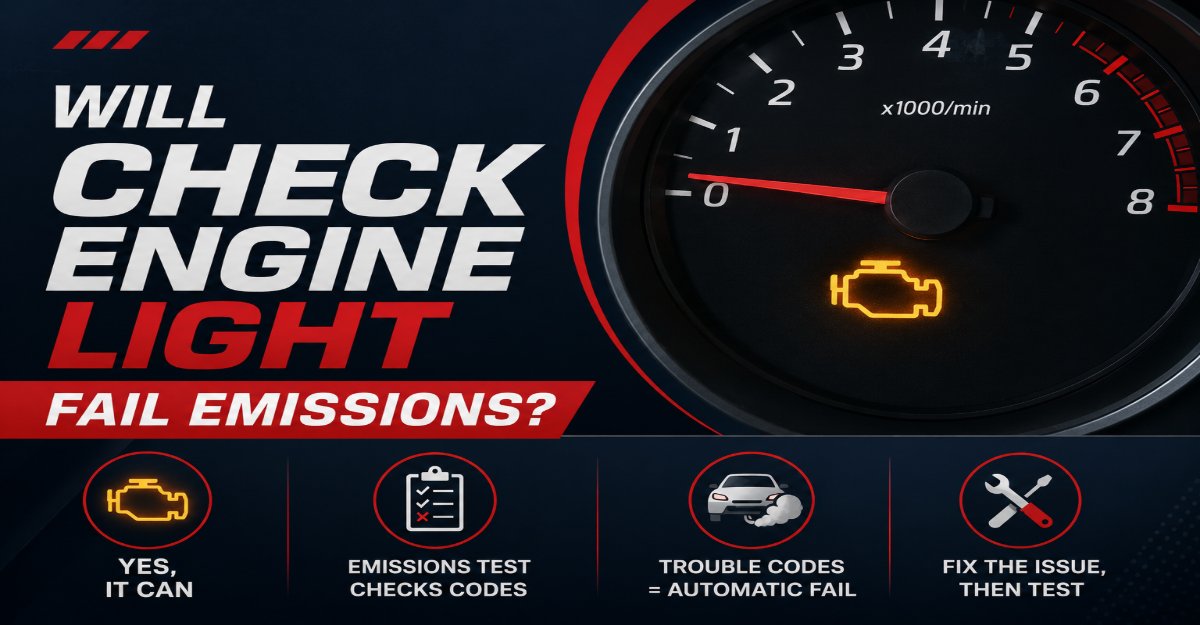
An illuminated check engine light will cause an automatic emissions test failure in almost every U.S. state using On-Board Diagnostics (OBD-II) testing. When a vehicle’s onboard computer detects an active emission-related diagnostic trouble code, it commands the light on and transmits a failure signal directly to the state’s inspection terminal.
At a Glance
- An active check engine light triggers an instant, automatic failure during an OBD-II emissions inspection regardless of tailpipe exhaust cleanliness.
- Resetting the computer or disconnecting the battery resets readiness monitors to “Not Ready,” leading to test rejection rather than a pass.
- Vehicles built in model year 2001 or newer generally allow a maximum of 1 incomplete readiness monitor, while California mandates 0 incomplete monitors.
- Failing the Key-On, Engine-Off (KOEO) bulb check will cause an automatic failure even if no diagnostic codes are stored in the engine computer.
- Non-emissions dashboard lights, such as ABS, Airbag, or Maintenance Required indicators, do not trigger an emissions test failure.
- Financial hardship repair waivers require spending between $450 and $1,500 on certified repairs, depending on state jurisdiction.
Why does a check engine light cause an automatic emissions test failure?
An illuminated check engine light causes an automatic emissions test failure because modern state inspection protocols rely on software querying the vehicle’s Powertrain Control Module (PCM) rather than measuring tailpipe gases alone.
OBD-II Inspection Process
When an inspector plugs the state analyzer cable into the 16-pin OBD-II diagnostic port located under the dashboard, the testing terminal reads the status of the Malfunction Indicator Light (MIL). If the PCM confirms that the MIL is actively commanded “ON” due to a stored fault code, the inspection software registers an immediate failure.
Federal standards under the Clean Air Act require passenger vehicles to monitor tailpipe emissions, evaporative fuel leaks, and engine misfires continuously. When a component such as an oxygen sensor, catalytic converter, or evaporative emissions (EVAP) valve operates outside set parameters, the PCM stores a Diagnostic Trouble Code (DTC) and turns on the light. Because the system flags excess pollutants at the source, states enforce an automatic failure rule to ensure malfunctioning emissions components are repaired promptly.
What are OBD-II readiness monitors and how many can be incomplete?
OBD-II readiness monitors are internal self-testing routines run by the vehicle’s computer to evaluate the performance of critical emissions control subsystems. Rather than running continuously, these monitors run periodically under specific operating conditions to verify that components like the catalytic converter, fuel system, oxygen sensors, and EVAP system function within legal tolerances.
OBD-II READINESS MONITOR MATRIX
The maximum number of incomplete readiness monitors permitted during an emissions test depends on the vehicle’s age and state regulations:
- Model Years 1996 to 2000: Most state programs permit up to 2 readiness monitors to remain in an “Incomplete” or “Not Ready” state while still granting a passing result.
- Model Years 2001 and Newer: Federal guidelines allow a maximum of 1 incomplete readiness monitor (typically the EVAP monitor, which requires strict ambient temperature and fuel level conditions to execute).
- California Standards: Under updated California Bureau of Automotive Repair rules, 2001 and newer gasoline vehicles must have 0 incomplete readiness monitors to pass testing.
Why does clearing codes or disconnecting the battery fail emissions testing?
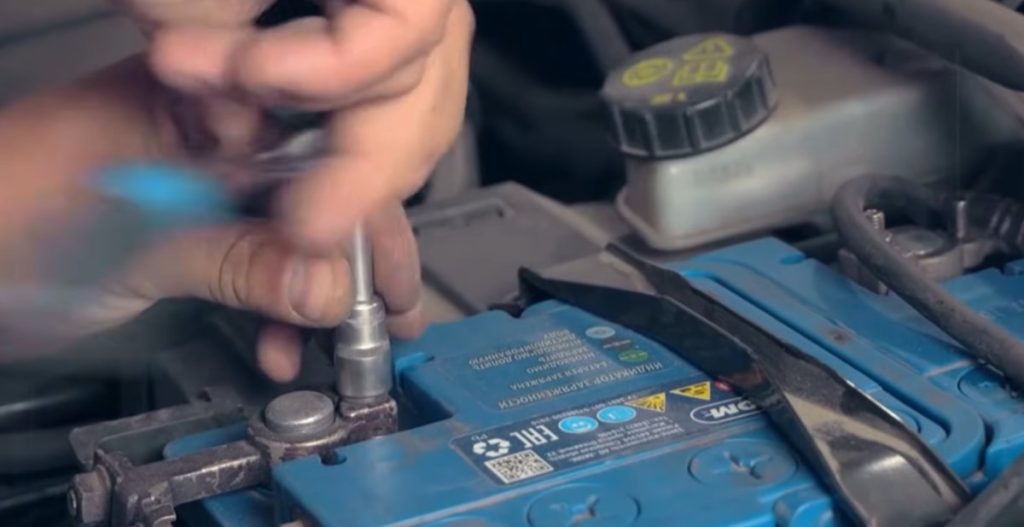
Clearing diagnostic codes with an OBD-II scanner or disconnecting the battery fails emissions testing because it resets all internal readiness monitors to an “Incomplete” or “Not Ready” state.
While clearing codes extinguishes the check engine light temporarily, it erases the operational history stored within the Powertrain Control Module. When the testing computer plugs into a vehicle with reset monitors, the inspection software immediately identifies that the vehicle has not completed its required self-diagnostic routines.
Instead of issuing a passing certificate, the inspection station issues a test rejection or “Un-Testable” result. The inspector will hand you a report stating that the vehicle cannot be sampled until it completes a full drive cycle. Driving the vehicle to set the monitors will simply cause the PCM to detect the original mechanical fault again, turning the check engine light back on.
What happens during the Key-On, Engine-Off (KOEO) visual bulb test?
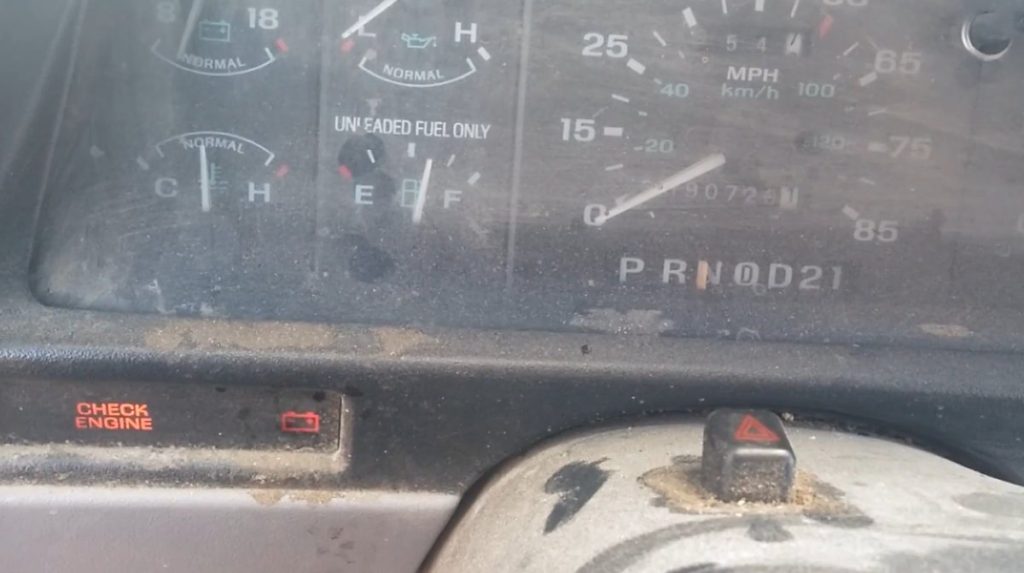
During the Key-On, Engine-Off (KOEO) visual test, the emissions inspector verifies that the check engine light bulb functions correctly when the ignition key is turned to the “ON” position without starting the engine.
This manual or automated check ensures that vehicle owners have not tampered with the instrument cluster by removing the bulb, cutting circuit traces, or placing electrical tape over the display. During the KOEO phase, all dashboard warning lights illuminate briefly as a system check.
If the check engine light fails to illuminate during this key-turn test, the vehicle receives an instant visual failure, even if the vehicle’s Powertrain Control Module contains zero diagnostic trouble codes. Replacing a burnt-out cluster bulb or restoring proper electrical connections is mandatory before the vehicle can retest.
Can you pass an emissions test with a pending diagnostic code?
Yes, you can generally pass an emissions test with a pending diagnostic code, provided the check engine light is not illuminated and the required number of readiness monitors are set to “Ready.”
A pending code (also known as a non-matured code) indicates that the Powertrain Control Module detected an operational anomaly during a single drive cycle, but has not yet confirmed the fault. Most emissions systems require a specific fault to occur across two consecutive drive cycles before commanding the Malfunction Indicator Light to turn on.
Because state testing software focuses on active MIL illumination and readiness monitor completion, a single pending code stored in memory will not trigger an automatic failure in most OBD-II jurisdictions. However, if that pending code matures into an active code during your trip to the inspection center, the light will illuminate and cause a failure.
Can you pass emissions if your check engine light turns off by itself?
Yes, you can pass an emissions test if your check engine light turns off by itself, provided the required readiness monitors remain set to “Ready” and no active codes remain in the Powertrain Control Module.
When an intermittent fault (such as a temporarily loose gas cap or a minor misfire under load) resolves itself, the PCM will extinguish the check engine light after a set number of consecutive fault-free drive cycles. Unlike manual code clearing, automatic bulb turn-off does not reset the vehicle’s readiness monitors. The self-tests remain in a “Ready” status in the computer’s memory.
If you bring the vehicle for an inspection while the light is off and the fault has cleared to a “history” or “stored” state without illuminating the MIL, the state testing terminal will register a pass.
How long or far do you need to drive after clearing a code to pass?
Setting readiness monitors after clearing codes requires completing a specific drive cycle rather than driving a set distance or time, though it typically takes between 20 and 150 miles of varied driving.
TYPICAL OBD-II DRIVE CYCLE
A standard drive cycle requires a combination of precise operating conditions:
- Cold Start: Let the car sit idle overnight so the engine coolant temperature drops below 122°F (50°C) and stays within 11°F of ambient air temperature.
- Initial Idle: Start the engine and allow it to idle smoothly in Park or Neutral for 2 to 3 minutes with the air conditioning and rear defroster turned off.
- Accelerate and City Drive: Accelerate smoothly up to 35–40 mph using light throttle pressure, maintaining city driving speeds for approximately 10 to 15 minutes.
- Highway Cruise: Merge onto a highway and maintain a steady speed between 55 mph and 60 mph for 15 to 20 minutes using steady throttle (avoid using cruise control on older models).
- Deceleration Coast: Allow the vehicle to coast down to 20 mph without pressing the brake pedal or shifting gears to allow the EVAP and oxygen sensor monitors to sample airflow changes.
While engine, fuel, and oxygen sensor monitors usually complete within 20 to 30 miles, stubborn routines like the Evaporative Emissions (EVAP) monitor require the fuel tank to sit strictly between 1/4 and 3/4 full and may take several days of daily driving to register as “Ready.”
What should you do immediately if your emissions test is rejected for ‘Not Ready’?
If your emissions test is rejected for “Not Ready” status, you should drive the vehicle through a full drive cycle routine rather than clearing codes again or paying for unnecessary component replacements.
Emissions Test Rejected: Not Ready
Steps to Take After an Un-Testable Rejection
- Do not disconnect the battery or scan-tool reset the computer: Doing so restarts the entire monitor evaluation process from zero.
- Verify your fuel level: Keep your gas tank between 25% and 75% capacity. Many EVAP readiness monitors refuse to execute if the tank is completely full or near empty.
- Use an inexpensive OBD-II code reader: Purchase or borrow a scanner that features an “I/M Readiness” hotkey. Verify that the required monitors read “Ready” before returning to the inspection lane.
- Execute targeted driving: If the catalyst monitor is incomplete, focus on steady highway driving. If the EVAP monitor is incomplete, ensure cold starts occur after overnight parking.
Do non-emissions dashboard lights like ABS or Airbag fail an emissions test?
No, non-emissions dashboard lights such as ABS (Anti-lock Braking System), Airbag (SRS), Traction Control, Tyre Pressure (TPMS), or Maintenance Required indicators do not cause an emissions test failure.
State emissions testing terminals strictly monitor the Powertrain Control Module (PCM) and Transmission Control Module (TCM) for diagnostic trouble codes that command the Malfunction Indicator Light (check engine light). Secondary vehicle safety modules operate on separate CAN-bus networks.
While an active ABS or SRS light will prevent a vehicle from passing a separate visual safety inspection in states that mandate safety checks (such as Texas, Pennsylvania, or Massachusetts), those lights have zero effect on an OBD-II emissions pass/fail determination.
How does an emissions repair hardship waiver work and what does it cost?
An emissions repair hardship waiver allows a vehicle owner to receive a temporary pass or registration approval if the vehicle fails an emissions test and cannot be brought into compliance without unreasonable expenditure.
To qualify for an emissions waiver, states establish strict financial thresholds and procedural criteria:
- Spending Thresholds: Most states mandate that the vehicle owner spend a minimum statutory amount—typically between $450 and $1,500—on diagnostic labor and emission-related repairs.
- Certified Repair Facility Requirement: Repair receipts must originate from a state-certified emissions repair technician or licensed facility. Parts purchased for DIY repairs usually do not count toward the financial threshold, or apply strictly to part costs without labor credit.
- Tampering Exclusions: Waivers are denied if inspectors detect illegal modifications, such as removed catalytic converters, straight-piped exhausts, or disabled oxygen sensors.
- Prior Failure Proof: You must present an initial failing inspection report alongside itemized repair invoices showing that legitimate attempts were made to fix the specific trouble codes.
Which vehicles are completely exempt from OBD-II emissions testing?
Vehicles are exempt from OBD-II emissions testing based on age, fuel type, or Gross Vehicle Weight Rating (GVWR), varying by state jurisdiction.
OBD-II EMISSIONS EXEMPTION CATEGORIES
The primary exemption categories include:
- Pre-1996 Vehicles: Passenger cars and light trucks manufactured prior to model year 1996 lack standardized OBD-II systems and are tested via tailpipe gas analyzers, dyno runs, or simple visual checks.
- Historic and Collector Vehicles: Most states exempt vehicles over 20 to 25 years old if registered with classic, antique, or vintage license plates and driven limited annual miles.
- Heavy-Duty Vehicles: Trucks and commercial vehicles with a GVWR exceeding 8,500 lbs (or 14,000 lbs in specific regions) fall outside light-duty OBD-II testing mandates.
- 100% Electric Vehicles: Battery Electric Vehicles (BEVs) produce zero direct tailpipe or evaporative emissions and are universally exempt from inspection requirements.
How do UK MOT and European emissions rules compare to US OBD-II rules?
Unlike the federal OBD-II testing model used in the United States, the UK MOT (Ministry of Transport) test and several European testing frameworks do not trigger an immediate failure solely because an engine management light is on, provided tailpipe exhaust readings meet legal cutoffs.
US OBD-II VS. UK MOT / EUROPEAN RULES
Under current UK MOT guidelines updated in 2018, an illuminated engine management light is classified as a “Major” defect, which results in a test fail. However, historical and European regional models prioritize physical gas analyzer readings:
In a physical tailpipe test, a probe measures actual levels of Carbon Monoxide (CO), Hydrocarbons (HC), and Nitrogen Oxides (NOx) flowing from the exhaust pipe. If the physical emissions remain within statutory limits, European systems evaluate the vehicle based on output rather than strict electronic monitoring flags. In contrast, U.S. states treat the check engine light command as a absolute electronic fail switch regardless of physical tailpipe output.
Can you get a temporary DMV extension if your vehicle fails emissions?
Yes, most state DMVs offer temporary registration extensions or operating permits if your vehicle fails an emissions test near your registration renewal deadline.
These temporary permits allow you to legally operate the vehicle on public roads while completing necessary repairs or performing drive cycles to set readiness monitors:
- Duration: Extension permits are typically valid for 30 to 60 days, depending on local DMV policies.
- Cost: States charge a nominal administrative fee (typically $10 to $25) for issuing a temporary operating permit.
- Documentation Required: You must show proof of a recent failing emissions inspection report, active vehicle insurance, and ownership documents.
- Limits: Most jurisdictions limit drivers to a single temporary extension per renewal cycle to prevent vehicle owners from delaying necessary emissions repairs indefinitely.
The Bottom Line
An illuminated check engine light results in an automatic emissions test failure in almost all OBD-II jurisdictions because state inspection terminals read fault flags directly from your vehicle’s engine computer.
Attempting to bypass the test by clearing codes or disconnecting the battery will lead to an immediate rejection for incomplete readiness monitors rather than a pass.
To resolve a check engine light issue for emissions testing, diagnose the specific diagnostic trouble code, complete necessary repairs, execute a proper drive cycle, and confirm that all required monitors show “Ready” using a code reader before entering the inspection lane.


