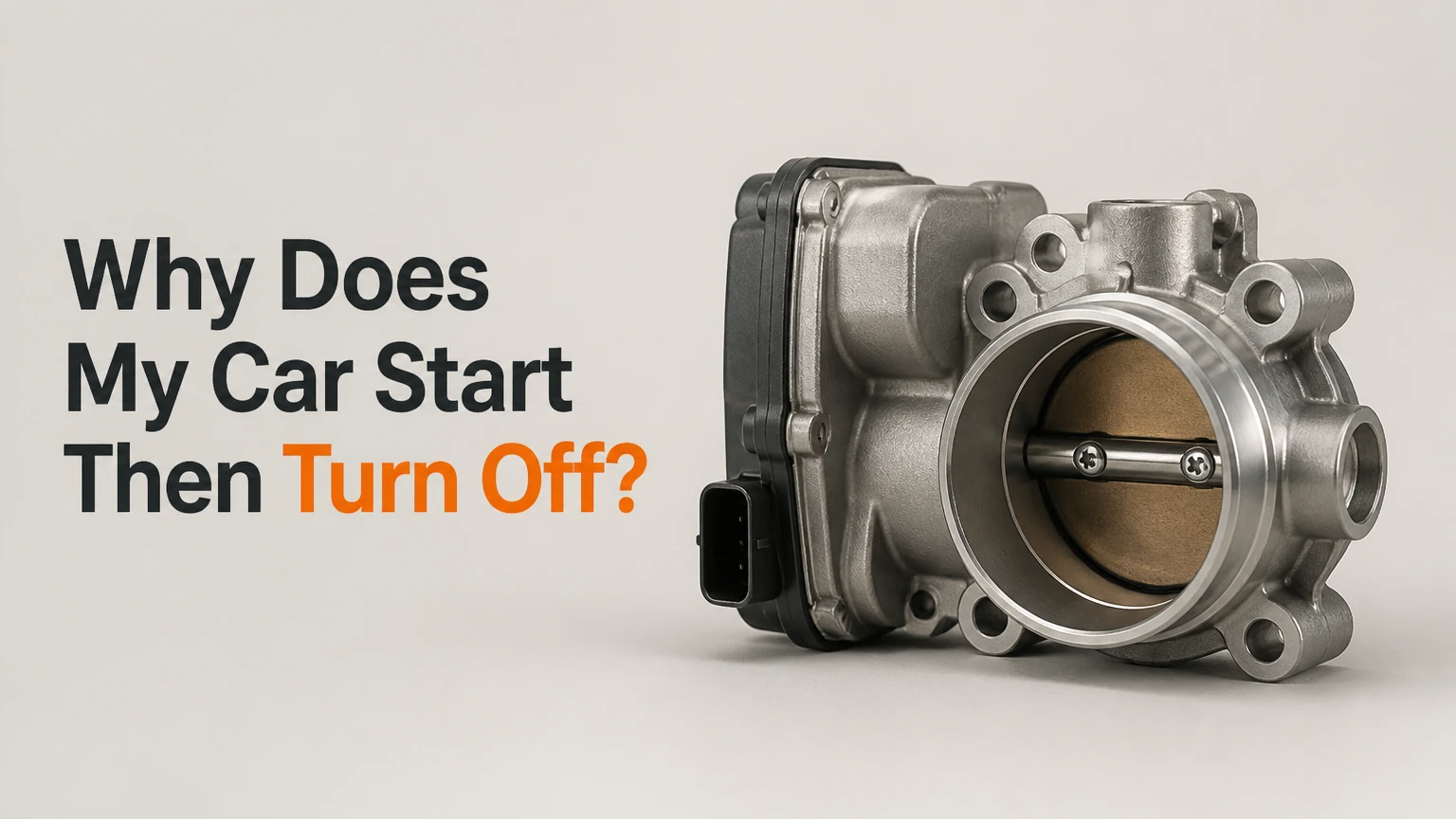
A car that starts then turns off immediately is typically experiencing an anti-theft immobilizer security error or a rapid fuel pressure drop below 20 PSI. Modern Engine Control Units start the engine on primed fuel, but automatically cut ignition coil or fuel injector power within 1 to 3 seconds if security handshakes fail or fuel delivery collapses.
At a Glance
- Anti-theft immobilizers shut down the fuel injectors within 2 to 5 seconds if key transponder signals are missing or corrupted.
- Fuel delivery systems require 35 to 60 PSI to maintain idle; drops below 20 PSI cause immediate engine starvation after priming.
- Alternator failures cause battery voltage to drop below 10.5 Volts during cranking, triggering automatic ECU shutdown.
- Faulty ignition switches cut power to the ignition system when the key springs back from “Start” to “Run.”
- Holding the gas pedal open bypasses a defective Idle Air Control valve by manually supplying intake air.
Why does my car start then turn off immediately?
A car starts then turns off immediately because the Engine Control Unit cuts fuel injector pulse or ignition spark right after the initial engine firing. When you turn the ignition key, the fuel pump primes the fuel rail with a brief pulse of pressurized gasoline. This initial charge allows the engine to catch and run for 1 to 3 seconds. However, if the ECU detects a critical safety violation, a drop in fuel pressure below 20 PSI, or an unmetered air influx, it intentionally halts combustion to protect mechanical components or prevent vehicle theft.
How does an anti-theft immobilizer cause an engine to stall?
An anti-theft immobilizer causes an engine to stall by cutting power to the fuel injectors or ignition coils within a strict 2-second to 5-second verification window. When an ignition key turns, an antenna ring around the lock cylinder sends a Radio Frequency signal to the transponder chip inside the key. If the engine control unit receives an unrecognized security code, an incomplete signal, or no response at all, it permits the initial crank but abruptly revokes engine management functions to prevent hotwiring.
Systems such as Honda’s Immobilizer System or Ford’s SecuriLock rely on a synchronized rolling code protocol between the transponder key, the security module, and the powertrain control module. If any component in this communication chain fails, the engine fires briefly using pre-primed fuel before the security protocol disables fuel injection.
What fuel pressure failures cause a car to start and die?
A car starts and dies when fuel system pressure drops below 20 PSI immediately following the initial fuel priming phase. Healthy port fuel injection systems require continuous operating pressure between 35 and 60 PSI, while direct injection systems rely on low-pressure feed pumps delivering similar baseline metrics to a high-pressure pump.
When the ignition enters the “On” position, the electric fuel pump runs for roughly two seconds to pressurize the fuel rail. This brief prime provides enough pressure for the engine to start. If the fuel pump motor overheats, the internal pump check valve leaks, or the fuel pressure regulator diaphragm tears, system pressure bleeds back into the gas tank instantly. The engine exhausts the small volume of fuel remaining in the injectors and stalls within two seconds.
What diagnostic thresholds and voltage numbers trigger this issue?
Specific voltage drops, air mass mismatches, and fluid pressure deficiencies force the Engine Control Unit into an immediate safety shutdown mode:
- System Voltage Drop: During engine cranking, battery voltage drops significantly. If system voltage drops below 10.5 Volts during cranking, or if the alternator fails to deliver 13.5 to 14.5 Volts the millisecond the engine catches, low-voltage protection algorithms stall the vehicle.
- Mass Air Flow (MAF) Thresholds: A warm engine at idle requires roughly 1 gram per second (g/s) of air per liter of engine displacement (for example, 2.0 to 2.5 g/s for a 2.4-liter engine). If a corrupted MAF sensor reports 0 g/s or spikes unnaturally upon starting, the ECU cannot calculate fuel delivery and shuts down injection.
- Fuel Pressure Floor: A drop below 20 PSI in standard fuel rails halts atomization, causing lean misfires that stall the engine immediately.
How can a faulty ignition switch cause an engine to start and turn off?
A faulty ignition switch causes an engine to start and turn off because worn electrical contacts break the ignition circuit when the key transitions from “Start” to “Run.” The mechanical ignition cylinder features distinct internal positions: Off, Accessory, Run, and Start. When turned to “Start,” heavy spring tension forces internal copper contacts together to supply power to the starter solenoid, fuel pump, and ECU.
Once the engine fires, the driver releases the key, allowing internal springs to push the key back into the “Run” position. If the electrical contacts inside the “Run” track are eroded, pitted, or coated in carbon deposits, power to the ignition coil and engine control module cuts out instantly. The engine dies the exact millisecond the key springs back.
Why does my car stay running only if I press the gas pedal?
A car stays running only when pressing the gas pedal because the Idle Air Control (IAC) valve or electronic throttle body fails to allow intake air into the engine when the accelerator is released. Engines require a precise balance of air and fuel to maintain idle. When your foot is off the accelerator pedal, the throttle plate closes completely, forcing intake air to pass through a tiny bypass passage managed by the IAC valve or an electronically controlled throttle motor.
If heavy carbon buildup blocks the IAC bypass port, or if the internal stepper motor fails, no air enters the engine at rest. Depressing the gas pedal manually tilts the primary throttle plate open. This physical action supplies the necessary intake airflow to keep combustion alive, overriding the broken automatic idle circuit.
Why won’t changing fuel filters or spark plugs fix an immediate stall?
Changing fuel filters or spark plugs fails to fix an immediate engine stall because these components rarely cause a car to catch, idle briefly, and instantly shut down:
| Common Component Myth | Why The Diagnosis Fails | What Is Actually Happening |
| Clogged Fuel Filter | Fuel filters restrict high-volume fuel flow required at highway speeds. They almost never block the minimal fuel volume needed for a 2-second idle. | A torn internal fuel pump diaphragm or failed check valve allowing fuel rail pressure to bleed back into the gas tank. |
| Fouled Spark Plugs | Severely fouled spark plugs cause engine misfires, rough cranking, or complete no-start conditions across all cylinders. | Ignition switch contact failure or ECU security shutoff cutting power to all spark plugs simultaneously. |
| Dirty Throttle Body | Carbon buildup on a throttle plate causes an uneven or fluctuating idle, not an aggressive, instant engine shutoff. | A massive vacuum leak downstream of the MAF sensor, such as a torn brake booster diaphragm or stuck PCV valve. |
How do key fob battery drains and proximity faults trigger engine stalls?
Dying key fob batteries and proximity sensor interference trigger engine stalls by interrupting the continuous RF signal required by push-button start security modules. Modern vehicles equipped with passive entry and keyless ignition systems continuously poll the cabin area for the smart key’s unique transponder signature.
If a key fob battery drops below 2.0 Volts, the fob may transmit a signal strong enough to authorize the initial starter engagement. However, as the driver places the key into a cupholder or pocket, signal strength drops. If the central body control module loses the high-frequency response within the initial post-start polling window, it signals the engine module to kill ignition power as an anti-theft safeguard.
Why do GM Passlock systems lock out drivers after an engine stall?
General Motors Passlock and Passkey systems lock out drivers because worn ignition lock cylinders generate incorrect electrical resistance values during key rotation. Passlock systems use a Hall-effect sensor or mechanical contacts inside the ignition cylinder to read a specific resistance value when the key turns.
When wear occurs on the ignition switch housing, the measured resistance strays outside the programmed tolerance band recognized by the Body Control Module. The module allows the vehicle to start on fuel priming power, immediately cuts injector pulses when the resistance value fails validation, and flashes the dashboard “Security” light. To prevent theft attempts, the security module initiates an automatic 10-minute tamper timer, disabling starter control until the countdown expires.
How does a corrupted flex-fuel sensor cause an engine to drown itself?
A corrupted flex-fuel sensor causes an engine to drown itself by falsely calculating an extremely high ethanol concentration, leading the Engine Control Unit to over-fuel the intake manifold. Flex-fuel vehicles automatically adjust fuel injection volume based on the ethanol percentage detected in the fuel line, as pure ethanol requires a much richer air-fuel ratio (roughly 9:1 stoichiometric ratio) compared to standard E10 gasoline (14.7:1).
If a fuel composition sensor fails electronically, it can falsely report a 100 percent ethanol (E85/E100) mixture when the tank actually holds standard gasoline. Upon starting, the ECU opens the fuel injectors wide to deliver extra fuel volume needed for ethanol. This massive over-injection floods the spark plugs with liquid gasoline within two seconds of starting, effectively suffocating the flame kernel and stalling the engine.
Why does a car start and turn off only when cold or hot?
A car starts and turns off under extreme temperatures due to thermal expansion in electrical circuits or faulty sensor inputs that alter air-fuel mixtures:
- Cold-Engine Thermal Stalls: A defective Engine Coolant Temperature (ECT) sensor may fail internally and constantly report a fully warmed engine temperature (e.g., 195 degrees Fahrenheit) to the computer on a freezing morning. The ECU fails to deliver the extra fuel required for a cold enrichment cycle, causing the engine to starve and die right after catching.
- Hot-Engine Thermal Stalls: High ambient heat causes micro-fractures in solder joints inside fuel pump relays or main engine control relays to expand. While cold electrical contacts touch and allow starting, engine bay heat immediately forces the solder gap open, severing power to the fuel pump after a few seconds of operation.
Why do all my dashboard lights illuminate right when the engine dies?
Dashboard lights illuminate right when an engine dies because the vehicle’s electrical system reverts to the “Key On, Engine Off” state the instant engine rotation stops. Drivers often mistake this visual display for a catastrophic electrical short or blown fuse panel.
When an engine stalls from any mechanical, fuel, or sensor failure, the engine stops turning, which halts the alternator pulley. Because the alternator no longer generates electricity, system voltage drops back to battery level. The computer detects zero engine RPM while the ignition switch remains in the “On” position. The vehicle automatically illuminates the battery light, oil pressure warning light, and check engine light to alert the driver that the engine is no longer running while electrical accessories remain powered.
How can you test if an immobilizer is causing your car to turn off?
You can test if an immobilizer is causing an engine stall by monitoring instrument cluster security icons and attempting a secondary key authorization check:
- Observe Instrument Cluster Icons: Turn the ignition key to the “On” position without cranking. Locate the security light (typically shaped like a key, a padlock, or a car with a key inside). If this light continues to flash rapidly or remains solid red/green after three seconds, the security system has flagged an authentication error.
- Perform the Auxiliary Key Test: Attempt to start the vehicle using your spare master key. If the vehicle starts and stays running with the backup key, the transponder chip inside your primary key is damaged or desynchronized.
- Execute the Mechanical Key Bypass: For push-button start vehicles, physically press the top of the key fob directly against the Start/Stop button while pressing the brake. This utilizes a backup Near Field Communication (NFC) coil inside the button to read the fob key chip passively, even if the key fob battery is dead.
How do you perform an ECU hard reset after an immediate engine stall?
You perform an Engine Control Unit hard reset by disconnecting battery power to drain residual capacitive memory and clear temporary diagnostic lockout states:
- Safety Preparation: Turn the ignition switch to the “Off” position and remove the key from the vehicle. Engage the parking brake.
- Disconnect the Negative Terminal: Use an appropriately sized wrench (typically 10mm) to loosen the nut on the negative (-) black battery terminal clamp. Remove the cable terminal from the post and isolate it away from metal surfaces.
- Drain Capacitive Energy: Press and hold the vehicle horn on the steering wheel for 15 seconds, or turn on the headlight switch for 30 seconds. This drains lingering voltage stored in internal circuit capacitors.
- Wait and Reconnect: Leave the battery disconnected for at least 15 minutes. Reattach the negative battery cable terminal to the battery post and tighten the retaining nut securely.
- Relearn Idle Calibration: Start the engine without touching the gas pedal. Allow the vehicle to idle undisturbed for 10 minutes to allow the ECU to rebuild baseline air-fuel and idle trim values.
How much does it cost to fix a car that starts then shuts off?
Fixing a car that starts then shuts off ranges from $50 to over $1,200 depending on whether the root cause is electrical, fuel-related, or sensor-driven:
- Key Fob Battery Replacement: $5 to $15 for standard CR2032 lithium coin batteries.
- Idle Air Control Valve / Throttle Body Cleaning: $20 for a can of dedicated intake cleaner if performing DIY maintenance; $150 to $300 for professional shop replacement.
- Ignition Switch Module: $120 to $350 including mechanical parts and labor.
- Fuel Pump Assembly: $400 to $900 depending on whether tank removal is required.
- Transponder Key Programming & Immobilizer Diagnostics: $150 to $450 through an automotive locksmith or dealership service center.
Is it safe to repeatedly crank an engine that starts and dies?
Repeatedly cranking an engine that starts and dies is unsafe because it causes severe starter motor overheating, battery plate degradation, and unburnt fuel contamination inside the catalytic converter. Starter motors are rated for short operational cycles; continuous cranking draws upwards of 150 to 200 Amperes, rapidly melting internal copper windings.
Furthermore, every failed start cycle pumps unburnt raw gasoline into the exhaust manifold. When the engine finally catches, this pooled fuel ignites inside the honeycomb structure of the catalytic converter, causing extreme thermal shock that melts internal precious metals and creates costly exhaust blockages. Limit diagnostic cranking attempts to 5-second intervals with at least 30 seconds of cooling time between tries.
The Bottom Line
A car that starts then turns off within seconds is almost always reacting to a security immobilizer lockout or an immediate drop in fuel pressure below 20 PSI. Diagnostic priority should focus on checking instrument cluster security lights and measuring fuel rail pressure rather than replacing high-wear maintenance parts like spark plugs or fuel filters. Confirming ignition switch contact integrity and battery voltage under load will quickly identify electrical faults before investing in expensive component replacements.


