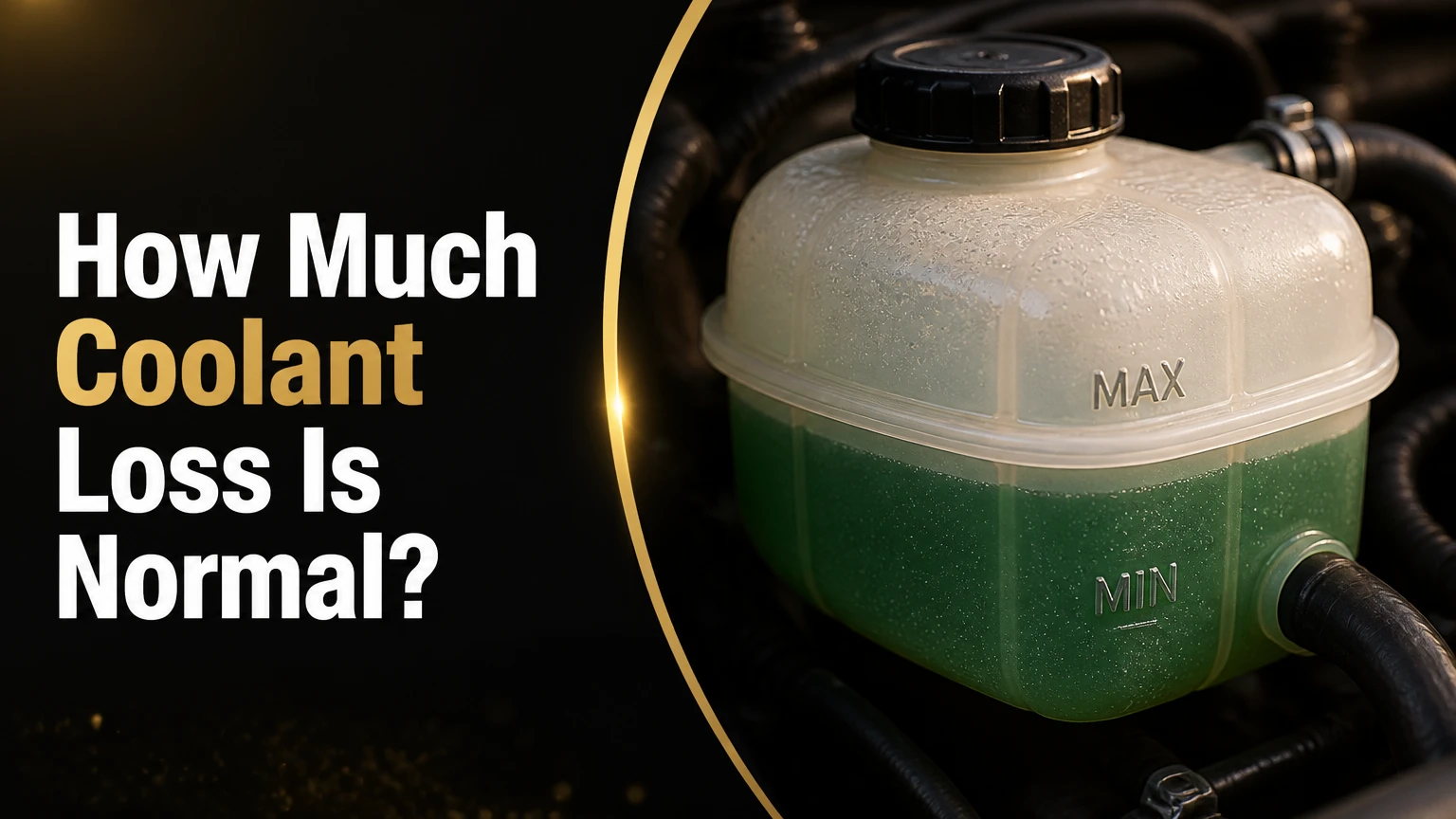
Under standard operating conditions, a healthy engine cooling system should experience zero noticeable coolant loss, losing fewer than 0.5 to 1 fluid ounce (15 to 30 mL) per year. Because engine cooling systems are fully sealed, any visible drop on the expansion tank reservoir dipstick over a few months signals a micro-leak, pressure cap breakdown, or internal component failure that requires diagnosis.
At a Glance
- Ideal Annual Loss: Less than 1 ounce (30 mL) per year due to microscopic hose permeation.
- Borderline Threshold: 2 to 3 ounces per year indicates early rubber hose degradation or loose hose clamps.
- Abnormal Loss: Any drop exceeding 4 ounces per year or a visible drop over 1 to 3 months requires a pressure test.
- Post-Service Drop: A drop of 8 to 16 ounces after a coolant flush is normal due to trapped air burping out.
- No Puddle Leaks: Coolant loss without ground puddles stems from internal combustion burning or atomized mist evaporation.
Is Any Amount of Coolant Loss Acceptable in a Sealed System?
A completely sealed, modern automotive cooling system should ideally suffer zero fluid loss between service intervals. However, losing under 0.5 to 1 fluid ounce (15 to 30 mL) per year is technically acceptable due to microscopic permeation through rubber cooling hoses and slight venting through pressure relief caps.
An engine cooling system functions as a closed-loop pressure vessel. When coolant expands under operating temperatures reaching 190°F to 220°F (88°C to 104°C), the system pressurizes to roughly 15 to 22 PSI. This pressure elevates the boiling point of the water-antifreeze mixture. Under these extreme thermal conditions, tiny amounts of water vapor slowly migrate through the porous structure of standard ethylene-propylene-diene monomer (EPDM) rubber hoses over hundreds of heat cycles. This micro-permeation lowers the fluid level by fractions of an inch over thousands of miles, making it functionally invisible on the coolant reservoir lines during routine oil change intervals.
What Is the Acceptable Coolant Loss Rate Per Year?
The acceptable coolant loss rate is fewer than 1 fluid ounce per year, while any loss exceeding 4 fluid ounces per year is abnormal and signals an active leak.
+--------------------------+----------------------------+-------------------------------------------------------+
| Annual Fluid Loss        | System Status              | Primary Mechanical Cause                              |
+--------------------------+----------------------------+-------------------------------------------------------+
| 0 Ounces / Year          | Optimal                    | System fully sealed; pristine components              |
| < 1 Ounce / Year         | Acceptable                 | Microscopic hose permeation & normal pressure venting |
| 2 to 3 Ounces / Year     | Borderline                 | Minor hose degradation, dry rot, or loose worm clamps  |
| > 4 Ounces / Year        | Defective (Requires Test)  | Active external pinhole leak or internal burning      |
+--------------------------+----------------------------+-------------------------------------------------------+
When tracking fluid levels, measure only when the engine is completely cold. Fluid expands when heated, which alters the reading on the expansion reservoir tank. If you must top off the reservoir more than once between scheduled annual maintenance services, the system has exceeded normal loss thresholds and requires a cooling system pressure test.
How Much Coolant Level Drop Occurs After Replacing Components?
Replacing cooling system components typically causes a one-time fluid level drop of 8 to 16 fluid ounces (240 to 475 mL) within the first week of driving due to trapped air evacuation.
                                COOLANT REPLACEMENT AIR EVACUATION PROCESS

 +------------------------+     +------------------------+     +------------------------+     +------------------------+
 | New Component / Flush  | --> | Air Pockets Trapped In | --> | Driving Cycles Vent    | --> | Fluid Level Drops 8-16 |
 | Installation Completed |     | Engine Block & Core    |     | Air To Expansion Tank  |     | Ounces in Reservoir    |
 +------------------------+     +------------------------+     +------------------------+     +------------------------+
When mechanics refill a cooling system after changing a radiator, water pump, or thermostat, air pockets become trapped inside the narrow passages of the heater core and engine cylinder head. As the engine runs through complete heating and cooling cycles, the thermostat opens and allows the water pump to purge these trapped air pockets into the expansion bottle. As air vents out, fluid from the reservoir draws back into the engine block to fill the void, causing a sudden drop in the reservoir level. Additionally, newly installed heavy-duty rubber or silicone hoses experience minor thermal expansion during their initial heat cycles, causing a permanent 1 to 2 ounce volume increase inside the hose lines.
How Do Non-Pressurized Overflow Tanks Differ From Pressurized Expansion Tanks?
Non-pressurized overflow tanks lose up to 2 fluid ounces of water every 6 months through natural evaporation, whereas pressurized expansion tanks experience virtually zero evaporation loss.
- Pressurized Expansion Tanks: Found on most modern vehicles, these tanks are part of the active pressurized loop. The pressure cap sits directly on the tank, sealing the fluid off from atmospheric pressure. Because steam cannot escape the closed loop under normal operating temperatures, water loss from evaporation is eliminated.
- Non-Pressurized Overflow Bottles: Common on older Asian and domestic vehicles, these tanks act as catch basins for fluid expelled past a pressurized radiator cap. The bottle vents directly to the outside air through a loose lid or open overflow hose. During hot summer months, the water portion of the 50/50 coolant mixture slowly evaporates into the atmosphere through this open vent, gradually dropping the reservoir level while increasing the concentration of antifreeze inside the bottle.
Why Is My Coolant Low When There Is No Visible Leak on the Ground?
A low coolant level without ground puddles indicates the engine is either burning the fluid internally or evaporating atomized spray from a high-pressure micro-leak against hot engine surfaces.
                      DIAGNOSING HIDDEN COOLANT LOSS (NO GROUND PUDDLE)

                                   Is There a Puddle on the Ground?
                                              |
                                              +---> NO
                                              |
                     +------------------------+------------------------+
                     |                                                 |
         High-Pressure Micro-Leak                          Internal Fluid Consumption
                     |                                                 |
    +----------------+----------------+               +----------------+----------------+
    |                                 |               |                                 |
 Hot Engine Surface           Atomized Spray     Exhaust Gas Recirculation    Intake Manifold / Head Gasket
 Evaporates Fluid            Leaves Sweet Smell       (EGR) Cooler Leak           Burns Fluid In Combustion
 Leaves White Residue        Under Hood               Exits via Tailpipe          Exits as White Smoke
Standard driveway inspection fails to detect low-volume coolant loss because modern engine bays feature full-underbody plastic skid plates that catch and hold small leaks. Additionally, several mechanical failures consume coolant under specific pressure or temperature conditions that completely leave no liquid residue beneath the vehicle:
- High-Pressure Micro-Pinholes: Tiny cracks in radiator plastic tanks or aging hoses only expand when the cooling system reaches full operating pressure (15 to 22 PSI). The fluid sprays out as a fine mist directly onto the hot radiator fins, engine block, or exhaust manifold, evaporating instantly before hitting the pavement.
- Internal Combustion Consumption: Coolant leaking into combustion chambers through a cracked cylinder head, failed intake manifold gasket, or damaged Exhaust Gas Recirculation (EGR) cooler burns during the power stroke and exits the tailpipe as steam.
- Driving-Only Reservoir Purging: Certain gasket breaches vent high-pressure cylinder gases into the cooling jacket only under heavy engine loads. This over-pressurizes the system and forces coolant out of the overflow tube while driving down the highway, leaving the driveway completely dry when parked.
Why Does High-Pressure Micro-Pinhole Leaking Leave No Puddle?
High-pressure micro-pinholes do not leave puddles because the coolant escapes as an atomized vapor mist that instantly evaporates against hot engine components.
When an engine reaches its operating temperature of 200°F (93°C), the internal pressure inside the radiator hoses rises to roughly 15 PSI. This pressure forces coolant through hairline fractures in plastic radiator side tanks or micro-tears in hose rubber. Because the fluid exits under pressure onto surrounding engine metals exceeding 220°F, the liquid flashes into steam instantly. Mechanics diagnose these phantom leaks by searching for a faint, sweet syrup smell under the hood after driving, or by inspecting hose couplings and radiator seams for a chalky, white, or greenish powder residue left behind by evaporated ethylene glycol.
How Does an EGR Cooler or Intake Manifold Leak Burn Coolant?
An EGR cooler or intake manifold leak burns coolant by drawing fluid into the engine’s intake air stream, passing it directly into the combustion chambers where it vaporizes during engine firing.
In modern diesel and gasoline engines, Exhaust Gas Recirculation (EGR) coolers use engine coolant to lower the temperature of hot exhaust gases before reintroducing them into the engine intake. When the internal stainless-steel tubes of the EGR cooler crack from thermal stress, the higher-pressure coolant flows into the exhaust gas path. Similarly, a failed intake manifold gasket allows coolant from adjacent cooling ports to be sucked into the engine cylinder intake ports by vacuum pressure. The engine burns the glycol mixture during combustion, blowing invisible water vapor or dense white smoke out the tailpipe without dropping a single drop on the ground.
Can a Head Gasket Leak Coolant Without Turning Engine Oil Milky?
Yes, a head gasket can leak coolant without contaminating the engine oil if the breach occurs exclusively between the coolant jacket and the combustion cylinder.
                        HEAD GASKET BREACH COMPARISON

+---------------------------------------+---------------------------------------+
| Coolant-to-Oil Breach                 | Combustion-to-Coolant Breach          |
+---------------------------------------+---------------------------------------+
| Blown passage between oil passage     | Blown passage between cylinder ring   |
| and cooling jacket.                   | and cooling jacket.                   |
|                                       |                                       |
| RESULTS:                              | RESULTS:                              |
| - Milky, frothy oil on dipstick       | - Clean oil on dipstick               |
| - Sludge under oil filler cap         | - Extreme cooling system pressure     |
| - Oil level rises unexpectedly        | - Coolant blown out overflow tube     |
+---------------------------------------+---------------------------------------+
The common diagnostic belief that a blown head gasket always produces “milky oil” is incorrect. A head gasket seals three distinct zones: high-pressure combustion cylinders, high-pressure oil passages, and low-pressure coolant passages. If the gasket material degrades specifically between a cylinder ring and a coolant port, combustion gases rated at over 1,000 PSI blast straight into the 15 PSI cooling system. This over-pressurizes the radiator hoses, causes rapid coolant displacement into the expansion bottle, and forces fluid out through the pressure cap overflow pipe during highway driving, all while the engine oil remains completely clean and free of moisture.
Does Coolant Evaporate Over Time?
Coolant does not evaporate in a functioning, pressurized cooling system, but the water component will evaporate slowly in non-pressurized overflow reservoirs.
Commercial engine coolant consists of a 50/50 mixture of ethylene glycol (or propylene glycol) and distilled water. Ethylene glycol has a boiling point of 387°F (197°C) and does not evaporate at normal engine operating temperatures. Water, however, has a lower boiling point of 212°F (100°C). In a sealed system held under 15 PSI, the boiling point of the water component rises to roughly 250°F (121°C), stopping boiling and evaporation. If the system has a weak pressure cap that fails to maintain its rated pressure, water vapor vents past the cap seal, lowering the overall fluid volume and leaving behind an overly concentrated antifreeze mix.
Can I Top Off My Cooling System With Water?
You should only top off with distilled water in an emergency, and you must never use tap water or bottled drinking water in your cooling system.
- Emergency Field Fill: If your coolant reservoir is empty and you are stranded, adding clean water allows you to reach a repair facility without overheating the engine block.
- Use Distilled Water Only: Tap water and mineral water contain calcium, magnesium, and chloride minerals. When subjected to engine heat, these minerals precipitate out of the liquid, forming hard scale deposits inside the radiator core tubes and accelerating galvanic corrosion on aluminum cylinder heads.
- Correct Fluid Ratio: Pure water lowers the freeze point and boil-over protection of your system. After using water in an emergency, drain the system and refill it with a 50/50 pre-mixed coolant matching your vehicle manufacturer’s specification (such as OAT, HOAT, or IAT chemistry).
What Does Milky or Brown Coolant Indicate?
Milky or brown coolant indicates severe fluid contamination caused by internal oil mixing, transmission fluid cooler failure, or severe cooling system rust.
+--------------------------+-----------------------------------+---------------------------------------------------+
| Fluid Color / Texture    | Primary Failure Mode              | Mechanical Root Cause                             |
+--------------------------+-----------------------------------+---------------------------------------------------+
| Milky / Chocolate Milk   | Engine Oil Contamination          | Blown head gasket or cracked engine block/head    |
| Pink Milkshake / Strawberry | Transmission Fluid Contamination | Broken internal transmission cooler inside radiator|
| Muddy Brown / Rusty      | Severe System Oxidation           | Depleted corrosion inhibitors; iron block rust    |
+--------------------------+-----------------------------------+---------------------------------------------------+
- Milky Brown / Frothy Appearance: Indicates engine oil is mixing with coolant. Engine oil pressure operates at 30 to 60 PSI, which forces oil into the 15 PSI cooling jacket through a blown head gasket or cracked cylinder head, creating a thick emulsion.
- Pink “Milkshake” Appearance: Occurs in vehicles equipped with an automatic transmission fluid cooler built inside the radiator. If the internal heat exchanger tube splits, transmission fluid mixes with engine coolant, risking catastrophic damage to both the engine and automatic transmission.
- Dark Brown Muddy Appearance: Indicates that the protective anti-corrosion additives in old coolant have broken down completely, allowing raw cast-iron engine blocks to rust internally.
How Do You Perform a Pressure Test to Find Low-Volume Coolant Leaks?
To find subtle cooling system leaks, perform a manual pressure pump test on a cold engine using the following multi-step process:
                      COOLING SYSTEM PRESSURE TESTING PROCEDURE

 +-----------------------+     +-----------------------+     +-----------------------+     +-----------------------+
 | 1. Ensure Engine Is   | --> | 2. Attach Hand Pump   | --> | 3. Pump System To     | --> | 4. Monitor Gauge For  |
 | Fully Cold & Off      |     | Adapter To Reservoir  |     | Rated PSI (15-18 PSI) |     | Pressure Drop & Spray |
 +-----------------------+     +-----------------------+     +-----------------------+     +-----------------------+
- Prep the Engine: Park the vehicle on a level surface and ensure the engine is fully cold to prevent hot fluid spray or false thermal expansion readings.
- Attach the Pressure Tester: Remove the radiator or expansion tank cap. Select the matching adapter ring from a radiator pressure tester kit and secure the hand pump unit onto the filler neck.
- Pressurize the System: Pump the hand unit until the pressure gauge reaches the exact system specifications printed on your vehicle’s factory cap (typically 15 to 18 PSI). Never exceed the rated cap pressure.
- Monitor Gauge and Inspect: Watch the pressure needle for 10 to 15 minutes. If the gauge loses pressure, inspect all hose connections, water pump weep holes, heater core bypass pipes, and radiator end tanks with a flashlight. Look for fresh drips, pinhole mist, or liquid gathering on top of lower engine skid plates.
- Check Cap Pressure Relief: Attach the original radiator cap to the pressure tester adapter and pump the unit. The cap should hold pressure up to its rated limit and release immediately once exceeded. If it fails to hold pressure, replace the cap.
What Are the Immediate Risks of Driving With Low Coolant Levels?
Driving with low coolant levels risks severe engine overheating, warped aluminum cylinder heads, blown head gaskets, and total engine failure.
                           ENGINE OVERHEATING DESTRUCTION TIMELINE

 +--------------------+     +--------------------+     +--------------------+     +--------------------+
 | Air Pockets Form   | --> | Temperature Sensor | --> | Aluminum Cylinder  | --> | Engine Cylinder    |
 | Around Thermostat  |     | Fails To Read Steam|     | Head Warps         |     | Seizes Completely  |
 +--------------------+     +--------------------+     +--------------------+     +--------------------+
When the coolant volume drops significantly below the full line, air pockets collect around the temperature sender unit and thermostat. Because steam does not transfer heat as efficiently as liquid coolant, the dashboard temperature gauge may display a normal temperature even as metal components overheat. Without adequate liquid circulation, combustion chamber temperatures rapidly exceed 300°F (149°C). This extreme heat causes aluminum cylinder heads to warp, breaks the seal of the head gasket, cracks cylinder walls, and eventually seizes the engine pistons inside the cylinder bores, turning a simple repair into a total engine replacement.
The Bottom Line
A healthy, modern automotive cooling system is fully sealed and should lose under 1 fluid ounce of coolant per year due to microscopic hose permeation. Any visible or continuous drop in fluid level over a short period indicates an active leak, a failing pressure cap, or an internal engine component issue that requires attention. Because low-volume leaks often evaporate on hot engine metals or burn off inside combustion chambers without leaving puddles on the ground, a static cooling system pressure test is the most reliable diagnostic method to locate the source of loss before engine damage occurs.


