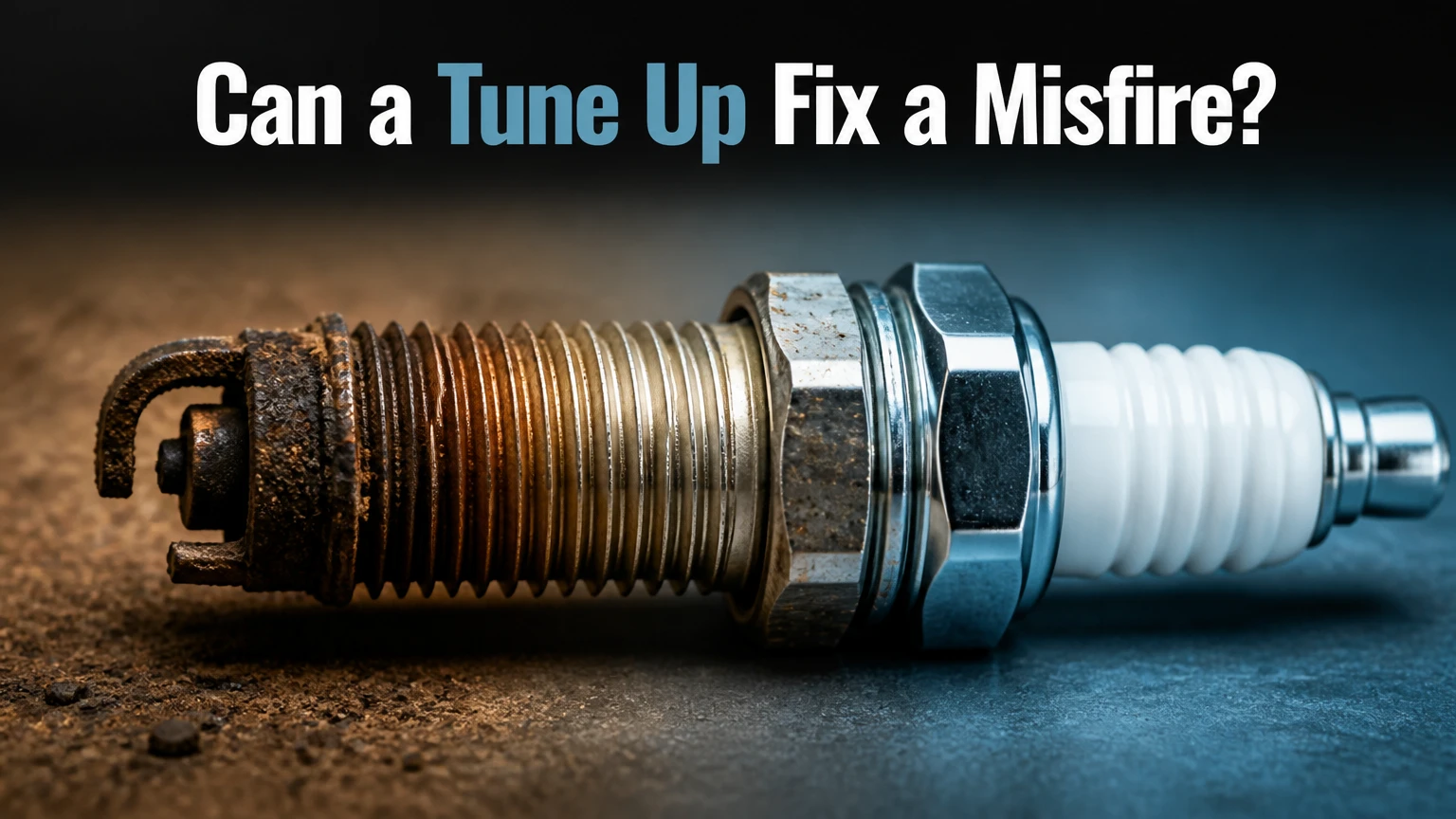
A tune-up can fix an engine misfire if the underlying cause stems from worn spark plugs, degraded ignition wires, or failing ignition coil boots. Replacing these worn ignition components resolves roughly 60% to 70% of all common engine misfires. However, if the misfire is caused by low mechanical compression, a clogged fuel injector, or an intake vacuum leak, a standard tune-up will not fix the problem.
Key Facts at a Glance
- Ignition Success Rate: A tune-up resolves between 60% and 70% of engine misfires caused by degraded spark components.
- Core Components Replaced: Modern tune-ups center on spark plugs, ignition coil boots, air filters, and plug wires where applicable.
- Diagnostic Code Range: Engine misfires trigger Diagnostic Trouble Codes (DTCs) ranging from P0300 (random/multiple) to P0312 (cylinder 12 specific).
- Non-Ignition Causes: A tune-up cannot repair mechanical compression loss, burned valves, vacuum leaks, or fuel pump delivery failures.
- Catalytic Converter Risk: Driving with an unaddressed, flashing Check Engine Light allows unburnt fuel to overheat and destroy the catalytic converter.
What Is an Engine Misfire and How Does It Occur?
An engine misfire occurs when the air-fuel mixture inside one or more internal combustion cylinders fails to ignite or burn efficiently during the power stroke. An engine requires four balanced factors to complete combustion: correct air volume, precise fuel delivery, sufficient mechanical compression, and a properly timed electrical spark. If any of these four elements drops below operating parameters, cylinder combustion fails.
       [Air Intake] + [Fuel Injection] + [Compression] + [Spark Pulse]
                                      │
                                      ▼
                        [Balanced Combustion Cycle]
                                      │
               ┌──────────────────────┴──────────────────────┐
               ▼                                             ▼
       [Optimal Power Output]                       [ELEMENT MISSING]
                                                             │
                                                             ▼
                                                    [ENGINE MISFIRE]
                                                             │
                                             ┌───────────────┴───────────────┐
                                             ▼                               ▼
                                   [P0300: Random Misfire]       [P0301-P0312: Specific Cylinder]
When a misfire happens, the engine’s Powertrain Control Module (PCM) detects a micro-deceleration in crankshaft rotational speed via the crankshaft position sensor. The computer logs this speed fluctuation as a combustion drop.
If the misfire frequency exceeds a calibrated emission threshold, the PCM illuminates the Check Engine Light (CEL). If the misfire is severe enough that raw, unburnt fuel enters the exhaust system, the CEL flashes continuously. A flashing light warns the driver that catalyst temperature spikes are actively threatening to melt the internal honeycomb structure of the catalytic converter.
What Does a Modern Engine Tune-Up Include?
A modern engine tune-up is a targeted preventive maintenance procedure designed to restore electrical efficiency and air flow to the combustion system. On modern vehicles equipped with electronic fuel injection (EFI) and computer-controlled distributorless ignition systems (DIS) or Coil-on-Plug (COP) architecture, a tune-up no longer involves adjusting points, ignition timing, or carburetor jets.
Primary Modern Tune-Up Components
- Spark Plugs: Replacement of worn platinum, double-platinum, or iridium plugs to maintain precise spark gap dimensions.
- Ignition Coil Boots / Wires: Replacement of silicon boots, spring connectors, or high-resistance spark plug cables to prevent voltage leaks.
- Engine Air Filter: Replacement of the intake air filter element to restore optimal mass airflow readings.
- PCV Valve (Positive Crankcase Ventilation): Replacement or cleaning to maintain proper crankcase pressure and prevent oil vapor contamination.
- Intake / Throttle Body Cleaning: Removal of carbon deposits around the throttle plate to restore correct idle air management.
Which Misfire Causes Can a Tune-Up Actually Fix?
A tune-up fixes misfires caused exclusively by electrical spark starvation or severe intake air restriction. Over thousands of miles, combustion system parts degrade physically and electrically, raising the minimum voltage needed to initiate a flame kernel.
[Weak or Intermittent Voltage] ──► [Spark Gap Over-Expansion] ──► [Dielectric Arc Failure] ──► [CYLINDER MISFIRE]
                                                                                                       │
[New Tune-Up Components]       ──► [Corrected Electrode Gap] ──► [Restored 30kV Voltage]  ──► [HEALTHY COMBUSTION]
1. Worn Spark Plug Electrodes
As spark plugs age, the electrical discharge gradually erodes the center and ground electrodes. This erosion expands the plug gap. A wider gap demands significantly higher secondary voltage from the ignition coil to bridge the space. Cold weather or high engine load increases this voltage demand further. If the required voltage exceeds the coil output capacity, the spark fails to jump the gap, causing a spark-based misfire.
2. Carbon Tracking and Insulation Breakdown
Over time, the ceramic insulator body of a spark plug can develop microscopic cracks or carbon tracks (thin lines of conductive carbon deposits). Electrical voltage takes the path of least resistance, traveling down the outside of the ceramic shell to the engine cylinder head rather than jumping the electrode gap inside the combustion chamber. New spark plugs and fresh insulating boots eliminate these flashover paths.
3. Degraded Ignition Coil Boots and Wires
In Coil-on-Plug systems, rubber boots seal the high-voltage connection between the ignition coil transformer and the tail of the spark plug. Engine heat, oil exposure, and ozone degrade this rubber, making it brittle and porous. High voltage leaks through degraded rubber to the surrounding cylinder wall. Installing new boots, wires, and internal spring contacts restores dielectric insulation strength.
4. Severe Air Intake Restriction
A heavily clogged engine air filter starves the intake manifold of oxygen, pulling the air-fuel ratio into a “rich” condition where excess unburned gasoline dampens spark propagation. Swapping the air filter restores intake volume, allowing the PCM to maintain a 14.7:1 stoichiometric air-to-fuel balance.
When Will a Tune-Up Fail to Fix a Misfire?
A tune-up will fail to fix a misfire when the underlying failure originates from mechanical compression loss, fuel delivery faults, sensor signal errors, or intake vacuum leaks. Replacing spark plugs on a cylinder with zero mechanical compression will not restore combustion.
                               ┌─────────────────────────────────────────┐
                               │     PERSISTENT POST-TUNE-UP MISFIRE     │
                               └────────────────────┬────────────────────┘
                                                    │
         ┌──────────────────────────────────────────┼──────────────────────────────────────────┐
         ▼                                          ▼                                          ▼
┌─────────────────┐                        ┌─────────────────┐                        ┌─────────────────┐
│   FUEL SYSTEM   │                        │ VACUUM / AIR    │                        │   MECHANICAL    │
├─────────────────┤                        ├─────────────────┤                        ├─────────────────┤
│• Bad Injector   │                        │• Cracked Hose   │                        │• Low Compression│
│• Weak Pump      │                        │• Intake Gasket  │                        │• Blown Gasket   │
│• Dirty Filter   │                        │• Sticky EGR     │                        │• Worn Rings     │
└─────────────────┘                        └─────────────────┘                        └─────────────────┘
Non-Ignition Misfire Root Causes
- Fuel Injector Failure: A dirty, clogged, or electrically shorted fuel injector prevents sufficient atomized gasoline from reaching the cylinder. This creates a “lean misfire.”
- Vacuum and Intake Leaks: Unmetered air entering through a split vacuum line, torn intake duct, or degraded intake manifold gasket leans out the air-fuel ratio. This condition is most pronounced at idle speed when manifold vacuum is high.
- Loss of Mechanical Compression: Physical engine damage prevents the cylinder from building the pressure required to compress the air-fuel mixture. Common causes include burned exhaust valves, stuck piston rings, scored cylinder walls, or a blown cylinder head gasket.
- Variable Valve Timing (VVT) Solenoid Malfunctions: Clogged VVT oil control valves cause camshaft timing to lag or over-advance, throwing off cylinder breathing dynamics.
- EGR System Stuck Open: An Exhaust Gas Recirculation valve stuck in the open position introduces excessive inert exhaust gas into the intake stream at idle, smothering the air-fuel charge.
How Do You Diagnose and Perform a Misfire Tune-Up Step by Step?
Executing a systematic diagnostic routine prevents unnecessary component replacement and identifies the exact source of a misfire before installation begins.
[Read OBD-II Codes] ──► [Swap Ignition Coils] ──► [Inspect Spark Plugs] ──► [Torque New Plugs] ──► [Apply Dielectric Grease]
Step 1: Extract Diagnostic Trouble Codes and Freeze Frame Data
Connect an OBD-II diagnostic scanner to the vehicle vehicle port beneath the driver side dashboard. Scan for active, pending, and historic trouble codes.
- P0300: Indicates a random or multiple cylinder misfire, often caused by common sources like low fuel pressure, mass air flow sensor faults, or system-wide vacuum leaks.
- P0301 through P0312: Indicates a misfire isolated to a specific cylinder number (for example, P0304 points directly to cylinder number 4).
Document the freeze frame data to understand engine temperature, RPM, engine load, and short-term fuel trim (STFT) values recorded at the exact moment the misfire code triggered.
Step 2: Perform an Ignition Component Isolation Test
To confirm whether a single ignition coil is failing before buying new parts, execute a component swap test:
- Identify the misfiring cylinder indicated by the DTC (for example, Cylinder 3 for code P0303).
- Remove the retaining bolt and disconnect the wiring harness from coil number 3.
- Swap ignition coil number 3 with ignition coil number 1 on healthy cylinder 1.
- Clear the diagnostic trouble codes using your scan tool.
- Start the engine and test drive under conditions matching the freeze frame log until the Check Engine Light returns.
- Re-scan the system:
- If the code changes to P0301, the fault moved with the coil. The coil is defective.
- If the code remains P0303, the fault stayed on cylinder 3. The issue is a spark plug, fuel injector, wiring fault, or compression issue.
Step 3: Remove and Read the Spark Plugs
Ensure the engine block is completely cold to prevent aluminum cylinder head thread stripping. Disconnect the negative battery cable. Blow compressed air around the spark plug well tubes to clear dirt, debris, and sand before tool insertion.
Unscrew the spark plug using a specialized magnetic or rubber-grommet spark plug socket attached to an extension. Inspect the firing tip condition to read cylinder combustion health:
┌───────────────────┬──────────────────────────────────┬──────────────────────────────────────────┐
│ Plug Condition    │ Visual Indicators                │ Primary Engine Root Cause                │
├───────────────────┼──────────────────────────────────┼──────────────────────────────────────────┤
│ Normal            │ Light tan or gray deposits       │ Healthy combustion process               │
│ Carbon Fouled     │ Fluffy, dry black soot           │ Rich air-fuel mixture, weak ignition     │
│ Oil Fouled        │ Wet, shiny black oily deposits   │ Leaking valve stem seals or piston rings │
│ Ash Deposits      │ Heavy white, crusty accumulation │ Oil burning from low-quality additives   │
│ Blistered/Melted  │ White ceramic, melted electrode  │ Severe lean condition, over-advanced spark│
└───────────────────┴──────────────────────────────────┴──────────────────────────────────────────┘
Step 4: Verify Gap and Torque New Plugs
Check the center-to-ground electrode gap on new spark plugs using a wire feeler gauge or wire gapping tool, matching factory specifications (typically between 0.028 in and 0.044 in / 0.7mm and 1.1mm). Do not force feeler tools against delicate iridium or platinum center electrode tips, as precious metal coatings chip easily.
Thread new spark plugs into the cylinder head by hand using only the socket and an extension. Turn clockwise until hand-tight to guarantee threads engage properly without cross-threading. Attach a calibrated torque wrench and tighten the plug to factory specification (typically 12 to 20 ft-lbs / 16 to 27 Nm depending on thread diameter and aluminum vs. iron head material).
Step 5: Apply Dielectric Compound and Reassemble
Apply a small bead of dielectric silicone grease directly to the interior rubber boot opening of the ignition coil or wire terminal. Do not cover the metal electrical terminals directly; grease belongs on the silicon boot wall to seal out moisture, stop flashover tracking, and prevent the rubber from vulcanizing onto the plug porcelain over time. Seat the coils onto the plugs until you feel a firm seal, tighten mounting bolts, reconnect electrical harness connectors, and clear all codes.
How Much Does a Tune-Up Cost Compared to Other Misfire Repairs?
Tune-up costs vary significantly based on engine layout, component selection, and labor complexity. V6 and V8 engines often require removing the upper intake manifold intake plenum to access rear cylinder bank spark plugs, increasing labor hours.
Estimated Cost Comparison Matrix
| Repair Service Category | Covered Components & Work Scope | Typical Material Cost | Typical Labor Cost | Total Industry Cost Range |
| Basic Maintenance Tune-Up | Standard Spark Plugs, Engine Air Filter | $40 – $110 | $100 – $200 | $140 – $310 |
| Comprehensive Ignition Tune-Up | Iridium Plugs, Coil Boots/Wires, Air Filter, Intake Clean | $120 – $320 | $180 – $450 | $300 – $770 |
| Master Ignition Overhaul | Plugs, All Ignition Coils, PCV Valve, Air Filters | $280 – $750 | $220 – $650 | $500 – $1,400 |
| Fuel Injector Replacement | Single or Set Fuel Injectors + O-Rings | $80 – $400 | $150 – $500 | $230 – $900 |
| Vacuum Leak / Intake Gasket Repair | Intake Manifold Gaskets, Vacuum Lines | $30 – $120 | $250 – $600 | $280 – $720 |
| Engine Mechanical Repair | Valve Job, Head Gasket, Piston Ring Work | $200 – $800 | $1,200 – $3,500 | $1,400 – $4,300+ |
What Should You Do If a Tune-Up Does Not Fix the Misfire?
If an engine continues to misfire after installing new spark plugs, wires, and coils, system troubleshooting must shift to fuel delivery, air sealing, and mechanical integrity tests.
[Persistent Misfire] ──► [Check Fuel Trims] ──► [Perform Smoke Test] ──► [Run Compression Test]
1. Evaluate Fuel Trims with a Scan Tool
Read Live Data on your scanner to inspect Short Term Fuel Trim (STFT) and Long Term Fuel Trim (LTFT).
- Positive Fuel Trims Above +10%: Indicates the engine computer is adding excess fuel because it detects a lean condition. Look for vacuum leaks, unmetered air entering past the Mass Air Flow (MAF) sensor, or low fuel pressure.
- Negative Fuel Trims Below -10%: Indicates the computer is cutting fuel due to a rich condition. Look for leaking fuel injectors or a sticking purge valve.
2. Smoke Test the Intake System
Connect an automotive diagnostic smoke machine to an intake vacuum port. Inject dense mineral oil smoke into the closed engine intake system at low pressure (1-2 PSI). Watch for smoke escaping around intake gaskets, throttle body seals, brake booster lines, or split vacuum hoses to pinpoint unmetered air leaks.
3. Perform a Compression and Cylinder Leak-Down Test
Remove spark plugs and thread a mechanical compression gauge into the misfiring cylinder’s spark plug port. Disable fuel injection, open the throttle plate fully, and crank the engine over 5 compression strokes.
- Standard Target: A healthy cylinder builds between 125 and 175 PSI.
- Variance Rule: Pressure values across all cylinders should remain within a 10% tolerance band of each other.
- Low Compression Fix: If a cylinder registers below 90 PSI or drops more than 15% below adjacent cylinders, run a wet compression test by adding 1 teaspoon of clean engine oil into the cylinder. If compression rises significantly, piston rings are worn. If compression stays low, an intake/exhaust valve is burned or sealed improperly, or the head gasket is compromised.
What Are the Most Common Installation Errors During a Tune-Up?
Avoid these common mechanical mistakes during a misfire repair tune-up to prevent engine damage or immediate component failure.
- Cross-Threading Spark Plugs in Aluminum Heads: Threading a steel plug shell crookedly into soft aluminum head threads destroys cylinder head threading. Always start threading plugs using hand pressure only for at least 4 to 5 full turns before attaching sockets or wrenches.
- Ignoring Cold Engine Working Requirements: Extracting spark plugs from a hot engine causes aluminum threads to expand and lock onto steel plug bodies, tearing out internal threads during removal. Always allow the engine block to cool to ambient temperature.
- Skipping Pre-Installation Gap Inspections: Never assume factory spark plugs out of the box carry the correct gap setting. Drop impacts during transit can compress ground electrodes down to zero gap, causing an immediate total misfire upon starting.
- Over-Torquing or Under-Torquing Plugs: Under-torquing allows high-pressure combustion gas to blow past the plug seat gasket, damaging coil boots. Over-torquing stretches plug shells, warps ceramic insulators, or strips cylinder head threads.
- Mixing Up Ignition Wire and Harness Routing: Unplugging multiple ignition coil connectors or plug wires simultaneously without marking cylinder numbers can scramble firing order sequences. Scrambled connections cause engine backfiring and severe misfires. Label every cable with tape matching its cylinder number prior to removal.
Frequently Asked Questions
Can I drive my car with a misfire if I plan to get a tune-up soon?
No, you should avoid driving a vehicle with an active engine misfire, especially if the Check Engine Light is flashing. A flashing light signals that unburnt fuel is flowing through the exhaust manifold into the catalytic converter. Unburnt fuel ignites inside the converter, pushing temperatures past 1,600 degrees Fahrenheit (870 degrees Celsius) and melting its internal structure, causing costly secondary damage.
Will changing spark plugs alone fix a P0300 code?
Changing spark plugs alone may fix a P0300 code if all spark plugs are worn evenly, but P0300 indicates a random or multiple cylinder misfire. Random misfires are often caused by common fuel or air intake system faults, such as low fuel pressure, a contaminated mass air flow sensor, or a main intake vacuum leak. Diagnose root causes fully before replacing parts.
How often does a modern car need a tune-up to prevent misfires?
Modern vehicles using iridium or platinum spark plugs typically require an ignition tune-up every 60,000 to 100,000 miles (96,000 to 160,000 km). Conventional copper spark plugs used in older or high-performance vehicles demand shorter service intervals of 30,000 to 45,000 miles (48,000 to 72,000 km).
How can I tell if a misfire is caused by a coil or a spark plug?
Perform an ignition component swap test to distinguish between a faulty coil and a worn spark plug. Swap the suspect cylinder’s ignition coil to an adjacent healthy cylinder while leaving the spark plug in place. If the misfire trouble code moves to the new cylinder number, the coil is broken. If the misfire remains on the original cylinder, inspect the spark plug, fuel injector, or mechanical compression.
Why does my engine misfire only at idle or under acceleration?
A misfire occurring only at idle is typically caused by a vacuum leak or dirty throttle body, as intake manifold vacuum is highest when the throttle plate is closed. A misfire occurring specifically under heavy load or hard acceleration is usually caused by weak ignition components (worn plugs or failing coils) or low fuel delivery pressure, where higher cylinder pressures require maximum electrical voltage to spark.
The Bottom Line
A standard tune-up is an effective initial step for resolving engine misfires caused by worn spark plugs, degraded wires, or failing ignition coil boots, fixing 60% to 70% of common cases. However, if diagnostic codes or post-repair symptoms point to fuel starvation, vacuum leaks, or mechanical compression loss, performing a tune-up alone will not solve the problem. Follow a structured diagnostic process: scan for OBD-II trouble codes, swap ignition coils to isolate electrical failures, and confirm compression health to fix your engine misfire accurately and cost-effectively.


