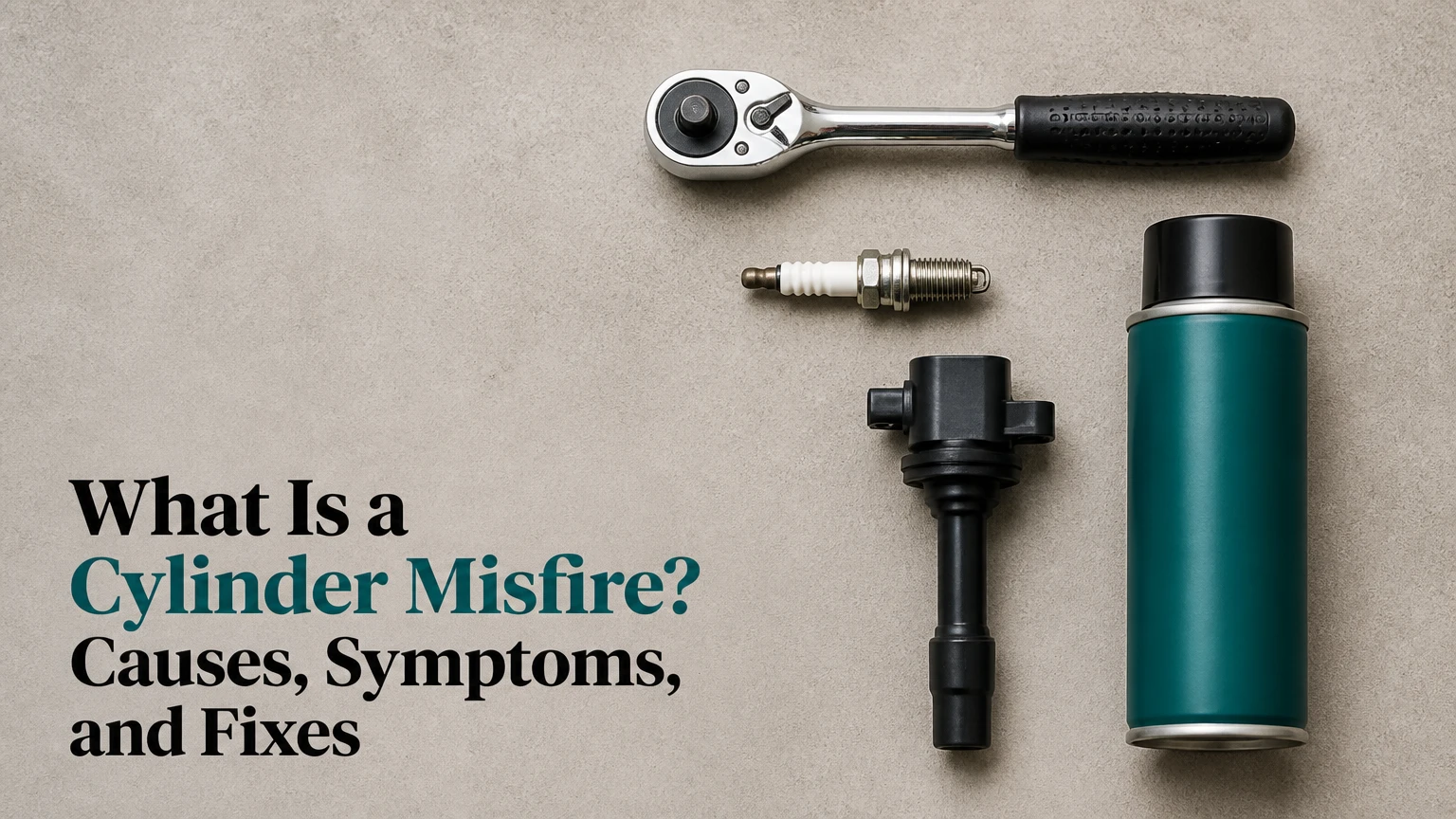
A cylinder misfire is an internal combustion engine operational failure where an individual cylinder fails to generate power during its combustion stroke. This condition occurs when the air-fuel mixture inside the combustion chamber fails to ignite, ignites at the incorrect time, or lacks sufficient compression pressure to drive the piston downward.
At a Glance
- OBD-II systems illuminate a solid Check Engine Light when a cylinder misfire rate exceeds 2 percent over 100 engine revolutions.
- A flashing Check Engine Light indicates a critical misfire rate above 10 to 15 percent, risking immediate catalytic converter destruction.
- Misfires stem from three fundamental requirements: ignition spark failure, air-fuel delivery imbalance, or mechanical compression loss.
- Healthy engine cylinders maintain 120 to 180 PSI of compression, with less than a 10 percent variance between cylinders.
- Driving with an active misfire can dump unburned gasoline into the exhaust, melting the catalytic converter within minutes.
What does a cylinder misfire feel and sound like while driving?
A cylinder misfire creates distinct physical and auditory symptoms caused by unbalanced rotational force on the engine crankshaft. When one cylinder fails to fire, the crankshaft loses its expected torque impulse, causing an uneven power cycle that propagates through the powertrain.
Drivers typically experience the following warning signs:
- Pulsing Jerk or Hesitation: During acceleration, the vehicle stutters or jerks rhythmically as the dead cylinder fails to produce power under load.
- Rough Engine Idle: At a standstill, the engine shakes abnormally, sending vibrations through the steering wheel, floorboards, and seat frames.
- Stumbling Exhaust Note: The exhaust pipe emits a popping, sputtering, or uneven puffing sound rather than a smooth, continuous hum.
- Reduced Fuel Economy: Unburned fuel gets pumped straight into the exhaust system, causing fuel consumption to drop by 15 to 25 percent.
- Sluggish Response: The engine loses horsepower, requiring deeper accelerator pedal input to maintain highway speeds.
If the misfire occurs under heavy engine load (such as climbing a steep hill or towing), the shaking will intensify sharply as fuel demands increase.
How does an engine’s OBD-II system detect a cylinder misfire?
An onboard diagnostic system (OBD-II) detects a cylinder misfire by constantly measuring microscopic changes in crankshaft rotational speed. The engine control module (ECM) uses the crankshaft position sensor to measure the exact time in milliseconds it takes for the crankshaft to rotate through each cylinder’s power stroke.
When a healthy cylinder fires, the explosion accelerates the crankshaft briefly. If a cylinder misfires, its power stroke fails to accelerate the shaft, causing a minute rotational deceleration. The ECM compares these timing measurements against pre-programmed engine speed profiles:
- 2 Percent Threshold (Solid Light): If a cylinder misfires more than 2 times out of 100 engine revolutions, the ECM stores a non-continuous diagnostic trouble code (DTC) and turns on the solid Check Engine Light.
- 10 to 15 Percent Threshold (Flashing Light): If the misfire rate reaches 10 to 15 percent over 200 to 1000 engine revolutions, the ECM recognizes an immediate hazard to catalytic components and flashes the Check Engine Light continuously.
What OBD-II trouble codes indicate a cylinder misfire?
OBD-II trouble codes for cylinder misfires range from P0300 to P0312, where the final two digits pinpoint the exact faulty cylinder location. Interpreting these diagnostic codes allows technicians to isolate whether an issue is isolated to one combustion chamber or widespread across the entire engine block.
| Diagnostic Code | Code Description | Typical Primary Causes |
| P0300 | Random / Multiple Cylinder Misfire Detected | Vacuum leaks, low fuel pressure, faulty mass air flow sensor, worn crankshaft sensor. |
| P0301 | Cylinder 1 Misfire Detected | Bad spark plug #1, failed ignition coil #1, clogged fuel injector #1, low cylinder 1 compression. |
| P0302 | Cylinder 2 Misfire Detected | Bad spark plug #2, failed ignition coil #2, clogged fuel injector #2, low cylinder 2 compression. |
| P0303 – P0308 | Cylinder 3 through 8 Misfire Detected | Individual ignition, fuel injector, or valve mechanical failure in the designated cylinder number. |
| P0316 | Misfire Detected On Startup (First 1000 Revolutions) | Intake valve carbon buildup (GDI), leaking fuel injector, weak battery during cold crank. |
How do you tell if a misfire is caused by spark, fuel, or compression?
You determine whether a misfire is caused by spark, fuel, or compression by using a systematic process of elimination that isolates each subsystem individually. Testing components in order prevents unnecessary parts replacement and isolates root mechanical faults.
Step-by-Step System Isolation
- Test the Spark System: Remove the ignition coil from the misfiring cylinder (for example, Cylinder 1) and swap it with a healthy cylinder (such as Cylinder 2). Clear the codes and run the engine. If the misfire code moves from P0301 to P0302, the ignition coil is defective. If the code stays at P0301, inspect the spark plug gap. Standard plug gaps range between 0.030 and 0.060 inches. A gap variance exceeding 0.005 inches outside manufacturer specs can cause high-load spark blowout.
- Test the Fuel System: If ignition components are healthy, listen to the misfiring cylinder’s fuel injector using a mechanic’s stethoscope while the engine idles. A rapid clicking sound confirms electrical operation. If no sound is heard, check the injector’s resistance with a multimeter (typically 11 to 18 ohms for high-impedance injectors).
- Test Engine Compression: If spark and fuel function properly, thread a mechanical pressure gauge into the spark plug hole and crank the engine. Healthy engines show 120 to 180 PSI per cylinder. Readings below 100 PSI, or a variance greater than 10 percent between cylinders, confirm a mechanical breakdown such as a burnt valve, blown head gasket, or damaged piston ring.
Why does an engine misfire only at idle but clear up when accelerating?
An engine that misfires at idle but runs smoothly upon acceleration is almost always suffering from a manifold vacuum leak or an intake air leak downstream of the mass air flow sensor. Vacuum leaks introduce unmetered air into the combustion chamber, destabilizing the air-fuel ratio.
At idle, the throttle plate is nearly closed, creating high manifold vacuum (typically 17 to 21 inches of mercury). A small gasket leak or cracked vacuum hose allows outside air to enter, creating an extremely lean mixture that fails to ignite. When the driver depresses the gas pedal, the throttle plate opens wide, allowing massive volumes of air through the main intake. The extra air entering through the tiny vacuum leak becomes statistically negligible relative to total airflow, restoring proper combustion balance at higher RPMs.
Why does a car misfire only in rainy or humid weather?
A car misfires in rainy or humid weather because atmospheric moisture degrades damaged electrical insulation on high-voltage ignition components. Rain drops and humidity form a conductive film over hairline cracks in spark plug boots, ignition wires, and plastic coil packs.
Ignition coils convert 12-volt battery power into 25,000 to 50,000 volts of electricity to jump the spark plug gap. When ambient humidity is high, this high-voltage current follows the path of least resistance through microscopic rubber cracks and arcs directly onto the metal engine block. This stray electrical grounding prevents the spark plug electrode from receiving voltage, causing a total misfire until the engine bay warms up and evaporates the moisture.
What is a ghost misfire and what triggers a false P0300 code?
A ghost misfire is a diagnostic false-alarm where the engine control module logs a P0300 multiple-misfire code despite smooth, complete fuel combustion taking place inside every cylinder. This occurs because OBD-II systems infer misfires solely from crankshaft vibration and speed changes rather than physical combustion sensors inside the cylinders.
Common causes of false misfire codes include:
- Faulty Crankshaft Position Sensor: Internal sensor signal degradation or metallic debris buildup on the sensor tip causes erratic speed readings that the ECM misinterprets as misfires.
- Damaged Flywheel or Flexplate: A cracked flexplate, loose mounting bolt, or chipped ring-gear tooth creates mechanical wobble, triggering vibration patterns that mirror cylinder misfires.
- Low Fuel Tank Slosh: Driving aggressively on a fuel tank filled below 1/16th capacity allows air pockets into the fuel pump intake. The momentary drop in line pressure creates a transient lean condition, setting a false P0300 code.
- Severe Dual-Mass Flywheel Wear: Worn internal damper springs inside a dual-mass flywheel introduce rotational harmonics that trick the ECM into logging misfire events.
Why do GDI engines develop cold-start misfires that vanish when warm?
Gasoline Direct Injection (GDI) engines develop cold-start misfires due to carbon accumulation on the backside of intake valves. Unlike traditional Port Fuel Injection (PFI) systems, GDI injectors spray fuel directly into the combustion chamber rather than over the intake valves.
Because raw gasoline never washes across the intake valves, oil vapor from the Positive Crankcase Ventilation (PCV) system bakes onto the hot intake valves, forming thick, sponge-like carbon crusts. During a cold start, these dry carbon deposits absorb the atomized fuel entering the cylinder, creating an excessively lean air-fuel mixture that misfires. Once the engine reaches full operating temperature, the carbon becomes saturated with fuel and valve metals expand, eliminating the lean condition until the next cold cycle. Replacing spark plugs cannot solve this issue; the valves must be physically cleaned using walnut shell blasting.
How does carbon tracking ruin a new ignition coil?
Carbon tracking occurs when high-voltage electricity burns a permanent carbonized pathway across the ceramic insulator body of a spark plug. This condition is triggered by worn plug gaps, oil contamination, or degraded rubber spark plug boots.
When high voltage arcs over the outside of the spark plug ceramic rather than across the electrode tip, it burns a microscopic, conductive carbon track into the ceramic glazed shell. If a mechanic replaces a failed ignition coil but leaves the old, carbon-tracked spark plug installed, the high voltage from the new coil will instantly follow the existing carbon line down the plug body. This arc shorts out the new coil boot and damages its internal secondary windings, destroying the replacement coil within days or even miles of installation.
Why does an ignition coil pass a bench test but misfire on the road?
An ignition coil can pass a cold bench test with a multimeter because thermal expansion and high electrical stress only manifest under actual engine operating conditions. Cold resistance tests measure primary and secondary coil wire resistance under zero electrical load at ambient room temperatures.
Inside an ignition coil, miles of hair-thin copper wire are wrapped into tight secondary windings insulated by thin enamel coatings. As the vehicle operates, engine bay heat causes the internal copper wiring and plastic housing to expand. Thermal expansion pulls hair-thin internal fractures apart, breaking electrical continuity once the engine gets hot. Furthermore, an ignition coil requires up to 35,000 volts to jump a spark gap under combustion chamber pressure, whereas a standard digital multimeter tests with less than 9 volts of direct current under zero pressure.
Can you drive with a cylinder misfire?
You cannot safely drive a vehicle with an active cylinder misfire if the Check Engine Light is flashing. A flashing light signifies a severe misfire rate above 10 to 15 percent, which dumps raw, unburned gasoline directly into the exhaust manifold and catalytic converter.
Unburned fuel inside a hot catalytic converter ignites on the internal ceramic honeycomb substrate, raising temperatures above 1,600 degrees Fahrenheit. This intense heat melts the internal catalyst bricks, creating exhaust blockages that can ignite engine bay fires and cause thousands of dollars in secondary structural damage. If your Check Engine Light is solid, you may drive cautiously at low speeds to a nearby repair facility. If the light blinks continuously, pull off the road safely and call a tow truck immediately.
What happens if you ignore a cylinder misfire for too long?
Ignoring a cylinder misfire leads to severe mechanical engine breakdown and catastrophic exhaust system damage over time. The unburned air-fuel mixture and mechanical imbalances caused by a dead cylinder trigger a cascade of secondary failures:
- Catalytic Converter Meltdown: Excess fuel destroys the precious metals (platinum, palladium, rhodium) inside the exhaust catalyst, leading to replacement costs ranging between $1,000 and $3,000.
- Cylinder Wall Scuffing: Raw gasoline washes away protective oil films on cylinder walls, causing piston ring friction that scores cylinder bores and damages engine compression permanently.
- Engine Oil Dilution: Gasoline blows past worn piston rings into the oil pan, thinning crankcase oil. Diluted oil loses its lubricating film strength, causing accelerated main bearing and camshaft wear.
- Hydro-Locking Damage: A stuck-open fuel injector continuously fills an inactive cylinder with liquid fuel. Because liquids cannot compress, cranking the engine bends connecting rods and cracks engine blocks.
How much does it cost to fix a cylinder misfire?
Fixing a cylinder misfire costs anywhere from $100 to over $3,000 depending on whether the root cause is electrical, fuel-related, or mechanical. Diagnostic labor typically ranges between $100 and $200 before repairs begin.
| Failure Category | Specific Component Issue | Average Repair Cost Range |
| Basic Electrical | Spark plug replacement (set of 4 to 8) | $100 – $300 |
| Ignition Components | Single ignition coil pack replacement | $150 – $350 |
| Fuel System | Single fuel injector replacement | $250 – $600 |
| Induction Maintenance | GDI intake valve walnut blasting | $400 – $800 |
| Vacuum Leaks | Intake manifold gasket replacement | $300 – $700 |
| Severe Mechanical | Blown head gasket, valve job, or piston repair | $1,800 – $4,000+ |
How do you fix a cylinder misfire step by step?
Fixing a cylinder misfire requires a systematic diagnostic workflow to isolate component failure without wasting money on unneeded auto parts.
1.Scan for Diagnostic Trouble Codes:Identify specific cylinder locations using an OBD-II scanner.
Plug an OBD-II code scanner into the port beneath the driver dashboard. Document all active, pending, and permanent codes (such as P0300 or P0303) to pinpoint whether the misfire is isolated or random.
2.Perform Component Swapping:Isolate ignition coil and spark plug faults.
Remove the ignition coil and spark plug from the misfiring cylinder. Swap the coil to an adjacent cylinder and install a fresh spark plug correctly gapped to factory specifications. Clear the codes and test drive the vehicle.
3.Inspect Fuel and Air Systems:Check fuel delivery and intake integrity.
If the code remains on the original cylinder, test fuel injector pulse with a multimeter or stethoscope. Inspect intake manifolds, PCV hoses, and vacuum lines for leaks using smoke testing or soapy water solutions.
4.Conduct Compression and Leak-Down Testing:Verify internal engine mechanical condition.
If spark and fuel systems function correctly, perform a mechanical compression test across all cylinders. Verify that cylinder pressures exceed 100 PSI and stay within a 10 percent variance across the engine block.
The Bottom Line
A cylinder misfire signals that an engine cylinder has lost its ability to convert fuel into mechanical rotational energy due to missing spark, incorrect fuel delivery, or lost cylinder compression. Diagnosing misfires accurately requires swapping ignition components to trace codes and measuring cylinder compression thresholds. Never drive with a flashing Check Engine Light, as unburned fuel will ruin your catalytic converter within minutes.


