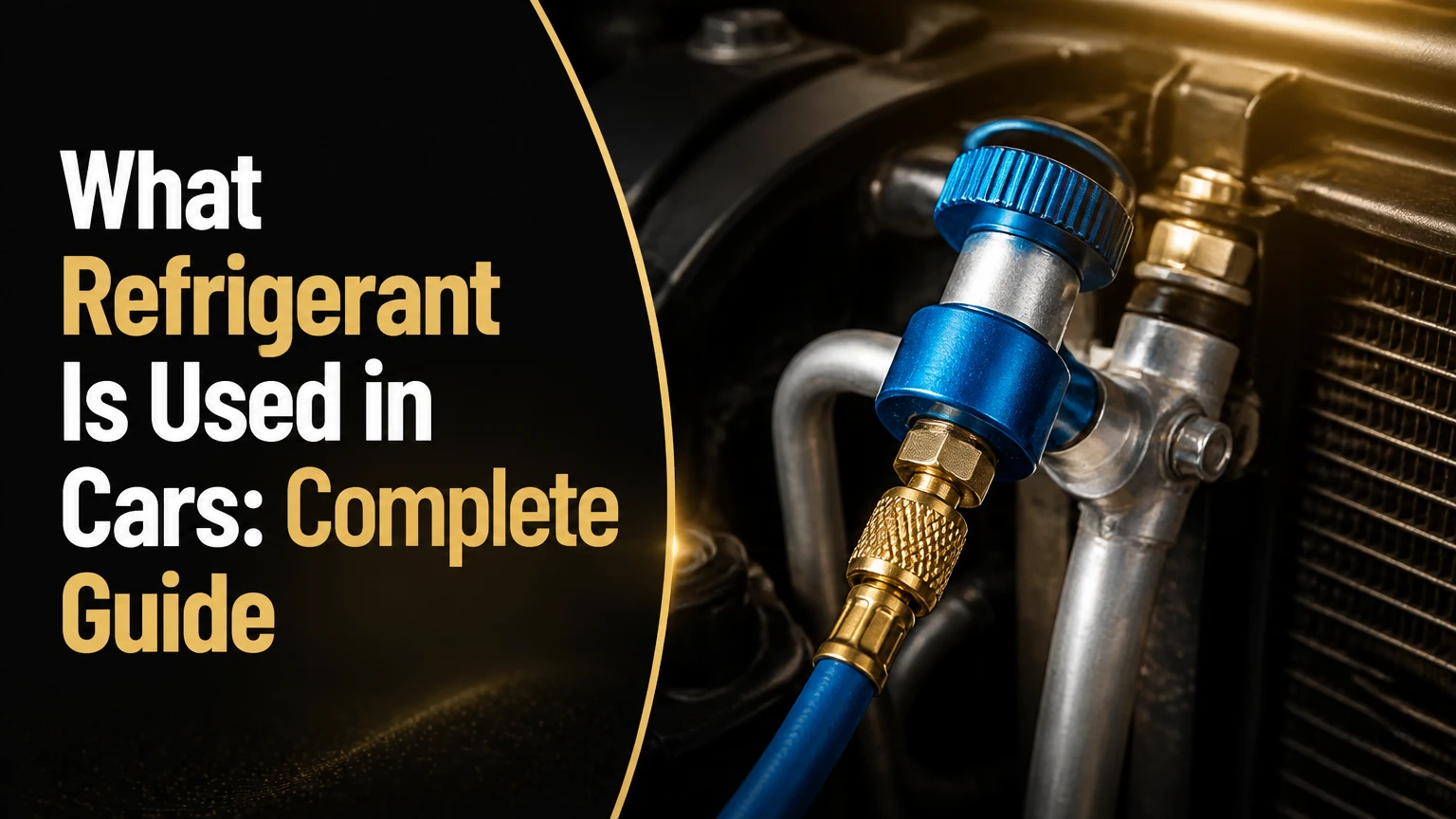
Modern vehicles primarily use R-134a or R-1234yf refrigerant. Cars manufactured between 1994 and 2013 typically rely on R-134a, while vehicles built after 2017 predominantly use the environmentally friendly R-1234yf. This specialized fluid cycles continuously between liquid and gas states under extreme pressure to extract cabin heat and release it into the outside air.
Key Facts / At a Glance
- R-1234yf is mandatory in all new vehicles sold in the US and Europe to meet strict global warming potential regulations.
- Mixing different automotive refrigerants causes catastrophic compressor failure and destroys professional recovery equipment.
- Older R-134a systems operate at similar pressures to modern R-1234yf setups, but the two chemicals require entirely different, incompatible service fittings.
- Electric vehicles and hybrids require specialized POE compressor oils because standard PAG oils conduct electricity and pose a severe high-voltage shock hazard.
- A standard professional evacuation and recharge service typically takes 45 to 90 minutes.
How Do I Know What Refrigerant Is Used in Cars?
You can identify the exact refrigerant used in your car by locating the Vehicle Emission Control Information label or the dedicated Air Conditioning specification sticker under the hood. Automakers place this label on the radiator fan shroud, the underside of the hood, or the front core support.
This sticker provides three pieces of non-negotiable data for servicing your system. First, it identifies the chemical type, printing either R-134a or R-1234yf in large bold letters. Second, it lists the total system charge weight in ounces and grams. AC systems require a highly precise amount of fluid to function, and guessing the volume based on pressure alone often leads to compressor damage. Third, the label specifies the correct compressor oil, typically a variant of PAG (Polyalkylene Glycol) or POE (Polyolester).
If the sticker is missing due to a collision repair, the service ports offer a secondary clue. The automotive industry uses distinct physical fittings for different chemicals. R-134a utilizes standard quick-disconnect fittings, while R-1234yf ports are distinctly larger and require specific couplers. This physical difference prevents technicians and DIY mechanics from accidentally cross-contaminating the systems.
The 4 Primary Types of Automotive Refrigerant
Automotive manufacturers have transitioned through several distinct chemical compounds over the last five decades, driven entirely by evolving environmental regulations. The transition from ozone-depleting chemicals to greenhouse gases, and finally to low-impact hydrofluoroolefins, dictates exactly how your car is serviced today.
R-12 (Freon)
Vehicles built prior to 1994 used R-12, a chlorofluorocarbon (CFC) commercially known as Freon. The industry abandoned this chemical after global environmental treaties linked CFCs directly to the depletion of the Earth’s ozone layer. Under current Environmental Protection Agency (EPA) regulations, manufacturing R-12 is illegal. You cannot purchase it for automotive use, and any pre-1994 vehicle still on the road must be legally retrofitted to accept modern refrigerants. R-12 systems utilized mineral oil for lubrication and operated at slightly lower pressures than modern equivalents.
R-134a (HFC-134a)
Automakers adopted R-134a as the global standard from 1994 through roughly 2014. This hydrofluorocarbon (HFC) solved the ozone depletion problem entirely, but scientists later realized it possessed a high Global Warming Potential (GWP). One pound of R-134a traps roughly 1,430 times more atmospheric heat than one pound of carbon dioxide. R-134a relies on PAG oil for compressor lubrication. While highly effective at cooling, the chemical faces aggressive phase-downs, production limits, and heavy taxation in modern markets to discourage its long-term use.
R-1234yf (HFO-1234yf)
R-1234yf represents the current global standard for automotive air conditioning. The European Union mandated its use starting in 2017, and the United States market fully adopted it for nearly all light-duty vehicles by 2021. This hydrofluoroolefin (HFO) breaks down in the atmosphere within 11 days, resulting in a GWP of less than 1. R-1234yf provides cooling efficiency nearly identical to R-134a, but it carries an A2L classification, meaning it is mildly flammable under specific extreme conditions. Consequently, shops must use highly specialized, spark-free recovery machines to service these vehicles.
R-744 (Carbon Dioxide)
A small subset of German luxury vehicles and select electric vehicles utilize R-744, which is highly purified carbon dioxide. Carbon dioxide serves as the baseline for global warming metrics, giving it a GWP of exactly 1. While completely non-flammable and environmentally benign, R-744 requires operating pressures exceeding 1,500 PSI, roughly ten times higher than standard AC systems. This extreme pressure requires heavy, thick-walled steel components, making the systems too expensive and heavy for widespread adoption in economy vehicles.
Refrigerant Specifications and System Compatibility
When comparing automotive AC chemicals, engineers evaluate environmental impact, safety classifications, and the physical pressures required to achieve optimal cooling. The table below outlines the core attributes of the four main automotive compounds.
| Refrigerant Type | Global Warming Potential | Flammability Rating | Operating Pressure Range | Required Compressor Lubricant |
| R-12 | 10,900 (Extreme) | A1 (Non-flammable) | Low to Moderate | Mineral Oil |
| R-134a | 1,430 (High) | A1 (Non-flammable) | Moderate to High | PAG Oil (Standard) |
| R-1234yf | < 1 (Ultra-Low) | A2L (Mildly Flammable) | Moderate to High | Specific yf-rated PAG or POE |
| R-744 ($CO_2$) | 1 (Baseline) | A1 (Non-flammable) | Extremely High (10x normal) | Specialized PAG |
How Does Car Air Conditioning Actually Work?
Car air conditioning systems rely on thermodynamic pressure changes to move heat out of the cabin. The system does not create cold air. Instead, it absorbs heat from the passenger area and mechanically forces that heat into the outside atmosphere. This continuous cycle requires four major mechanical stages.
1. Compress and Heat
The engine-driven or electric compressor serves as the heart of the system. It draws in low-pressure, low-temperature refrigerant gas from the cabin. The compressor rapidly squeezes this gas, packing the molecules tightly together. This mechanical compression converts the fluid into a high-pressure, high-temperature gas, often exceeding 200 degrees Fahrenheit on hot days.
2. Condense and Liquefy
The boiling hot gas flows forward into the condenser, which sits just behind the vehicle’s front grille. As you drive, ambient outside air rams through the condenser fins, assisted by electric radiator fans. Because the gas inside the condenser is hotter than the outside air, heat transfers outward. As the heat escapes, the gas condenses into a high-pressure liquid.
3. Expand and Chill
The high-pressure liquid travels toward the cabin and encounters a precise restriction point, typically a Thermal Expansion Valve (TXV) or an Orifice Tube. As the liquid forces its way through this tiny opening, it enters a larger chamber, causing the pressure to drop instantly. This rapid depressurization forces the liquid to boil at a low temperature, transforming it into an ice-cold mixture of liquid and vapor.
4. Evaporate and Absorb
This freezing mixture enters the evaporator core hidden deep behind your dashboard. The interior blower motor pushes warm cabin air through the icy fins of the evaporator. The cold refrigerant absorbs the heat from the cabin air, dropping the air temperature significantly before it flows through your vents. Having absorbed the heat, the fluid transforms entirely back into a low-pressure gas and travels back to the compressor to restart the cycle.
How Much Does an AC Recharge Cost?
Recharging your air conditioning system ranges from $25 for a basic DIY top-off to over $700 for a complex professional service on a modern vehicle. The massive price disparity stems directly from the cost of the raw chemicals and the strict equipment requirements for handling them legally.
R-134a remains relatively inexpensive, though aggressive EPA phase-downs continue to drive the price upward each year. DIY kits containing simple trigger-style gauges are widely available at auto parts stores. Professional shops charge moderate rates for R-134a service because the recovery machines are ubiquitous and the gas itself is affordable in 30-pound bulk cylinders.
Conversely, R-1234yf carries a steep premium. Chemical giants Honeywell and Chemours hold strict patents on the manufacturing process, keeping the wholesale cost exponentially higher than legacy compounds. Furthermore, because R-1234yf is mildly flammable, independent repair shops had to invest upwards of $5,000 to $8,000 in new, spark-free recovery machines to service these cars legally. Shops pass both the chemical cost and the equipment overhead directly to the consumer.
| Service Category | R-134a Price Range | R-1234yf Price Range | Estimated Service Time |
| DIY Retail Canister | $25 to $60 | $40 to $90 | 15 to 30 minutes |
| Professional Evacuate & Recharge | $100 to $250 | $300 to $700 | 45 to 90 minutes |
| Leak Diagnostic Testing | $50 to $100 | $100 to $150 | 30 to 60 minutes |
| Complete System Flush & Fill | $250 to $400 | $500 to $900+ | 2 to 4 hours |
What Are the Most Common DIY Recharge Mistakes?
Attempting to service your own AC system without professional equipment often leads to thousands of dollars in mechanical damage. Automotive AC systems demand extreme precision, and the cheap trigger gauges found in retail auto parts stores provide a dangerously incomplete picture of system health.
Using Stop-Leak Additives
Avoid chemical sealants at all costs. Retail cans heavily advertise stop-leak formulas designed to swell O-rings and block microscopic holes. However, these sealants harden when exposed to air and moisture. They routinely clog expansion valves, requiring a complete dashboard removal to replace the evaporator. A standard rule of thumb among ASE certified technicians is to outright refuse service on any vehicle that tests positive for chemical sealants, as these additives will instantly destroy the shop’s expensive recovery equipment.
Mixing Different Refrigerants
Never cross-contaminate R-134a and R-1234yf. Impatient owners sometimes attempt to force cheaper R-134a gas into modern R-1234yf systems using adapter fittings. This chemical mixture alters the boiling point of the fluid, completely ruining the cooling efficiency. Worse, it creates an unrecyclable cocktail that triggers automated lockouts on professional AC machines. Shops will charge you a massive hazard fee to extract and dispose of contaminated fluid.
Overcharging the System
Adding too much gas raises the high-side head pressure beyond safe operating limits. When you force extra fluid into a system trying to get colder air, the compressor has to work much harder to compress the increased volume. Modern vehicles feature high-pressure cutoff switches that will instantly disable the compressor clutch to prevent explosions. If your system is full but blowing warm air, adding more gas will only trigger a shutdown.
Ignoring the Vacuum Stage
Skipping the deep evacuation process leaves air and moisture trapped inside the lines. When moisture mixes with fluorinated refrigerants and compressor oil, it creates highly corrosive hydrofluoric or hydrochloric acid. This acid silently eats away at the aluminum lines and internal compressor bearings from the inside out. Professionals use micron gauges and heavy-duty vacuum pumps to boil off system moisture before injecting new fluid.
How to Troubleshoot Common Car AC Problems
Diagnosing an underperforming AC system requires understanding the relationship between pressure, temperature, and airflow. The chart below outlines the most frequent failures, their underlying causes, and the required actions.
| AC Symptom | Primary Cause | Required Diagnostic Step | Repair Complexity |
| Blows completely warm air | Low fluid from a leak, or blown compressor fuse | Check static pressures with a manifold gauge; test electrical relays | Moderate to High |
| Works only at highway speeds | Condenser fan failure or blocked front grille | Verify both radiator fans spin up when AC is engaged | Low to Moderate |
| Rapid clicking from engine bay | Compressor short-cycling due to low pressure | Hook up gauges to verify low-side pressure drop | Moderate |
| Musty smell from vents | Mold buildup on the dark, damp evaporator core | Apply foaming evaporator cleaner through the condensation drain tube | Low |
| Water pooling on passenger floor | Clogged condensation drain tube | Locate the rubber drain tube under the chassis and clear debris | Low |
Oil Compatibility: Why PAG and POE Oils Matter
The refrigerant gas alone cannot keep the mechanical compressor alive. The system requires specialized oil suspended in the gas to lubricate the moving metal parts. Using the wrong oil will destroy a compressor in a matter of days.
Standard internal combustion vehicles utilize PAG oil. PAG oil is highly hygroscopic, meaning it absorbs moisture rapidly from the atmosphere if left uncapped. Automotive engineers formulate PAG oil in different viscosities, typically PAG 46, PAG 100, or PAG 150. You must use the exact viscosity stated on your underhood label to maintain proper lubrication at extreme temperatures.
Hybrid and electric vehicles present a unique and dangerous variable. These vehicles use high-voltage electric compressors rather than belt-driven units. Standard PAG oil conducts electricity. If you inject PAG oil into a Prius or a Tesla, the high-voltage current from the compressor windings will travel through the fluid directly into the vehicle’s metal chassis. This creates a lethal shock hazard for technicians and drivers. Therefore, electric and hybrid vehicles mandate the use of strictly non-conductive POE (Polyolester) oil.
Expert Recommendations for System Longevity
Regular usage prevents the vast majority of air conditioning failures. Run your car’s AC for at least five minutes every single month, even in the dead of winter. The circulating fluid carries the compressor oil throughout the system. This oil coats the rubber O-rings and front shaft seals, keeping them pliable. When a system sits dormant for six months, those seals dry out, shrink, and allow gas to escape into the atmosphere.
Keep your condenser clean. The condenser sits at the very front of the vehicle and takes a constant beating from road debris, bugs, and dirt. A layer of caked-on dirt acts as an insulating blanket, trapping heat inside the condenser rather than letting it dissipate. Gently spraying the front grille with a garden hose once a season restores optimal airflow and dramatically lowers compressor operating temperatures.
Finally, if you own a vehicle built after 2018, take it to a licensed shop for AC repairs. The extreme precision required to weigh R-1234yf charges leaves no margin for error. A system that calls for 18 ounces of fluid will severely underperform if it receives 16 ounces, and will likely trigger a pressure lockout if it receives 20 ounces. Professional machines measure the fluid digitally down to the gram.
Frequently Asked Questions
Can I upgrade my R-134a car to use R-1234yf?
You should not attempt this conversion. While the physical operating pressures are similar, the oils and specific system tunings differ greatly. There is no performance or financial benefit to converting an older vehicle to R-1234yf, and retrofitting requires extensive custom line work and component replacement.
What happens if I mix R-134a and R-1234yf?
Mixing the two chemicals creates a corrupted blend that ruins cooling efficiency and heavily damages system seals. Furthermore, this mixture destroys professional recovery machines. Repair shops use chemical sniffers to detect mixtures and will charge severe penalty fees if they discover cross-contamination in your vehicle.
Does my car AC use gas from my fuel tank?
The AC system does not consume liquid gasoline directly. However, the belt-driven compressor places a heavy mechanical load on the engine. The engine must burn extra fuel to turn the compressor pulley, which generally reduces your overall fuel economy by 1 to 2 miles per gallon while the system is running.
Why is R-1234yf refrigerant so expensive?
R-1234yf remains expensive because it is a highly complex, patented chemical designed to meet aggressive global environmental mandates. Only a few approved chemical manufacturers hold the rights to produce it, eliminating the cheap, widespread generic competition that keeps legacy R-134a prices relatively low.
How much refrigerant does a typical car hold?
A typical modern passenger car holds between 14 and 28 ounces of refrigerant. Large SUVs with secondary rear AC units often hold between 35 and 50 ounces. You must check the specific underhood emission label for your vehicle, as being off by just two ounces can drastically impact cooling performance.
The Bottom Line: Knowing what refrigerant is used in cars ultimately comes down to the manufacturing year and the underhood label. Pre-2014 vehicles generally require R-134a, while modern fleets rely heavily on R-1234yf. Always verify your system type before attempting any repairs, avoid retail stop-leak products entirely, and rely on exact weight measurements rather than dashboard pressure gauges to keep your cabin cool.


