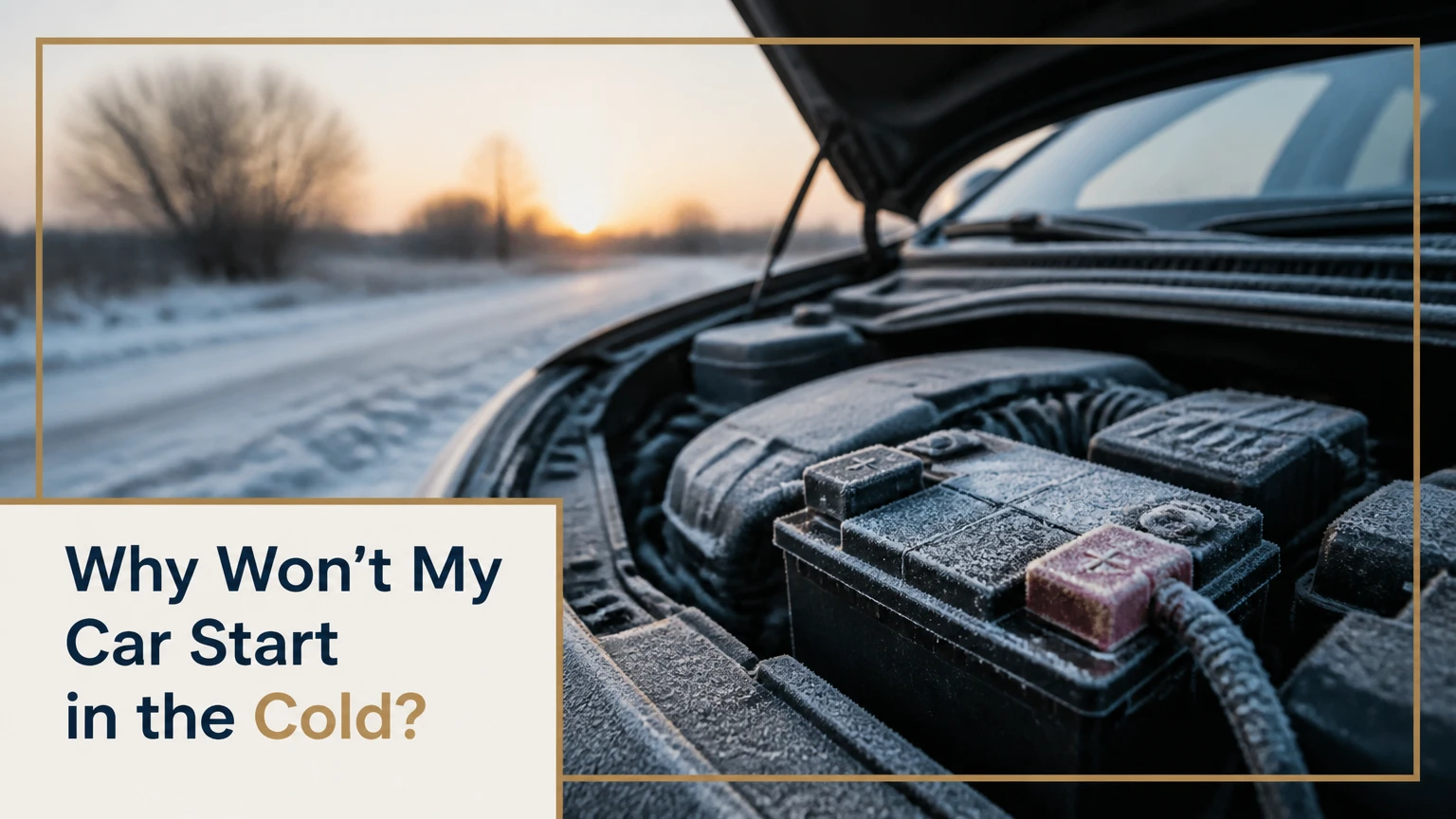
Cars fail to start in freezing weather because sub-zero temperatures drastically reduce battery output while simultaneously thickening engine oil. A standard automotive battery loses nearly 60 percent of its cranking power at 0°F. Meanwhile, cold oil forces the starter motor to require double the electrical current just to turn the crankshaft. If you are wondering why won’t my car start in the cold, the answer almost always traces back to this mathematical mismatch between available voltage and mechanical resistance.
At a Glance: The Core Numbers Behind Winter No-Starts
- A fully charged battery operates at 100 percent efficiency at 80°F (27°C) but drops to 40 percent efficiency at 0°F (-18°C).
- Standard motor oil increases in viscosity drag at 0°F, requiring the starter to pull 2.5 times more amperage than normal.
- A healthy car battery reads 12.6 volts at rest. A reading of 12.2 volts at freezing indicates the battery lacks the chemical energy to spin the starter.
- Discharged batteries freeze solid at 32°F (0°C), while fully charged batteries resist freezing down to -76°F (-60°C).
- Modern vehicles only require 30-60 seconds of idling before driving safely in winter weather.
How much power does a car battery lose at 0 degrees Fahrenheit?
A standard lead-acid car battery loses between 50 and 60 percent of its total cranking power when the ambient temperature reaches 0°F (-18°C). Automotive batteries rely on a liquid chemical reaction between lead plates and sulfuric acid to generate electrons. Cold temperatures severely slow this chemical reaction down. At the exact moment the engine requires maximum power to overcome stiffened metal components, the battery can only deliver a fraction of its normal output.
According to cold-weather testing data (Battery Council International 2022), battery efficiency drops on a predictable curve as temperatures plummet. A battery reading a healthy 12.6 volts in a heated garage might drop to a functional capacity equivalent to 12.2 volts after sitting outside overnight. That slight numerical drop represents a massive loss of functional amperage. A battery outputting only 40 percent of its rated capacity simply cannot overcome the immense mechanical resistance of a frozen engine block.
| Outside Temperature | Battery Efficiency | Engine Cranking Power Required |
| 80°F (27°C) | 100% | 100% (Normal Baseline) |
| 32°F (0°C) | 80% | 155% |
| 0°F (-18°C) | 40% | 210% |
| -20°F (-29°C) | 18% | 350% |
What happens to engine oil at freezing temperatures?
Engine oil thickens significantly at freezing temperatures, creating immense physical drag on internal moving parts. Motor oil is designed to lubricate the crankshaft, pistons, and valvetrain. When temperatures drop below freezing, conventional oils become highly viscous. They flow like thick syrup rather than a fluid liquid. The starter motor must force the heavy metal engine components through this thickened sludge, requiring up to 250 percent more electrical amperage than a summer start requires.
The type of oil inside the crankcase dictates how severely the engine fights the starter motor. Synthetic oils contain chemically engineered molecules of uniform size that resist thickening far better than conventional mineral oils. Automotive engineers (Society of Automotive Engineers 2021) note that switching to a 0W-20 synthetic oil dramatically reduces viscosity drag during winter starts compared to older 5W-30 conventional blends. The “W” stands for winter. A lower number before the W means the oil maintains better flow characteristics in extreme cold, directly reducing the strain placed on the battery and starter solenoid.
Can a completely dead car battery freeze solid?
Yes, a completely dead car battery will freeze solid at 32°F (0°C). A fully charged battery contains a mixture of 25 percent sulfuric acid and 75 percent water, giving it a freezing point of -76°F (-60°C). As a battery discharges, the sulfuric acid bonds to the internal lead plates, leaving behind a liquid mixture that is almost entirely pure water. Because water freezes at 32°F, a discharged battery easily turns into a solid block of ice during a mild winter night.
Attempting to jump-start a frozen battery poses extreme risks. The expanding ice can warp the internal lead plates and crack the external plastic casing. Applying electrical current to a frozen battery can cause hydrogen gas buildup and lead to an explosion. Technicians strongly advise drivers to visually inspect the sides of the battery case before attaching jumper cables. If the plastic housing appears bloated, swollen, or distorted, the internal liquids have frozen. The battery must be removed and thawed completely in a warm environment before taking a charge, though structural damage usually requires a full replacement.
What Cold Cranking Amps rating is required for severe winter weather?
Vehicles operating in severe winter weather require a battery rated for at least 600 Cold Cranking Amps (CCA), while heavy-duty trucks and SUVs need 800 CCA or higher. Cold Cranking Amps measure the exact amount of electrical current a battery can deliver at 0°F for 30 seconds while maintaining a voltage of at least 7.2 volts. This metric serves as the primary indicator of a battery’s winter reliability.
Many drivers confuse CCA with Cranking Amps (CA). Cranking Amps are measured at a mild 32°F, making the CA number artificially higher and less relevant for harsh winter climates. Buying a battery based on the CA rating will leave a vehicle underpowered during a deep freeze. A standard compact car requires around 400 CCA, but upsizing to a 600 CCA battery provides an essential buffer against the 60 percent power loss that occurs at zero degrees. Installing the highest CCA battery that physically fits the vehicle’s battery tray remains the most effective defense against winter starting failures.
What causes a car starter to click without cranking?
A single, loud click from the engine bay usually means the starter solenoid grease has solidified or the battery lacks the surface charge to engage the gear. The starter relies on internal mechanical grease to push a small pinion gear into the heavy engine flywheel. In extreme cold, this lubricating grease turns into a stiff paste. The electrical solenoid fires (creating the audible click), but the thickened grease physically blocks the gear from moving forward.
Rapid, machine-gun-style clicking indicates a slightly different problem. Rapid clicking means the battery possesses enough voltage to push the starter gear forward, but lacks the raw amperage to actually spin the heavy engine block. The gear hits the flywheel, the voltage instantly drops, the gear retracts, voltage recovers, and the cycle repeats endlessly. A single click often requires mechanical intervention (like lightly tapping the starter housing with a wrench to break the frozen grease), whereas rapid clicking usually responds well to a standard jump-start.
Why does a cold engine crank normally but refuse to fire?
An engine that spins at normal speed but refuses to start usually suffers from frozen fuel lines, a flooded combustion chamber, or a defective Engine Coolant Temperature (ECT) sensor. If the starter motor spins the crankshaft vigorously, the battery and starter are functioning perfectly. The failure lies entirely within the fuel delivery or ignition systems.
Water condensation forms inside gas tanks during temperature fluctuations. This moisture sinks to the bottom of the tank and easily freezes solid inside the narrow metal fuel lines or microscopic fuel injectors, blocking gasoline from reaching the cylinders entirely. Alternatively, cold engines require a very rich mixture of fuel to air. If the engine computer receives faulty data from a broken ECT sensor, it might inject a lean summer fuel mixture into a freezing engine. Conversely, multiple failed starting attempts can flood the engine. Raw liquid gasoline coats the spark plugs, completely preventing the electrical spark necessary for combustion.
How do high-ethanol blends and diesel fuels react to winter?
High-ethanol gasoline struggles to vaporize below 50°F (10°C), while standard diesel fuel solidifies into a thick wax below 15°F (-9°C). Internal combustion engines cannot burn liquid fuel directly. The fuel must evaporate into a fine vapor before a spark plug can ignite it. E85 fuel contains 85 percent ethanol, a chemical with exceptionally low vapor pressure. In cold weather, E85 remains a dense liquid inside the cylinders, causing the engine to crank endlessly without firing.
Diesel engines face an entirely different chemical challenge known as gelling. Diesel fuel naturally contains paraffin wax molecules. When temperatures drop below 15°F, these wax molecules precipitate out of the liquid suspension and form a cloudy, semi-solid gel. This gel gets sucked into the fuel system and instantly plugs the microscopic pores of the fuel filter. The engine becomes completely starved of fuel. Diesel drivers prevent gelling by mixing winter anti-gel fuel additives into the tank during autumn, which chemically prevents the wax crystals from bonding together.
Why won’t my car start in the cold if the battery is new?
If a car with a brand-new battery fails to start in the cold, the culprit is typically a parasitic electrical draw or a malfunctioning alternator. Modern vehicles contain dozens of computers, security cameras, and telematics systems that draw continuous power while the vehicle sits parked. In summer temperatures, a new battery easily absorbs a 50-milliamp drain for weeks. At 0°F, that identical parasitic draw will flatten a new, cold-diminished battery in a matter of days.
Aftermarket accessories cause the vast majority of parasitic drains. Dashcams left in parking mode, plugged-in phone chargers, or poorly wired remote starters silently bleed voltage overnight. The other primary culprit is the alternator. If the alternator fails to output at least 13.8 volts while the engine runs, it never actually recharges the new battery during your commute. The battery slowly degrades over a week of short trips until the first freezing morning pushes its remaining capacity below the threshold needed to turn the starter.
How do winter starting issues differ for hybrid vehicles?
Hybrid vehicles experience winter starting failures primarily due to their small 12-volt auxiliary batteries rather than their massive high-voltage traction packs. A hybrid car utilizes two distinct electrical systems. The large lithium-ion or nickel-metal hydride battery pack (often operating at 200 to 400 volts) physically drives the wheels and spins the gasoline engine. However, a traditional, much smaller 12-volt lead-acid battery powers the vehicle’s onboard computers, relays, and security systems.
When you press the start button on a hybrid, the small 12-volt battery must boot up the main computer. The computer then closes a heavy-duty mechanical relay (contactor) that connects the high-voltage pack to the engine. If extreme cold kills the small 12-volt battery, the car’s computer remains dead. The vehicle cannot close the relays to access the massive power reserves sitting fully charged in the high-voltage pack. Jump-starting a hybrid involves attaching cables to the small 12-volt battery just long enough to wake the computer system up.
Should you pump the gas pedal to start a cold engine?
No, you should never pump the gas pedal to start a modern fuel-injected vehicle in cold weather. Vehicles manufactured after 1990 rely entirely on electronic engine control modules to determine the exact fuel-to-air ratio required for a cold start. Pumping the pedal does not physically add any fuel to the engine. Instead, erratic pedal movements confuse the throttle position sensors and disrupt the computer’s automated cold-start sequence.
In many modern vehicles, holding the gas pedal entirely to the floor while cranking actually triggers a feature called “clear flood mode.” The engine computer interprets the wide-open throttle during a start attempt as a signal that the engine is flooded with raw gas. The computer responds by completely shutting off the electronic fuel injectors to allow excess fuel to clear the cylinders. Pumping the pedal will inadvertently toggle this fuel-cut feature on and off, guaranteeing the engine refuses to start.
How long should you warm up a modern vehicle?
You only need to let a modern vehicle idle for 30 to 60 seconds before driving gently in cold weather. Modern electronic fuel injection systems and advanced synthetic oils lubricate engine components rapidly. The US Department of Energy (2022) states that driving the vehicle is the fastest and most efficient way to bring the engine block and catalytic converter up to proper operating temperature.
Idling a car in the driveway for ten minutes actually causes long-term mechanical damage. Cold engines run rich, meaning they inject extra gasoline into the cylinders to keep the fire lit. When a car idles excessively, this unburned liquid gasoline washes down the cylinder walls, stripping away the protective oil film. The raw fuel then drips down into the crankcase and dilutes the engine oil. Drivers should start the car, wait 30 seconds for the oil pressure to stabilize, and then drive at moderate speeds until the temperature gauge rises.
What are the fastest ways to start a frozen vehicle?
The fastest way to start a frozen vehicle is to use a high-output lithium-ion jump starter pack or apply direct, safe heat to the engine bay. A lithium jump pack bypasses the vehicle’s frozen battery entirely, delivering a massive surge of instant amperage directly to the starter motor leads. This temporary surge easily overcomes the viscosity drag of thickened oil.
If a jump pack fails, the problem requires thermal intervention. Technicians recommend placing a high-wattage drop light or a specialized magnetic block heater directly against the metal oil pan for 45 minutes. This localized heat warms the oil from a thick paste back into a fluid, drastically reducing the resistance on the starter gear. If the engine spins rapidly but smells strongly of gasoline, the cylinders are likely flooded. Depress the accelerator completely to the floor and hold it there while turning the key. This activates clear flood mode, stopping fuel delivery and allowing the wet spark plugs to dry out and finally spark.
Are battery blankets more effective than engine block heaters?
Engine block heaters are significantly more effective for mechanical reliability, while battery blankets are strictly electrical preservation tools. An engine block heater plugs into a wall outlet and uses an internal element to keep the engine coolant warm. This ambient heat transfers to the engine block and oil pan, ensuring the oil remains fluid. A warm engine requires drastically less electrical energy to turn over, effectively solving the root cause of the winter starting problem.
A battery blanket wraps directly around the plastic battery casing and generates mild heat. This keeps the internal chemical mixture at optimal temperatures, preventing the 60 percent capacity loss associated with freezing weather. However, a warm battery still has to fight against thick, freezing engine oil. In climates regularly dropping below -10°F (-23°C), professionals recommend utilizing both accessories simultaneously.
| Accessory Type | Primary Function | Best Used For |
| Engine Block Heater | Keeps coolant and oil warm | Protecting internal engine components |
| Battery Blanket | Prevents chemical power loss | Vehicles parked outside below 0°F |
| Magnetic Oil Pan Heater | Directly heats thickened oil | Emergency thawing of frozen engines |
| Trickle Charger | Maintains surface voltage | Vehicles left sitting for days |
How much does winterizing a car electrical system cost?
Winterizing a vehicle’s electrical system typically costs between $150 and $400, depending on the age of the vehicle and the required accessories. The most critical component of winterization involves replacing an aging battery with a high-CCA variant. A premium automotive battery designed for deep freezes generally runs between $180 and $250.
Labor costs add to the total if professional installation is required. Installing a permanent engine block heater is a labor-intensive job because it often requires draining the coolant system and removing a core plug from the side of the engine block. Simple electrical accessories like battery blankets and trickle chargers are cheap and easy to install in a driveway without specialized tools.
| Component / Service | Average Parts Cost | Average Labor Cost |
| Premium 800+ CCA Battery | $180 – $250 | $20 – $50 (or free at auto stores) |
| Engine Block Heater | $40 – $80 | $150 – $250 |
| Battery Blanket | $25 – $45 | $0 (DIY Installation) |
| Synthetic 0W-20 Oil Change | $50 – $80 | $20 – $40 |
How long does a standard car battery last in cold climates?
A standard lead-acid car battery lasts between 3 and 5 years in environments with severe winter weather. Cold climates mask the physical damage actually caused by summer heat. High temperatures evaporate the internal battery fluids and slowly destroy the internal lead plates. However, a heat-damaged battery can easily start a warm engine in July. The true extent of the damage remains hidden until the first hard freeze in November.
When winter arrives, the temperature drop instantly demands double the cranking amperage. The internally damaged battery abruptly fails the winter stress test. Automotive technicians advise load-testing any battery over three years old every autumn. A professional load tester applies a simulated 500-amp draw to the battery to see if the voltage collapses under strain. Replacing a marginal battery in October prevents a dangerous stranding scenario in January.
The Bottom Line
Cars refuse to start in the winter due to a brutal combination of chemical power loss and mechanical drag. At 0°F, your battery loses more than half its output precisely when your engine oil thickens and requires double the normal effort to spin. Upgrading to a battery with at least 600 Cold Cranking Amps and switching to a synthetic 0W-20 winter oil will solve the vast majority of cold-weather starting failures. If the engine spins rapidly but refuses to catch, step away from the jumper cables and begin checking for frozen fuel lines or flooded cylinders.


