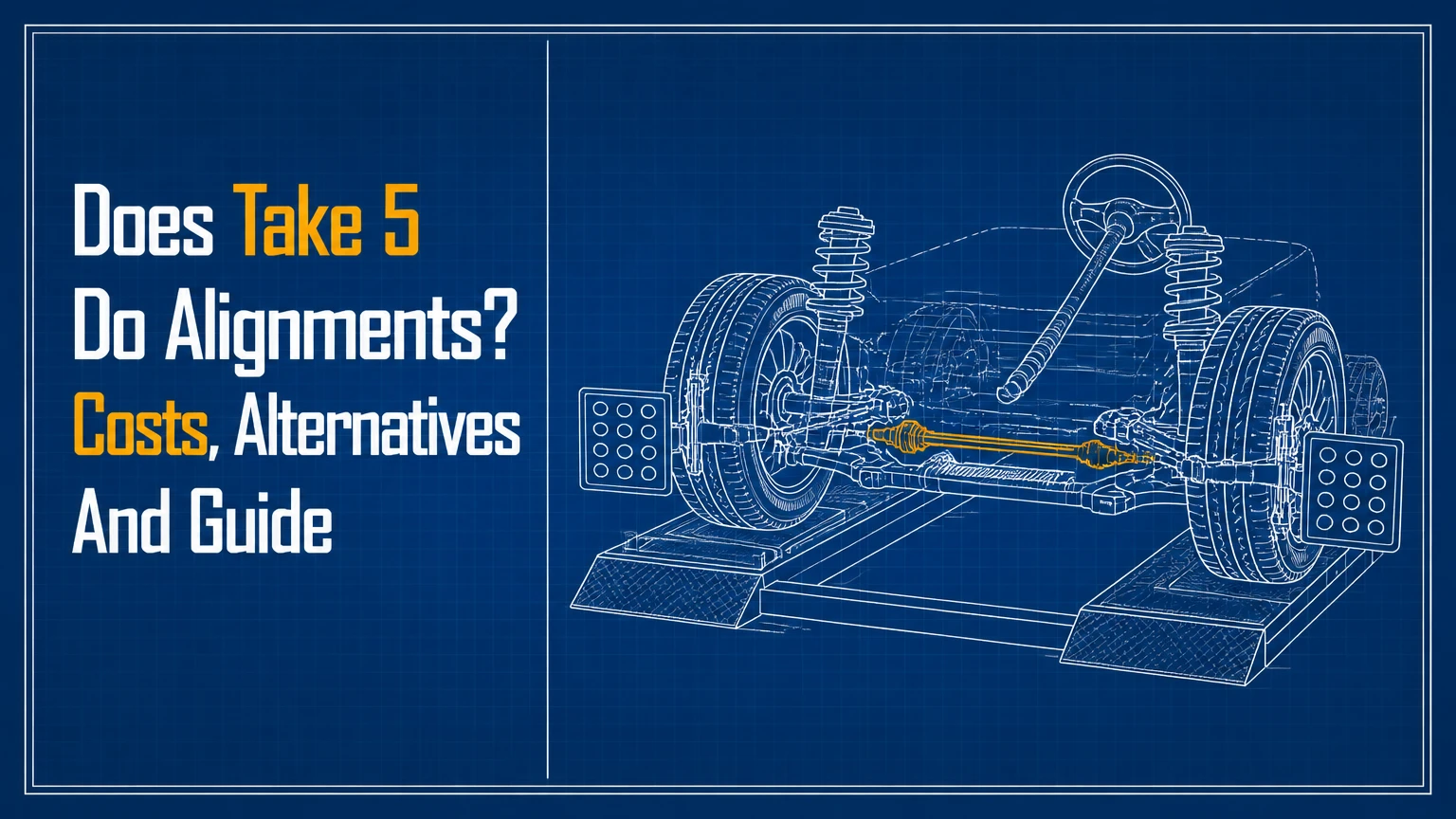
Take 5 Oil Change does not perform wheel alignments. As a specialized preventative maintenance facility, standard Take 5 locations lack the heavy alignment racks, laser measuring systems, and mechanical tools required to alter a vehicle’s suspension geometry. You must visit a full-service tire or repair shop for alignment services.
Key Facts / At A Glance
- Take 5 focuses exclusively on fluid changes, wiper blades, and filter replacements.
- Wheel alignments require minimum 14-foot level racks that do not fit over drive-through oil pits.
- A standard four-wheel alignment at a dedicated tire shop costs between $90 and $160.
- You should have your alignment checked every 6,000 miles or whenever you install new tires.
- If your steering wheel shakes at high speeds, you need a wheel balance rather than an alignment.
Why Does Take 5 Not Do Alignments?
Standard Take 5 Oil Change facilities physically cannot accommodate wheel alignment equipment. Their business model relies on a drive-through structure where vehicles park over an open basement pit. This layout allows technicians to drain fluids rapidly from below without operating automotive lifts.
Wheel alignments require a perfectly level, solid concrete foundation to mount heavy alignment racks. A standard Hunter Engineering alignment machine demands a bay that is at least 14 feet wide and 24 feet long. The rack itself features integrated turn plates and slip plates that allow the vehicle’s suspension to relax during adjustment. Placing this equipment over an open oil pit presents structural impossibilities and severe safety hazards.
Furthermore, alignments require highly specialized labor. Take 5 technicians receive training for rapid fluid maintenance and visual inspections. Suspension tuning requires mechanics who understand chassis geometry, can read computerized specification charts, and possess the tools to unfreeze rusted eccentric bolts on older vehicles. Some international Take 5 full-service centers offer mechanical repairs, but domestic drive-through locations strictly avoid suspension work.
Where Can You Get A Wheel Alignment Instead?
You must take your vehicle to a dedicated tire retailer, a national repair chain, or an independent mechanic to correct suspension geometry. These facilities invest heavily in optical sensors and computerized specification databases required to bring a vehicle back to factory tolerances.
When choosing an alternative provider, look for shops that advertise laser alignments or computerized suspension adjustments. Chain stores generally offer standardized pricing and nationwide warranties, while independent shops might provide more custom tuning options for lifted trucks or lowered cars.
Top Alternative Service Centers Compared
If you need immediate service, several national chains specialize in tire and suspension work. The table below outlines typical costs and service offerings at major automotive centers based on 2024 pricing models.
| Service Provider | Standard 4-Wheel Alignment Cost | Warranty Structure | Best Driver Profile |
|---|---|---|---|
| Firestone Complete Auto Care | $100 – $130 | One-Time or Lifetime ($200) | Highway commuters keeping their car for 3+ years. |
| Goodyear Auto Service | $110 – $140 | One-Time or 3-Year Plan | Drivers seeking comprehensive suspension diagnostics. |
| Discount Tire (Select Locations) | $90 – $120 | One-Time Only | Budget-conscious drivers buying a new set of tires. |
| Pep Boys | $100 – $125 | One-Time, 1-Year, or 3-Year | Drivers who want mid-tier warranty coverage options. |
| Independent Specialty Shops | $120 – $200 | Typically One-Time Only | Owners of modified vehicles requiring custom specifications. |
What Is A Wheel Alignment?
A wheel alignment is a mechanical adjustment of a vehicle’s suspension system rather than a manipulation of the tires or wheels themselves. The suspension system connects the vehicle to its wheels. The alignment process configures the angles of the tires so they sit perfectly perpendicular to the ground and parallel to one another.
Mechanically, the procedure works by altering threaded suspension components located underneath the car. Technicians adjust tie rods, control arms, and strut mounts while the vehicle sits on a specialized level rack. Highly sensitive optical targets clamp to each wheel. These targets feed measurements back to a computer program containing the exact manufacturer specifications for your specific make, model, and year.
The Three Core Alignment Angles Explained
Technicians adjust three primary geometric angles to establish proper tracking and tire wear. Understanding these angles helps you communicate effectively with your mechanic.
Camber Camber measures the inward or outward tilt of the tire when viewed from the front of the vehicle. Outward tilt at the top of the tire is positive camber. Inward tilt at the top is negative camber. Manufacturers design passenger cars with slight negative camber to improve cornering stability. Severe misalignment here causes rapid, single-edge tire wear. If the inside edge of your front tire looks bald while the outside looks new, your camber specifications are dangerously off.
Toe Toe represents the inward or outward direction the tires point when viewed from directly above the vehicle. It functions exactly like human feet. Pointing inward is toe-in, while pointing outward is toe-out. Toe misalignment is the leading cause of premature tire destruction. Excessive toe-in wears the outside edge of the tread, leaving a feathered pattern across the rubber. Excessive toe-out destroys the inside edge at an equally rapid pace.
Caster Caster measures the forward or backward tilt of the steering axis when viewed from the side of the vehicle. It does not affect tire wear directly. Instead, caster identifies the balance between steering effort, high-speed stability, and cornering performance. Positive caster tilts the steering axis toward the rear of the car, which helps the steering wheel return to the center automatically after a turn. Negative caster tilts the axis forward, making the steering feel dangerously light and unstable at highway speeds.
How A Full-Service Shop Performs The Alignment
If you take your vehicle to a dedicated repair shop, technicians execute a highly regimented procedure to ensure geometric accuracy. A standard service takes between 45 and 60 minutes.
Step 1: Pre-Service Inspection
Technicians verify uniform tire inflation pressure across all four wheels. They then raise the vehicle to check for loose or worn suspension components. The technician inspects ball joints, tie rod ends, and wheel bearings. If these parts have structural play, an alignment is impossible and the shop will halt the service.
Step 2: Rack Mounting And Sensor Calibration
The mechanic drives the vehicle onto a precisely leveled alignment rack. High-definition optical targets clamp onto the outer lips of all four wheels. The computer system links to these targets to establish a spatial grid around the car.
Step 3: Baseline Measurement
The alignment system requires the technician to roll the vehicle slightly forward and backward on the slip plates. This rolling action calculates initial caster, camber, and toe specifications. The computer outputs a color-coded chart on a main monitor. Red numbers indicate angles outside factory tolerances, while green numbers indicate safe specifications.
Step 4: Mechanical Tuning
The mechanic goes underneath the car with wrenches and heating torches. They loosen rusted locknuts and turn adjustment sleeves to manipulate the tie rods and suspension arms. The mechanic watches the live computer screen while turning the wrenches, stopping only when the red numbers shift into the green-spec zone.
Step 5: Final Printout And Test Drive
The computer records a post-adjustment reading for the customer. The technician then performs a mandatory road test on public streets. This test drive guarantees the steering wheel sits perfectly centered and confirms the vehicle tracks straight without drifting into adjacent lanes.
Which Alignment Type Do You Need?
Vehicles require different alignment procedures based on their drivetrain layout and rear suspension design. Your mechanic will determine the correct type based on your vehicle identification number (VIN).
| Alignment Type | Best For | What Is Adjusted | Average Cost | Timeframe |
|---|---|---|---|---|
| Front-End Alignment | Older vehicles and trucks with a solid rear axle. | Front toe, front camber, and front caster only. | $70 – $100 | 30 – 45 mins |
| Four-Wheel Alignment | Modern front-wheel drive cars, AWD vehicles, and independent rear suspensions. | Front and rear toe, plus front and rear camber. | $90 – $160 | 45 – 60 mins |
| Thrust Angle Alignment | Vehicles where the rear axle lacks adjustment mechanisms but sits crooked. | Front wheels are aligned to match the tracking path of the fixed rear axle. | $80 – $120 | 45 – 60 mins |
Should You Buy A One-Time Or Lifetime Alignment Warranty?
When selecting a service at a dedicated shop, service advisors will ask you to choose between a one-time payment or a long-term warranty package. This decision depends entirely on your driving habits and vehicle ownership timeline.
A one-time standard alignment offers the lowest upfront out-of-pocket cost. It works perfectly if you plan to trade in or sell the car within the next six months. However, a single service provides zero protection against hitting a pothole the very next day. If you knock the suspension out of spec, you must pay full price for another service.
Lifetime or extended warranties require a higher initial purchase price but pay for themselves rapidly. A $200 lifetime package allows you to get your alignment checked and tweaked for free every 6,000 miles. This is highly recommended for daily commuters. The only major drawback is that the warranty forces you to return to that specific service chain for the coverage to remain valid.
How To Tell If You Need An Alignment Immediately
Drivers frequently misdiagnose suspension issues. Knowing how to interpret your vehicle’s physical symptoms saves you from buying services you do not need.
The most obvious sign of an alignment issue is a steering wheel that sits off-center when driving straight. If the logo on your steering wheel tilts to the left while the car travels perfectly forward, your toe angles require immediate adjustment. Additionally, if the vehicle aggressively pulls to one side when you let go of the wheel on a flat road, your camber or caster specifications are likely compromised.
Expert Insight: Many drivers confuse alignment problems with wheel balancing problems. If your car drifts to one side, it is an alignment issue. If your steering wheel violently vibrates or shakes in your hands at speeds over 60 miles per hour, it is a wheel balancing issue. An alignment will not cure high-speed vibrations.
Symptom Diagnosis Matrix
Use this table to determine what specific service your vehicle requires before visiting a repair shop.
| Experienced Symptom | Likely Mechanical Cause | Required Service | Danger Level |
|---|---|---|---|
| Steering wheel is crooked while driving straight | Improper Toe adjustment on front tie rods | Four-Wheel Alignment | Moderate |
| Vehicle drifts heavily to the left or right | Improper Camber adjustment or low tire pressure | Alignment and Pressure Check | High |
| Steering wheel shakes heavily above 60 MPH | Weights fell off the wheel rim | Wheel Balance (Not Alignment) | Moderate |
| Loud clunking noise when turning the wheel | Worn ball joints or broken MacPherson struts | Suspension Repair | Severe |
| Inside edge of tire tread is completely smooth | Excessive negative Camber or extreme Toe-out | Four-Wheel Alignment | Severe |
Common Mistakes And Post-Alignment Troubleshooting
Alignment procedures fail when mechanics cut corners or owners ignore severe mechanical damage. Understanding these failure modes helps you hold your repair shop accountable.
The most common mistake is attempting to align worn out suspension components. Attempting an alignment when control arm bushings or outer tie rod ends are structurally loose wastes time and money. The vehicle will instantly shift back out of spec the moment it hits a bump.
Technician’s Rule of Thumb: Never authorize an alignment if the shop tells you your tie rods have more than 1/16th of an inch of vertical play. Always replace the worn metal parts first, then perform the alignment to lock in the new geometry.
If your car still drifts immediately after an alignment, check for a phenomenon called radial tire pull. Unevenly worn tires force the car to drift even when the underlying suspension angles are mathematically perfect. If the tires are brand new and the car still drifts, the shop likely failed to lock the steering wheel completely center during the adjustment phase. You must return and demand a re-service.
Expert Recommendations By Driver Profile
Your optimal alignment strategy depends on the vehicle you drive and the environment you drive it in. Match your profile to the recommendations below to maximize your tire life.
The Daily Commuter And Highway Driver Choose a four-wheel alignment coupled with a lifetime or 3-year service package. Routine highway driving exposes cars to thousands of recurring micro-impacts. These small bumps degrade suspension geometry gradually, sapping fuel efficiency and ruining tire tread over time. Having the ability to check the specs for free twice a year ensures maximum tire longevity.
The Off-Roader And Truck Owner Opt for a one-time heavy-duty thrust alignment immediately after installing lift kits, larger tires, or modifying suspension components. You should choose a specialized off-road shop over a generic retail tire chain. Modified geometries require custom specification tolerances that deviate significantly from factory settings, which standard retail computers struggle to process.
The Budget-Conscious Or Short-Term Owner Get a one-time standard alignment only if you notice uneven tire wear or severe drifting. Avoid extended service packages if you intend to keep the car for less than a year. Save your money for routine oil changes and basic fluid maintenance.
Do You Need An Alignment After Replacing Tires?
You are not legally required to get an alignment after installing new tires, but skipping the service is financially reckless. New tires do not push a vehicle out of alignment. However, whatever suspension geometry ruined your old tires will immediately begin destroying your new ones.
Tires are the most expensive wear item on your vehicle. Spending $800 on a new set of rubber only to have them destroyed in 10,000 miles by a misaligned tie rod is a common mistake. You should always pair a fresh set of tires with a fresh alignment. This ensures the tires sit perfectly flat on the pavement, giving you the maximum possible tread life and validating the manufacturer’s mileage warranty.
What Is The Financial Impact Of Skipping Alignments?
Ignoring your vehicle’s suspension geometry creates a compounding financial drain. Misaligned tires fight each other as they roll down the road. This constant friction increases rolling resistance dramatically.
According to automotive engineering data, a vehicle driving with just 0.17 inches of toe misalignment drags its tires sideways for the equivalent of 68 miles over the course of a single year. This severe dragging action reduces fuel efficiency by up to 10 percent. If you spend $2,000 a year on gasoline, skipping an alignment costs you $200 in wasted fuel alone.
Furthermore, driving with excessive camber destroys the structural integrity of the tire shoulder. This forces you to replace tires tens of thousands of miles before their rated lifespan. A $100 alignment service effectively protects a $1,000 tire investment while simultaneously lowering your monthly fuel bill.
Frequently Asked Questions
Does Take 5 check tire pressure during an oil change? Yes. While Take 5 does not perform alignments or tire rotations, their standard preventative maintenance package includes checking and topping off tire air pressure to the manufacturer’s recommended levels.
Can you do a wheel alignment at home? You can perform a rudimentary string alignment at home to get a vehicle drivable after replacing a tie rod. However, modern vehicles require measurements accurate to a tenth of a degree. You cannot achieve this precision without a computerized laser rack.
Does auto insurance cover wheel alignments? Standard automotive insurance policies do not cover routine maintenance alignments. However, if your alignment was knocked out of specification during an accident or a collision with a large object, your comprehensive or collision coverage will usually pay for the repair.
How long does a wheel alignment take? A standard four-wheel alignment takes between 45 and 60 minutes at a professional shop. If the vehicle has severely rusted adjustment bolts that require heating with a torch to loosen, the process can take up to two hours.
Are wheel alignments required to pass state vehicle inspections? Most state inspections do not directly measure suspension geometry. However, they do measure tire tread depth. If bad alignment has caused your tires to wear down past 2/32 of an inch on any specific edge, your vehicle will fail the state safety inspection.
The Bottom Line Understanding the answer to does Take 5 do alignments helps you navigate your vehicle’s maintenance schedule efficiently. Use Take 5 for your fast, routine fluid changes, but rely on a dedicated tire service center to protect your suspension geometry and preserve your tire investment.


