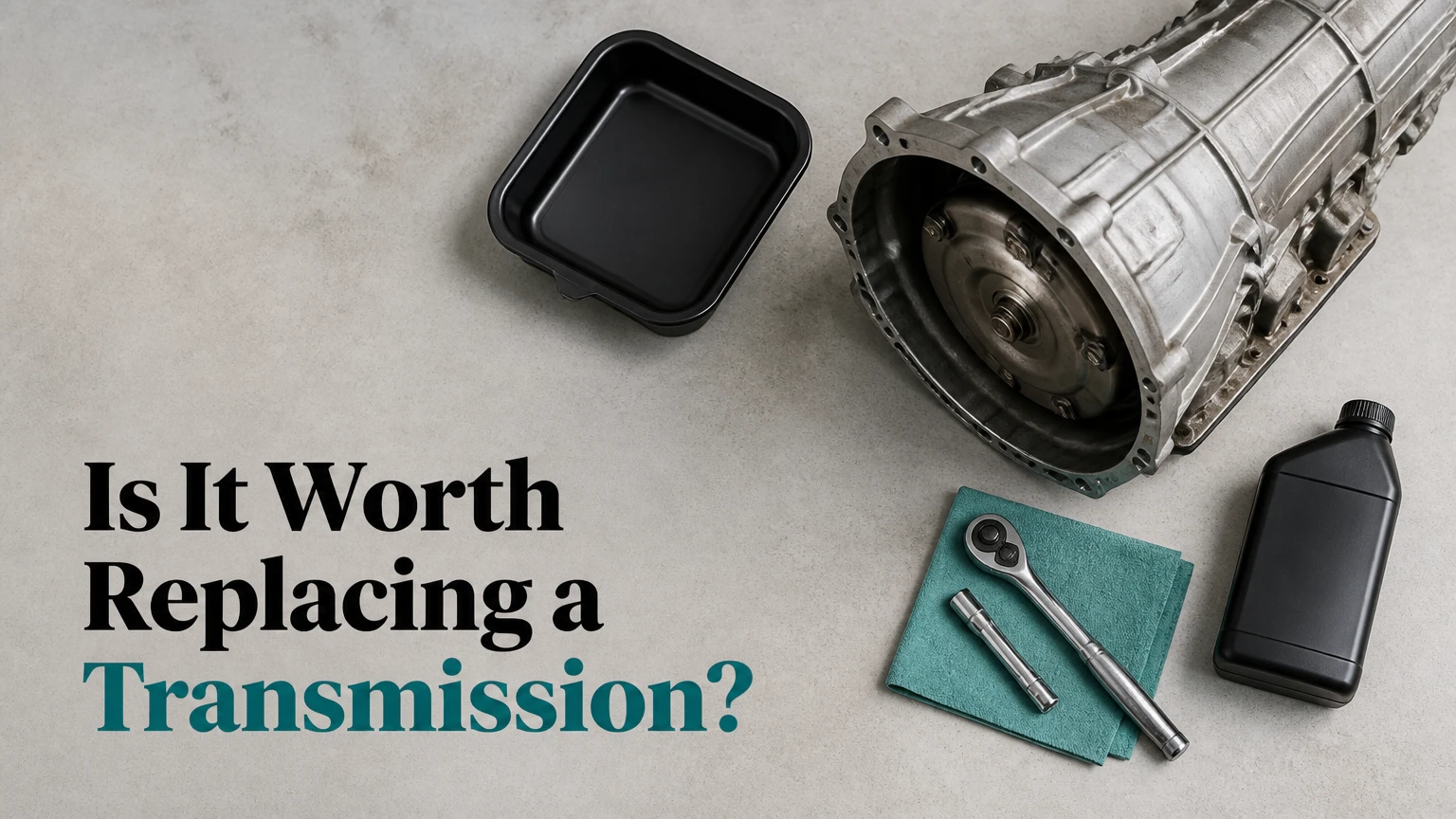
Replacing a transmission is worth it if the vehicle’s engine and overall structure are in good condition, and the replacement cost does not exceed 50 to 60 percent of the car’s total market value. Because it is one of the most expensive automotive investments you can make, the decision should be driven strictly by math rather than emotion.
Key Facts / At a Glance
- Targeted repairs cost $300 to $1,500 while full remanufactured replacements require $3,500 to $8,000.
- Shop turnaround times range from two business days for direct unit swaps to eight days for custom bench rebuilds.
- A failed shift solenoid or a dirty mass air flow sensor can easily mimic a complete mechanical transmission failure.
- Installing a remanufactured transmission typically provides nationwide warranty coverage for up to three years.
- Vehicles valued under $5,000 with over 175,000 miles rarely justify a complete transmission replacement.
Quick Verdicts by Vehicle Profile
- High-Mileage Commuters (Under $5,000 Value): Do not replace the transmission. Sell or scrap the vehicle to fund a replacement car.
- Middle-Aged Vehicles (Paid Off, Good Engine): Replace the transmission. Spending $4,000 to avoid three years of new car payments is mathematically sound.
- Heavy-Duty Trucks and Luxury Imports: Install a premium remanufactured unit. Severe duty applications demand strict factory tolerances.
- Late-Model Vehicles (Out of Warranty): Opt for a targeted repair or a used salvage unit to retain the high residual value of the car.
Transmission Replacement Hardware Categories
Choosing the right replacement hardware dictates your total financial exposure, your vehicle downtime, and your long-term warranty protection. You have four distinct hardware paths when a transmission fails. The correct choice depends entirely on your budget and how long you plan to keep the car.
Targeted Repair A targeted repair involves replacing only the specific component that failed. Mechanics leave the transmission in the vehicle or drop it partially to access accessible parts like the valve body, solenoids, or input shaft seals. This approach minimizes labor costs but ignores the remaining internal wear on the clutch packs and planetary gears.
Used or Salvage Units Salvage units come directly from donor vehicles at a scrapyard. You pay a fraction of the cost for the actual hardware. The downside is the extreme risk involved. You cannot verify the internal health of a used transmission until the mechanic installs it and runs the vehicle. If the used unit fails during the test drive, you still owe the mechanic for the installation labor.
Shop Rebuild A local transmission specialist removes your broken unit, takes it entirely apart on a workbench, and replaces all worn items (soft parts) like seals, gaskets, bands, and friction plates. The mechanic cleans and reuses the heavy metal components (hard parts) like the gear sets and the main case. Quality depends entirely on the individual mechanic’s skill and cleanliness.
Remanufactured Assemblies Remanufactured transmissions are rebuilt in massive, specialized factories. Technicians completely disassemble the core, machine the hard parts back to exact factory specifications, and replace all soft parts. Engineers often update the internal components to fix design flaws present in the original factory unit. These units carry the highest upfront price but offer the most reliable long-term performance.
| Hardware Option | Average Component Cost | Billed Labor Hours | Average Total Cost | Typical Warranty Coverage |
|---|---|---|---|---|
| Targeted Repair | $200 to $1,000 | 1 to 4 hours | $300 to $1,500 | 90 Days to 1 Year |
| Used / Salvage | $100 to $1,500 | 4 to 10 hours | $1,000 to $3,000 | 30 to 90 Days (Hardware Only) |
| Shop Rebuild | $800 to $2,500 | 11 to 16 hours | $2,000 to $5,000 | 1 to 2 Years (Local Shop) |
| Remanufactured | $1,500 to $4,500 | 6 to 10 hours | $3,500 to $8,000+ | 3 Years (Nationwide) |
Data compiled utilizing baseline pricing insights from automotive estimators like RepairPal and AutoZone.
When Is It Worth Replacing a Transmission?
It is worth replacing a transmission when the cost of the repair buys you several more years of reliable transportation at a lower annualized cost than purchasing a different vehicle. You must calculate the hidden costs of buying a new car, such as sales tax, dealer documentation fees, and elevated insurance premiums, before rejecting a high repair bill.
Evaluating Your Vehicle Market Value
The standard automotive rule states you should not authorize a repair that costs more than 50 to 60 percent of the vehicle’s total market value. A $4,000 transmission job on a car worth $3,500 puts you in negative equity immediately. You must check objective valuation tools to determine what your vehicle would sell for in working condition. Subtract the cost of the transmission repair from that working-condition value. If the resulting number is negative, you should scrap or sell the broken vehicle as-is.
Assessing Engine and Drivetrain Health
A new transmission cannot save a dying engine. Before committing to a transmission overhaul, ask your mechanic to perform a comprehensive engine health check. This includes a cylinder compression test, a cooling system pressure test, and an inspection of the suspension and brake systems. Dropping thousands of dollars into a drivetrain is only a sound investment if the surrounding mechanical infrastructure can safely operate for another 50,000 miles.
How Does Transmission Technology Impact Costs?
The specific technology inside your transmission directly dictates the cost of replacement hardware and the labor required for installation. Modern vehicles utilize highly complex systems that combine hydraulic pressure, mechanical gears, and computer-controlled electronics.
A transmission is a critical mechanical system that converts the raw power of your car’s engine into controlled motion. Internal combustion engines generate power efficiently only within a narrow RPM range. The transmission utilizes varying gear ratios to maximize this power whether the vehicle is starting from a complete stop or cruising at highway speeds.
Manual transmissions represent the simplest mechanical configuration, utilizing a driver-operated clutch package and physical gear sets. Traditional automatics use planetary gears, a complex hydraulic valve body, and a fluid-driven torque converter to shift automatically. Continuously Variable Transmissions (CVTs) abandon fixed gears entirely, utilizing a steel belt-and-pulley design to deliver seamless ratio transitions. Dual-Clutch Transmissions (DCTs) function as automated manuals, using two separate clutches to pre-select alternating gears for lightning-fast shifting.
| Transmission Technology | Core Mechanism | Common Failure Point | Replacement Complexity & Cost Modifier |
|---|---|---|---|
| Manual | Driver-operated physical gear sets | Worn clutch disc or synchronizers | Lowest complexity (Clutch replacements average $1,200) |
| Traditional Automatic | Planetary gears and hydraulics | Valve body or burnt clutch packs | Standard complexity (Base rates apply) |
| Continuously Variable (CVT) | Expanding pulleys and steel belt | Snapped steel push-belt | High complexity (Add 20% to 30% to base rates) |
| Dual-Clutch (DCT) | Twin automated clutch packs | Mechatronics control unit | Extreme complexity (Requires specialized calibration tools) |
Essential Pre-Replacement Troubleshooting Checkpoints
Before authorizing thousands of dollars for a complete replacement, you must ensure your mechanic rules out simple external failures. Many drivers mistake minor electronic sensor glitches for catastrophic mechanical destruction.
Fluid Condition and Level Check Severe shuttering, slipping gears, or delayed engagements are frequently resolved via a simple fluid filter renewal and fresh factory-specification fluid. Low fluid levels cause an immediate drop in internal hydraulic pressure. This prevents the clutch packs from clamping down tightly, which the driver feels as a severe transmission slip.
Shift Solenoid Failures Electronic shifting anomalies often stem from a failed exterior plug-in shift solenoid rather than internal broken gears. Solenoids are electromagnet valves that direct fluid flow. If a solenoid burns out, the transmission cannot engage a specific gear. Replacing a shift solenoid is a localized repair that costs hundreds, not thousands, of dollars.
Engine Misfires and Air Flow Sensors Severe engine hesitation can easily trick drivers into feeling a mechanical transmission slip. Furthermore, a dirty Mass Air Flow (MAF) sensor sends incorrect load data to the transmission control computer. The computer reacts to this bad data by commanding maximum line pressure, resulting in violent, bone-rattling gear shifts. Cleaning the MAF sensor can resolve this issue instantly.
Expert Insight: Never authorize a complete transmission replacement without pulling diagnostic trouble codes (DTCs) and performing electrical circuit testing. According to automotive diagnostic specialists, a massive percentage of transmission drivability complaints originate from the engine management system, wheel speed sensors, or corroded wiring harnesses rather than internal gear failure.
The Standard Transmission Replacement Procedure
A standard transmission replacement is a highly technical, multi-day operation requiring specialized heavy-duty equipment. Understanding the labor involved explains why replacement bills carry such high labor charges.
Step 1: Diagnostic Validation Technicians link a professional scanner to the vehicle network to read all historical diagnostic trouble codes. They perform electrical circuit testing to verify that the failure is genuinely mechanical and not a computer module error.
Step 2: Vehicle Preparation and Fluid Drain The technician secures the vehicle on a heavy-duty hydraulic lift. They disconnect the battery to prevent electrical shorts and drain the old transmission fluid into a catch pan to reduce the weight of the assembly.
Step 3: Drivetrain Disconnection The mechanic carefully removes the driveshaft on rear-wheel-drive vehicles or the CV axles on front-wheel-drive vehicles. They must also remove exhaust piping sections, the starter motor, and the physical shift linkages connecting the cabin gear selector to the unit.
Step 4: Engine Support and Bellhousing Removal Because the transmission structurally supports the rear of the engine, the mechanic must stabilize the engine block with an overhead support bridge or an under-car pole jack. They then disconnect the heavy bellhousing bolts, the main wiring harnesses, the external oil cooler lines, and the structural crossmember mounts.
Step 5: Unit Swapping A dedicated hydraulic transmission jack lowers the spent assembly safely away from the vehicle. The mechanic transfers required external sensors to the new or remanufactured unit. The new unit is raised into the tunnel and meticulously aligned with the engine block dowel pins.
Step 6: Torque Spec Reassembly Every anchor bolt is tightened to exact manufacturer torque specifications using a calibrated torque wrench. All electronic connectors, cooling lines, driveshafts, and linkages are re-established in their proper positions.
Step 7: Fluid Flush and Calibration The transmission cooling lines running to the radiator are forcefully flushed out to eradicate any lingering metal filings. The system is filled with clean OEM-specified fluid. The technician then uses a high-end scan tool to program adaptation parameters and reset the transmission control module.
Step 8: Multi-Stage Testing Technicians execute initial in-shop lift tests to verify leak-free operation and proper gear engagement. This is followed by a rigorous variable-speed road test to ensure the computer adapts properly to the new mechanical hardware.
Which Repair Strategy Should You Choose?
Selecting the right strategy requires matching your vehicle’s current condition and value to the appropriate financial investment. You must balance the upfront hardware cost against your desired vehicle lifespan.
| Vehicle Profile | Typical Mileage | Recommended Action | Financial Logic |
|---|---|---|---|
| Low-Value Commuter Car | 175,000+ miles | Sell or Scrap | Repair costs exceed vehicle market value. |
| Mid-Life Paid-Off Vehicle | 80,000 to 130,000 miles | Rebuild or Remanufactured | Avoids financing a new car at high interest rates. |
| Heavy-Duty or Luxury | 100,000+ miles | Premium Remanufactured | Requires strict factory tolerances for severe duty. |
| Late-Model Out of Warranty | 40,000 to 70,000 miles | Used Salvage or Targeted Repair | Preserves high residual value with lowest immediate cash outlay. |
Scenario 1: The Commuter with a Low-Value Vehicle
If your car market value is under $5,000 and the odometer reads north of 175,000 miles, you should sell or scrap the vehicle. Do not put a $4,000 repair into a vehicle worth $3,500. A car with this much mileage will soon need suspension work, timing belt replacements, and engine reseals. You should take the scrap value of the vehicle, combine it with the $4,000 you saved by declining the repair, and use that capital as a down payment on a more reliable daily driver.
Scenario 2: The Owner of a Fair-Condition Vehicle
If your vehicle is six to ten years old, has 80,000 to 130,000 miles, and is completely paid off, you should opt for a bench rebuild or a remanufactured unit. Assuming the engine block is mechanically sound, spending $4,000 to secure another five years of operation is vastly cheaper than absorbing modern car payments. Buying a new car introduces elevated insurance premiums, annual property taxes, and dealer fees that easily eclipse the cost of fixing your current transmission.
Scenario 3: The Heavy-Duty Truck or Luxury Import Owner
If you operate a vehicle under severe duties for towing and hauling, or you own a complex luxury import, you should install a premium remanufactured unit exclusively. Do not cut corners with a standard local rebuild. Heavy-duty applications and precision German imports require strict factory assembly tolerances and upgraded internal components to properly survive severe operating parameters. A nationwide warranty is mandatory for these high-stress applications.
Scenario 4: The Late-Model Vehicle with Premature Failure
If you own a relatively new vehicle that suffered a premature transmission failure just outside the factory warranty period, opt for a used salvage unit or a targeted repair. The vehicle still holds significant market value, making a repair mandatory. However, since the car design is new, salvage yards often have pristine, low-mileage transmissions from collision-totaled vehicles available at a steep discount.
Common Mistakes During Transmission Installation
Even the most expensive remanufactured transmission will fail rapidly if the installation process is flawed. Avoiding these common mistakes dictates the longevity of the repair.
Skipping the Cooler Line Flush Failing to forcefully flush out the transmission oil cooler lines during a swap is a catastrophic error. When the original transmission failed, it pumped tiny metal shavings into the cooling lines and the radiator. If the mechanic fails to flush these lines, the old metal shavings wash directly into the brand-new transmission, destroying the sensitive valve body within days.
Ignoring the Torque Converter Installing a fresh transmission while reusing a contaminated or warped torque converter instantly degrades the new internal fluid pressure. The torque converter holds a massive amount of fluid and acts as the primary fluid pump drive. A complete replacement must always include a fresh, balanced torque converter.
Using Incorrect Fluid Specifications Modern transmissions are highly sensitive to fluid viscosity, friction modifiers, and additive packages. Pouring generic, multi-vehicle fluid into a system requiring strict factory specifications will trigger premature clutch wear and harsh shifting. Always demand that the shop uses the exact fluid chemistry dictated by the vehicle manufacturer.
Expert Insight: Another critical failure point is skipping the computer adaptation reset. The transmission control module learns how to shift based on the worn-out clutches of the old unit. If the mechanic installs a new transmission but fails to clear the computer’s memory, the computer will apply incorrect hydraulic pressure to the new clutches, causing immediate friction damage.
Frequently Asked Questions
Will a new transmission make my car run like new? A new transmission will restore factory-smooth shifting and proper power delivery to the wheels. However, it will not fix engine hesitations, worn suspension parts, or electrical gremlins elsewhere in the vehicle.
How long does a transmission replacement take? A standard direct swap of a remanufactured unit takes two to four business days, depending on shop scheduling. A custom bench rebuild can take five to eight business days due to meticulous machining processes and delays in ordering specific internal hard parts.
Can you replace a transmission yourself at home? Replacing a transmission requires a heavy-duty lift, specialized transmission jacks, engine support bars, and costly diagnostic scanning tools for calibration. Attempting this repair in a residential driveway without overhead clearance is highly dangerous and generally not recommended.
Does insurance cover transmission replacement? Standard collision and comprehensive auto insurance policies do not cover mechanical wear and tear, including transmission failures. You are only covered if the transmission was destroyed by a specific insured event, such as an accident, severe flooding, or vandalism.
Can you drive a car with a slipping transmission? Driving with a slipping transmission is highly risky and guarantees further mechanical destruction. As clutches slip, they generate extreme heat that rapidly degrades the remaining fluid, eventually leaving the vehicle completely immobilized and unable to move forward or backward.


