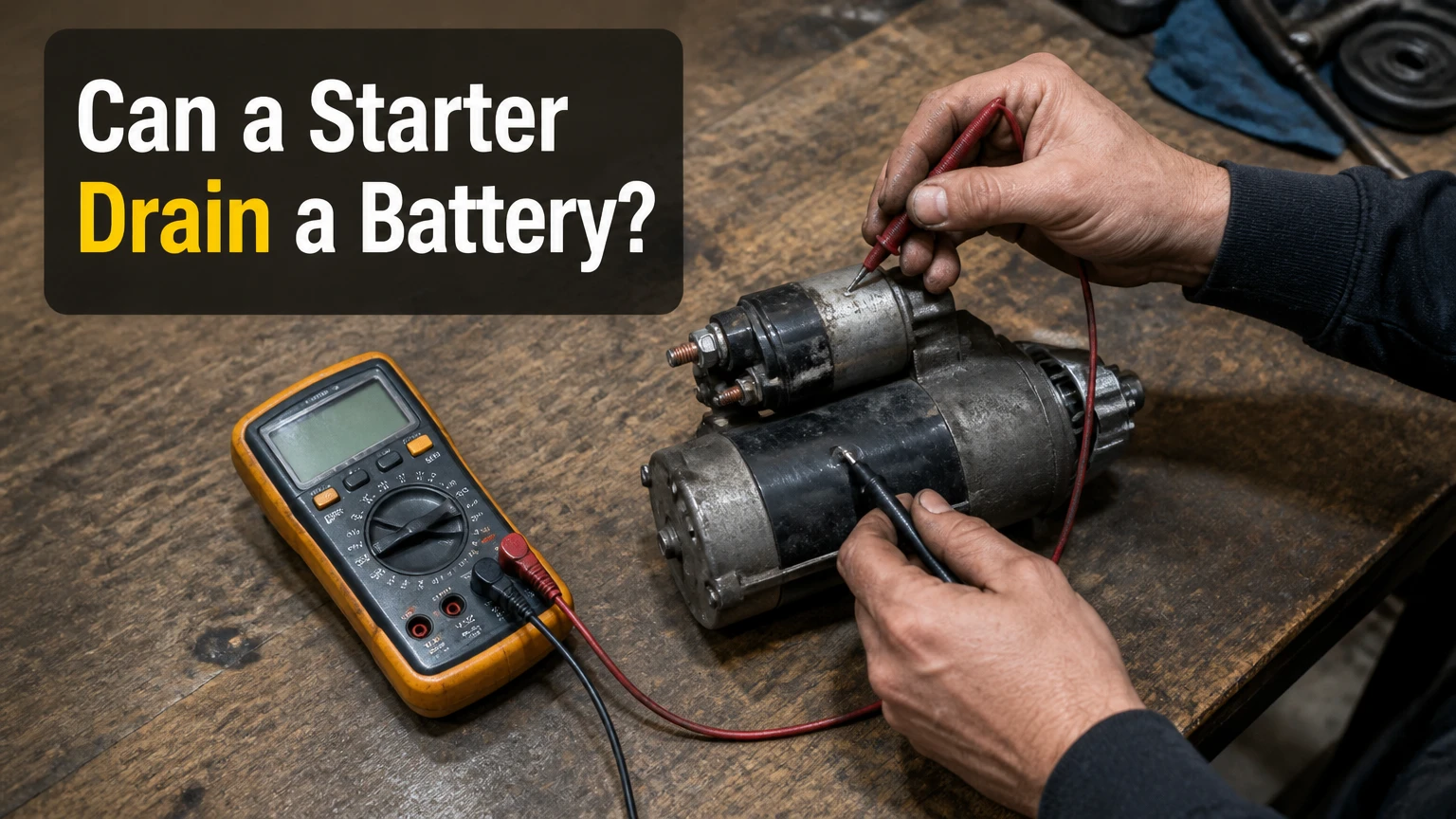
Yes, a faulty starter can completely drain a vehicle battery. This electrical depletion occurs rapidly during engine cranking if internal shorts cause excessive current draw, or slowly while the vehicle is parked due to a parasitic electrical leak from a failing starter solenoid. A degraded starter motor will quickly destroy a perfectly healthy battery.
Key Facts / At a Glance
- A healthy automotive starter draws between 150 and 250 Amps for standard four-cylinder and six-cylinder engines.
- A defective starter motor with internal mechanical binding can pull well over 600 Amps during a cranking attempt.
- Normal vehicle parasitic electrical draw rests below 50 milliamps when the ignition remains turned off.
- A failing starter solenoid with welded internal contacts can leak up to 3 Amps continuously while the vehicle sits parked.
- Cranking a vehicle engine for more than 15 consecutive seconds generates extreme heat that permanently melts internal starter insulation.
- Replacing a functional starter is a frequent diagnostic error when the actual root cause is a corroded negative ground wire.
The Mechanics of the Engine Cranking Cycle
The internal combustion cycle requires massive initial rotational force to begin operating. An automotive starter provides this force by acting as a powerful direct-current electric motor. It converts stored electrical energy from the battery into the mechanical torque required to rotate the engine crankshaft.
The cranking process follows a highly specific sequence of electrical and mechanical events. The driver initiates the process by turning the ignition key or pressing the start button. This action sends a low-current electrical signal to the starter solenoid. The solenoid functions as a heavy-duty electromagnetic switch. It physically pushes the starter drive gear forward while simultaneously closing a set of high-current copper contacts.
Once the drive gear meshes with the engine flywheel, the closed contacts allow massive electrical current to flow directly from the battery to the starter motor. The motor spins the flywheel, drawing atmospheric air and fuel into the engine cylinders. When the engine finally fires and exceeds the rotational speed of the starter, a one-way clutch protects the motor. Releasing the ignition key breaks the electrical circuit, and a return spring pulls the drive gear away from the flywheel.
How a Failing Starter Draws Excessive Current
A compromised starter drains a battery rapidly during the cranking phase through internal electrical resistance. When internal components degrade, the starter requires significantly more electrical power to achieve the same rotational mechanical output. This creates a severe voltage drop across the entire electrical system.
Mechanical friction acts as the primary catalyst for this rapid battery drain. Worn internal armature bearings allow the central spinning shaft to physically drag against the stationary magnetic housing. This dragging forces the electric motor to stall or slow down drastically. To overcome this immense physical resistance, the starter draws a massive spike in electrical current directly from the battery. According to diagnostic protocols published by the Automotive Service Excellence organization (2023), a four-cylinder engine starter that normally requires 150 Amps will instantly spike to 400 Amps or higher when internal bearings bind.
Electrical short circuits within the starter casing create an identical rapid drain scenario. The internal copper windings feature a thin coat of thermal insulation. Years of engine heat and extended cranking sessions eventually degrade this clear insulating layer. When the bare copper wires touch each other, electrical current bypasses the designated magnetic path. The starter loses its torque capacity while simultaneously pulling maximum available amperage from the battery. This massive current draw forces the battery voltage below the critical 9.6-volt threshold required to keep engine control modules powered. The battery depletes its reserve capacity in a matter of seconds.
Can a Starter Drain a Battery Overnight?
Yes, a starter can drain a battery overnight if the attached starter solenoid develops an internal failure that creates a constant parasitic electrical draw. This specific failure mechanism empties a battery while the vehicle remains parked with the ignition completely turned off.
The starter solenoid contains a heavy copper disc that bridges two large electrical terminals during engine cranking. Every time the driver starts the vehicle, electrical arcing occurs across these internal contacts. Over thousands of starting cycles, this intense heat causes the copper surfaces to pit, melt, and degrade. Eventually, carbon deposits or tiny pieces of melted copper create a permanent physical bridge between the main battery input terminal and the starter motor ground circuit.
This permanent bridge allows electrical current to flow continuously. A healthy vehicle should register a parasitic draw of less than 50 milliamps while sleeping. A compromised starter solenoid often pulls a constant draw ranging from 100 milliamps to several full Amps. Because the average automotive battery holds roughly 40 to 50 Amp-hours of reserve capacity, a continuous 2-Amp solenoid leak will completely deaden the battery in under 24 hours. The battery will lack the surface charge necessary to trigger the fuel pump or illuminate the dashboard lights the next morning.
Diagnosing Battery Drain Causes
Differentiating a starter issue from a battery or alternator failure requires isolating the specific conditions under which the power loss occurs. Misdiagnosis frequently leads vehicle owners to replace expensive components unnecessarily.
You must determine exactly when the electrical depletion happens. If the vehicle drives perfectly but fails to restart after sitting for a week, you have a parasitic draw or a degraded battery. If the vehicle dies while driving down the highway, the alternator has failed to provide sustaining voltage. If the battery tests perfectly healthy but drops to 7 volts the moment you turn the key, the starter is experiencing an internal short circuit.
Diagnostic Value Matrix for Electrical Failures
| Component Failure | Primary Observed Symptom | Expected Cranking Voltage | Engine Off Parasitic Draw |
| Healthy Baseline System | Brisk engine rotation under 2 seconds | 10.5 Volts to 11.5 Volts | 20 milliamps to 45 milliamps |
| Failing Starter Motor | Slow, labored rotation or single loud click | Drops below 9.0 Volts instantly | Normal (under 50 milliamps) |
| Failing Starter Solenoid | Dead battery after sitting 12 to 24 hours | Will not crank (dead battery) | 100 milliamps to 3000+ milliamps |
| Degraded Battery Cells | Rapid dashboard clicking upon key turn | 10.0 Volts but lacks amperage | Normal (under 50 milliamps) |
| Defective Alternator Diode | Vehicle dies while driving on the road | Will not crank (dead battery) | 500 milliamps to 2000 milliamps |
What Are the Main Types of Automotive Starters?
Automotive engineers utilize different starter motor architectures based on the space constraints and compression ratios of specific engines. The physical design of the starter directly influences its susceptibility to causing a battery drain.
Direct Drive starters represent the oldest and simplest architecture. The electric motor connects directly to the pinion gear at a one-to-one ratio. Because they lack mechanical advantage, these large units require immense electrical current to spin high-compression engines. Direct Drive units pose a high risk for rapid battery drain because any minor internal friction immediately results in a massive amperage spike.
Permanent Magnet Gear Reduction starters utilize an internal planetary gear set to multiply torque. The electric motor spins at a very high speed, and the gears step the rotational output down at a ratio of four-to-one or greater. This mechanical advantage allows the starter to be much smaller and lighter while drawing significantly less initial amperage. Gear reduction units drain batteries when the internal ceramic magnets shatter or when the planetary gears lose lubrication and bind together.
Integrated Starter Alternators combine both starting and charging functions into a single unit clamped between the engine and transmission. Modern mild-hybrid vehicles utilize this technology to facilitate seamless start-stop operation at traffic lights. These units are highly managed by digital control modules and rarely experience traditional parasitic drains, though they cost thousands of dollars to replace when internal phase boards short out.
Starter Motor Architecture and Drain Susceptibility
| Starter Design Architecture | Mechanical Operation Method | Standard Amperage Requirement | Parasitic Drain Vulnerability |
| Direct Drive System | 1:1 ratio direct pinion engagement | 180 Amps to 250 Amps | High (Extreme internal resistance) |
| Permanent Magnet Gear Reduction | 4:1 planetary gear torque multiplication | 130 Amps to 170 Amps | Moderate (Magnet degradation) |
| Integrated Starter Alternator | Belt-driven or flywheel-mounted hybrid unit | Varies by battery voltage (48V) | Low (Computer managed isolation) |
| Heavy Commercial Pneumatic | Compressed air turbine rotation (No electricity) | Zero Amps (Air pressure based) | None (Requires no battery power) |
How Do You Test a Starter for Parasitic Draw?
Testing a starter requires measuring the electrical current flowing out of the battery while the vehicle systems remain asleep. You need a digital multimeter capable of reading direct-current amperage to perform this diagnostic procedure safely and accurately.
Step 1: Prepare the Vehicle for Sleep Mode. Open the vehicle hood and manually trip the hood latch mechanism with a screwdriver so the vehicle computer believes the hood is closed. Ensure all doors are shut, the key is removed from the ignition, and the vehicle alarm is armed. Wait exactly 45 minutes for all onboard control modules to enter their low-power sleep state.
Step 2: Configure the Digital Multimeter. Plug the black multimeter probe into the common port. Plug the red probe into the dedicated 10-Amp port. Turn the central dial to the direct-current Amps setting.
Step 3: Bridge the Electrical Connection. Loosen the nut on the negative battery cable terminal. Press the black multimeter probe directly against the negative lead battery post. Press the red multimeter probe against the metal clamp of the negative battery cable.
Step 4: Break the Physical Connection. While holding both probes firmly in place, lift the negative battery cable completely off the battery post. All electrical current powering the sleeping vehicle must now flow through your multimeter.
Step 5: Isolate the Starter Circuit. Observe the reading on the multimeter screen. If the reading sits above 0.050 Amps (50 milliamps), you have an active parasitic drain. To confirm the starter is the culprit, disconnect the main heavy-gauge positive cable bolted to the starter solenoid. If the multimeter reading drops instantly to a normal range, the internal solenoid contacts are welded shut and bleeding electrical current. You’ll know it worked when the excessive amperage disappears the moment the starter is removed from the circuit. A common mistake at this step is waking up the vehicle computer by opening a car door, which temporarily ruins the test accuracy.
Expert Insights on Starter Failure and Maintenance
Automotive electrical diagnostics often present misleading symptoms. Industry professionals rely on specific diagnostic rules to avoid replacing expensive parts unnecessarily.
Do not misdiagnose a high-resistance ground cable. Replacing a perfectly functional starter is the most common mistake novice mechanics make. A heavily corroded battery-to-chassis ground wire produces the exact same slow, labored cranking sound as a failing starter motor. Before condemning the starter, professional technicians perform a voltage drop test on the negative circuit. According to baseline voltage charts published by the Battery Council International (2022), a voltage drop exceeding 0.2 Volts on the negative cable indicates severe corrosion blocking current flow.
Never strike a modern starter with a metal hammer. Decades ago, tapping a Direct Drive starter solenoid with a hammer could temporarily unstick welded copper contacts. Modern vehicles utilize Permanent Magnet Gear Reduction starters. Hitting the outer casing of these modern units shatters the brittle ceramic magnets glued inside the housing. This destroys the electric motor instantly and guarantees a tow truck bill.
Respect the maximum cranking time limits. An automotive starter lacks internal cooling fans or liquid cooling jackets. It dissipates heat entirely through its outer metal casing. Cranking an engine for longer than 15 consecutive seconds pushes internal temperatures past the melting point of the copper wire insulation. If a vehicle refuses to start, you must allow the starter to cool down for at least two full minutes between cranking attempts to prevent catastrophic thermal failure.
Component Replacement Economics and Options
When a starter demonstrates internal binding or excessive electrical drain, replacement remains the only permanent solution. Vehicle owners face several purchasing pathways depending on their budget constraints and long-term vehicle ownership plans.
A brand-new Original Equipment Manufacturer starter provides maximum reliability. These units utilize premium-grade copper windings and feature factory-calibrated solenoid contacts designed specifically for your engine compression ratio. However, OEM parts carry significant upfront costs and may require dealership ordering lead times.
Remanufactured aftermarket starters offer a balanced economic compromise. Reputable retail auto parts chains rebuild factory cores by replacing the brushes, bearings, and solenoids while retaining the original heavy metal casing. These cost roughly half the price of a new OEM unit and typically include a nationwide lifetime warranty. You must avoid unbranded, ultra-cheap discount starters found on global shipping websites. Data published by Delphi Technologies (2021) indicates that low-tier discount starters fail at a rate three times higher than premium remanufactured units within the first year of operation.
Starter Replacement Economics and Lifespan
| Replacement Pathway | Average Component Part Cost | Estimated Professional Labor Time | Typical Warranty Coverage Period |
| Brand New OEM Assembly | $250 to $450+ | 1.5 Hours to 3.5 Hours | 12 Months to 24 Months |
| Premium Remanufactured Unit | $130 to $200 | 1.5 Hours to 3.5 Hours | Limited Lifetime Exchange |
| Ultra-Discount Aftermarket | $60 to $90 | 1.5 Hours to 3.5 Hours | 30 Days to 90 Days |
| DIY Solenoid Contact Rebuild | $15 to $35 | 3.0 Hours to 5.0 Hours (Bench time) | No Warranty Provided |
Common Mistakes When Troubleshooting Starter Drains
Diagnostic errors cost vehicle owners significant amounts of money and time. You must methodically eliminate variables before unbolting electrical components from the engine block.
Ignoring alternator diode failures leads to persistent dead battery complaints. Many drivers assume the starter drained the battery overnight because the vehicle refuses to crank in the morning. In reality, a defective alternator diode failed to charge the battery during the evening commute, leaving the vehicle completely empty before it was even parked. You must load-test the battery and check alternator charging voltage before assuming the starter is at fault.
Misinterpreting the clicking sounds prevents accurate diagnosis. A single, loud metallic “clunk” when turning the key usually indicates the starter solenoid is engaging, but the internal motor has failed or the engine itself is seized. Conversely, a rapid, machine-gun style clicking sound almost always indicates a dead battery or loose terminal connection. The rapid clicking occurs because the battery possesses enough voltage to push the solenoid gear forward, but lacks the amperage to spin the motor. The voltage immediately collapses, the gear retracts, voltage recovers, and the cycle repeats rapidly.
Failing to clean battery terminals properly ruins voltage flow. A thin, invisible layer of lead sulfate oxidation on the inside of a battery terminal clamp introduces massive electrical resistance. You must scrub the battery posts and the inside of the terminal clamps with a wire brush until the metal shines brightly before conducting any starter diagnostic tests.
Frequently Asked Questions
Will a bad starter ruin a new battery?
Yes, a bad starter with internal electrical shorts will ruin a brand-new battery very quickly. Pulling 600 Amps of current during cranking overheats the internal lead plates of the battery, causing them to warp, shed active material, and permanently lose their ability to hold a deep charge.
Can a bad starter ruin an alternator?
A bad starter does not directly damage an alternator through electrical feedback. However, if a parasitic starter drain constantly kills the battery, forcing the alternator to recharge a completely dead battery every single morning, the alternator will eventually overheat and burn out its internal voltage regulator.
What does a starter sound like when it fails?
A failing starter exhibits several distinct auditory warnings. You might hear a high-pitched metallic whining sound if the internal bearings fail. You may hear a loud grinding noise if the pinion gear fails to engage the flywheel properly. A completely dead internal motor will produce a single loud click with no subsequent rotation.
How long does a typical car starter last?
A typical automotive starter lasts between 80,000 and 125,000 miles under normal driving conditions. Starters on delivery vehicles or cars used primarily for very short urban commutes fail much sooner due to the drastically higher number of ignition cycles required per mile driven.
Can you jump-start a car with a bad starter?
You cannot jump-start a car if the starter motor has suffered a catastrophic internal mechanical failure or an open electrical circuit. Jump-starting only provides external battery amperage. If the starter motor itself cannot process that electricity into mechanical rotation, attaching jumper cables will not crank the engine.


