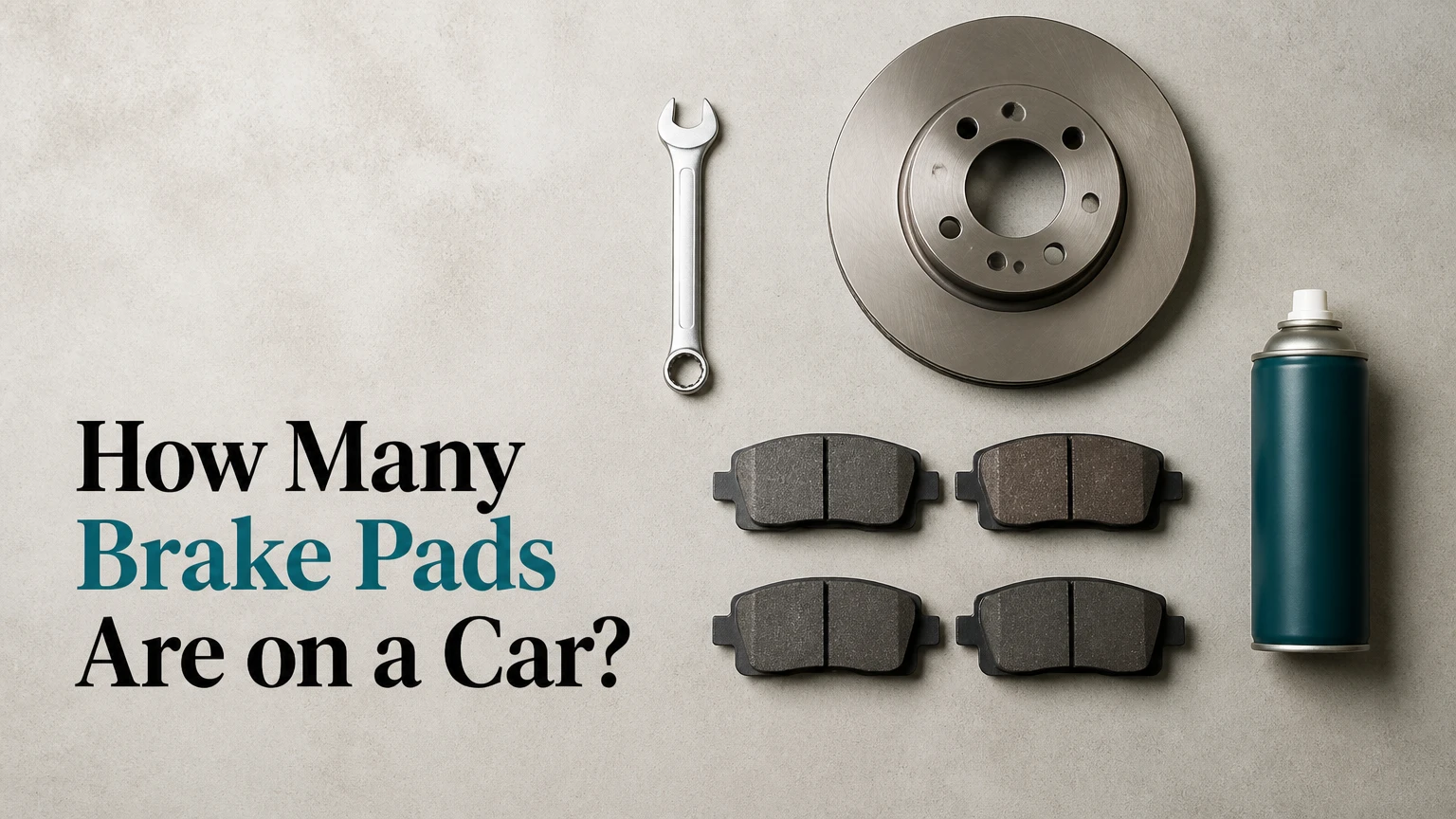
A typical modern car has exactly eight brake pads in total. You will find four brake pads on the front axle and four brake pads on the rear axle, which equates to two brake pads per wheel. The brake caliper clamps these two friction blocks against a spinning metal rotor to stop the vehicle.
If you are diagnosing a noise or ordering parts, knowing exactly how many brake pads are on a car prevents costly ordering mistakes. Replacing friction materials requires purchasing complete axle sets, meaning you will always buy front pads in a box of four, and rear pads in a separate box of four.
Key Facts / At a Glance
- Standard Configuration: Eight total pads (two per wheel on vehicles with four-wheel disc brakes).
- Replacement Requirement: Pads must be replaced in pairs across a complete axle to maintain steering stability.
- Average Lifespan: 30,000 to 70,000 miles, highly dependent on material composition and driving environment.
- Primary Materials: Non-Asbestos Organic (NAO), Semi-Metallic, and Ceramic.
- Average Axle Cost: $100 to $300 for both parts and professional labor per axle.
What Is the Standard Brake Pad Configuration?
Passenger vehicles equipped with four-wheel disc brakes utilize a standardized eight-pad layout. Each individual wheel assembly houses one brake rotor and one brake caliper. Inside each caliper, engineers place two brake pads: an inboard pad and an outboard pad.
When you press the brake pedal, hydraulic fluid travels from the master cylinder to the caliper. The caliper contains metal pistons that push the inboard pad directly against the inner face of the rotor. Simultaneously, the sliding mechanism of the caliper pulls the outboard pad against the outer face of the rotor. This clamping action generates the extreme friction required to halt thousands of pounds of moving mass.
Because every disc brake requires an inner and outer friction surface, one single wheel always uses two pads. Multiply this by four wheels, and you arrive at the industry standard of eight pads per vehicle.
Do All Vehicles Have Eight Brake Pads?
Not every vehicle on the road features exactly eight brake pads. You must check your specific drivetrain and trim level to verify your configuration. The two most common exceptions involve rear drum brakes and high-performance braking systems.
Many entry-level compact cars and mid-size pickup trucks utilize a disc/drum hybrid setup to reduce manufacturing costs. These vehicles feature disc brakes on the front axle (four brake pads) and drum brakes on the rear axle. Drum brakes do not use pads. Instead, they use four curved brake shoes that press outward against a hollow iron drum. A vehicle with this configuration contains exactly four brake pads and four brake shoes.
Conversely, high-performance sports cars and heavy-duty tow rigs sometimes utilize specialized multi-pad calipers. Certain six-piston or eight-piston calipers designed by companies like Brembo or Pagid separate the friction material into four smaller, discrete pads per wheel rather than two large ones. A high-performance car with this exact setup on the front axle would carry eight brake pads on the front wheels alone.
How Do Brake Pads Stop Your Vehicle?
Brake pads do not actually stop the vehicle directly. They operate as mechanical energy converters. When a car travels at highway speeds, it carries massive amounts of kinetic energy. To bring the car to a halt, the braking system must convert that kinetic energy into thermal energy.
When the caliper forces the brake pads against the spinning cast-iron rotor, the resulting friction generates immense heat. A standard passenger car making a sudden stop from 70 miles per hour will generate localized temperatures exceeding 400 degrees Fahrenheit (204 degrees Celsius) at the pad surface.
To survive this environment, a brake pad requires a robust physical structure. Manufacturers start with a solid steel backing plate. They apply a specialized bonding adhesive and press a thick block of friction material onto the plate under immense heat and pressure. Finally, engineers attach thin metal shims to the back of the steel plate to absorb high-frequency vibrations and prevent audible squealing during operation.
Which Brake Pad Material Should You Choose?
Selecting the correct friction material determines your vehicle’s stopping distance, wheel cleanliness, and rotor longevity. The automotive industry categorizes pads into three primary chemical matrixes, plus a fourth category for specialized track vehicles.
The Motor & Equipment Manufacturers Association (MEMA) 2024 index reports that modern ceramic pads now account for over 60 percent of aftermarket passenger car installations. However, ceramic materials fail under the extreme thermal loads of heavy towing. You must match the material to the exact weight and operating conditions of your vehicle.
| Pad Material Type | Friction Coefficient | Thermal Tolerance Ceiling | Average Life Expectancy | Primary Use Case |
|---|---|---|---|---|
| Non-Asbestos Organic | Low (0.25 to 0.35) | 400 F (204 C) | 20,000 to 30,000 miles | Light commuter cars, low budget |
| Semi-Metallic | High (0.38 to 0.50) | 1,300 F (704 C) | 30,000 to 50,000 miles | Heavy trucks, towing, spirited driving |
| Ceramic | Moderate (0.33 to 0.45) | 1,000 F (537 C) | 50,000 to 70,000 miles | Daily drivers, luxury vehicles |
| Carbon-Ceramic | Extreme (0.45 to 0.60) | 2,500 F (1,371 C) | Track use dependent | Supercars, track-dedicated chassis |
Organic pads offer quiet operation and gentle rotor wear, but they produce heavy black dust and wear out rapidly. Semi-metallic pads contain 30 to 65 percent iron, steel, and copper filings. They provide unmatched cold-weather grip and high heat dissipation, but they grind down rotors quickly and generate significant noise. Ceramic pads mix dense ceramic fibers with copper or brass filings, offering exceptional longevity, ultra-light colored dust, and silent operation.
How Much Does Brake Pad Replacement Cost?
The financial outlay for brake replacement scales directly with the weight and performance tier of your vehicle. Replacing friction material represents one of the most predictable ownership costs, but budgeting requires understanding the split between raw parts and professional labor.
Labor rates dictate a significant portion of the final bill. Automotive Service Excellence (ASE) certified technicians typically charge between $80 and $150 per axle for labor, assuming the rotors only require resurfacing rather than total replacement. A standard mechanic requires 30 to 45 minutes to complete one axle. If you perform the work yourself, you remove the labor cost entirely, though novice mechanics should budget one to two hours per axle for their first attempt.
| Vehicle Class | Pad Material Type | Average Parts Cost (Per Axle) | Average Labor Cost (Per Axle) | Total Estimated Job Cost |
|---|---|---|---|---|
| Compact Economy Car | Organic (NAO) | $20 to $40 | $90 | $110 to $130 |
| Mid-Size SUV | Ceramic | $50 to $70 | $120 | $170 to $190 |
| Half-Ton Pickup Truck | Heavy-Duty Semi-Metallic | $60 to $90 | $130 | $190 to $220 |
| High-Performance Sports Car | Aggressive Semi-Metallic | $120 to $180 | $150 | $270 to $330 |
What Are the Symptoms of Failing Brake Pads?
Your vehicle relies on acoustic and tactile warning systems to alert you when friction material drops below safe tolerances. Ignoring these mechanical signals rapidly escalates a basic pad replacement into a catastrophic failure requiring new rotors and calipers.
New brake pads feature approximately 10 to 12 millimeters of friction material. Manufacturers recommend replacing the pads when the material reaches 3 millimeters of thickness. At 2 millimeters, state safety inspections consider the vehicle legally unsafe for road use.
| Symptom Observed | Mechanical Cause | Immediate Risk Level | Recommended Action |
|---|---|---|---|
| High-Pitch Squealing | Steel wear indicator tab is physically scraping against the spinning rotor. | Low | Schedule a standard pad replacement within two weeks. |
| Harsh Grinding Noise | Friction material is completely depleted, forcing the steel backing plate to gouge the iron rotor. | Severe | Stop driving immediately. Replace both pads and rotors. |
| Steering Wheel Shake | Uneven pad material transfer or physical warping of the brake rotor surface. | Moderate | Resurface or replace rotors alongside new pads. |
| Spongy Pedal Feel | Air bubbles trapped in hydraulic lines or brake fluid boiling under high heat. | Severe | Bleed the hydraulic system and check for caliper fluid leaks. |
How Often Should You Replace Your Brake Pads?
Brake pad longevity lacks a universal timeline because wear rates depend entirely on driver behavior and geographic topography. A driver navigating the steep hills of San Francisco will consume brake pads in 20,000 miles, whereas a highway commuter driving across flat Midwestern states might exceed 80,000 miles on the exact same vehicle.
Heat cycles dictate the chemical breakdown of the friction matrix. Aggressive braking forces the pad to operate near its thermal ceiling, which accelerates the degradation of the resin binders holding the material together. To maximize pad life, practice engine braking on long descents and look far ahead in traffic to allow for gentle, coasting decelerations.
Can You Replace Brake Pads on Just One Wheel?
You must never replace brake pads on a single wheel. Automotive engineering standards mandate that friction components must be replaced in matched pairs across an entire axle. You replace both front wheels together or both rear wheels together.
If you place brand new pads on the front-left wheel while leaving worn pads on the front-right wheel, you create an aggressive friction imbalance. The new pads will generate significantly more clamping torque. During an emergency stop, this imbalance creates a violent yaw moment, physically pulling the steering wheel out of your hands and forcing the vehicle into an adjacent lane of traffic.
What Are the Most Common Brake Maintenance Mistakes?
First-time mechanics frequently execute the mechanical steps correctly but fail on the chemical and procedural nuances. These errors lead to premature wear, steering vibrations, and hydraulic system damage.
Expert Insight: Caliper Pin Lubrication Floating brake calipers rely on steel guide pins to slide back and forth. Mechanics often lubricate these pins with standard petroleum-based grease. Petroleum rapidly swells and degrades the protective rubber boots surrounding the pins, allowing water inside. The pins rust and seize in place, forcing the inner pad to drag against the rotor permanently. You must use high-temperature, silicone-based brake grease exclusively.
Expert Insight: Managing Fluid Volume As brake pads wear thinner over time, the caliper pistons extend further outward. The brake fluid level in the master cylinder reservoir drops to fill this new void in the caliper. When you compress the pistons back into the caliper to fit thick new pads, that fluid rushes backward up the lines. If you topped off your brake fluid recently, compressing the pistons will overflow the reservoir, spilling highly corrosive brake fluid onto your engine bay paint. Always open the reservoir cap and siphon out a few ounces of fluid before compressing pistons.
Do Front and Rear Brake Pads Wear at the Same Rate?
Front brake pads wear out nearly twice as fast as rear brake pads on standard passenger vehicles. When you press the brake pedal, the physical weight of the vehicle transfers forward onto the front suspension. To manage this massive weight transfer, manufacturers install larger rotors and higher-clamping calipers on the front axle.
The front axle handles 60 to 70 percent of the total braking load. Consequently, mechanics generally replace front brake pads twice for every single time they replace the rear brake pads.
Modern technology introduces a slight exception to this rule. Vehicles equipped with Electronic Brakeforce Distribution (EBD) and electronic parking brakes frequently use the rear calipers to prevent nose-dive during light braking. Owners of late-model European SUVs often find their rear pads wearing out slightly faster than historical averages due to these active stability systems.
How Do You Bed In New Brake Pads?
Bolting on new brake parts does not complete the replacement job. You must perform a specific driving procedure known as “bedding in” to mate the new pads to the rotors. Skipping this step guarantees squealing brakes and a vibrating steering wheel.
Bedding transfers a microscopic, even layer of friction material from the pad onto the bare iron rotor surface. You must find an empty, safe stretch of road to perform this procedure. Accelerate to 60 miles per hour, then apply firm, aggressive brake pressure to slow the vehicle down to 10 miles per hour. Do not come to a complete stop. Immediately accelerate back to 60 miles per hour and repeat the process five to eight times.
You will smell burning resin, and the brakes will feel slightly weak. This indicates the pads have reached their proper transfer temperature. Drive normally for ten minutes to cool the system down without coming to a complete, stationary stop with your foot holding the pedal down.
What Is the Difference Between Brake Pads and Brake Shoes?
Consumers frequently use the terms interchangeably, but brake pads and brake shoes represent entirely different mechanical architectures. Pads belong to disc brake systems, while shoes belong to drum brake systems.
A brake pad is a flat, thick block of material that clamps down onto a flat, spinning metal disc. A brake shoe is a curved, crescent-shaped piece of metal lined with friction material. Shoes sit inside a hollow metal drum. Instead of clamping inward like a caliper, a hydraulic wheel cylinder pushes the shoes outward to scrape against the inside wall of the drum. Drum systems are mechanically complex, featuring multiple return springs and star-wheel adjusters, making shoes significantly more difficult to replace than standard pads.
Summary: How Many Brake Pads Are on a Car?
A standard passenger vehicle with four-wheel disc brakes requires exactly eight brake pads to operate safely. The system distributes four pads to the front axle and four pads to the rear axle. When purchasing replacement parts, you will buy them in sets of four per axle. Always verify whether your specific vehicle utilizes rear disc brakes or rear drum brakes before ordering components, and always match your pad material to your specific driving habits.
Frequently Asked Questions
Do electric cars use fewer brake pads?
Electric vehicles (EVs) use the exact same eight-pad mechanical configuration as gas-powered cars. However, EVs rely heavily on regenerative braking, using the electric motors to slow the vehicle. This drastically reduces the physical workload on the friction pads, allowing EV brake pads to easily exceed 100,000 miles of usable life.
Can I use different brake pad materials on the front and rear?
You can safely mix pad materials between the front and rear axles, provided you keep the materials identical across the left and right sides of the same axle. Some mechanics install aggressive semi-metallic pads on the front axle for stopping power and quiet ceramic pads on the rear axle to reduce total brake dust.
How thick are brand new brake pads?
Brand new passenger car brake pads typically measure between 10 and 12 millimeters (roughly 3/8 to 1/2 of an inch) of usable friction material, excluding the steel backing plate. Heavy-duty truck pads often start at 14 millimeters. Mechanics recommend scheduling a replacement when the thickness drops to 3 millimeters.
What is brake fade?
Brake fade occurs when the braking system exceeds its maximum thermal capacity, resulting in a sudden loss of stopping power. Fluid fade happens when the brake fluid boils into compressible gas bubbles. Structural fade occurs when the pad material melts, releasing a layer of gas that prevents the pad from physically touching the rotor.
Are carbon-ceramic brakes different from ceramic brake pads?
Standard ceramic brake pads use a steel backing plate and operate on cheap cast-iron rotors. Carbon-ceramic brakes refer to a complete, exotic braking system where the entire rotor is manufactured from a carbon-fiber composite. Carbon-ceramic rotors cost thousands of dollars per wheel and are reserved exclusively for high-end supercars and track vehicles.


