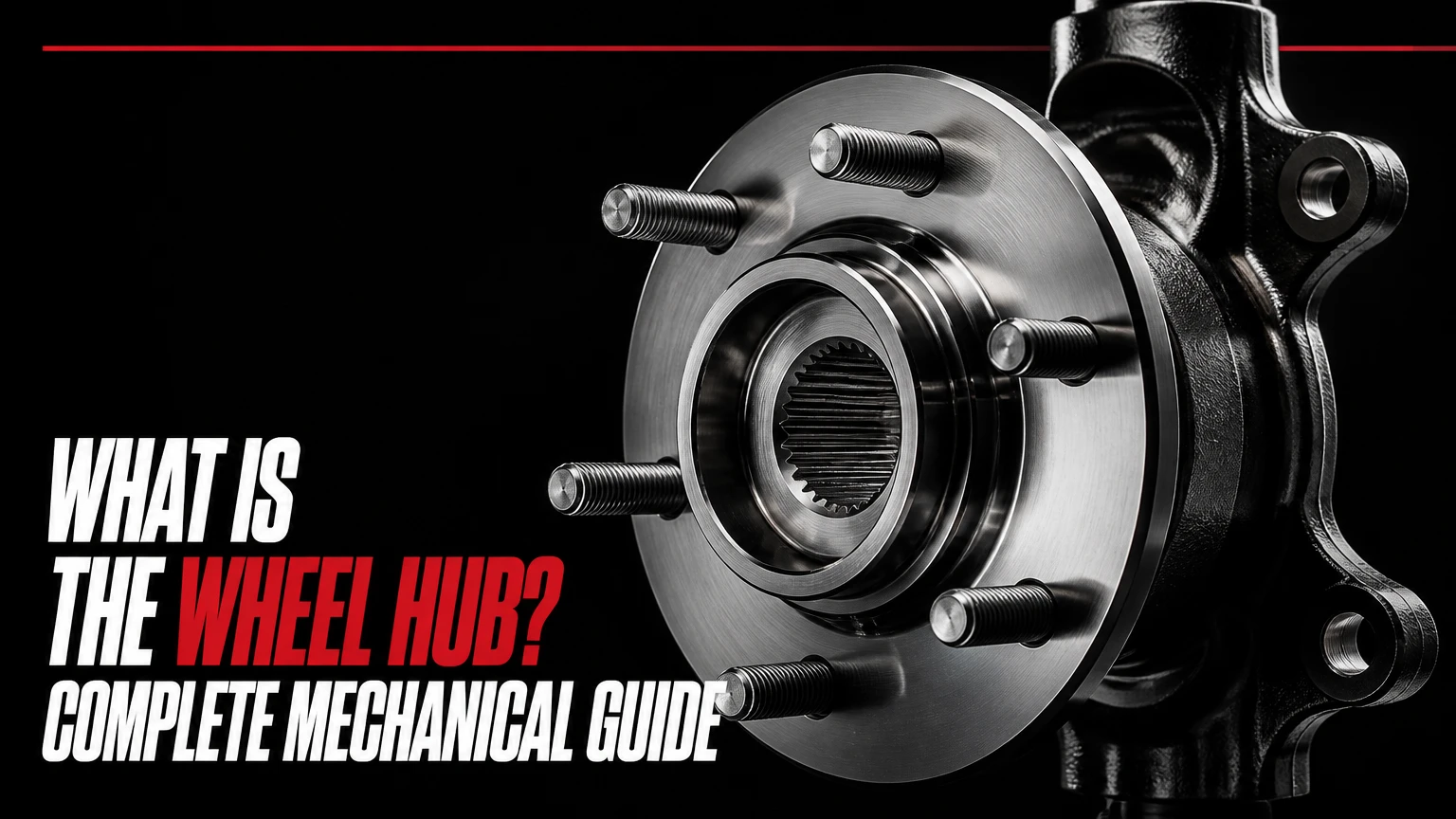
The wheel hub is the central structural component connecting a vehicle’s wheels to its suspension and braking systems. It acts as the mechanical core that allows wheels to rotate freely while remaining securely attached. The wheel hub houses internal bearings and often integrates magnetic speed sensors for anti-lock braking systems.
Key Facts / At a Glance
- Expected service life ranges from 100,000 to 150,000 miles under normal driving conditions.
- Axle nut torque specifications typically range between 150 and 300 lb-ft.
- Modern integrated units cannot be serviced and require complete replacement upon failure.
- Integrated tone rings provide real-time rotational data to traction control computers.
- A failing internal bearing generally produces a low-pitched growling noise that changes pitch with steering angle.
How Does A Wheel Hub Operate?
The assembly remains stationary on one side where it bolts to the steering knuckle, while the outer flange spins freely to rotate the attached tire. This component manages severe mechanical stress, supporting the entire vehicle weight while transferring acceleration torque and braking forces. The mechanical process follows five distinct operational stages.
Rotational Power Input
In driven wheels, the engine transfers rotational torque through the transmission directly to the drive axle. The axle acts as a rigid conduit for this mechanical force. Front-wheel-drive vehicles send this power to the front hubs, while rear-wheel-drive platforms direct it to the rear units.
Spline And Axle Shaft Engagement
The splined end of the axle shaft inserts directly into the center receiver of the wheel hub. The male splines on the axle mate precisely with the female splines inside the receiver. This locked physical connection ensures that when the axle turns, the outer flange must turn at the exact same rotational speed without slipping.
Friction Reduction Through Bearings
High-precision internal bearings minimize friction, allowing smooth rotation as the axle forces the flange to spin. These bearings consist of hardened steel balls or tapered rollers trapped between an inner and outer metal race. Premium assemblies utilize synthetic lithium complex grease to manage the extreme heat generated during highway driving.
Braking System Integration
The brake rotor or brake drum slides directly over the protruding wheel studs on the outer flange. When you press the brake pedal, the hydraulic caliper squeezes the brake pads against the rotor. Because the rotor is pinned against the hub by the wheel lugs, slowing the rotor instantly slows the entire assembly and the attached tire.
Electronic Speed Data Monitoring
An integrated wheel speed sensor reads a magnetic tone ring located inside the bearing seal as the assembly spins. This tone ring features alternating magnetic poles. The sensor counts these poles as they pass by, calculating the exact rotational speed and sending this real-time data to the Anti-lock Braking System and Traction Control System.
What Are The Different Hub Types?
Automotive manufacturers utilize three primary designs based on the vehicle’s drivetrain, age, and intended heavy-duty application. Understanding your specific type dictates exactly how you approach maintenance and replacement.
Integrated Assembly Units
An integrated assembly is a sealed, pre-assembled unit containing the mounting flange, high-capacity bearings, outer seals, and the ABS speed sensor. You will find this design on almost all modern passenger cars, crossover SUVs, and light trucks.
This modern standard completely eliminates routine maintenance. The factory presses the bearings together under exact mechanical tolerances and seals the lubricating grease inside for life. However, this convenience brings a distinct limitation: these units are entirely non-serviceable. If a minor seal leaks or a single steel ball pits, you cannot repair the internal components individually. You must discard and replace the entire assembly.
Traditional Non-Integrated Flanges
A non-integrated design features a bare forged steel flange that requires separate inner and outer tapered roller bearings to be manually pressed into it. This style dominates older rear-wheel-drive vehicles, heavy-duty commercial trucks, and utility trailers.
Unlike modern sealed units, this traditional style is highly serviceable. Technicians can remove the bearings, clean out contaminated grease, inspect the metal rollers, and repack them with fresh lubrication. You can replace a single damaged bearing for a few dollars without buying a new metal flange. This serviceability requires labor-intensive installation, leaving the unit vulnerable to incorrect manual bearing preload adjustments by inexperienced mechanics.
Manual And Automatic Locking Mechanisms
Locking mechanisms are used exclusively on four-wheel-drive vehicles to disconnect the front wheels from the front axle shafts when four-wheel drive is not needed. Disconnecting the axles prevents the front driveline from spinning during highway travel, which improves fuel economy and reduces mechanical wear.
Manual versions require the driver to physically exit the vehicle and turn a mechanical dial on the center of the wheel to lock the axle to the flange. Automatic versions engage electronically or via vacuum-mechanical actuators controlled by a dashboard switch. Manual dials offer superior reliability for severe off-road driving, while automatic systems provide daily convenience at the cost of potential vacuum leak failures.
| Hub Type | Primary Vehicle Application | Serviceability Level | Initial Component Cost |
| Integrated Assembly | Modern passenger cars, SUVs | Zero (Replace entire unit) | $150 to $350 |
| Non-Integrated | Older RWD cars, heavy trucks | High (Repackable bearings) | $40 to $80 |
| Manual Locking | Dedicated 4WD off-road vehicles | Moderate (Manual teardown) | $200 to $400 |
| Automatic Locking | Modern 4WD pickup trucks | Low (Electronic failure risks) | $250 to $500 |
What Are The Warning Signs Of Failure?
When the component or its internal bearings begin to degrade, the vehicle will display distinct auditory and physical warning signs long before a catastrophic separation occurs. Ignoring these symptoms leads to suspension damage and severely compromised braking distances.
Low-Pitched Growling Sounds
A failing unit produces a low-pitched humming, growling, or metallic chirping sound that gets progressively louder as the vehicle accelerates. The sound usually intensifies when you turn the steering wheel slightly in the opposite direction of the failing side. A typical practitioner rule of thumb states that if turning left makes the growl louder, the load is shifting to the right side of the vehicle, indicating the right bearing is damaged.
Steering Wheel Vibration
A degraded bearing causes physical looseness in the assembly, which translates directly into a shaky steering wheel or vague steering play. The metal rollers inside the bearing lose their exact tolerances, allowing the wheel to tilt slightly off its vertical axis. This looseness accelerates uneven tire wear and makes the vehicle feel unstable at highway speeds.
Anti-lock Braking System Warning Lights
If the internal ABS tone ring or the magnetic sensor gets damaged by excessive heat or physical bearing play, it will instantly trip the dashboard ABS warning light. The computer detects an erratic speed signal or a complete loss of data from that specific wheel. The system will disable anti-lock braking functions until you replace the faulty sensor or the entire integrated unit.
Uneven Brake Rotor Wear
A loose flange causes the attached brake rotor to wobble slightly as it spins, a condition known as lateral runout. This wobble repeatedly slaps the brake pads away from the rotor, causing uneven pad wear and a rhythmic pulsation in the brake pedal when stopping. You cannot fix this pulsation permanently by replacing the brakes; the underlying looseness will destroy the new brakes within a few thousand miles.
| Warning Symptom | Primary Mechanical Cause | Secondary System Impact | Diagnostic Urgency |
| Low-Pitch Growling | Pitted steel bearing races | Bearing seizure and lockup | High |
| Steering Vibration | Loose internal tolerances | Accelerated tire tread wear | Moderate |
| ABS Dashboard Light | Tone ring magnetic failure | Loss of traction control | High |
| Uneven Brake Wear | Flange lateral runout | Warped brake rotors | Low |
How Do You Test A Wheel Hub?
You can test the component for internal looseness and bearing failure using three simple physical diagnostics. Lift the vehicle securely on jack stands and ensure the transmission is in park before beginning the inspection.
- The 12-and-6 Play Check: Grasp the suspended tire at the top (12 o’clock) and bottom (6 o’clock) positions. Push the top away from you while pulling the bottom toward you, alternating back and forth. You’ll know it worked when you feel zero clicking or looseness. Any physical knocking indicates internal bearing collapse.
- The Coil Spring Vibration Test: Place one bare hand firmly on the vehicle’s metal suspension coil spring. Use your other hand to spin the tire as fast as possible. A healthy bearing spins smoothly. A failing bearing sends high-frequency grinding vibrations straight through the knuckle and up into the coil spring where you can feel them.
- The Lateral Runout Measurement: Remove the tire and bolt a magnetic dial indicator to the steering knuckle. Rest the indicator tip directly against the bare metal hub flange. Rotate the flange slowly by hand. The dial should read less than 0.002 inches of lateral movement; anything higher requires immediate replacement.
How Much Does Replacement Cost?
Replacement costs depend heavily on your vehicle model, the quality tier of the replacement part, and local mechanic labor rates. Most assemblies feature a service life of 160,000 to 240,000 kilometers (100,000 to 150,000 miles).
Economy aftermarket assemblies cost between $50 and $100. Premium original equipment manufacturer (OEM) quality assemblies cost between $150 and $350. Labor costs add $100 to $300 per wheel, depending on local shop rates and suspension rust. A professional mechanic requires 1.0 to 2.5 flat-rate hours to complete the job.
Your intended driving scenario should dictate your purchasing decision:
- The Daily Commuter: Stick strictly to Premium Tier-1 aftermarket brands. Paying slightly more upfront ensures you get high-grade multi-lip seals that protect against rain, road salt, and potholes for another decade.
- The Budget-Conscious Driver: Mid-tier aftermarket brands offer a solid balance for older commuter cars. Avoid generic no-name online listings, as cheap assemblies frequently suffer from defective ABS sensors straight out of the box.
- The Off-Roader: Look for heavy-duty forged steel assemblies if you frequently tow heavy loads or hit muddy trails. If your rig uses traditional non-integrated hubs, perform manual bearing inspections and grease repacking after every deep water crossing.
| Replacement Tier | Parts Cost Range | Labor Cost Range | Expected Mileage Yield |
| Economy Aftermarket | $50 to $100 | $100 to $150 | 30,000 to 50,000 miles |
| OEM Equivalent | $150 to $350 | $150 to $200 | 100,000 to 150,000 miles |
| Heavy-Duty Upgraded | $250 to $450 | $200 to $300 | 150,000+ miles (towing) |
| Dealer Original Part | $400 to $600 | $200 to $300 | 100,000 to 150,000 miles |
What Are Common Installation Mistakes?
Improper installation procedures account for the vast majority of premature part failures. Professional mechanics adhere to strict protocols that at-home DIYers frequently ignore to save time.
Using Impact Wrenches On Axle Nuts
Using an air impact gun to zip the main axle nut tight can instantly mar the internal bearing races, cutting the lifespan of the new component down to a few thousand miles. A common practitioner rule of thumb dictates that impact shock loads drive the internal steel balls directly into the hardened races, creating microscopic indentations. You must always use a calibrated manual torque wrench to apply the exact factory specification, which usually ranges from 150 to 300 lb-ft.
Ignoring The Steering Knuckle Surface
Failing to wire-brush rust and corrosion off the steering knuckle mating surface prevents the new flange from seating entirely flush. This trapped rust causes the component to sit at a microscopic angle, resulting in severe wheel misalignment and instant brake rotor runout. You must clean the aluminum or steel knuckle down to bare, shiny metal and apply a thin layer of anti-seize paste to prevent future galvanic corrosion.
Reusing The Old Axle Nut
Many automobile manufacturers utilize one-time-use locking nuts or prevailing-torque axle nuts from the factory. Reusing an old axle nut drastically increases the risk of it backing off under heavy suspension vibration. If the axle nut loses torque, the bearing loses its critical mechanical preload, causing the internal rollers to separate and destroy themselves in a matter of days. Always purchase and install a brand-new axle nut.
Wheel Hub Versus Wheel Bearing Differences?
The terms are often used interchangeably by consumers, but they refer to distinctly different mechanical components. The bearing is a friction-reduction device consisting of steel rollers, while the hub is the heavy metal structural housing that holds that bearing.
In modern integrated assemblies, the two components are permanently fused together at the factory and sold as a single unit. You cannot buy the bearing separately from the structural housing. In older traditional systems, the structural flange is a permanent part of the vehicle, and the bearings are disposable inserts that you press in and out of the housing as needed.
Frequently Asked Questions
Can you safely drive on a failing bearing?
Driving on a failing bearing presents severe safety risks and should be avoided. Heat buildup from metal-on-metal friction causes the assembly to seize completely while driving. In extreme cases, a seized bearing shears the metal spindle, causing the entire wheel to detach from the vehicle at highway speeds.
How long does replacement take?
A professional technician requires 1.0 to 2.5 flat-rate hours per wheel in a fully equipped shop. Rusted suspension components in northern climates often push this time to the higher end due to seized bolts. At-home mechanics working on floor jacks should budget three to four hours per side.
Do you need an alignment after replacing a hub?
You do not typically need a wheel alignment if you only unbolt the central flange. However, removing the entire steering knuckle or disconnecting the upper strut bolts to gain access alters your factory camber and toe angles, making a four-wheel alignment strictly necessary before driving.
Are front and rear hubs identical?
Front and rear units vary significantly based on the vehicle’s specific drivetrain layout. Front-wheel-drive vehicles utilize splined front receivers to accept transmission torque, while the rear units remain unpowered solid spindles. All-wheel-drive platforms often feature powered splined units on all four corners.
What causes premature component failure?
Impact damage from deep potholes acts as the primary cause of premature mechanical failure. The kinetic energy forces the internal steel balls to dent the metal race. Prolonged exposure to deep standing water also breaches the protective rubber seals, washing out the factory grease and causing rapid rust.


