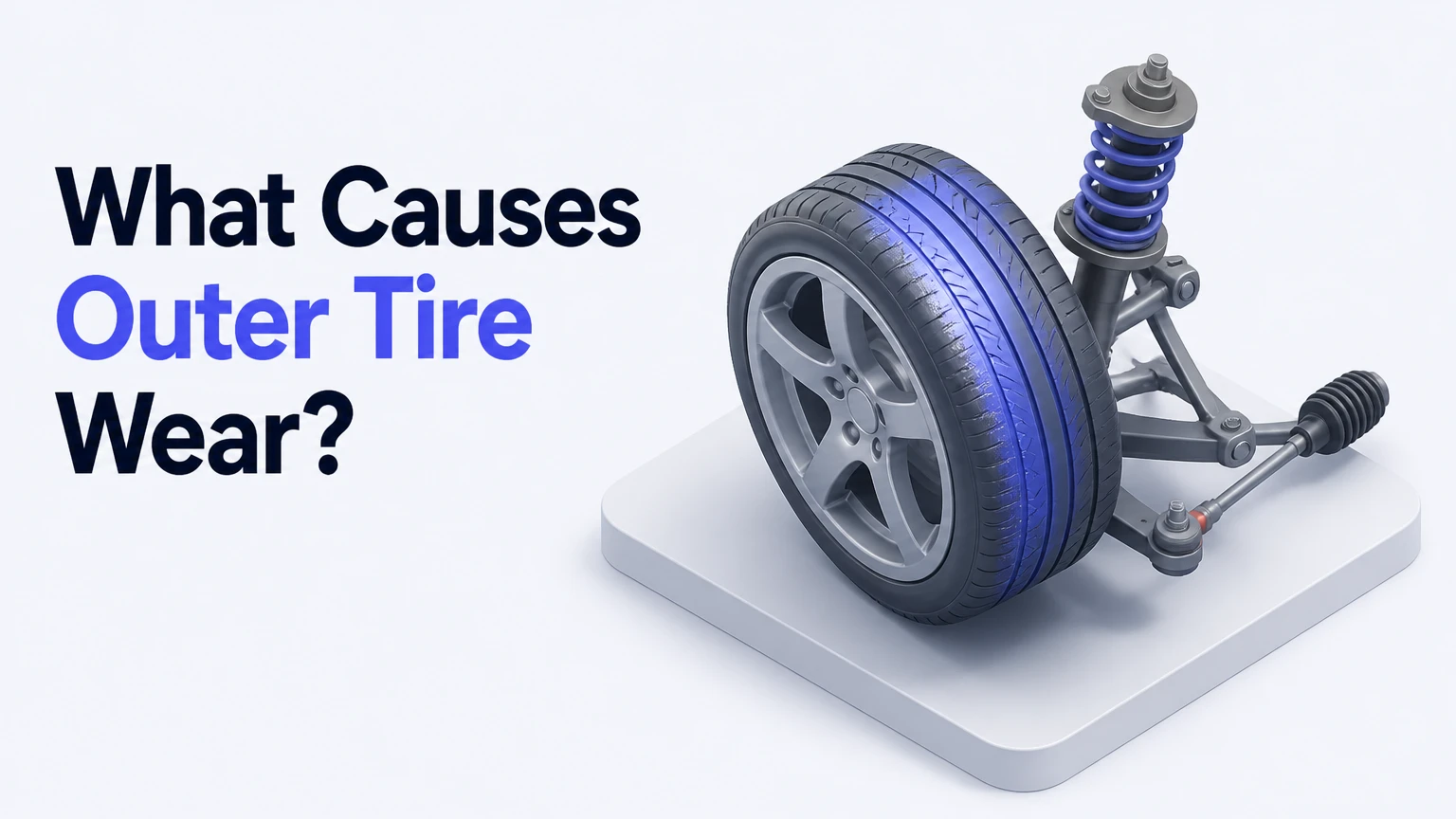
What causes outer tire wear is usually incorrect wheel alignment, especially excessive positive camber or improper toe, but low tire pressure, worn suspension parts, hard cornering, overloading, and impact damage can create similar patterns. The exact cause depends on whether one outer edge, both shoulders, one tire, or an entire axle is wearing.
Key Facts at a Glance
- Wear on one outer shoulder usually indicates alignment or suspension geometry trouble.
- Wear on both shoulders of the same tire usually indicates chronic underinflation.
- Feathered tread blocks point more strongly to an incorrect toe setting than camber.
- A tire rotation redistributes wear but does not repair its mechanical cause.
- An alignment cannot remain accurate when ball joints, bushings, or tie rods are loose.
- Irregular tread wear cannot grow back after the underlying fault is corrected.
What Does Outer Tire Wear Mean?
Outer tire wear means the tread near the outside sidewall has lost more rubber than the center or inner portion of the tire. Technicians often call this area the outer shoulder, but the shape and location of the damage matter more than the name.
A single smooth, sloping outer edge usually points toward camber or a bent suspension component. Sharp, sawtooth-like tread blocks suggest toe-related scrubbing. Wear across both outer shoulders, with deeper tread remaining in the middle, more often indicates that the tire has operated below the vehicle manufacturer’s recommended pressure.
Michelin’s tire-wear guidance makes the same core distinction: wear on both edges is associated with chronic underinflation, while wear confined to one edge points toward an alignment problem. The company also notes that feathering is linked to incorrect toe.
| Visible tread pattern | Most likely cause | Confirming clue | First check |
| Outer edge only, smooth slope | Positive camber or geometry fault | Wheel may lean outward at the top | Alignment measurement |
| Outer edge with feathering | Incorrect toe | Blocks feel sharp one direction | Toe reading |
| Both shoulders worn | Underinflation | Center tread remains deeper | Cold tire pressure |
| Scalloped shoulder patches | Worn damper, imbalance, looseness | Vibration or bouncing | Suspension and balance |
| One isolated outer patch | Bent wheel or localized damage | Started after pothole impact | Wheel runout and suspension |
| Both front outer shoulders | Cornering, pressure, or alignment | Front axle affected most | Pressure and four-wheel alignment |
How Does Wheel Alignment Cause Outer-Edge Wear?
Wheel alignment causes outer-edge wear by forcing the tire to roll at an angle or scrub sideways instead of tracking straight. Camber changes where the vehicle’s load sits across the tread, while toe changes the direction in which the tire attempts to travel.
The result is repeated friction at the outer shoulder. Rubber heats, flexes, and abrades every time the tire rotates. A small geometry error may appear harmless when the vehicle is parked, yet it can remove tread rapidly over thousands of loaded revolutions.
Alignment specifications are vehicle-specific. A camber or toe value that is normal for one model may be outside tolerance for another, so universal statements such as “anything above a particular angle causes severe wear” should not replace the manufacturer’s specification or a model-specific alignment database.
Can Positive Camber Wear the Outside Edge?
Excessive positive camber can wear the outside edge because the top of the wheel leans outward, concentrating more load on the outer shoulder. Positive camber may result from impact damage, altered ride height, worn suspension parts, incorrect adjustment, or a bent structural component.
Static camber measured on the alignment rack is only part of the diagnosis. Worn control-arm bushings or ball joints can allow the angle to change while braking, accelerating, or cornering. A vehicle can therefore display an acceptable unloaded measurement but still wear tires because the suspension moves outside its intended range on the road.
Outer-edge camber wear usually looks smooth. Tread depth declines progressively from the inner ribs toward the outer shoulder rather than producing alternating sharp and rounded block edges.
How Does Toe Cause Outer Tire Wear?
Incorrect toe causes shoulder wear by dragging the tread sideways across the pavement. Excessive toe-in means the fronts of the tires point too far toward each other, while toe-out means they point too far apart.
Toe wear often creates feathering. Run a flat hand lightly across the tread from the inside toward the outside, then reverse direction. Tread blocks that feel smooth one way and sharp the other have been scrubbed rather than simply overloaded.
Toe is frequently the fastest tire-wearing alignment error because every rotation produces lateral slip. The worn shoulder may be outer, inner, or spread across several ribs depending on toe direction, steering position, camber, tire design, and axle geometry.
Can Low Tire Pressure Cause Outer Tire Wear?
Low tire pressure can cause outer tire wear, but it normally wears both shoulders rather than only the outside edge. Underinflation lets the tire’s sidewalls flex more and shifts a larger share of the load toward the shoulder regions.
Michelin states that chronic underinflation increases wear on the outside edges, generates excess heat, reduces durability, and raises rolling resistance. The correct pressure should come from the vehicle’s door-jamb placard or owner’s manual, not the maximum pressure molded into the tire sidewall.
Pressure must be checked when the tires are cold, usually before driving or after the vehicle has remained parked for several hours. Heat generated during driving raises pressure and can conceal an underinflated cold reading.
| Pressure-related pattern | Tread appearance | Likely explanation | Corrective action |
| Both shoulders worn | Outer and inner edges low | Chronic underinflation | Set cold PSI to placard value |
| Center worn | Middle ribs low | Chronic overinflation | Verify gauge and placard PSI |
| One shoulder worn | One edge low | Alignment more likely | Measure camber and toe |
| Random shoulder damage | Irregular chunks or cuts | Road hazard or overload | Inspect casing and load history |
| Repeated pressure loss | Pattern returns after inflation | Leak, valve, bead, or wheel fault | Perform leak test |
A tire that repeatedly loses pressure requires more than periodic refilling. A technician should inspect the tread for punctures, the valve stem for leakage, the bead seal for corrosion, and the wheel for cracks or deformation.
Does Hard Cornering Wear the Outer Shoulder?
Hard cornering can wear the outer shoulders because vehicle weight transfers toward the outside tires and loads their outer tread blocks. Frequent high-speed turns, tight roundabouts, mountain roads, autocross use, and abrupt steering inputs intensify this effect.
The pattern often appears on both front tires, especially on front-heavy vehicles, because the front axle handles steering while carrying a large share of the vehicle’s mass. Performance tires may use reinforced outer shoulder blocks for this reason, but stronger blocks do not eliminate wear caused by repeated high lateral loads.
Cornering wear should not be diagnosed by driving style alone. A correctly aligned street car driven briskly may show some outer-shoulder wear, but severe or rapid wear still justifies pressure, alignment, and suspension checks.
Practitioner insight: When both front outer shoulders wear at nearly the same rate and the tread is not feathered, check pressure history and driving route before assuming a bent suspension part. Repeated roundabouts or tight urban turns can produce a surprisingly symmetrical pattern.
Which Suspension Problems Cause Outer Tire Wear?
Worn or damaged suspension and steering parts cause outer tire wear when they change camber or toe under load. Common sources include control-arm bushings, ball joints, tie-rod ends, strut mounts, wheel bearings, steering knuckles, bent control arms, and weakened springs.
A conventional alignment adjusts geometry at one moment. It cannot compensate for a joint that moves after the vehicle leaves the rack. Any measurable looseness should therefore be corrected before final alignment.
Common Mechanical Causes
- Control-arm bushings: Split or softened rubber lets the wheel shift during braking and acceleration.
- Ball joints: Excess clearance allows camber and toe to change as road load moves the joint.
- Tie-rod ends: Steering looseness changes toe and may produce feathering or wandering.
- Struts and shocks: Weak damping contributes more often to cupping, but damaged mounts can also alter geometry.
- Wheel bearings: Excess play lets the hub and wheel tilt under load.
- Bent knuckles or control arms: Pothole and curb impacts can create a persistent one-sided angle error.
- Sagging springs: Reduced ride height changes suspension-arm position and alignment angles.
- Modified suspension: Lowering springs, lift kits, spacers, and nonstandard control arms require appropriate alignment targets.
| Component or condition | Typical driving symptom | Common wear clue | Usual confirmation |
| Control-arm bushing | Clunking or brake wander | Changing outer-edge wear | Loaded bushing inspection |
| Ball joint | Loose steering or knocking | Camber-related shoulder wear | Joint-play test |
| Tie-rod end | Wandering or crooked wheel | Feathering | Steering-play and toe test |
| Weak strut or shock | Bouncing or instability | Cupping or scalloping | Bounce and damper inspection |
| Wheel bearing | Humming or hub looseness | Irregular one-sided wear | Bearing-play measurement |
| Bent control arm or knuckle | Pull after impact | One tire wears rapidly | Geometry comparison |
| Sagging spring | Uneven ride height | Persistent camber change | Ride-height measurement |
| Lift or lowering kit | Changed handling | Both tires wear after modification | Modified-vehicle alignment |
Why Is Only One Tire Wearing on the Outside?
Outer wear on only one tire usually indicates a localized alignment, suspension, wheel, or impact problem. Underinflation remains possible, but pressure-related wear generally affects both shoulders of that tire rather than only its outer edge.
Start by asking what changed before the wear appeared. A pothole strike, curb impact, collision, bearing replacement, suspension repair, or ride-height modification provides valuable diagnostic direction.
Compare the affected tire with the opposite tire on the same axle. A large difference between left and right camber, caster, toe, setback, or ride height often identifies the responsible side. The alignment printout should include both initial and corrected measurements rather than only a statement that the vehicle is “in the green.”
Why Do Both Front Tires Wear on the Outside?
Both front tires may wear on the outside because the front axle carries steering loads, cornering forces, and often a greater proportion of vehicle weight. Common causes include low pressure, aggressive cornering, incorrect total toe, unsuitable camber settings, and delayed tire rotation.
Pattern shape remains the deciding evidence. Both shoulders worn on each tire suggests pressure. Matching smooth outer edges suggest alignment or cornering loads. Feathering across both front tires makes toe a stronger suspect.
Front-wheel-drive vehicles may accelerate front-tire wear because the same tires steer, transmit engine torque, and handle much of the braking load. Rotation can balance axle wear, but it cannot prevent rapid shoulder loss when pressure or geometry remains wrong.
Can Tire Rotation Fix Outer Tire Wear?
Tire rotation cannot repair outer tire wear because lost tread cannot be restored. Rotation can move the damaged tire to a position where future wear is distributed differently, but only after the original pressure, alignment, suspension, or driving cause has been corrected.
Michelin states that the cause of irregular wear can be repaired, yet the existing wear pattern itself cannot be reversed.
Bridgestone recommends following the vehicle manufacturer’s rotation schedule and notes that a typical interval is about 5,000 miles when no different interval is specified. Directional tires, staggered wheel sizes, and certain all-wheel-drive systems may restrict the available rotation pattern.
Practitioner insight: Rotating a heavily feathered tire may change the noise rather than cure it. The tread blocks retain their uneven shape, so road noise can remain or become more noticeable after the tire changes position.
How Can You Diagnose the Exact Cause?
Diagnose outer tire wear by checking the pattern, pressure, tread depth, axle location, suspension condition, and alignment measurements in that order. This sequence separates simple pressure problems from geometry faults before new tires are installed.
Step 1: Inspect the Whole Tread
Turn the steering wheel so the front tread is visible. Inspect the inner shoulder, center ribs, outer shoulder, and full circumference. Look for smooth slopes, feathering, cupping, cracks, bulges, cuts, exposed cords, and embedded objects.
Step 2: Measure Three Tread Positions
Use a tread-depth gauge at the inner, center, and outer grooves. Record the readings in 32nds of an inch or millimeters. Repeat the measurements at three points around the tire to detect localized damage.
Step 3: Check Cold Tire Pressure
Measure all tires before driving and compare the readings with the door-jamb placard. Do not use the sidewall maximum as the normal operating target.
NHTSA advises checking pressure and tread at least monthly. The agency also states that tires should be replaced when tread reaches 2/32 inch.
Step 4: Feel for Feathering
Slide your hand across the tread in both directions. Smooth travel one way and sharp edges the other way strongly indicate toe-related scrubbing.
Step 5: Compare Tires by Axle
Determine whether the problem affects one tire, both tires on one axle, or all four tires. Symmetry provides diagnostic evidence that a single damaged part cannot.
Step 6: Inspect Steering and Suspension
Check ball joints, tie rods, bushings, bearings, springs, struts, and mounting points. Perform the checks according to the vehicle manufacturer’s procedures because some joints must be loaded while others are tested unloaded.
Step 7: Obtain a Four-Wheel Alignment Printout
Request before-and-after measurements for camber, caster, individual toe, total toe, thrust angle, and setback where supported. A four-wheel reading can reveal a rear thrust-angle problem that forces the steering wheel off-center and affects front tracking.
What Causes Outer Tire Wear After an Alignment?
Outer tire wear after an alignment usually means the original diagnosis was incomplete, the alignment was performed before worn parts were repaired, the specifications were unsuitable for the vehicle’s condition, or the tire was already permanently worn.
Other possibilities include:
- A loose bushing or joint changed position after the alignment.
- Ride height was not measured before angles were adjusted.
- The steering wheel or suspension was not settled correctly on the rack.
- The vehicle carries permanent cargo that was absent during alignment.
- A lowering or lift kit requires modified components or different targets.
- The driver is seeing old wear that remains visible after the repair.
- A pothole or curb impact altered alignment again.
An alignment printout is more useful than a verbal assurance. Compare the final numbers with the vehicle manufacturer’s permitted range and examine left-to-right differences, not only green or red screen colors.
Is Outer Tire Wear Dangerous?
Outer tire wear becomes dangerous when the shoulder reaches the tread-wear indicators, cords become visible, the tire develops a bulge or separation, or the vehicle loses predictable steering and wet grip. The least-worn center groove does not make a severely worn shoulder safe.
NHTSA identifies 2/32 inch as the replacement threshold and advises replacing tires that show irregular wear or physical damage related to underinflation or overloading. Local inspection laws or tire manufacturers may impose additional requirements.
Stop driving and arrange professional inspection when:
- Fabric or steel cords are exposed.
- The sidewall or shoulder has a bulge.
- The vehicle suddenly pulls or wanders.
- The steering wheel shakes after an impact.
- The tire repeatedly loses pressure.
- The worn area is cracked, cut, or separating.
- Wet-road traction has declined noticeably.
How Much Does It Cost to Fix the Cause?
Fixing outer tire wear typically costs from about $20 for a puncture or pressure-related service to more than $1,500 when several suspension components and tires require replacement. The correct repair cost depends on the failed part, vehicle design, labor rate, tire size, and whether the wear has made the tire unusable.
The following are typical U.S. consumer ranges, not quotes for a specific vehicle.
| Service | Typical cost | Typical time | When it applies |
| Pressure check and inflation | $0-$20 | 10-20 minutes | Incorrect pressure only |
| Tire rotation | $25-$80 | 30-60 minutes | Wear still minor and cause corrected |
| Wheel balance | $60-$160 per set | 45-90 minutes | Vibration or imbalance |
| Four-wheel alignment | $100-$250 | 60-120 minutes | Camber, toe, or thrust-angle fault |
| Tie-rod end replacement | $150-$450 each | 1-2 hours | Loose steering or unstable toe |
| Ball joint replacement | $200-$650 each | 1-3 hours | Joint play alters geometry |
| Control-arm replacement | $300-$1,000 each | 2-4 hours | Bent arm or failed bushings |
| Strut replacement | $600-$1,600 per axle | 3-6 hours | Damper or mount failure |
| Wheel bearing replacement | $300-$800 each | 2-4 hours | Hub play or bearing noise |
| Replacement tire | $120-$500 each | 30-60 minutes | Tread unsafe or structurally damaged |
Alignment should normally follow suspension replacement. Installing new tires before correcting the mechanical fault risks damaging the replacement tread in the same pattern.
How Do You Prevent Outer Shoulder Wear?
Prevent outer shoulder wear by maintaining placard pressure, rotating tires on schedule, checking tread monthly, repairing loose suspension parts promptly, and obtaining an alignment after significant impacts or ride-height changes.
Use these practical intervals:
- Check cold pressure at least once each month and before long trips.
- Inspect inner, center, and outer tread during the same monthly check.
- Follow the manufacturer’s rotation interval, commonly around 5,000-8,000 miles.
- Recheck alignment after curb impacts, severe potholes, suspension repairs, or steering changes.
- Measure tread depth instead of relying only on visual inspection.
- Reduce speed through repeated tight turns when shoulder wear is developing.
- Use the loaded-pressure recommendation when the manufacturer provides one for heavy cargo or towing.
NHTSA recommends recurring tire rotation, balancing, and alignment services as part of tire maintenance, while Michelin emphasizes that proper inflation and correction of alignment or suspension faults must occur before the pattern can be prevented from returning.
Frequently Asked Questions
Does excessive positive camber always cause outer wear?
Excessive positive camber commonly causes outer-shoulder wear, but the measured angle must be compared with the vehicle’s own specification. Dynamic movement from worn bushings, ball joints, bearings, or springs can also load the outer edge even when a static alignment reading appears acceptable.
Can a bent rim cause outer tire wear?
A bent rim can contribute to irregular shoulder wear if wheel runout changes the contact pattern or creates vibration. A bent wheel more often causes localized or repeating wear than a perfectly smooth shoulder slope, so technicians should check wheel runout, balance, hub condition, and alignment together.
Will adding air correct an already worn tire?
Adding air corrects the operating pressure but cannot restore missing tread. The tire may remain usable when tread depth, structure, and handling are still safe, but severe shoulder wear may require replacement. Pressure should be corrected immediately, followed by a leak check if the tire loses air again.
Why is the outside edge worn but the car does not pull?
A vehicle can have outer-edge wear without pulling because matching alignment errors exist on both sides, the steering system compensates, or toe is scrubbing both tires symmetrically. Tire pull also depends on road crown, tire construction, caster difference, pressure, and rear thrust angle.
Can worn shocks cause only outer-edge wear?
Worn shocks usually create cupping or scalloped patches rather than a uniform outer-edge slope. However, damaged strut mounts, sagging springs, or related suspension movement can alter alignment. A smooth one-sided shoulder pattern should still prompt camber, toe, bearing, bushing, and joint checks.
Should all four tires be replaced for outer wear?
All four tires do not always require replacement. Replace each tire according to tread depth, structural condition, axle-matching requirements, and drivetrain rules. Some all-wheel-drive vehicles limit permissible tread-depth differences, so the owner’s manual or manufacturer procedure should guide whether one, two, or four tires are needed.
The Bottom Line
What causes outer tire wear depends on the shape and distribution of the damage. One smooth outer edge usually points toward camber, toe, impact damage, or suspension movement, while wear on both shoulders usually points toward chronic underinflation. Hard cornering, overloading, modified ride height, and delayed rotation can accelerate either pattern.
Check cold pressure first, measure tread across three positions, inspect for feathering, test steering and suspension parts, and obtain a complete four-wheel alignment printout. Correct the mechanical cause before installing new tires because rotation or replacement alone will not prevent the outer shoulder from wearing again.


