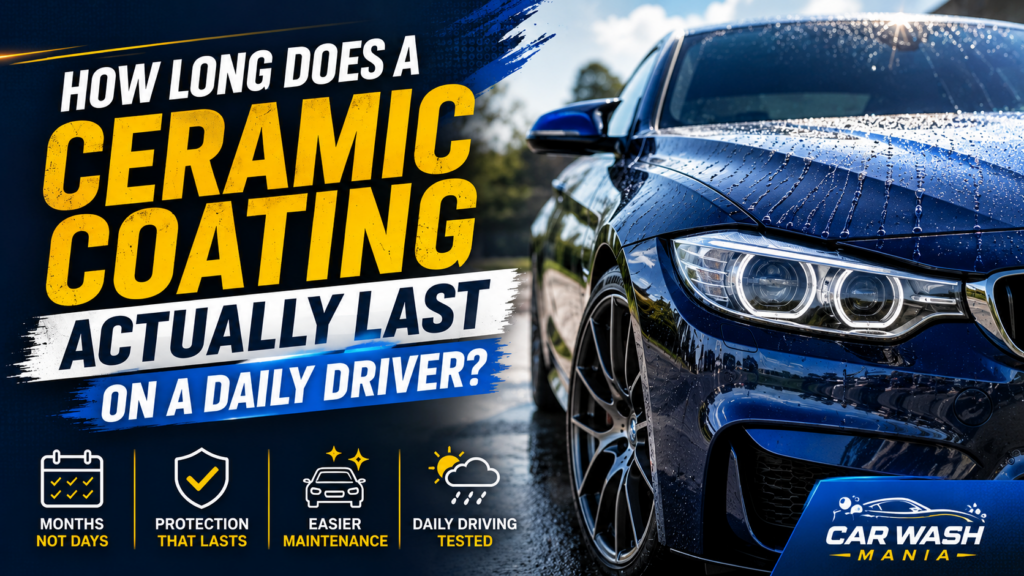
If you drive your car every day, the honest answer is this: a ceramic coating on a daily driver actually lasts 2 to 5 years for consumer DIY kits and 3 to 7 years for professional grade applications. Those numbers sit well below the 8 or 10 year figures you see on the bottle, and there is a good reason for that gap. Manufacturer claims come from controlled lab panels, not from a car that lives in a parking lot, crawls through highway grime, and takes a few automatic washes a month.
This guide is built for the person who does not baby their vehicle. You park outside. You commute. You maybe wash it every couple of weeks when you remember. The question you actually care about is not what a coating can do in a lab. It is how long the protection holds up on your car, in your climate, with your habits, and whether the price makes sense.
Below you will find real world lifespan ranges, the exact factors that speed up wear, the difference between a coating that is failing and one that is simply clogged, and a maintenance plan that can push your coating to the top of its range instead of the bottom.
The Quick Answer: Real World Ceramic Coating Lifespan by Type
Not every product marketed as “ceramic” belongs in the same conversation. A spray sealant and a professional SiC coating both repel water on day one, yet one is gone in months and the other holds for years. Ceramic coating durability depends almost entirely on the chemistry and the film thickness that formula can build.
Here is how the main categories actually perform on a car that gets driven daily and parked outdoors.
| Product Type | Real World Lifespan | Best For |
|---|---|---|
| Professional Grade Coating | 3 to 7 years | Long term protection, resale value, minimal upkeep |
| DIY Wipe On Kit | 2 to 5 years | Enthusiasts who want strong protection on a budget |
| Ceramic Spray Sealant | 6 to 12 months | Easy entry point or a sacrificial top layer |
| Ceramic Wax or Hybrid | 2 to 6 months | Quick gloss boost between deeper protection |
To make the gap easy to see, here is the same data as a colorful lifespan chart. Each bar shows how far into the timeline each product typically protects a daily driver.
Why Lab Claims and Real World Ceramic Coating Durability Never Match
The single most important thing to understand about ceramic coating longevity is that the number on the label is a ceiling, not a promise. A “10 year coating” means the chemistry is capable of surviving roughly a decade under ideal, controlled conditions. Your daily driver does not live in ideal conditions.
Lab durability tests use flat test panels, filtered light, temperature control, and no physical contact. Your car faces UV that bakes the finish for hours, sudden temperature swings, acidic rain, wash after wash, and thousands of tiny impacts from road debris. Every one of those variables shaves time off that ceiling.
The coating is doing its job as a sacrificial barrier, which means it degrades on purpose so your clear coat does not. That is the whole point. So a realistic daily driver ceramic coating lifespan lands in the 2 to 7 year window depending on the product and how you treat it, and that is a sign the coating is working, not failing.
The Environmental Factors That Degrade a Daily Driver Coating
A garage kept weekend car and a daily commuter can have the exact same coating and end up years apart in longevity. The difference is exposure. A daily driver absorbs a stack of stressors that a covered car never sees.
- UV radiation and extreme heat. Constant sunlight slowly wears down the slick hydrophobic top layer. Heat also accelerates the breakdown of any weaker sacrificial products layered on top. Cars that park outside in hot, sunny regions age their coatings faster than cars in mild, shaded climates.
- Traffic film and road debris. Highway commuting throws a steady stream of micro abrasives, atomized engine oils, brake dust, and road salt against the lower panels and rocker areas. This is why the bottom third of a coated car almost always fails first.
- Environmental contaminants. Bird droppings, tree sap, industrial fallout, and acid rain are acidic and will etch into the coating if they are left to sit and bake. A dropping left on hot paint for a day can leave a permanent mark even through a coating.
- Salt and winter chemicals. In snow regions, road salt and de-icing brine are relentless on the lower body and can strip protection quickly if the car is not rinsed regularly.
The takeaway is simple. Where and how you park matters almost as much as the coating you buy. If you can get your daily driver under cover, even a carport, you meaningfully extend its ceramic coating lifespan.
How Your Washing Routine Decides Everything
This is the factor most owners underestimate, and it is the one they control completely. How you wash your car is the single biggest lever on ceramic coating longevity. The same product can last five years or fail in five months based on nothing but wash method.
A coating is hard, but it is a thin, glass like film measured in microns, and it scratches when you drag grit across it.
| Wash Method | What It Does to the Coating | Lifespan Effect |
|---|---|---|
| Automatic Brush Wash | Spinning bristles carry grit from every prior car and grind it into your paint under pressure. | Cuts lifespan by 50 percent or more |
| Touchless Car Wash | No brushes, but relies on very high pH chemicals to blast off dirt. | Gradually weakens the bond |
| Two Bucket Hand Wash | Grit guards, a clean mitt, and pH neutral soap lift dirt without dragging it. | Maximizes coating longevity |
If you take one action from this entire article, make it this: stop running your coated car through spinning brush washes. Those tunnels are the fastest way to destroy a coating you paid to protect. A touchless wash is a reasonable compromise on a rainy week, but a proper two bucket hand wash with pH neutral shampoo is what actually delivers the years you are paying for.
Signs of Ceramic Coating Failure (and the Clogging Trap)
Most owners assume the coating is dead the moment water stops beading. That is often wrong, and mistaking one for the other leads people to strip and recoat years too early or, worse, to give up on coatings entirely.
The Real Signs of Ceramic Coating Failure
Genuine failure means the chemical bond has broken down and the clear coat underneath is exposed again. Watch for these together, not in isolation:
- Water behavior changes. Water stops forming tight, high beads and instead flattens out or sheets off slowly. Weak or no beading across the whole panel is the clearest early warning.
- Loss of slickness. After a proper wash and dry, run the back of your hand across the paint. A healthy coating feels glassy and slick. A failing one feels rough, grabby, or sticky.
- Dulling and faster soiling. The deep gloss looks muted, and dirt starts clinging faster and harder than it used to because the self cleaning effect is gone.
Clogging Is Not Failure
Here is the part almost no competing article explains clearly. When water stops beading, the coating is very often not dead. It is clogged. Microscopic contamination, road grime, mineral deposits from hard water, and embedded iron fallout build a thin film over the coating and smother its hydrophobic properties. The coating is still there and still bonded. It is just buried.
The fix is not a recoat. It is a decontamination wash. An iron remover dissolves the bonded metallic particles, a clay treatment pulls off embedded grit, and the original slickness and water beading usually snap right back to life. Many owners who think their coating failed at year two actually just needed one deep decon wash. Learning to tell clogging from true failure can save you hundreds of dollars and add years to your coating.
The Maintenance Schedule That Extends Ceramic Coating Longevity
A coating is not a set and forget product. It is a system that rewards a little routine care. Ceramic coating maintenance is the difference between hitting the bottom of your lifespan range and hitting the top. Follow this timeline and you give your daily driver every chance to reach the high end of its rating.
- Every two weeks: gentle hand wash. Use a dedicated pH neutral shampoo that leaves no wax or gloss enhancers behind. The two bucket method with a grit guard is ideal. Regular gentle washing removes contaminants before they can bond and etch.
- Every three months: apply a ceramic booster. A ceramic booster or topper spray lays down a fresh sacrificial layer. Environmental wear then hits the booster instead of your base coating, so the expensive layer underneath stays fresh longer. This one habit does more for longevity than almost anything else.
- Every 6 to 12 months: chemical decontamination. Perform a decon wash with an iron remover and a tar remover to dissolve bonded surface contaminants. This is the step that reverses clogging and restores beading and slickness. Skip it and your coating will look “dead” long before it truly is.
Stick to that rhythm and a good professional coating can comfortably reach the far end of its 3 to 7 year window. Ignore it and even a premium coating starts underperforming inside a year.
What Ceramic Coating Actually Costs on a Daily Driver
Longevity and price are tied together, and understanding the cost split helps you choose the right path. The main driver of price is not the liquid in the bottle. It is the labor, equipment, and paint correction needed to prep the surface so the coating bonds properly. A coating applied over swirled, contaminated paint will never last, no matter how good the formula.
| Approach | Vehicle Size | Average Cost | Expected Longevity |
|---|---|---|---|
| DIY Kit Only | Small to Midsize | $40 to $100 | 1 to 3 years |
| DIY Kit Only | Large Truck / SUV | $100 to $200 | 1 to 3 years |
| Professional Entry | Any Size | $600 to $1,200 | 2 to 3 years |
| Professional Premium | Any Size | $1,500 to $3,500 plus | 5 to 7 years plus |
The DIY Route in Detail
If you do it yourself, a realistic full setup runs about $150 to $450 once you account for prep. The coating kit itself is only part of it. Enthusiast favorites such as graphene infused kits or established SiO2 kits fall in the $40 to $120 range.
You then need prep chemicals, roughly $50 to $100, including an iron remover, a clay treatment with lubricant, and an isopropyl alcohol panel wipe to strip old waxes so the coating can bond. If your paint has swirls, add a dual action polisher and compounds, another $100 to $200, because ceramic coating vs wax is a permanence question and you do not want to lock swirl marks in for two years.
The Professional Route in Detail
When you hire a shop, roughly 80 percent of the price is skilled labor. A quality installer spends 10 to 20 hours prepping the vehicle. Paint correction, the machine polishing that erases swirls and defects, alone runs $300 to $1,000 or more and is mandatory on weathered daily driver paint.
Basic packages ($600 to $1,500) usually include a thorough wash, light single stage polish, and a single coating layer. Premium packages ($1,800 to $3,500 plus) add multi stage correction that removes most defects, multi layer professional coatings, wheel and glass protection, and a registered warranty.
Is a Ceramic Coating Worth It on a Car You Drive Every Day?
Yes, for most daily drivers, provided you match the product to your habits. If you park outside, commute on the highway, and will not commit to hand washing, a mid tier professional coating or a strong DIY kit topped regularly with a booster gives you real protection against etching, easier cleaning, and better gloss for years. The coating pays for itself in reduced wash effort, fewer water spots, protection against bird dropping etching, and stronger resale appearance.
Where a coating disappoints is when expectations do not match care. If you buy a “10 year” coating and then run it through brush washes twice a month and never decontaminate it, you will be frustrated by year one. Coatings reward the owners who meet them halfway. Choose based on how you actually treat your car, not how you wish you did.
Conclusion: Set Realistic Expectations and Protect Your Investment
On a daily driver, a ceramic coating actually lasts 2 to 5 years for DIY kits and 3 to 7 years for professional applications, and where you land inside those ranges is mostly in your hands. Environmental exposure, your washing routine, and your maintenance discipline matter more than the marketing number on the bottle.
Learn the difference between a clogged coating and a failed one, keep spinning brushes far away from your paint, top the coating with a booster every few months, and run a decon wash once or twice a year. Do that, and even a modest coating will outlast its rating expectations while a premium one comfortably reaches the top of its range.
The smartest move is to be honest about your car, your climate, and your habits, then pick the coating and care plan that fits all three. That is how ceramic coating longevity actually happens in the real world.
Next Step: Get a Coating Plan Built for Your Daily Driver
Not sure whether a DIY kit or a professional coating makes sense for how you drive? Contact us for a free ceramic coating consultation.
Tell us your vehicle, your climate, where you park, and how often you wash, and we will recommend the right coating tier and a simple maintenance plan to get the maximum lifespan for your budget. Reach out today and protect your paint before the next season of sun, salt, and road grime goes to work on it.