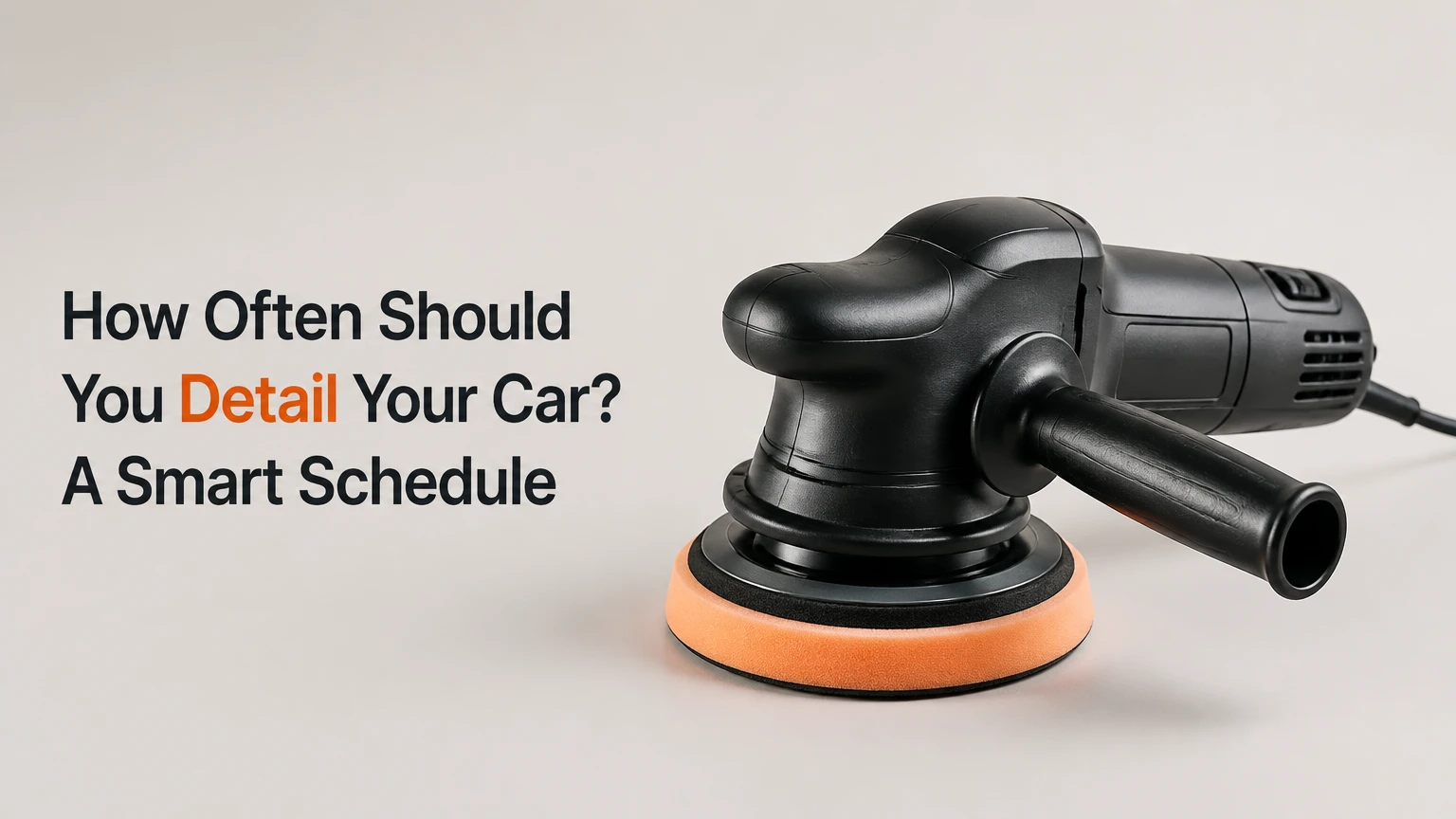
Most daily-driver vehicles should receive a professional or thorough DIY detail two to four times per year, with maintenance washes every one to three weeks. Detail more often when your car faces road salt, heavy rain, dust, tree sap, pets, children, or high mileage. The correct interval depends on contamination and material condition, not the calendar alone.
Key Facts at a Glance
- A typical daily driver needs a full interior and exterior detail every 3-6 months.
- A maintenance wash every 1-3 weeks prevents abrasive dirt from accumulating between details.
- Parents, pet owners, and rideshare drivers often need interior detailing every 1-3 months.
- Winter road salt should be removed promptly, especially from wheel wells, rocker panels, and underbody areas.
- Paint correction is condition-based and should not be repeated on a fixed annual schedule.
- Ceramic coatings reduce contamination bonding, but coated vehicles still require regular washing and inspections.
How Often Should You Detail Your Car?
A practical detailing schedule is quarterly for heavily used vehicles and twice yearly for lightly used daily drivers. Spring and autumn are useful anchor points because spring removes winter salt and grime, while autumn prepares paint and interior materials for colder, wetter conditions.
A full detail is more intensive than a car wash. Exterior detailing can include wheel cleaning, chemical decontamination, clay treatment, machine polishing, trim care, and paint protection. Interior detailing can include deep vacuuming, fabric extraction, leather cleaning, odor treatment, dashboard cleaning, and glass polishing.
The strongest schedule combines calendar intervals with condition triggers. A garage-kept weekend car in a mild climate may remain presentable for six months, while a commuter parked outdoors under trees may need attention every eight to twelve weeks.
Recommended Schedule by Vehicle Use
| Vehicle situation | Full detail interval | Maintenance wash | Priority tasks |
|---|---|---|---|
| Garage-kept weekend car | Every 6-12 months | Every 3-4 weeks | Dust removal, paint inspection, tire care |
| Average daily commuter | Every 3-6 months | Every 1-3 weeks | Road film, wheels, vacuuming, paint sealant |
| Rideshare or delivery vehicle | Every 4-8 weeks | 1-2 times weekly | Seats, odor control, high-touch surfaces |
| Family vehicle with children | Every 2-4 months | Every 1-2 weeks | Spill extraction, mats, door pockets, glass |
| Vehicle carrying pets | Every 1-3 months | Every 1-2 weeks | Hair removal, upholstery extraction, odor sources |
| Off-road or rural-use vehicle | Every 1-3 months | After heavy use | Mud, underbody, wheel wells, paint contamination |
What Does a Full Car Detail Include?
A full car detail normally covers the cabin and exterior, but the exact service varies by provider. A basic full detail may clean and protect existing surfaces, whereas a restoration detail adds paint correction, stain removal, headlight work, or specialized coating preparation.
Exterior work commonly follows this sequence:
- Clean wheels and tires with dedicated, surface-safe chemicals.
- Rinse and pre-wash to loosen abrasive soil.
- Hand wash with a lubricated microfiber mitt.
- Remove tar, iron fallout, sap, and bonded contamination.
- Inspect paint under strong, diffuse lighting.
- Polish only when defects justify paint removal.
- Apply wax, synthetic sealant, or ceramic coating.
- Dress tires and inspect trim, glass, badges, and door jambs.
Interior work usually includes debris removal, vacuuming, dashboard and console cleaning, mat washing, fabric spot treatment, glass cleaning, and material-specific conditioning. Steam can help with selected hard surfaces, but excessive heat or moisture can damage electronics, adhesives, leather finishes, and poorly dried upholstery.
Service Types Compared
| Service type | Typical price | Typical time | Best use |
|---|---|---|---|
| Express detail | $75-$150 | 1-2 hours | Maintaining a recently detailed vehicle |
| Interior detail | $100-$250 | 2-5 hours | Stains, hair, odors, neglected cabin surfaces |
| Exterior detail | $100-$300 | 2-5 hours | Decontamination, gloss, and paint protection |
| Full interior and exterior detail | $150-$400 | 4-8 hours | Seasonal reset for a daily driver |
| Paint correction | $400-$1,500 | 1-2 days | Swirls, oxidation, and measurable paint defects |
| Ceramic coating installation | $600-$2,500+ | 1-3 days | Long-term hydrophobic and chemical protection |
Prices are typical United States ranges, not fixed market rates. Mobile services, metropolitan labor rates, vehicle size, contamination, and the required correction level can move the final estimate substantially.
Which Parts of a Detail Need Repeating Most Often?
Interior cleaning usually needs repeating before paint correction or long-term coating work. Cabin contamination accumulates through contact, food, moisture, skin oils, pet hair, and tracked-in grit, while paint deterioration depends more heavily on washing technique, ultraviolet exposure, weather, and airborne contamination.
Wheels and lower body panels often need attention every one to two weeks in winter or wet climates. Brake dust contains metallic particles, and road salt can remain in seams and wheel wells even when the upper panels look clean.
Clay treatment is not a monthly task. Use a clay bar or synthetic clay towel only when bonded contamination remains after washing and chemical decontamination. Repeated aggressive claying can add marring and create more polishing work.
Material-Specific Intervals
| Vehicle area or material | Routine cleaning interval | Deep-care interval | Main warning |
|---|---|---|---|
| Cloth seats and carpet | Every 1-2 weeks vacuuming | Every 3-6 months extraction | Dry completely to prevent odor |
| Leather seats | Weekly wipe of high-contact areas | Condition every 3-6 months | Avoid oily dressings that increase slip |
| Dashboard and vinyl | Every 1-2 weeks | Every 3-6 months | Use UV-safe, low-gloss products |
| Exterior paint | Every 1-3 weeks washing | Detail every 3-6 months | Do not wash hot panels in direct sun |
| Wheels and tires | Every 1-2 weeks | Deep clean every 1-3 months | Avoid harsh acid on damaged finishes |
| Glass and mirrors | Every 1-2 weeks | Polish water spots as needed | Use separate glass towels |
| Rubber seals | Every 1-3 months | Inspect twice yearly | Remove grime before applying protectant |
Should You Detail Your Car by Season or by Condition?
Condition-based scheduling is more accurate than a fixed seasonal routine, but seasonal detailing remains useful because exposure changes predictably. A winter detail should prioritize salt removal and durable protection, while a spring detail should address contamination that remained through cold-weather washing.
Seasonal Schedule
Before winter: wash and decontaminate the exterior, inspect existing protection, clean wheel wells, vacuum the interior, and apply a synthetic sealant if the vehicle faces snow or salted roads.
During winter: wash whenever temperatures safely permit, with particular attention to salt on rocker panels, wheel arches, door jambs, and underbody components. Do not wait for a full detail if salt remains visible.
After winter: perform a thorough wash and underbody rinse, inspect paint for bonded contamination, clean rubber mats and upholstery, and check whether the previous protection still sheets or beads water consistently.
During spring and summer: remove tree sap, bird droppings, insect residue, and pollen quickly. These contaminants can etch or stain clear coat when exposed to heat and sunlight.
Climate modifies the schedule. Dry desert dust can act as an abrasive during improper wiping, coastal air can increase corrosion risk, and humid regions can prolong upholstery drying and promote odor when moisture is trapped.
How Often Should a Ceramic-Coated Car Be Detailed?
A ceramic-coated car still needs washing every one to three weeks and a professional inspection or decontamination detail every six to twelve months. Ceramic coatings reduce surface energy and improve chemical resistance, but they do not make paint self-cleaning, scratch-proof, or immune to water spots.
A coating-safe service generally includes a gentle wash, iron-removal treatment when needed, inspection under lighting, and a manufacturer-approved maintenance product. Aggressive clay, abrasive polishing, strong solvents, and automatic brushes can reduce coating performance or introduce defects.
Wax and sealant schedules differ from coating schedules. A conventional spray wax may last several weeks, a quality synthetic sealant may last three to six months, and a professionally installed coating may be marketed for several years, although real service life depends on washing, environmental exposure, and maintenance products.
Water behavior is a useful inspection clue, not proof of coating failure. Reduced beading can result from surfactant residue or contamination, so clean the surface before deciding that the coating needs replacement.
Is Detailing Different for a New, Older, or Neglected Car?
New vehicles often need decontamination and paint inspection rather than automatic polishing. Dealer transport, rail dust, adhesive residue, water spots, and installation marks can appear before the first owner receives the vehicle.
Older or neglected vehicles may require staged restoration. A detailer should identify paint thickness, clear-coat failure, permanent staining, torn upholstery, and damaged trim before promising correction. Cleaning can improve appearance, but detailing cannot rebuild missing clear coat or reverse cracked leather.
A vehicle with failing clear coat should not receive aggressive machine polishing. Polishing removes a small amount of paint, and clear-coat failure requires refinishing rather than repeated correction.
Situation-Based Recommendations
| Situation | Recommended action | Timing | What to avoid |
|---|---|---|---|
| New vehicle delivery | Inspect, decontaminate, protect | Within 2-6 weeks | Assuming dealer wax is durable protection |
| Lease return | Interior reset and exterior cleanup | 2-4 weeks before inspection | Hiding damage instead of documenting it |
| Private sale | Detail cabin, glass, wheels, and paint | 1-2 weeks before photographs | Expensive correction with no resale payoff |
| Heavy tree-sap exposure | Spot-clean contamination | Same day when possible | Leaving sap through hot weather |
| Bird-dropping contamination | Rinse and soften before removal | Within 24 hours | Dry wiping the deposit |
| Road-salt exposure | Rinse lower panels and underbody | As soon as practical | Waiting until spring for the first rinse |
| Flooded or moldy interior | Professional extraction and assessment | Immediately | Running ozone without removing the source |
What Is the Difference Between Washing and Detailing?
A car wash removes loose surface contamination, while detailing cleans, restores, and protects specific vehicle materials. Washing is recurring maintenance; detailing is a deeper service that addresses embedded contamination, stains, surface defects, and protection.
A useful ownership rhythm is a maintenance wash every one to three weeks, a light interior reset monthly, and a full detail two to four times annually. The wash controls contamination before it becomes bonded, while the detail resets areas that routine washing cannot reach.
Automatic brush washes can be convenient, but brushes may carry abrasive grit between vehicles. Touchless systems reduce contact-related marring yet may use stronger detergents and leave bonded contamination behind. Hand washing with clean microfiber tools provides more control when paint condition matters.
Does Detailing Remove Scratches?
Detailing removes some defects, but it cannot remove every scratch. Light swirl marks and fine oxidation may respond to polishing, while scratches that catch a fingernail often extend through the clear coat and require touch-up or body repair.
Paint correction should begin with the least aggressive method that produces the desired improvement. A detailer may test a small section with a finishing polish before moving to a stronger compound, because removing clear coat for invisible defects reduces future repair margin.
Paint correction is not an annual cleaning requirement. Repeating it unnecessarily can thin the clear coat, especially on edges, repainted panels, and older vehicles with limited remaining finish.
Can Detailing Damage Your Car?
Incorrect detailing can damage paint, trim, leather, electronics, and upholstery. The common causes are contaminated towels, excessive pressure, unsuitable chemicals, hot surfaces, over-wetting, and abrasive correction without paint inspection.
Professional detailers should identify the material and finish before selecting a chemical. Finished leather, aniline leather, vinyl, alcantara, coated plastics, piano-black trim, and gloss paint do not tolerate identical products or agitation.
Three practitioner rules prevent many expensive errors:
- Never polish a dirty surface. Embedded grit can create additional scratches.
- Never judge protection on beading alone. Surfactant residue can temporarily change water behavior.
- Never use one towel for every surface. Glass, wheels, interior plastics, and paint should have separate, clean microfiber cloths.
Direct sunlight can cause cleaners to dry before they are wiped away, leaving residue or mineral spotting. Work in shade, cool the panels, and clean small sections when ambient conditions are hot.
Should You Detail Your Car Yourself or Hire a Professional?
DIY detailing is suitable for routine washing, vacuuming, glass cleaning, and basic protection when the owner has shade, clean water, microfiber towels, appropriate chemicals, and enough drying time. Professional service becomes more valuable when contamination is severe, paint correction is required, odors persist, or the vehicle contains delicate materials.
A professional quote should identify the included tasks rather than use “full detail” as an undefined package. Ask whether the price includes stain extraction, pet-hair removal, clay treatment, paint correction, ceramic coating preparation, and disposal of heavily contaminated materials.
DIY and Professional Comparison
| Task | DIY difficulty | Typical DIY cost | Professional cost | Main risk |
|---|---|---|---|---|
| Maintenance wash | Low | $10-$30 per wash | $20-$60 | Scratching from poor technique |
| Interior vacuum and wipe | Low | $5-$25 | $50-$150 | Residue on screens and plastics |
| Upholstery extraction | Moderate | $30-$100 rental | $100-$250 | Trapped moisture and odor |
| Clay decontamination | Moderate | $20-$50 | $100-$300 | Marring from excess pressure |
| One-step polish | High | $150-$350 tools | $250-$700 | Removing unnecessary clear coat |
| Multi-stage correction | Very high | $250-$600 tools | $500-$1,500 | Edge burn or uneven finish |
Detailing is usually worthwhile before selling a vehicle when the interior has stains, the paint has heavy road film, or photographs will determine buyer interest. Expensive correction is less defensible when clear-coat failure, dents, rust, or mechanical problems dominate the vehicle’s value.
What Are the Common Detailing Mistakes?
The most damaging mistakes are usually process failures rather than product failures. Dish soap, for example, is not automatically a paint-destroying chemical after one use, but repeated use can remove existing protection and provide poor lubrication compared with a purpose-made car shampoo.
Avoid these specific errors:
- Dry wiping dust: rinse or use a suitable rinseless-wash method first.
- Using circular pressure: direction does not prevent scratches, but excessive pressure and dirty media do; use straight overlapping passes to control the process.
- Dropping a towel: retire it from paint work immediately rather than shaking it out.
- Overusing tire dressing: sling can stain lower panels and attract dust.
- Over-wetting seats: extraction requires controlled moisture and adequate ventilation.
- Applying wax over bonded grit: chemically decontaminate and test the surface first.
- Using household glass products on sensitive tint: confirm ammonia compatibility with the tint manufacturer.
- Spraying cleaner directly onto electronics: apply a small amount to a towel instead.
Troubleshooting Table
| Problem | Likely cause | Corrective action | Escalation point |
|---|---|---|---|
| Swirl marks | Abrasive wash media or automatic brushes | Test a mild polish on one panel | Professional correction |
| Persistent odor | Moisture, bacteria, filter, or hidden spill | Locate source, extract, dry, replace filter | Mold or flood assessment |
| Streaked windows | Excess cleaner or damp towel | Use less product and a dry glass towel | Polish mineral deposits |
| White trim residue | Dried wax or dressing | Use compatible trim cleaner | Replace permanently stained trim |
| Water spots | Minerals dried on hot paint | Use a safe water-spot remover | Assess etching before polishing |
| Pet hair remains | Hair embedded in fabric fibers | Use rubber tools before vacuuming | Specialist extraction |
| Coating seems inactive | Contamination or detergent residue | Wash and chemically decontaminate | Coating inspection |
How Can You Maintain a Detail Longer?
Maintenance determines whether a full detail lasts weeks or months. Wash painted surfaces when contamination is visible, remove bird droppings and sap promptly, keep separate microfiber towels for different zones, and avoid automatic brushes when preserving gloss is a priority.
Use a simple after-detail routine:
- Wash exterior paint every 1-3 weeks.
- Clean wheels before brake dust becomes thick.
- Vacuum cabin surfaces every 1-2 weeks.
- Blot spills immediately instead of scrubbing them deeper.
- Empty door pockets, cupholders, and cargo areas monthly.
- Inspect paint protection every 3-6 months.
- Clean rubber mats before trapped moisture reaches carpet.
- Keep a clean microfiber towel and compatible spot cleaner in the vehicle.
A detailer can also provide a maintenance plan based on the product applied. Coated paint, waxed paint, matte paint, vinyl wraps, and paint-protection film require different chemicals and drying methods.
What Does Car Detailing Cost and How Long Does It Take?
Typical car detailing costs range from $75 for an express service to more than $2,500 for multi-stage correction and premium coating work. A full interior and exterior detail generally takes 4-8 hours, while correction or coating preparation can occupy one to three days.
Vehicle size affects labor, but condition often matters more. A small, clean hatchback can take less time than a large SUV with embedded pet hair, sand, smoke odor, and neglected wheels.
Request a written scope and ask which defects are permanent. A reputable detailer should distinguish cleaning from correction and should not promise that every stain, scratch, or odor will disappear.
The Bottom Line
Most daily drivers should receive a full detail every 3-6 months, while lightly used, garage-kept cars may need only one or two full details per year. Wash every 1-3 weeks, respond quickly to salt, sap, bird droppings, and spills, and shorten the interval for pets, children, rideshare use, harsh weather, or outdoor parking.
The best answer to how often should you detail your car is therefore condition-based: detail when contamination, stains, odor, or failing protection exceed what routine washing can control. Do not schedule paint correction automatically, because unnecessary polishing removes clear coat without improving protection.
Frequently Asked Questions
Is detailing once a year enough?
Annual detailing can be enough for a low-mileage vehicle stored indoors, washed regularly, and protected with a durable sealant or coating. Annual service is usually insufficient for daily commuters, outdoor parking, winter salt, pets, children, or rideshare work. Those vehicles commonly need two to four full details each year.
How often should I detail a black car?
A black car benefits from washing every one to two weeks and detailing every three to four months when parked outdoors. Black paint reveals dust, water spots, and swirl marks sooner than lighter colors, but polishing should still depend on actual defects rather than color alone.
Should I detail my car before a road trip?
Detailing before a road trip is useful when the vehicle has contaminated paint, dirty glass, or an unpleasant interior, but a complete correction is unnecessary. Wash the exterior, clean headlights and glass, vacuum the cabin, inspect tire condition, and apply a short-term paint protectant one to seven days before departure.
How often should car seats be professionally cleaned?
Professionally clean child car seats only according to the seat manufacturer’s instructions, because unauthorized chemicals, steam, or soaking can affect harness materials and safety performance. Clean removable covers at the interval allowed by the manual, and wipe hard components promptly after spills.
Does rain mean I do not need to wash my car?
Rain does not reliably clean a car. Rainwater can contain dust and pollutants, and drying droplets may leave mineral spots, especially on dark paint. Wash when the vehicle has visible road film, bird residue, salt, or mud, regardless of recent rainfall.
Can I detail my car too often?
You can detail a car too often when the service includes repeated clay treatment, abrasive polishing, harsh chemicals, or excessive interior moisture. Frequent gentle washing and vacuuming are generally safe, but correction should occur only when measurable paint defects justify removing a small amount of clear coat.


