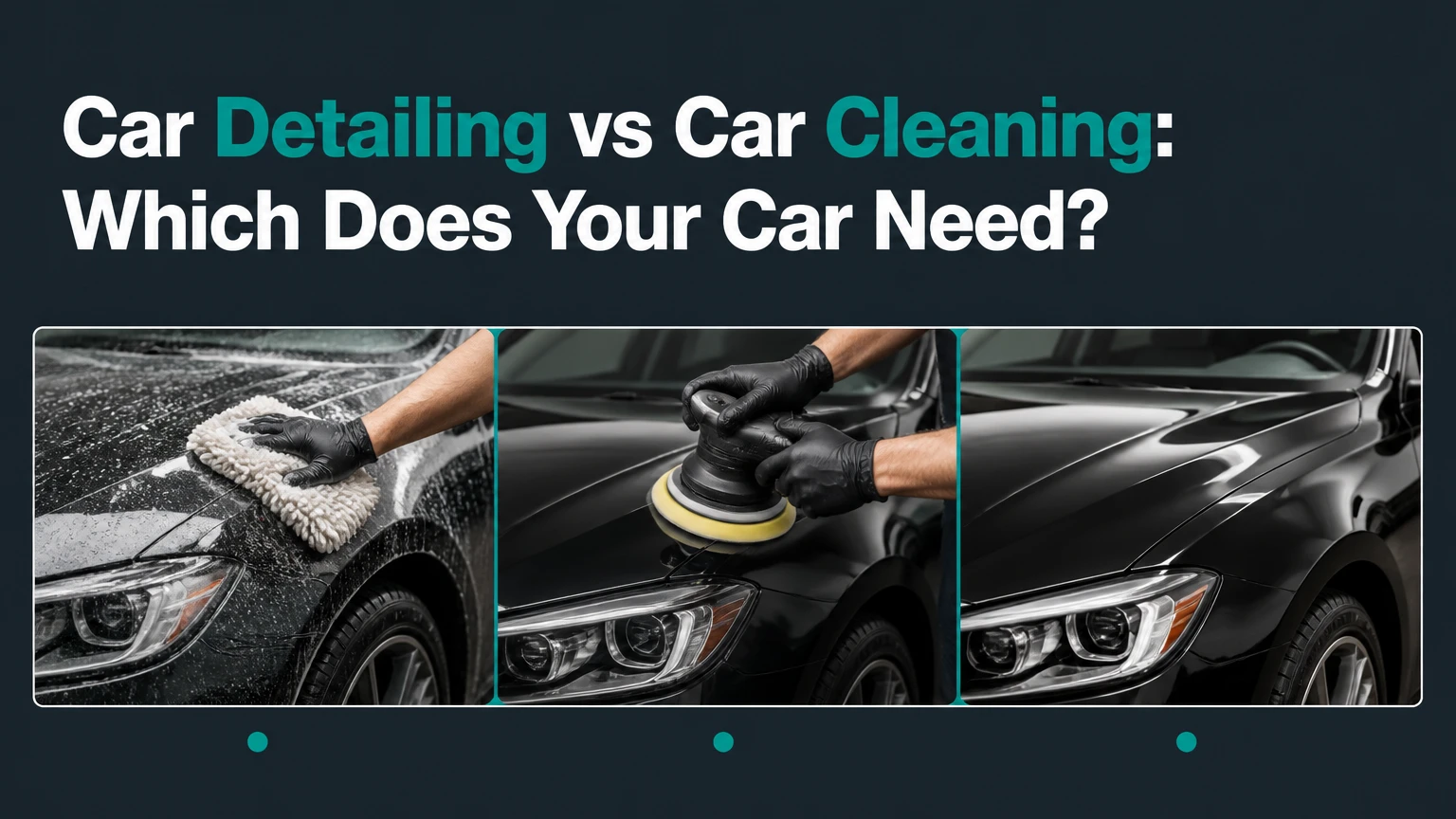
Car cleaning removes routine dirt from accessible surfaces, while car detailing cleans, decontaminates, corrects, and protects a vehicle in far greater depth. Choose cleaning for regular maintenance and detailing for embedded contamination, visible paint defects, serious interior buildup, resale preparation, or long-term surface protection.
Key Facts at a Glance
- A typical car cleaning takes 15-45 minutes and removes loose exterior dirt, dust, road film, and light interior debris.
- A professional detail usually takes 4-12 hours because technicians inspect, decontaminate, clean, correct, and protect separate surfaces.
- Car cleaning maintains appearance; car detailing may improve appearance and preserve paint, upholstery, plastics, glass, and trim.
- Paint correction can reduce suitable clear-coat defects, but it cannot safely erase every deep scratch or damaged panel.
- Ceramic coating is an optional detailing treatment, not an automatic feature of every detail package.
- Typical United States pricing ranges from $15-$50 for a basic wash and $150-$600 or more for a comprehensive detail.
Car Detailing vs Car Cleaning: The Core Difference
Car cleaning is a recurring maintenance activity, whereas car detailing is a condition-based restoration and preservation service. A cleaning removes what sits on the surface today; detailing also addresses contamination bonded to paint, stains inside fabric, neglected trim, odors, and selected cosmetic defects.
The terms are not standardized across the industry. One business may call a 30-minute wash a “detail,” while another reserves “full detail” for a multi-stage service involving paint decontamination, machine polishing, extraction, and protection. The package checklist matters more than the label.
A useful dividing line is the level of surface intervention. Cleaning generally uses shampoo, microfiber tools, vacuuming, and basic interior products. Detailing adds inspection lighting, chemical decontamination, clay media, steam or extraction equipment, polishers, dedicated brushes, dressings, and sealants when the vehicle’s condition justifies them.
What does a routine car cleaning include?
A routine car cleaning typically includes a pre-rinse, automotive shampoo, contact washing, wheel cleaning, rinse, drying, exterior glass cleaning, vacuuming, and a quick dashboard wipe. The service removes loose contamination efficiently, but it normally does not correct paint defects or extract deeply embedded upholstery contamination.
Typical inclusions vary by provider:
- Exterior wash and wheel rinse
- Microfiber or tunnel drying
- Interior vacuuming
- Floor-mat cleaning
- Basic glass and dashboard wipe
- Optional spray wax or tire dressing
A basic cleaning is appropriate after normal commuting, pollen exposure, light rain, or a dusty week. It is not a substitute for stain extraction, odor-source removal, paint polishing, headlight restoration, or engine-bay work.
What does professional car detailing include?
Professional car detailing combines cleaning with inspection, decontamination, cosmetic correction, and protective treatment. A full service may include separate interior and exterior packages rather than every possible procedure on every vehicle.
A typical exterior sequence is:
- Photograph and inspect the vehicle
- Clean wheels, tires, arches, and emblems
- Pre-rinse and wash with controlled contact
- Remove iron particles, tar, sap, and bonded road film
- Clay the paint if inspection confirms remaining roughness
- Measure or assess paint before polishing
- Machine polish selected defects
- Apply wax, polymer sealant, or ceramic coating
- Clean exterior glass and dress suitable trim
Interior detailing may include vacuuming, compressed-air cleaning, fabric pre-treatment, hot-water extraction, leather cleaning, plastic cleaning, odor-source treatment, and UV-resistant dressing. Mold, flood damage, bodily fluids, and persistent biological odors require specialist remediation rather than perfume or a routine detail.
How Do the Services Differ in Scope?
Car cleaning and car detailing overlap at the washing stage, but they diverge in labor, equipment, surface preparation, and expected outcome. The following comparison uses typical United States consumer-service ranges, not fixed national prices.
| Criterion | Basic car cleaning | Full car detailing | Practical meaning |
|---|---|---|---|
| Typical duration | 15-45 minutes | 4-12 hours | Detailing requires drying, inspection, correction, and curing time |
| Typical price | $15-$50 | $150-$600+ | Large SUVs, severe soil, and premium coatings increase cost |
| Exterior work | Wash, rinse, dry | Wash, decontamination, polishing, protection | Detail scope depends on paint condition |
| Interior work | Vacuum and surface wipe | Extraction, stain treatment, crevice cleaning | Embedded contamination needs moisture and agitation |
| Paint defects | No correction | Light-to-moderate correction possible | Deep scratches may need body-shop repair |
| Protection | Optional spray product, days to weeks | Sealant, wax, or coating, weeks to years | Longevity depends on product, preparation, and maintenance |
| Normal frequency | Every 1-3 weeks | 1-2 comprehensive services yearly | Coated cars still need regular washing |
| Main objective | Remove current dirt | Restore and preserve selected surfaces | Neither service repairs mechanical faults |
A quick wash is therefore not a lower-quality detail by definition. It is a narrower service designed for a different maintenance interval and vehicle condition.
Which service cleans more thoroughly?
Detailing cleans more thoroughly because technicians divide the vehicle into materials and contamination types rather than applying one product everywhere. A detail can address brake dust, iron fallout, tree sap, fabric stains, leather soil, plastic residue, and trapped debris in areas a routine wash leaves untouched.
Thoroughness still has limits. A contaminated vehicle may need multiple visits, and excessive scrubbing or polishing can create damage. A professional who refuses to promise perfect stain or scratch removal is usually giving a more technically accurate estimate.
What Does Each Service Cost and Take?
A basic car cleaning commonly costs $15-$50 and takes 15-45 minutes, while a full detail commonly costs $150-$600 or more and takes 4-12 hours. Mobile service, vehicle size, regional labor rates, contamination severity, and coating or correction work account for most variation.
| Service level | Typical time | Typical price | Common inclusions |
|---|---|---|---|
| Automatic exterior wash | 5-15 minutes | $8-$25 | Tunnel or touchless wash, rinse, drying cycle |
| Hand wash and vacuum | 30-90 minutes | $30-$100 | Contact wash, wheels, vacuum, glass, basic wipe |
| Interior deep clean | 2-5 hours | $100-$300 | Vacuum, crevices, fabric treatment, extraction |
| Exterior detail | 3-6 hours | $150-$400 | Decontamination, light polish, sealant |
| Full interior and exterior detail | 5-12 hours | $250-$600+ | Deep interior work plus exterior correction or protection |
| Ceramic coating package | 1-3 days | $600-$2,500+ | Correction, panel preparation, coating, curing controls |
These are typical practitioner ranges. A neglected three-row SUV with pet hair can exceed the interior range, while a small, well-maintained hatchback may cost less. Ask whether the quote includes tax, travel, stain extraction, paint correction, coating, and post-service inspection.
Time is also a quality variable. A technician who promises paint decontamination, correction, coating, and interior extraction in 45 minutes is describing a different service or an unrealistic workflow.
Which One Should You Choose?
The correct choice depends on the vehicle’s condition, the desired result, and how much time the owner can allocate. Cleaning wins for routine upkeep, while detailing wins when contamination, defects, neglected materials, or a major ownership event justify additional labor.
| Owner situation | Recommended service | Typical interval or timing | Reason |
|---|---|---|---|
| Daily commuter with light road dust | Hand wash or touchless wash | Every 1-3 weeks | Prevents buildup without paying for correction each time |
| Family vehicle with food and drink stains | Interior deep clean | Every 3-12 months | Extraction addresses contamination that vacuuming leaves behind |
| Vehicle being sold privately | Interior and exterior detail | 1-3 weeks before listing | Improves presentation and photographs without guaranteeing a higher price |
| Enthusiast with soft or dark paint | Safe hand wash and periodic detail | Wash weekly or biweekly, detail 1-2 times yearly | Reduces marring and maintains gloss |
| Vehicle with neglected paint | Decontamination and correction assessment | One initial assessment, then maintenance | Determines whether polishing or body repair is appropriate |
| Lease return with normal wear | Documented cleaning and targeted detail | 2-4 weeks before inspection | Improves cleanliness and identifies chargeable damage |
When is car cleaning the better choice?
Car cleaning is the better choice when dirt is loose, the paint has acceptable gloss, the interior has no embedded stains, and the owner needs fast recurring maintenance. Washing every two weeks is more beneficial than paying for a single detail and allowing contamination to accumulate for a year.
A touchless wash can reduce contact-induced marring, but strong detergents and poor drying may remove protection or leave mineral deposits. A careful hand wash with clean microfiber media is usually the better option for delicate or heavily polished paint when the operator can control grit and pressure.
When is detailing worth the money?
Detailing is worth the money when the vehicle has bonded contamination, visible swirls, stained upholstery, persistent odors, faded trim, or an upcoming sale, road trip, or seasonal transition. The value comes from solving a defined condition problem, not from buying the most expensive package.
Detailing is less worthwhile when a car has peeling clear coat, rust-through, torn upholstery, cracked dashboards, or mechanical faults. Polishing cannot rebuild missing clear coat, and interior products cannot reverse structural material failure.
How Does Paint Correction Work?
Paint correction uses abrasive polish and controlled machine movement to reduce the appearance of suitable defects in the clear coat. The process does not pull scratches out; it levels or refines the surrounding clear coat until the defect becomes less visible.
A light one-step polish may improve gloss and reduce fine wash marks. A multi-stage correction uses stronger compound followed by finishing polish, but each additional pass removes more clear coat and increases risk if the technician lacks paint knowledge.
| Paint condition | Likely treatment | Typical labor | Expected result |
|---|---|---|---|
| Light haze and fine swirls | Finishing polish | 2-4 hours | Gloss improvement and partial defect reduction |
| Moderate wash marring | Compound plus polish | 4-8 hours | Significant reduction if clear coat permits |
| Fingernail-catching scratch | Inspection and spot repair | 1-3 hours or body-shop referral | Often remains partly visible after polishing |
| Through-clear-coat damage | Paint repair | 1-3 days | Requires refinishing, not ordinary detailing |
| Oxidized headlights | Wet sanding and coating | 1-3 hours | Clarity improvement with UV protection |
The common claim that detailing removes “80%-95%” of scratches is not a reliable universal specification. Results depend on defect depth, paint hardness, available clear coat, panel shape, prior polishing, and the owner’s acceptable risk.
Practitioner rule: If a scratch catches a fingernail, assume complete removal is unsafe until a paint professional inspects it.
Is Ceramic Coating Part of Every Detail?
Ceramic coating is an optional protective treatment made from coating chemistry that bonds to a properly prepared surface; it is not a standard component of every detail. A coating can improve chemical resistance, water behavior, and cleaning convenience, but it does not make paint scratch-proof.
Preparation determines much of the result. The vehicle generally needs a decontamination wash, paint inspection, correction when required, panel wipe, controlled application, and an initial cure period. Applying coating over oily residue, embedded contamination, or severe defects preserves those problems beneath the coating.
Typical durability claims range from 6-24 months for consumer or entry-level products to 2-5 years for professionally installed systems, but warranty language, maintenance requirements, climate, washing practices, and product formulation control the real outcome. A polymer sealant may provide several months of protection at substantially lower cost.
Paint protection film is a different option. PPF provides a physical urethane layer and can protect vulnerable painted areas from stone chips, while ceramic coating primarily changes surface behavior and chemical resistance.
Are Automatic Car Washes Safe for Paint?
Automatic car washes vary in paint risk, so a blanket claim that every automatic wash uses nylon brushes is inaccurate. Touchless systems avoid physical brushes but may rely on stronger detergents and high-pressure water; friction tunnels can transfer grit through cloth, foam, or brushes and increase swirl risk when maintenance is poor.
The safest practical ranking for valuable or correction-sensitive paint is usually a careful two-bucket hand wash or reputable touchless wash, followed by a well-maintained friction wash when convenience matters more than maximum finish preservation. No method is risk-free.
What mistakes damage a clean car?
The most common damage comes from uncontrolled grit, drying contamination, excessive pressure, unsuitable chemicals, and dirty towels. Car owners can reduce risk with these rules:
- Use automotive shampoo with lubricating surfactants rather than household dish detergent for routine washing.
- Keep separate wheel and paint tools because brake dust can contain abrasive metallic particles.
- Rinse the mitt frequently and use a grit guard as an additional control, not as permission to reuse filthy water.
- Wash panels from the top downward, where lower sections usually hold heavier road soil.
- Dry with clean, absorbent microfiber towels or filtered air instead of letting hard water evaporate.
- Never rub dry dust across paint when a rinse or waterless-wash procedure is required.
- Avoid dressing pedals, steering wheels, brake surfaces, and seat bolsters with slippery products.
Dish soap does not contain a special ingredient that “eats” paint, but its degreasing formulation can remove wax and leave automotive materials without the intended protection. It may be useful for a deliberate wax-stripping wash before correction, not as a routine maintenance shampoo.
How Often Should You Wash and Detail a Car?
Most vehicles benefit from washing every 1-3 weeks and receiving a condition-based detail once or twice yearly. Cars exposed to road salt, coastal air, industrial fallout, tree sap, bird droppings, mud, or high annual mileage may need more frequent washing and targeted decontamination.
| Exposure or use pattern | Wash interval | Detail timing | Extra action |
|---|---|---|---|
| Covered garage, light weekend use | Every 3-4 weeks | Annually | Remove bird droppings promptly |
| Daily urban commuting | Every 1-2 weeks | Every 6-12 months | Clean wheels before brake dust bonds |
| Coastal or high-salt roads | Weekly | Before and after salt season | Rinse underbody where safe |
| Gravel roads and farm use | Weekly or after trips | Every 3-6 months | Inspect tar, sap, and packed mud |
| Children, pets, or frequent food use | Exterior every 2-3 weeks | Interior every 3-6 months | Remove spills before drying |
| Ceramic-coated vehicle | Every 1-3 weeks | Annual inspection | Use coating-compatible shampoo |
Detailing frequency should follow condition, not a calendar alone. A well-maintained garage-kept car may need only an annual deep service, while a work truck may need targeted interior and exterior attention several times each year.
Can You Detail a Car Yourself?
Owners can safely perform routine washing, vacuuming, glass cleaning, light plastic cleaning, and basic spray protection with modest equipment. Machine polishing, leather repair, stain extraction, mold remediation, headlight sanding, and coating installation require more training because incorrect product choice or technique can create expensive damage.
A sensible DIY starter setup includes two 15- to 20-liter wash buckets, a pH-balanced automotive shampoo, a dedicated wheel brush, several labeled microfiber towels, a wash mitt, a drying towel, a wet-dry vacuum, interior cleaner, glass cleaner, and nitrile gloves. Product labels matter because leather, alcantara, coated screens, piano-black trim, and raw aluminum tolerate different chemistry.
Do not steam electrical connectors, saturate seat electronics, polish unmeasured thin paint aggressively, or apply tire dressing to tread surfaces. Stop when a stain appears to involve mold, sewage, floodwater, or unknown biological material.
How Do You Fix Common Car Surface Problems?
Surface problems require diagnosis before treatment because similar symptoms can have different causes. Water spots may be mineral deposits, etched clear coat, or remaining detergent; a sticky leather surface may be product residue, degraded coating, or failing material.
| Problem | Likely cause | First safe action | Escalation point |
|---|---|---|---|
| Fine swirl marks | Dirty wash media or tunnel friction | Improve wash method and inspect under bright light | Use a measured polish or hire a detailer |
| White water spots | Mineral deposits or etching | Test an automotive water-spot remover on a hidden area | Polish if acid treatment fails |
| Musty odor | Damp carpet, HVAC contamination, or mold | Dry the cabin and inspect carpets and drains | Specialist remediation for visible mold |
| Sticky leather | Excess dressing or coating breakdown | Clean a small area with pH-appropriate leather cleaner | Repair or recolor if tackiness persists |
| Pet hair | Embedded hair in fabric fibers | Rubber brush and vacuum crevice work | Extraction after dry hair removal |
| Faded black trim | UV exposure and oxidation | Clean, dry, then apply trim protectant | Restoration or replacement for severe chalking |
| Tree sap | Hardened organic residue | Use a compatible tar and sap remover | Polish if the paint has etched |
Acidic water-spot removers can dissolve mineral deposits, but they cannot restore clear coat already etched by deposits. Steam and extraction can reduce odor sources, yet neither guarantees removal when foam, insulation, or HVAC components remain contaminated.
What Should You Ask Before Booking a Service?
Ask for an itemized checklist, estimated duration, total price, correction limitations, protection product, and aftercare instructions. A business that describes exactly what will and will not be done gives a more useful quote than one that relies on labels such as “premium” or “showroom.”
Confirm these points:
- Is the service exterior-only, interior-only, or both?
- Does “paint correction” mean a test spot, one-step polish, or multi-stage correction?
- Are stain extraction, pet hair, odor treatment, and heavy soil charged separately?
- Is ceramic coating included, optional, or unavailable?
- Will the provider photograph pre-existing dents, chips, and damaged trim?
- What happens if a scratch is deeper than polishing can safely correct?
- How long must the vehicle remain dry after protection is applied?
- Which shampoo and drying method should be used afterward?
A credible estimate changes when the technician sees the vehicle. Remote pricing is convenient, but severe stains, oversized vehicles, thin paint, and neglected interiors are difficult to price accurately from a short description.
The Bottom Line
Car cleaning is the right recurring maintenance choice for loose dirt, light interior debris, and ordinary commuter use. Car detailing is the better choice for embedded contamination, paint defects, deep stains, odors, resale preparation, and protective treatments that require inspection and specialized equipment.
Use cleaning every 1-3 weeks, then book detailing when condition or ownership goals justify it. The best car-care plan combines safe regular washing with occasional targeted detailing rather than treating every wash as a full restoration.
Frequently Asked Questions
Does a car detail include a car wash?
A professional detail almost always begins with an exterior wash, but the phrase “full detail” does not guarantee the same inclusions everywhere. Confirm whether the quote includes wheels, chemical decontamination, clay treatment, paint correction, interior extraction, glass cleaning, and protection because providers define packages differently.
Is valeting the same as detailing?
Valeting usually refers to cleaning and presentation work, especially interior and exterior preparation, while detailing often implies more precise decontamination, polishing, and protection. The distinction is regional and commercial rather than a universal technical standard, so compare the written service checklist instead of relying on the word “valet” or “detail.”
Should I wash my car before detailing it?
You do not need to wash the car before a professional detail because the technician must use a controlled pre-rinse and wash process. Removing loose dirt yourself can help an appointment, but driving a dry, dusty vehicle into a brush wash beforehand may add marring that the detailer then has to correct.
Can detailing remove cigarette smoke or mold odor?
Detailing can reduce cigarette odor when residue is limited to cleanable surfaces, fabrics, vents, and headliner areas. Mold, floodwater, and deeply absorbed smoke may require HVAC cleaning, material removal, ozone-free remediation protocols, or replacement. Fragrance only masks odor and does not remove the contamination source.
Is detailing before selling a car worth it?
Detailing before sale is usually worthwhile when the vehicle has visible dirt, stained upholstery, dull paint, or unpleasant odors because cleaner presentation improves photographs and buyer confidence. Detailing cannot guarantee a higher sale price, and expensive ceramic coating or extensive correction rarely returns its full cost on an older vehicle.
Does a ceramic coating eliminate the need for car cleaning?
A ceramic coating does not eliminate washing because dust, road film, minerals, and bird droppings still accumulate on the surface. Coated vehicles generally remain easier to clean, but they need compatible shampoo, safe drying, prompt contaminant removal, and periodic inspection to maintain water behavior and appearance.
Is car detailing safe for an older vehicle?
Car detailing is safe for an older vehicle when the technician assesses paint thickness, brittle trim, failing clear coat, aged leather, and electrical components before selecting methods. Aggressive polishing, steam, or solvent use can worsen fragile materials, so an older car may need preservation cleaning rather than maximum correction.


