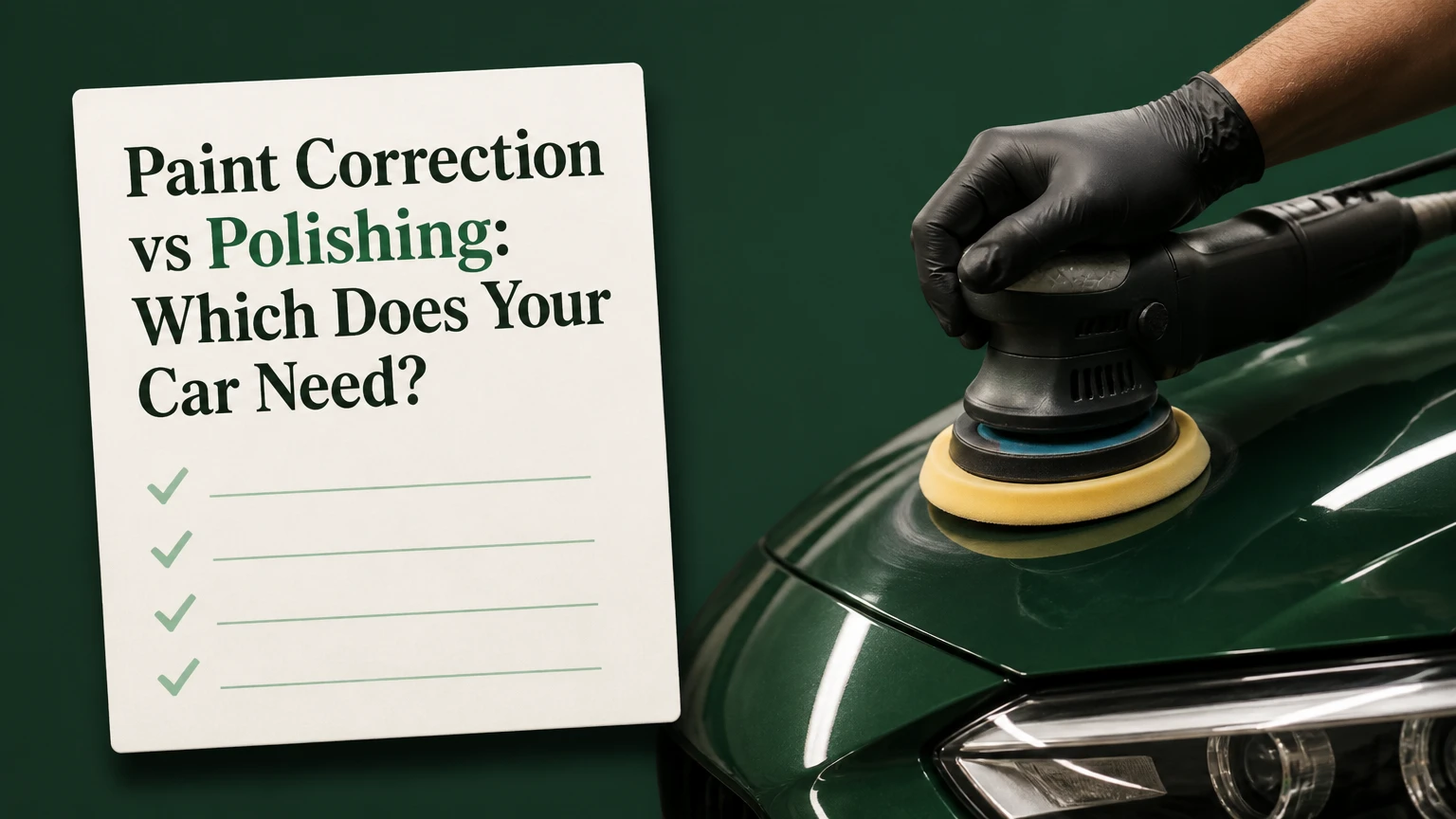
Paint correction removes or reduces paint defects by leveling the clear coat with controlled abrasives, while polishing usually means a lighter abrasive treatment that improves gloss, clarity, and minor marring. Polishing can be a correction step, but a full paint correction normally includes more aggressive compounding, defect inspection, and sometimes multiple stages.
Key Facts at a Glance
- Paint correction is a defect-removal process; polishing is usually a gloss-enhancement or finishing process.
- Both compound and polish can remove a measurable amount of clear coat because both use abrasives.
- A one-step polish may reduce light swirls by approximately 30-70% under typical conditions, but results vary substantially.
- A scratch that reaches through the clear coat cannot be safely leveled away with ordinary polishing.
- Paint thickness varies by panel and vehicle, so fixed claims such as “two corrections are always safe” are unreliable.
- A dual-action polisher reduces risk for beginners, but no machine makes paint damage impossible.
What Is the Difference Between Paint Correction and Polishing?
Paint correction targets visible defects, whereas polishing targets surface refinement and optical clarity. The practical difference is the amount of cut selected, the defects being addressed, and the amount of clear-coat leveling required to reach the desired result.
The terms overlap because professional detailers often call the entire machine-polishing process “paint correction.” A one-step correction may use a medium polish and pad to remove light wash marks, while a two-step correction uses a cutting compound followed by a finishing polish.
| Factor | Polishing or enhancement | One-step correction | Two-step paint correction | Wet sanding and multi-stage correction |
|---|---|---|---|---|
| Typical defect target | Light haze, oxidation, minor marring | Light to moderate swirls | Moderate swirls, haze, scratches | Severe texture and isolated defects |
| Typical labor time | 3-6 hours | 5-10 hours | 10-25 hours | 20-60+ hours |
| Typical professional price | $150-$400 | $300-$800 | $700-$1,800 | $1,500-$5,000+ |
| Common equipment | DA polisher, soft or medium foam pad | DA polisher, medium pad | Cutting pad, compound, finishing pad | Sandpaper, blocks, rotary, DA |
| Typical visual improvement | 10-40% defect reduction | 40-75% defect reduction | 70-95% defect reduction | 85-99% on suitable defects |
| Clear-coat risk | Low, but not zero | Moderate | Moderate to high | High |
These figures are typical detailing-industry ranges, not guaranteed specifications. Paint hardness, defect depth, panel shape, product technology, technician technique, and the owner’s inspection standard can move the result in either direction.
Does polishing remove clear coat?
Polishing removes a small amount of paint when its abrasives abrade the clear coat, although the amount may be too small to measure reliably with many consumer paint-depth gauges. “Polish removes nothing” is technically inaccurate, while “every polish removes a dangerous amount” is equally misleading.
A finishing polish used for a few passes on healthy paint may remove less material than a cutting compound on a microfiber pad. However, repeated annual polishing, aggressive pressure, high machine speed, heat, and thin edges can accumulate risk. Chemical cleaners and glazes may improve appearance through cleaning or filling without materially leveling every defect.
How Do Compounds and Polishes Work?
Compounds and polishes use abrasive particles, lubrication, pad behavior, and machine movement to reduce surface irregularities. The process does not pull scratches out; it lowers the surrounding clear coat or softens the defect’s visual contrast until reflected light appears more uniform.
A scratch is a valley in the clear coat. If the valley remains below the surrounding surface, the scratch continues to scatter light. Leveling the surrounding clear coat can remove the appearance of the scratch, but only when enough material remains above the defect to do so safely.
Machine choice changes the risk and finish. A dual-action polisher oscillates while rotating, which generally distributes heat and reduces the chance of concentrated burning. A rotary polisher cuts quickly but can create holograms or excessive heat when used without disciplined speed, pad control, and panel monitoring.
Why does a two-stage correction use both compound and polish?
A two-stage correction uses compound for controlled defect reduction and polish for the clarity that a cutting stage may not leave behind. Cutting pads can create haze, micro-marring, or rotary trails, particularly on soft black paint, so a finishing step restores the final optical quality.
A technician should not assume that a heavy cut is automatically better. The professional rule of thumb is to use the least aggressive combination that achieves the customer’s target, because unnecessary clear-coat removal creates no lasting visual benefit.
Which Paint Defects Need Correction?
Paint correction is appropriate for defects that are actually in the clear coat and shallow enough to level safely. Polishing alone is more suitable for light haze, mild oxidation, faint wash marring, and a gloss improvement when complete defect removal is unnecessary.
| Defect | Likely location | Suitable response | Safe expectation |
|---|---|---|---|
| Swirl marks | Clear coat | One-step or two-step correction | Strong reduction if shallow |
| Bird-dropping etching | Clear coat | Polish or compound after cleaning | Good if etching is shallow |
| Water-spot etching | Clear coat or mineral deposit | Decontamination, then polish or compound | Chemical removal may solve deposits |
| Deep scratch | Clear coat, color coat, or primer | Inspection, touch-up, wet sanding, or respray | Full removal may be unsafe |
| Oxidation | Clear coat or exposed single-stage paint | Chemical cleaning and polishing | Fading may require refinishing |
| Holograms | Clear coat | Finishing polish and suitable pad | Usually highly reducible |
| Paint transfer | On top of the paint | Solvent or mechanical cleaning first | Correction may be unnecessary |
| Rock chips | Through the paint system | Touch-up or panel repair | Polishing cannot replace missing paint |
A fingernail test provides a rough clue, not a paint-depth diagnosis. If a fingernail catches strongly, the damage may be too deep for safe leveling, but a shallow scratch can still catch because of its sharp edge, and a deep defect can sometimes feel smooth after paint transfer fills part of the valley.
Can paint correction remove every scratch?
Paint correction cannot safely remove every scratch. A scratch that penetrates the clear coat into the color layer, primer, or metal has no recoverable clear-coat surface above it, so polishing can only reduce its contrast or improve the surrounding gloss.
Paint-depth measurement also requires interpretation. A gauge generally measures the combined thickness of primer, color, and clear coat, not clear coat alone. Readings near body edges, repainted panels, aluminum, plastic, and sharply varying factory finishes require caution.
Paint Correction vs Polishing: Which Option Wins on Each Criterion?
Paint correction wins for measurable defect reduction, while polishing wins for speed, lower cost, and lower material removal when the vehicle has only mild defects. The correct choice depends on whether the owner values defect reduction, preservation, preparation for protection, or a quick visual improvement.
| Decision criterion | Polishing | Paint correction | Practical winner |
|---|---|---|---|
| Main outcome | Gloss and clarity enhancement | Defect reduction and refinement | Correction for damaged paint |
| Typical duration | 3-6 hours | 5-25 hours | Polishing for speed |
| Typical price | $150-$400 | $300-$1,800 | Polishing for budget |
| Defect capability | Light haze and marring | Moderate to severe clear-coat defects | Correction for defects |
| Clear-coat preservation | Lower material removal | Greater material removal | Polishing |
| Coating preparation | Adequate on clean, glossy paint | Better when defects need leveling | Depends on paint condition |
| DIY difficulty | Beginner to intermediate | Intermediate to advanced | Polishing |
| Maintenance value | Short-term enhancement without protection | Long-term improvement with protection | Correction plus protection |
Is a one-step polish paint correction?
A one-step polish is a light form of paint correction when the product and pad remove measurable defects rather than merely filling them. Detailers may also call it a gloss enhancement, one-step correction, or single-stage machine polish.
A one-step service is often the best compromise for a daily driver. It can improve a neglected vehicle substantially without chasing every isolated scratch, which preserves more clear coat and keeps labor within a realistic budget.
Is polishing better than correction for a new car?
Polishing is better for a new car when the paint has only light dealership wash marks and the owner wants gloss with minimal leveling. A light correction is preferable when inspection reveals transport scuffs, rotary trails, sanding marks, or widespread swirl damage before ceramic coating or paint protection film.
New does not always mean defect-free. Dealer washing, rail dust, adhesive residue, transport covers, and improper preparation can affect a factory-fresh vehicle, so a test spot should guide the service rather than the odometer alone.
What Does Each Process Involve?
Both processes begin with safe washing and decontamination, but paint correction adds paint inspection, test spots, defect mapping, cutting, and verification. Polishing may use the same preparation while limiting the machine work to a single finishing or medium-cut combination.
Shared preparation before machine work
- Wash the vehicle. Use a clean wash medium, separate wheel tools, and a product that removes road film without grinding grit into the paint.
- Remove bonded contamination. Use iron remover for embedded ferrous particles and tar remover for asphalt or adhesive residue.
- Clay only when necessary. A clay towel or bar removes bonded contamination, but it can create marring that requires subsequent polishing.
- Dry completely. Blow water from mirrors, trim, badges, grilles, and panel gaps before taping.
- Inspect under strong light. A high-CRI LED light reveals haze, scratches, sanding marks, and uneven previous repairs.
- Mask vulnerable areas. Protect textured plastic, rubber seals, exposed trim, badges, and sharp edges.
A high-pH strip wash is not mandatory for every vehicle and can affect sensitive trim or existing protection. The goal is a clean surface, not the strongest available chemical.
How is a paint correction performed?
A paint correction normally follows a test spot, then progresses from the least aggressive successful combination to heavier cutting only when necessary. The technician works small sections, controls heat, cleans the pad, wipes residue, and inspects the panel after an appropriate panel wipe.
- Measure and document the paint. Record representative readings and identify repainted panels, edges, and thin areas.
- Perform a test spot. Try a finishing polish, then increase pad or compound aggressiveness only if the result is insufficient.
- Cut the paint. Work approximately 18-by-18-inch to 24-by-24-inch sections with overlapping passes and controlled pressure.
- Clean and inspect. Remove residue, use an appropriate inspection wipe, and check the result under more than one light angle.
- Refine the finish. Use a softer pad and finishing polish when the cutting stage leaves haze or micro-marring.
- Protect the surface. Apply a sealant, wax, ceramic coating, or another compatible protection product after the surface is clean.
A technician should clean or change pads frequently. Saturated pads reduce consistency, increase heat, and can reintroduce spent abrasive and removed paint to the panel.
How is a gloss-enhancement polish performed?
A gloss-enhancement polish uses a soft or medium foam pad, a finishing or all-in-one product, moderate machine speed, and limited pressure. The operator works a small test section, confirms the finish, then repeats the same combination across the vehicle.
Typical working quantities are three to five small drops per section, although pad size and product lubrication change the amount. The residue should wipe away without force; a sticky film usually indicates excessive product, an overheated panel, or an overworked section.
The final protection matters. A polish without a sealant or wax leaves the improved surface exposed to washing, ultraviolet radiation, environmental contamination, and renewed oxidation.
What Do Professional Services Cost?
Professional polishing typically costs $150-$400, while paint correction commonly costs $300-$1,800 depending on the number of stages and vehicle condition. Large SUVs, soft or difficult paint, extensive contamination, previous repairs, and ceramic coating installation increase labor time and price.
| Service | Typical time | Typical price | Suitable vehicle condition |
|---|---|---|---|
| Hand polish or cleaner wax | 1-3 hours | $75-$200 | Clean paint with minor dullness |
| Machine gloss enhancement | 3-6 hours | $150-$400 | Light haze and wash marring |
| One-step correction | 5-10 hours | $300-$800 | Moderate swirls on a daily driver |
| Two-step correction | 10-25 hours | $700-$1,800 | Heavy swirls and widespread marring |
| Wet sanding repair | 20-60+ hours | $1,500-$5,000+ | Isolated texture or severe defects |
| Correction with coating | 1-3 days | $900-$3,000+ | Owners seeking prepared, protected paint |
These are typical United States ranges, not universal rates. A quote should identify the promised defect-reduction target, included preparation, protection product, vehicle size, number of stages, and whether paint touch-up or wet sanding is excluded.
Does correction increase resale value?
Paint correction can improve presentation and buyer confidence, but the service rarely returns its full cost as a direct resale increase. Mechanical condition, service records, accident history, tires, interior condition, and market demand usually influence valuation more than a high-gloss finish.
Correction makes more financial sense before selling when the vehicle has severe visible swirls, oxidation, or paint transfer that photographs poorly. A modest one-step enhancement often produces better cost control than a multi-stage show-car correction on a high-mileage daily driver.
Which Option Should You Choose?
Choose polishing for a quick gloss improvement and paint correction for substantial defect reduction. The following situations provide a more reliable decision than labels such as “premium polish” or “full correction,” because product names do not reveal the actual cut or promised result.
Choose polishing when you own a daily driver
Choose polishing when the vehicle has light wash marring, minor oxidation, and acceptable paint depth, and you want a cleaner appearance within one working day. Pair the process with a sealant or wax, then improve washing technique to prevent rapid recurrence.
Polishing is also sensible when the vehicle has already undergone several corrections. Preserving remaining clear coat can matter more than removing every visible mark.
Choose one-step correction for a used-car refresh
Choose a one-step correction when a used vehicle has moderate swirls and the owner wants a large visual improvement without pursuing perfect defect removal. A skilled detailer can often improve gloss, reflection sharpness, and swirl visibility in 5-10 labor hours.
This service should include a stated target, such as approximately 50-70% reduction under inspection lighting. No responsible technician should promise that every scratch will disappear before inspecting the paint.
Choose two-stage correction for a restoration project
Choose a two-stage correction when defects cover most painted panels and the vehicle justifies the time, cost, and clear-coat risk. The first stage cuts defects; the second stage removes cutting haze and maximizes clarity.
A two-stage service is not automatically appropriate for a thin, heavily repainted, or collectible vehicle. Preservation may require selective correction, spot treatment, or leaving safe defects visible.
Choose polishing before ceramic coating when the paint is already sound
Choose a finishing polish before a ceramic coating when the paint is clean, smooth, and already free from significant defects. Choose a correction instead when swirls, sanding marks, or oxidation would otherwise be permanently sealed beneath the coating.
Ceramic coating does not hide or repair paint defects. It adds a protective film, but the coating’s gloss still depends heavily on the surface beneath it.
What Are the Main Failure Modes?
Most poor results come from incorrect defect diagnosis, excessive aggressiveness, inadequate pad cleaning, or incomplete residue inspection. Product selection matters, but process control usually determines whether a panel finishes clear or becomes hazy.
- The compound will not wipe off: The panel is too hot, the section is too large, or too much product was used. Stop, let the panel cool, and reduce product quantity and working area.
- The paint looks hazier afterward: The pad and compound combination is too aggressive, or the paint is unusually soft. Refine with a softer pad and a less aggressive finishing polish.
- Swirls return after the next wash: The previous product may have contained fillers, or the wash process is creating new marring. Perform an inspection wipe and use safer wash media.
- The pad creates new scratches: Remove residue and inspect the pad for hardened compound, trapped grit, or damaged fibers. Replace contaminated pads immediately.
- Edges become lighter or exposed: Excessive work on a sharp body line removed too much material. Mask edges, reduce pressure, and avoid chasing defects in thin areas.
- Deep scratches remain: Stop escalating when the defect reaches color coat or primer, then consider touch-up, localized repair, or repainting.
Why can polishing make black paint look worse?
Black paint can look worse after polishing when the pad or abrasive leaves micro-marring that scatters light more visibly than the original haze. Soft clear coat, dirty pads, excessive pressure, and finishing under an overheated surface are common causes.
The practitioner’s rule is simple: inspect a 2-by-2-foot test section before committing to the entire vehicle. A combination that finishes perfectly on a hard silver panel may haze on soft black paint.
What Are the Safer Alternatives?
A glaze or all-in-one product can improve appearance when the owner accepts temporary filling or limited correction. Wet sanding can level texture and severe isolated defects, but it requires much greater skill and should not be treated as a stronger version of ordinary polishing.
| Alternative | Primary action | Typical durability | Best use |
|---|---|---|---|
| Glaze | Fills and masks fine defects | 2-8 weeks | Sale preparation or temporary enhancement |
| All-in-one product | Light polish plus sealant | 2-6 months | Fast daily-driver improvement |
| Touch-up paint | Replaces missing color | 6-24 months before refinement | Chips and deep isolated scratches |
| Wet sanding | Levels severe texture | Permanent material removal | Skilled localized repair |
| Paint protection film | Adds sacrificial urethane layer | 5-12 years | High-impact areas and new vehicles |
| Respray | Rebuilds the paint system | 5-15+ years with proper care | Damage through the paint layers |
A glaze is not a substitute for correction when the objective is permanent defect reduction. An all-in-one product is often the most practical alternative when time, budget, or clear-coat preservation limits a full correction.
How Can You Maintain the Result?
Maintain corrected or polished paint with clean wash media, adequate lubrication, controlled drying, and periodic decontamination. The maintenance method determines whether a one-time correction remains visible for months or becomes obscured by fresh wash marring within weeks.
Use a separate wash mitt for wheels, rinse grit from the mitt frequently, and avoid automatic brushes that contact many vehicles. Dry with a clean, absorbent towel or air blower rather than dragging a contaminated towel across the paint.
Apply protection at the interval specified by its manufacturer. A wax, paint sealant, or ceramic coating cannot prevent every scratch, but it can reduce contamination bonding and make safe washing easier.
FAQ
Can I polish a car by hand?
Hand polishing can improve gloss and remove very light oxidation, but it usually cannot match the consistent defect reduction of a machine polisher. Hand application is useful for small areas, delicate trim-adjacent sections, and maintenance products, while widespread swirl removal requires considerable time and physical effort.
How often should a car receive paint correction?
A vehicle should receive paint correction only when visible defects justify clear-coat removal, not on an automatic annual schedule. Many vehicles need a light enhancement every one to three years, while careful washing may delay aggressive correction much longer.
Is a dual-action polisher safe for beginners?
A dual-action polisher is generally the safer machine choice for beginners because its movement spreads heat and reduces concentrated cutting. The tool can still damage thin edges, overheat panels, stain trim, or create marring when used with an aggressive pad, excessive pressure, or contaminated equipment.
Should I wax after polishing?
Wax or sealant should normally follow polishing because polishing alone provides little lasting environmental protection. Remove incompatible oils or fillers when the chosen protection requires a bare surface, then apply the product according to its cure time and manufacturer instructions.
Can polishing remove water spots?
Polishing can remove mineral deposits and shallow water-spot etching, but the correct first response is chemical decontamination. If the mark remains after an appropriate water-spot remover, the damage may be etched into the clear coat and require a test spot with a mild abrasive.
Is paint correction worth it on an older car?
Paint correction is worth considering on an older car when the paint is structurally sound, defects are widespread, and the owner plans to keep the vehicle. It is usually poor value when clear coat is peeling, panels are severely thin, or the required repair approaches the cost of refinishing.
The Bottom Line
Paint correction vs polishing is a question of defect removal, material preservation, time, and finish expectations. Choose polishing for light haze and economical gloss, a one-step correction for balanced improvement, and multi-stage correction only when the paint condition and vehicle value justify greater cost and clear-coat risk. Inspect first, test one section, and use the least aggressive process that reaches the desired result.


