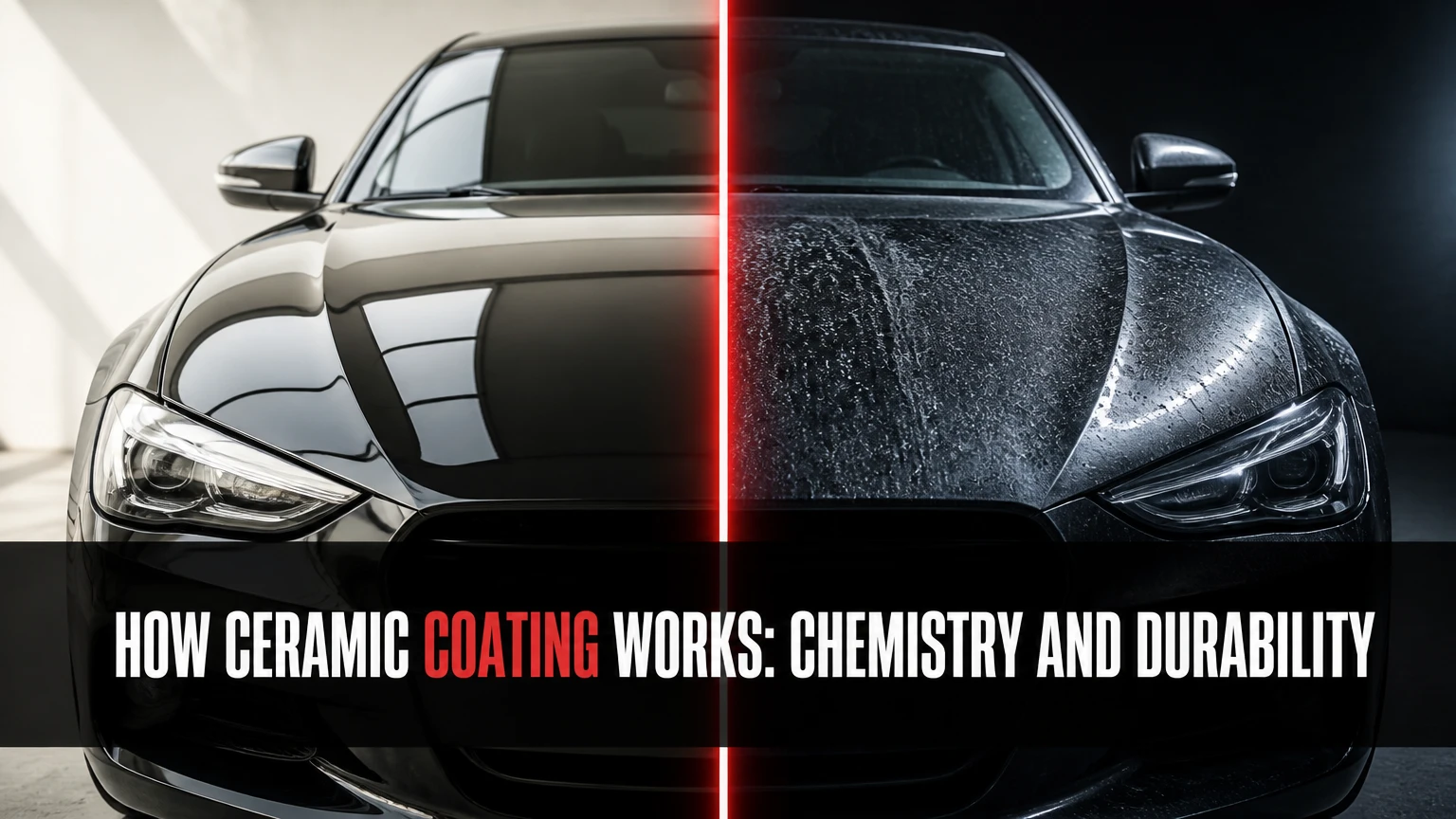
Ceramic coating works by converting a liquid formulation of reactive silicon-based compounds into a thin, cross-linked film on a vehicle’s prepared surface. During curing, the film chemically bonds to compatible surface groups and creates a low-surface-energy layer that improves gloss, chemical resistance, water release, and cleaning ease, but it does not stop stone chips or eliminate scratches.
Key facts at a glance
Automotive ceramic coatings usually form a film about 1-3 microns thick after curing.
Most durable paint coatings use silane or siloxane chemistry that forms a cross-linked network containing silicon, oxygen, and carbon.
Water beading comes primarily from low surface energy and surface texture, not from a perfectly flat “glass” sheet.
A 9H label refers to pencil-hardness testing, not guaranteed scratch-proof performance.
Ceramic coating resists UV exposure, road film, bird droppings, and many chemicals, but PPF provides far better impact protection.
Professional installation commonly takes 1-3 days because paint correction and controlled curing determine the result.
What Ceramic Coating Is
Ceramic coating is a reactive liquid surface treatment, not a conventional ceramic tile or a thick glass layer. Automotive formulas commonly contain organosilicon compounds, solvents, catalysts, and additives that react after application and leave a transparent, cross-linked film on paint, PPF, wheels, glass, or trim.
Silicon dioxide, or SiO₂, is associated with ceramic coatings because the cured network contains silicon-oxygen bonds. However, a bottle labeled “ceramic” does not automatically contain a specific percentage of free SiO₂. Product concentration claims are inconsistent across brands, and a higher advertised solids percentage does not independently prove better durability.
Titanium dioxide, graphene oxide, fluorinated compounds, and other additives may alter gloss, water behavior, curing speed, or chemical resistance. These additives do not turn every product into a superior coating. The resin system, preparation, film uniformity, and aftercare matter more than a single ingredient on the label.
How ceramic coating differs from a spray sealant
A true resin-based ceramic coating cures into a chemically resistant film. A ceramic spray sealant usually contains SiO₂-related ingredients in a diluted polymer or siloxane carrier and remains easier to apply, easier to remove, and shorter-lived.
| Product category | Typical application | Typical service life | Main limitation |
|---|---|---|---|
| SiO₂ detail spray | Spray and wipe, 15-45 minutes | 1-6 months | Lower film durability |
| Ceramic wash or rinse aid | Apply during wash, 10-30 minutes | 2-8 weeks | Minimal deposited material |
| Consumer bottle coating | Panel-by-panel wipe and level, 6-12 hours | 1-3 years | High-spot risk |
| Professional coating system | Correction, coating, controlled cure, 1-3 days | 3-9 years | Preparation and maintenance required |
“Ceramic spray” is therefore a category label, not a precise technical specification. Buyers should ask for the product name, expected cured life, preparation requirements, warranty conditions, and maintenance schedule.
How Ceramic Coating Works
Ceramic coating works through surface preparation, wetting, chemical reaction, solvent evaporation, and cross-linking. The liquid first spreads across the clear coat, then reactive groups hydrolyze and condense as solvents leave, producing a bonded polymeric network rather than a separate slab of solid glass.
Most automotive coatings use organosilane chemistry. In simplified form, alkoxy groups react with moisture during hydrolysis, and silanol groups then condense with one another or with compatible hydroxyl groups on the prepared surface. The exact reaction depends on the formulation, humidity, substrate, and catalyst package.
The coating does not usually sink deeply into paint. It fills and bridges microscopic surface irregularities while adhering to the upper surface of the clear coat. The finished film can increase optical clarity and gloss because it changes how light interacts with a smoother, more uniform interface.
Why does ceramic coating repel water?
Ceramic coating repels water because its cured surface has lower surface energy than untreated paint and presents a combination of chemical composition and microscopic texture that reduces water adhesion. A droplet forms a high contact angle, so gravity, airflow, or a drying towel can move it more easily.
Water behavior is not identical to protection. A highly beading coating can still develop mineral deposits if droplets dry in sunlight, while a less dramatic sheeting coating may leave fewer spots. Contact-angle figures around 100-120 degrees are typical marketing or laboratory ranges, but test method, contamination, angle, and surface cleanliness change the result.
Water spotting remains possible. Calcium, magnesium, silica, and acidic pollutants can concentrate at the edge of drying droplets, etching the coating or the underlying clear coat if deposits remain for days.
What does the coating protect against?
A cured coating protects the surface primarily by reducing chemical adhesion and slowing exposure to contaminants. Resistance depends on formulation and dwell time, but a coating can make removal of bird droppings, insects, road salt, tree sap, and oily traffic film less aggressive.
The protection is selective:
| Hazard | Ceramic coating response | Practical result |
|---|---|---|
| UV exposure | Slows oxidation and contamination-related degradation | Clear coat retains appearance longer |
| Bird droppings | Adds chemical resistance for short dwell periods | Remove promptly, preferably within hours |
| Road salt | Reduces direct contamination adhesion | Easier winter washing |
| Washing swirls | Reduces friction when lubricated correctly | Does not make paint swirl-proof |
| Stone chips | Thin film absorbs little impact energy | PPF is substantially better |
| Key scratches | Film is too thin to stop concentrated force | Clear coat can still be damaged |
Ceramic coating is a sacrificial chemical barrier, but “sacrificial” does not mean it absorbs every form of damage. A 1-3 micron coating is far thinner than the roughly 35-50 micron clear-coat layer often cited for modern automotive paint, and it cannot replace missing paint protection film.
What Do Hardness and Thickness Numbers Mean?
Ceramic coating thickness describes the cured film, while hardness describes resistance under a particular test method. Typical cured thickness is approximately 1-3 microns, and many products advertise 9H pencil hardness, but neither number predicts immunity from rock chips or careless washing.
The 9H rating comes from pencil-hardness scales such as ASTM D3363, where coated panels are challenged with pencils of increasing hardness under defined conditions. Pencil hardness is not the same as Mohs mineral hardness, indentation hardness, tensile strength, or real-world scratch resistance. A 9H coating can still be marked by sand trapped under a wash mitt.
| Metric | Typical value | What it indicates | What it does not prove |
|---|---|---|---|
| Cured film thickness | 1-3 microns | Deposited protective film | Impact resistance |
| Pencil hardness | 7H-9H | Resistance in a pencil test | Scratch-proof paint |
| Water contact angle | 100-120 degrees | Droplet wetting behavior | No water spotting |
| Initial dry time | 12-24 hours | Early moisture sensitivity | Full chemical cure |
| Functional cure | 5-14 days | Cross-linking progression | Permanent lifetime |
Manufacturer testing is useful only when test methods are disclosed. Comparing “9H” from two brands without comparing substrate, film thickness, cure period, and test standard can create a false equivalence.
What Types of Ceramic Protection Exist?
Ceramic protection includes resin coatings, spray sealants, and substrate-specific products. The correct choice depends on the surface, expected service life, working environment, and willingness to perform preparation and maintenance.
- Consumer bottle coatings: Usually offer the longest DIY service life and require careful leveling.
- Professional coatings: Often cure faster, use more controlled chemistry, and may support inspection, warranty, or multi-layer systems.
- Wheel coatings: Are formulated for brake dust, metallic fallout, and repeated heat cycles.
- Glass coatings: Optimize water release and optical clarity rather than paint gloss.
- Trim coatings: Use formulas designed for textured or porous plastics.
- Graphene-labeled coatings: May contain graphene oxide or carbon-based additives, but the label alone does not establish better durability or lower water spotting.
A coating designed for paint should not automatically be used on glass, rubber, matte vinyl, or textured plastic. The substrate changes adhesion, appearance, curing, and removal behavior.
How Ceramic Coating Is Applied
Ceramic coating application typically takes 6-12 hours for a prepared DIY vehicle and 1-3 days for a professional service. Preparation controls the outcome because polishing oils, bonded contamination, defects, dust, and uneven curing can remain visible beneath the transparent film.
Step 1: Wash and decontaminate the vehicle
Use a pH-appropriate automotive shampoo, clean wash media, and separate buckets for the vehicle and wheels. Remove tar, iron fallout, and bonded particles with dedicated products before polishing.
A typical medium-sized vehicle may require 30-60 milliliters of shampoo solution, 50-150 milliliters of iron remover, and one or two clay-medium passes. Rinse thoroughly and dry with clean microfiber towels or filtered compressed air.
Success checkpoint: The paint feels smooth under a clean plastic bag or nitrile-gloved hand.
Common mistake: Applying iron remover to a hot, drying panel and allowing it to stain trim.
Step 2: Correct the paint
Inspect under high-intensity lighting and polish according to defect severity. A finishing polish may improve gloss without significant clear-coat removal, while a cutting compound removes more defects but requires a refinement pass.
Ceramic coating does not repair scratches. Coating over a defect preserves that defect beneath the transparent film, so correction should happen before the panel wipe.
Success checkpoint: The intended defects are removed or reduced, and no oily polishing residue remains in the inspection light.
Common mistake: Chasing every deep scratch until excessive clear coat is removed.
Step 3: Degrease the surface
Use the coating manufacturer’s panel-preparation product or a compatible diluted solvent wipe. Isopropyl alcohol alone may not remove every polishing oil, and excessive solvent can soften sensitive trim or affect fresh repaint work.
Work in small areas with two clean microfiber towels. One towel distributes the panel wipe, and the second removes residue before evaporation marks form.
Success checkpoint: The surface wipes clear without rainbow smears or oily trails.
Common mistake: Reusing a saturated towel and spreading oils across the next panel.
Step 4: Apply a controlled amount
Apply the coating to a suede applicator, usually 6-10 drops for a small section, then spread a thin cross-hatch pattern over approximately 0.5-1 square meter. Follow the bottle’s instructions because flash time varies with formulation, temperature, and humidity.
Do not saturate the applicator. Excess product increases high spots, wastes material, and makes leveling more difficult.
Success checkpoint: The film appears evenly wet, with no dry gaps or heavy pooling.
Common mistake: Working across an entire hood before checking the flash behavior.
Step 5: Level the flashing film
When the coating begins to flash, it may show a rainbow, oily, or sweating appearance. Typical working time ranges from 30 seconds to 3 minutes, but a cool, dry garage can behave very differently from a warm, humid one.
Use a first towel to level the residue and a second dry towel to finish the panel. Inspect from multiple angles under bright light because high spots can disappear from one viewing angle.
Success checkpoint: The panel looks uniformly clear and feels smooth without dark smears.
Common mistake: Waiting for a dramatic rainbow when the product has already become difficult to remove.
Step 6: Allow the coating to cure
Keep the vehicle dry for at least 12-24 hours, prevent dust accumulation, and follow the manufacturer’s instructions before driving in rain. Avoid detergents and aggressive washing for roughly 5-14 days while the cross-linking reaction continues.
Cure time changes with temperature, humidity, airflow, film thickness, and product chemistry. A coating that feels dry is not necessarily fully cured.
How Long Does Ceramic Coating Last?
Ceramic coating commonly lasts 1-3 years for a consumer bottle product and 3-9 years for a professionally installed system when the vehicle is washed correctly. Advertised lifetime warranties usually require documented maintenance, approved products, inspections, and compliance with exclusions.
| Use case | Typical coating life | Maintenance frequency | Main life-shortening factor |
|---|---|---|---|
| Garaged weekend car | 3-7 years | Every 3-4 weeks | Infrequent decontamination |
| Daily commuter outdoors | 1-4 years | Every 2-4 weeks | UV, pollution, bird droppings |
| Coastal or salty climate | 1-3 years | Every 1-3 weeks | Salt and mineral deposits |
| Fleet or commercial vehicle | 6-24 months | Weekly or biweekly | High wash frequency and chemicals |
Loss of beading does not always mean the coating has disappeared. Oils, traffic film, mineral deposits, and alkaline cleaners can mask the surface. Decontamination may restore water behavior, whereas polishing removes the film.
How to Maintain a Coated Vehicle
Wash a coated vehicle every 2-4 weeks with a clean microfiber mitt, pH-neutral shampoo, and abundant lubrication. Rinse thoroughly, dry with a blower or soft towel, and remove bird droppings and insect residue as soon as practical.
Avoid automatic brush washes, abrasive compounds, household detergents, and strong degreasers used without a specific reason. A maintenance spray can add temporary slickness, but it cannot restore a chemically worn coating indefinitely.
Inspect quarterly for mineral deposits, reduced water release, dullness, and contamination. If the coating appears inconsistent, clean and chemically decontaminate before deciding that reapplication is necessary.
Ceramic Coating Versus Wax, Sealants, and PPF
Ceramic coating is the strongest choice for chemical resistance, gloss retention, and reduced cleaning effort. Paint protection film is the stronger choice for impact protection, while wax and sealants are better for low cost, easy application, and short-term appearance changes.
| Protection option | Typical life | Impact protection | Typical installed cost | Best use |
|---|---|---|---|---|
| Carnauba wax | 4-8 weeks | Negligible | $20-$150 | Warm gloss and low-cost upkeep |
| Synthetic sealant | 3-9 months | Negligible | $50-$250 | Simple seasonal protection |
| Ceramic coating | 1-9 years | Low | $500-$3,000 | Chemical resistance and gloss |
| PPF | 5-10 years | High | $1,500-$6,000+ | Rock-chip protection on impact zones |
Prices vary by country, vehicle size, paint condition, and installer reputation. A low quote may omit correction, wheels, glass, warranty registration, or aftercare.
Is ceramic coating worth it?
Ceramic coating is worth the cost for owners who keep a vehicle several years, wash it regularly, and value easier cleaning and stable gloss. Ceramic coating is poor value for a leased car returned soon, heavily damaged paint, or an owner expecting protection from highway stone impacts.
Professional coating also makes more sense on difficult colors, large SUVs, fresh repaint work, or vehicles that need extensive correction. DIY coating suits a controlled garage, patient preparation, and an owner willing to polish a panel if leveling fails.
When Does Ceramic Coating Need Special Treatment?
Matte paint, satin finishes, repainted panels, PPF, vinyl wraps, and porous trim require product-specific testing. Gloss-enhancing coatings can permanently alter the sheen of matte surfaces, and solvent-based products may react unpredictably with uncured paint or low-quality vinyl.
Fresh repaint work should follow the paint manufacturer’s recommended outgassing period, often at least 30-90 days, rather than an arbitrary coating schedule. PPF can receive a compatible coating, but the installer must confirm that the formula will not stain edges, soften the film, or affect warranty coverage.
Ceramic coating is also unsuitable as a rust repair. It can reduce contamination on painted metal, but it cannot seal structural corrosion or replace proper sanding, corrosion treatment, primer, and paint repair.
What Causes High Spots and Coating Failure?
High spots occur when excess coating remains unevenly leveled and cures as a visible dark, cloudy, or rainbow-like patch. Common causes include oversized work sections, excessive product, rapid flashing in heat, insufficient lighting, and delayed towel changes.
A fresh high spot may be corrected within the product’s working window by applying a small amount of the same coating to re-wet the area, then leveling it immediately. After the film has cured, the reliable repair is usually localized machine polishing, panel wiping, and reapplication.
Do not attack a cured high spot with aggressive solvent or a razor blade. Those methods can damage clear coat, trim, or adjacent film. Removal is normally mechanical, and the least aggressive polishing method should be tested first.
Other failures include water spots, coating streaks, premature loss of hydrophobicity, and adhesion failure. Water spots need mineral treatment; streaks need inspection under proper lighting; premature dullness often indicates contamination; adhesion failure usually traces back to oils, silicone, moisture, or incompatible substrate preparation.
Who Should Choose Ceramic Coating?
Ceramic coating suits three practical user groups: owners who want long-term chemical protection, enthusiasts willing to maintain a prepared surface, and professional detail customers seeking a controlled finish. PPF is the better first purchase when the vehicle regularly travels on gravel roads or highways with heavy truck traffic.
A budget-conscious owner can choose a spray sealant and spend the difference on better washing equipment. A weekend detailer can choose a consumer bottle coating after practicing panel leveling on a test area. A luxury-car owner may justify professional correction and coating when appearance, warranty documentation, and resale presentation matter.
The coating is not maintenance-free. Its value comes from reducing contamination adhesion and cleaning effort, not from making paint indestructible.
FAQ
Can ceramic coating prevent scratches?
Ceramic coating cannot reliably prevent scratches from keys, abrasive dirt, machine brushes, or stone impacts. The cured film may reduce very light marring when washing is performed correctly, but PPF is the appropriate material for meaningful impact and chip protection.
Can ceramic coating be applied over existing scratches?
Yes, but the scratch remains visible beneath the transparent film and may become harder to correct later. Polish or repair the surface first, while avoiding excessive clear-coat removal when a defect extends too deeply for safe correction.
Can ceramic coating stop water spots?
Ceramic coating can reduce contamination adhesion but cannot stop water spots. Mineral-rich droplets can dry into deposits, especially on hot panels, so drying the vehicle and removing deposits promptly remains necessary.
Can ceramic coating be applied at home?
DIY application is practical in a clean, shaded, temperature-controlled garage with strong lighting and enough time for correction, panel wiping, leveling, and curing. Outdoor application increases dust, moisture, wind, and premature-flashing risks.
Is graphene coating better than ceramic coating?
Graphene-labeled coating is not automatically better. Performance depends on the complete resin system, cured film, preparation, testing, and maintenance, so compare documented durability and substrate compatibility rather than the graphene label alone.
How is ceramic coating removed?
A cured ceramic coating is normally removed by controlled machine polishing until the film is eliminated, followed by panel preparation and reapplication if needed. Abrasive removal should be calibrated to the clear coat, because the coating itself is only a few microns thick while paint correction removes underlying material.
The Bottom Line
How ceramic coating works is best understood as controlled chemical film formation, not as liquid glass sinking into paint. Reactive silicon-based compounds spread over a prepared surface, cure into a thin cross-linked network, lower surface energy, and improve resistance to contamination and cleaning chemicals.
Ceramic coating delivers gloss, water release, and easier maintenance for years when preparation and aftercare are sound. It does not replace paint correction, careful washing, or PPF where stone-chip protection matters. Choose the coating for chemical resistance and appearance, and choose PPF when physical impact is the dominant risk.


