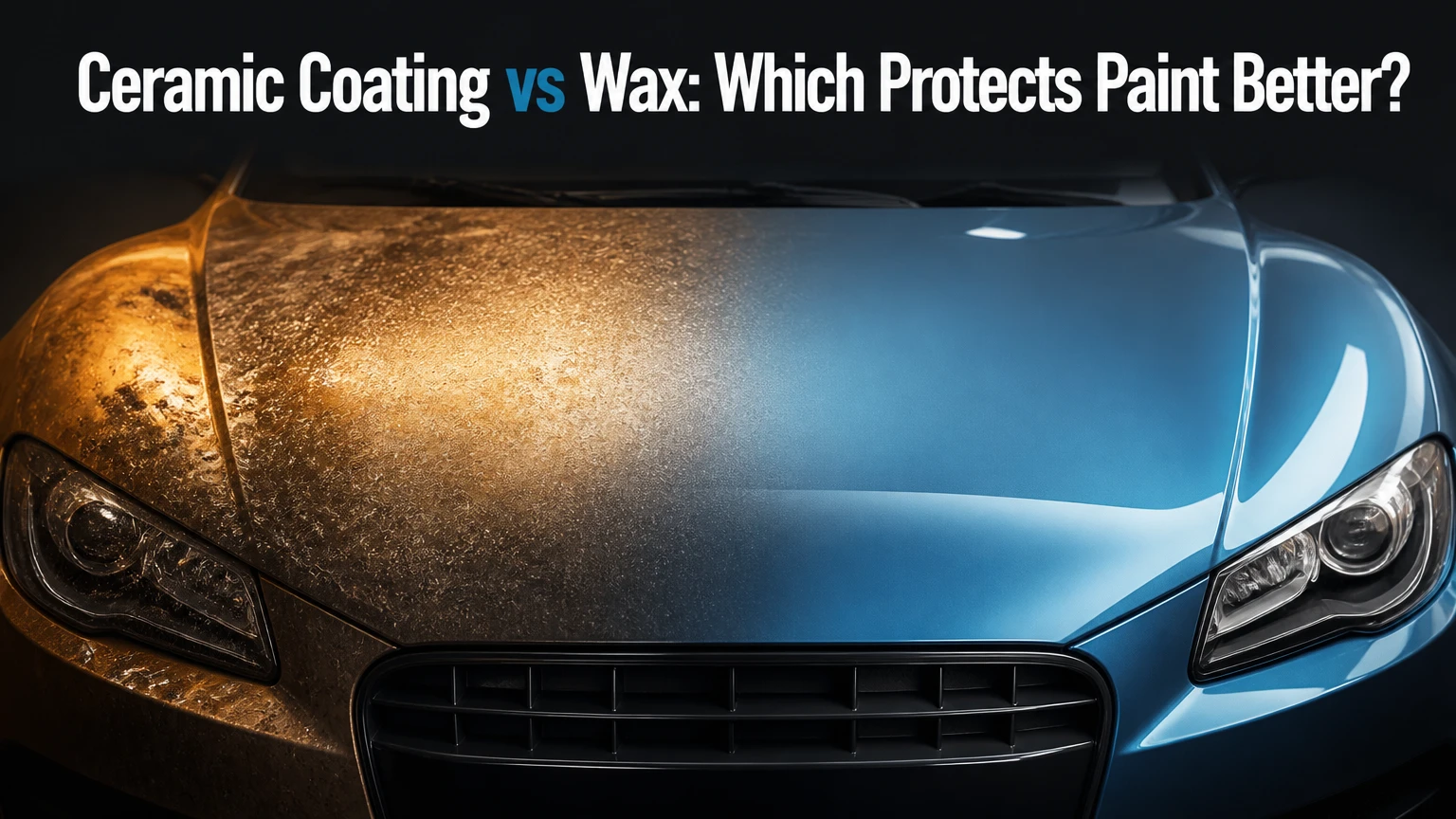
Ceramic coating vs wax is a choice between long-term chemical resistance and inexpensive, repeatable surface protection. Ceramic coating usually wins for durability, hydrophobic behavior, and easier maintenance, while wax wins for low cost, forgiving application, and a warm finish. Neither product prevents stone chips or deep scratches.
Key Facts at a Glance
Typical car wax protection lasts 4-12 weeks, while a professionally installed ceramic coating commonly lasts 2-5 years with proper maintenance.
A ceramic coating improves resistance to UV exposure, road film, and chemical staining, but it does not replace paint protection film.
“9H” describes a pencil-hardness test used in product marketing, not guaranteed resistance to scratches from keys, rocks, or abrasive washing.
A typical DIY wax job costs $15-$40 in materials and takes 1-2 hours after washing.
A professional coating commonly costs $800-$2,500 or more because paint correction often requires most of the labor.
Synthetic paint sealants and ceramic sprays occupy the practical middle ground between wax and a true coating.
What Is the Difference Between Ceramic Coating and Wax?
Ceramic coating is a cured protective film, usually based on silicon-containing chemistry, while wax is a softer sacrificial layer made from natural waxes, synthetic polymers, or both. Ceramic coating bonds more strongly to a properly prepared clear coat, whereas wax relies mainly on surface adhesion and gradually wears away through washing, heat, and contamination.
Traditional carnauba wax contains refined wax from Copernicia prunifera palm leaves. Carnauba products often produce a warm, visually soft gloss, but heat, detergents, and repeated rain reduce their life. Synthetic waxes and paint sealants use engineered polymers that generally last longer and look more reflective.
Automotive ceramic coatings are not all chemically identical. Many use silanes, siloxanes, polysilazanes, or silica-related resins that cross-link during curing. The cured layer is thin, commonly measured in microns, and its actual performance depends on surface preparation, film thickness, curing conditions, washing, and the specific formulation.
The common claim that a coating “penetrates the pores” of clear coat is an oversimplification. Clear coat is not a sponge, and a quality coating does not need deep penetration to work. The meaningful distinction is stronger chemical interaction and curing at the prepared surface, not a universal guarantee of covalent bonding for every bottle marketed as ceramic.
How Do Wax and Ceramic Coating Perform Differently?
Ceramic coating provides longer-lasting water behavior and chemical resistance, but wax provides adequate short-term protection at a fraction of the price. Performance depends on the product category, preparation quality, climate, wash method, and whether the owner refreshes the surface before protection has completely disappeared.
| Decision factor | Carnauba wax | Synthetic sealant | Ceramic spray | True ceramic coating |
|---|---|---|---|---|
| Typical service life | 4-8 weeks | 3-6 months | 3-9 months | 2-5 years |
| DIY material cost | $15-$40 | $20-$60 | $15-$50 | $60-$150 |
| Typical application time | 1-2 hours | 1-2 hours | 30-60 minutes | 8-30 hours |
| Paint correction required | Optional | Recommended | Recommended | Strongly recommended |
| Water repellency | Moderate | Moderate-high | High | High |
| Chemical resistance | Low-moderate | Moderate | Moderate-high | High |
| Rock-chip protection | None | None | None | None |
| Error recovery | Usually easy | Usually easy | Moderate | Difficult after curing |
Product claims vary widely, so these values are typical working ranges rather than universal specifications. A “five-year coating” may retain some protection for five years under favorable conditions while losing peak slickness much earlier. Warranty terms often require approved shampoos, inspection visits, or documented maintenance.
Durability and Maintenance
Ceramic coating lasts longer than wax because the cured film resists detergent exposure, temperature cycling, and chemical contamination more effectively. A wax layer normally needs renewal every month or two for consistent beading, while a coating may need only periodic decontamination and a compatible maintenance product.
Durability is not the same as permanent protection. A coated car can still collect iron particles, road tar, hard-water deposits, and mineral rings. Neglected contamination can cover the coating and make it appear to fail even when the film remains present underneath.
A practical maintenance schedule includes a gentle wash every 1-3 weeks, prompt removal of bird droppings, an iron remover approximately every 6-12 months when contamination warrants it, and a manufacturer-approved topper when water behavior declines. Automatic brushes can create marring through repeated abrasive contact, regardless of the coating.
Winner for service life: Ceramic coating, provided the owner follows the maintenance instructions and the installer prepared the paint correctly.
Gloss, Warmth, and Surface Feel
Wax usually produces the warmer, softer-looking finish that many owners prefer on black, red, or vintage paint. Ceramic coating typically increases gloss and clarity by adding a uniform clear film, but the visible difference depends more on polishing quality than on the protection product alone.
A coating cannot polish away oxidation or swirls after installation. Paint correction performed before coating removes or reduces those defects, so the preparation creates much of the final visual improvement. Wax can temporarily mask very fine defects because its softer material fills or visually refracts minor surface irregularities.
Surface slickness also changes over time. A new coating can feel extremely smooth, yet bonded contamination may make it feel rough after several months. Clay treatment, chemical decontamination, or a compatible topper can restore feel, but aggressive clay use can add marring.
Winner for warmth: Carnauba wax.
Winner for clarity and long-term gloss retention: Ceramic coating.
Chemical, UV, and Heat Resistance
Ceramic coating generally provides stronger resistance to acidic or alkaline contamination, ultraviolet exposure, and engine-bay or hot-panel temperatures than wax. Neither product makes paint immune to damage from bird droppings, tree sap, industrial fallout, brake dust, or concentrated chemicals left on the surface.
Wax softens and evaporates more readily on hot panels, especially on dark paint parked in direct summer sun. Synthetic sealants usually tolerate heat better than carnauba wax, although their real-world life still depends on detergent strength and exposure.
Ceramic coating manufacturers may publish pH ranges such as pH 2-12, but those figures describe controlled chemical resistance tests, not permission to leave strong chemicals on automotive paint. Concentrated wheel acid, high-pH degreasers, and dried mineral deposits can damage the coating or the clear coat beneath it.
UV protection is also indirect. A coating can reduce surface exposure and slow environmental degradation, but paint preservation still depends on the clear coat, pigment stability, parking conditions, and washing practices.
Winner for chemical and environmental resistance: Ceramic coating, with prompt contamination removal still required.
Resistance to Scratches and Stone Chips
Ceramic coating does not prevent rock chips, deep scratches, key marks, parking-lot impacts, or severe wash-induced swirls. The film is too thin to absorb the impact energy that a thick polyurethane paint protection film can handle.
The widely advertised “9H” label refers to pencil hardness under a defined test method. Pencil hardness is not equivalent to Mohs mineral hardness, and it does not mean a coated panel is invulnerable to every object rated below 9H. A dirty towel can still drag abrasive particles across the surface.
Paint protection film, commonly called PPF, is the correct product for high-impact zones such as the hood, front bumper, mirror caps, and rocker panels. A useful combination for a new or expensive car is PPF on impact areas and ceramic coating on the remaining painted surfaces.
Winner for impact protection: PPF, not wax or ceramic coating.
Winner for reducing chemical staining and wash-related wear: Ceramic coating.
Which Product Costs Less Over Time?
Wax costs less initially and remains cheaper when an owner is willing to reapply it several times each year. Ceramic coating can approach or exceed its installation cost in the first year, but the annualized price becomes more competitive when the owner values reduced reapplication and professional preparation.
| Ownership path | Initial cost | Renewal interval | Typical 3-year spend | Labor profile |
|---|---|---|---|---|
| DIY carnauba wax | $15-$40 | 1-2 months | $45-$240 | Owner applies |
| DIY synthetic sealant | $20-$60 | 3-6 months | $40-$180 | Owner applies |
| DIY ceramic spray | $15-$50 | 3-9 months | $30-$200 | Owner applies |
| Professional wax service | $150-$300 | 1-3 months | $1,800-$10,800 | Repeated detailing |
| DIY coating kit | $60-$150 | 2-5 years | $60-$300 | Preparation by owner |
| Professional coating | $800-$2,500+ | 2-5 years | $800-$3,000 | Correction and installation |
The three-year spend for repeated professional waxing can exceed the cost of one coating, but that comparison is fair only when the services include similar washing and paint correction. A simple hand wax is not equivalent to a multi-stage detail with machine polishing.
Coating quotes vary because paint condition controls preparation time. A new vehicle with clean, defect-free paint may need a light polish, while a five-year-old black SUV may require many hours of correction before installation.
Cost verdict: Wax wins for the lowest upfront price. Ceramic coating can win for long-term value when the vehicle is kept for several years and the owner would otherwise pay for repeated detailing.
How Difficult Is Application?
Wax is substantially easier to apply because minor residue or uneven coverage can usually be removed during the same session. A true ceramic coating demands controlled temperature, stable lighting, clean towels, measured panel sizes, and rapid correction of high spots before the material cures.
| Task | Wax procedure | Ceramic coating procedure |
|---|---|---|
| Wash | Car shampoo and microfiber drying | Car shampoo, then full drying |
| Decontaminate | Optional iron remover or clay | Iron remover and clay when needed |
| Correct paint | Optional light polish | Recommended before every installation |
| Surface wipe | Usually unnecessary | Panel wipe to remove polishing oils |
| Working area | One panel or larger section | Approximately 2 x 2 feet |
| Flash window | Usually 5-10 minutes to haze | Often 1-3 minutes, product dependent |
| Final wipe | One clean buffing towel | Short-nap leveling towel plus plush towel |
| Cure conditions | Dry until residue is removed | Dry indoors, commonly 12-24 hours |
| Initial washing | Follow product label | Often avoid shampoo for about 7 days |
Do not use a universal flash time. Humidity, temperature, coating chemistry, panel temperature, and application thickness change the window. The bottle instructions control, and a test spot on an inconspicuous panel is safer than coating the entire hood immediately.
Wax Application
- Wash the vehicle with a pH-balanced automotive shampoo.
- Dry with clean microfiber towels and inspect the paint in shade.
- Apply a very thin layer to a cool panel, usually 2-4 pea-sized drops per section.
- Allow the product to haze according to its label, often 5-10 minutes.
- Remove residue with one towel and perform a final inspection with a second towel.
The correct checkpoint is a clear, streak-free panel with no oily smears under a bright inspection light. The common mistake is applying a thick layer, which increases buffing effort without creating a proportionally thicker protective film.
Ceramic Coating Application
- Wash, chemically decontaminate, and clay the paint only where bonded contamination remains.
- Polish defects before installation; the coating will not hide significant swirls or oxidation.
- Wipe each panel with the specified panel-prep solution.
- Apply the coating in a small cross-hatched section using the recommended applicator.
- Watch for the product to flash, then level and buff at the specified time.
- Inspect from multiple angles under strong lighting.
- Keep the vehicle dry during the initial cure period and follow the product’s washing restriction.
The correct checkpoint is a uniform, residue-free surface with no rainbow smears, dark patches, or oily trails. The common mistake is working too large an area, because the first section may cure before the installer can level it.
What Are the Most Common Failure Modes?
Most coating failures begin with contamination, incorrect flash timing, poor towel control, or unrealistic maintenance expectations. Wax failures usually involve thick application, hot panels, incompatible cleaners, or allowing protection to disappear before renewal.
| Failure mode | Visible symptom | Likely cause | Correct response |
|---|---|---|---|
| Ceramic high spot | Dark or iridescent smear | Coating cured before leveling | Re-wipe immediately; polish if cured |
| Streaking | Uneven rainbow residue | Large work area or late wipe | Re-level during the product window |
| Early coating failure | Weak beading in weeks | Oils, moisture, or poor prep | Decontaminate and inspect application |
| Wax smearing | Oily haze after buffing | Thick layer or humid conditions | Use a clean towel and lighter application |
| Water spots | White mineral rings | Hard water dried on paint | Remove deposits promptly with approved cleaner |
| Towel marring | Fine linear scratches | Dirty or low-quality towel | Replace towels and wash with safer technique |
A fresh high spot may sometimes be reactivated with a small amount of the same coating and immediately leveled, but the product instructions should govern that repair. Once a coating has fully cured, hand polishing or machine polishing is usually required, followed by surface preparation and local reapplication.
A practitioner rule is to use more towels than expected. One towel can become saturated with residue and spread defects across adjacent panels, so separate leveling, buffing, inspection, and paint-prep towels reduce cross-contamination.
Another rule is to reduce panel size before reducing flash time. When the coating flashes too quickly, smaller sections and lower panel temperature usually solve the problem more reliably than hurried wiping.
Can Wax Go Over Ceramic Coating?
Wax can usually be applied over a cured ceramic coating, but the layer changes the coating’s surface behavior and may make diagnosis more difficult. A wax or topper can add warmth and temporarily improve slickness, yet it can also reduce the coating’s characteristic water behavior or complicate future maintenance.
Use a coating-compatible topper when the manufacturer recommends one. Avoid cleaners containing abrasive polishing agents, strong solvents, or petroleum distillates unless the product specifically states that the chemistry is safe for the coating.
Wax should not be used to conceal a coating defect. A high spot, streak, or cloudy patch remains underneath and may become harder to inspect after the wax fills the visual contrast.
What Is the Best Middle Ground?
A synthetic paint sealant is the simplest middle ground for owners who want more durability than carnauba wax without coating-level preparation. A ceramic spray is another practical option, especially for a commuter who wants stronger water behavior during routine washing.
| Product type | Best use case | Typical life | Preparation burden | Main limitation |
|---|---|---|---|---|
| Carnauba wax | Classic cars and show weekends | 4-8 weeks | Low | Short service life |
| Synthetic sealant | Budget-conscious daily driver | 3-6 months | Low-moderate | Less rich visual warmth |
| Ceramic spray | Fast maintenance after washing | 3-9 months | Moderate | Less durable than a cured coating |
| True ceramic coating | Long-term ownership | 2-5 years | High | Expensive, unforgiving installation |
| PPF | Front-end impact protection | 5-10 years | High | Higher cost and visible edges possible |
Ceramic sprays are not automatically equivalent to a professional ceramic coating. Some are diluted spray sealants with silica additives, while others contain more reactive chemistry and provide stronger durability. Product directions, not the word “ceramic,” determine the category.
Which Should You Choose?
The right choice depends mainly on ownership duration, parking exposure, paint condition, budget, and tolerance for preparation. A coating is a strong choice for long-term low-maintenance ownership, while wax or sealant is more rational for short leases, frequently traded vehicles, or owners who enjoy regular detailing.
Daily Commuter and Outdoor Parker
Choose a professional coating or a ceramic spray if the car stays outside and encounters rain, road salt, bird droppings, and traffic film. A ceramic spray costs less and can be renewed during a normal wash, while a full coating provides better chemical resistance when the owner can afford professional preparation.
Weekend Hobbyist and Classic-Car Owner
Choose carnauba wax when visual warmth and hands-on detailing matter more than multi-year durability. Wax is forgiving, easy to remove, and simple to change between products for a show or event.
New-Car Owner Keeping the Vehicle Five Years
Choose a professional ceramic coating after inspecting the factory paint and correcting transport marring. Add PPF to the front bumper, hood leading edge, and mirror caps if stone chips would materially reduce the vehicle’s value.
Leased Vehicle or Short-Term Owner
Choose a synthetic sealant or ceramic spray. A multi-thousand-dollar coating rarely produces a clear financial return on a vehicle that will be returned or sold within two years unless the owner places a high personal value on appearance.
Older, Neglected, or Heavily Scratched Paint
Correct the paint before choosing long-term protection. Wax can provide a temporary visual improvement, but ceramic coating locks the existing finish beneath a durable film and therefore makes poor preparation more consequential.
How Should You Maintain Either Protection?
Wash protected paint with a clean, pH-balanced shampoo every 1-3 weeks and remove bird droppings, sap, and fuel spills as soon as practical. Use separate microfiber towels for wheels and paint, avoid automatic brushes, and never judge protection solely by water beading.
Beading can decline because of contamination on top of a healthy coating. Conversely, strong beading can remain after a thin wax layer has lost much of its chemical protection because water behavior and barrier durability are related but not identical measurements.
For coated vehicles, use the manufacturer’s maintenance shampoo and topper schedule. For waxed vehicles, renew the product when washing becomes less uniform, surface slickness declines, or the protection no longer survives the owner’s normal wash interval.
FAQ
Does ceramic coating make a car easier to wash?
Ceramic coating usually makes routine washing easier because lower surface adhesion allows water and road film to release more readily. The coating does not eliminate washing, and neglected mineral deposits, tar, and iron contamination can still bond to the surface. A clean wash mitt and pre-rinse remain necessary.
Is ceramic coating worth it on a white car?
Ceramic coating can be worthwhile on white paint because it reduces contamination adhesion and helps maintain gloss, although visual depth changes are less dramatic than on black paint. Owners who park indoors and enjoy waxing may receive better value from a synthetic sealant or ceramic spray.
Does wax protect against bird droppings?
Wax can delay direct contact between acidic contamination and the clear coat, but it cannot prevent etching when droppings remain in sunlight. Remove bird droppings promptly with a lubricated microfiber towel or detailing spray, and do not scrub dried material across the paint.
Can ceramic coating be removed?
A cured ceramic coating is normally removed by machine polishing rather than ordinary shampoo, clay, or household solvents. The installer removes the film along with a controlled amount of surface material, which is why coating defects should be corrected early and why preparation quality matters.
Is a ceramic coating better than paint protection film?
Ceramic coating is better for chemical resistance, gloss, and easier washing, while PPF is better for impact protection against stone chips and road debris. Many high-value vehicles use both: PPF on vulnerable front panels and ceramic coating over the film and exposed paint.
How often should a car be waxed?
Most cars benefit from waxing every 4-12 weeks, depending on the formula, climate, wash frequency, storage, and paint exposure. A synthetic sealant can extend the interval to roughly 3-6 months, while a ceramic spray can provide several additional months when maintained correctly.
The Bottom Line
Ceramic coating vs wax is not a contest between a modern product and an obsolete one. Ceramic coating is the better choice for multi-year ownership, chemical resistance, reduced maintenance, and consistent hydrophobic behavior; wax is the better choice for low cost, easy application, warm gloss, and frequent hands-on detailing. For stone-chip defense, choose PPF rather than either product.


