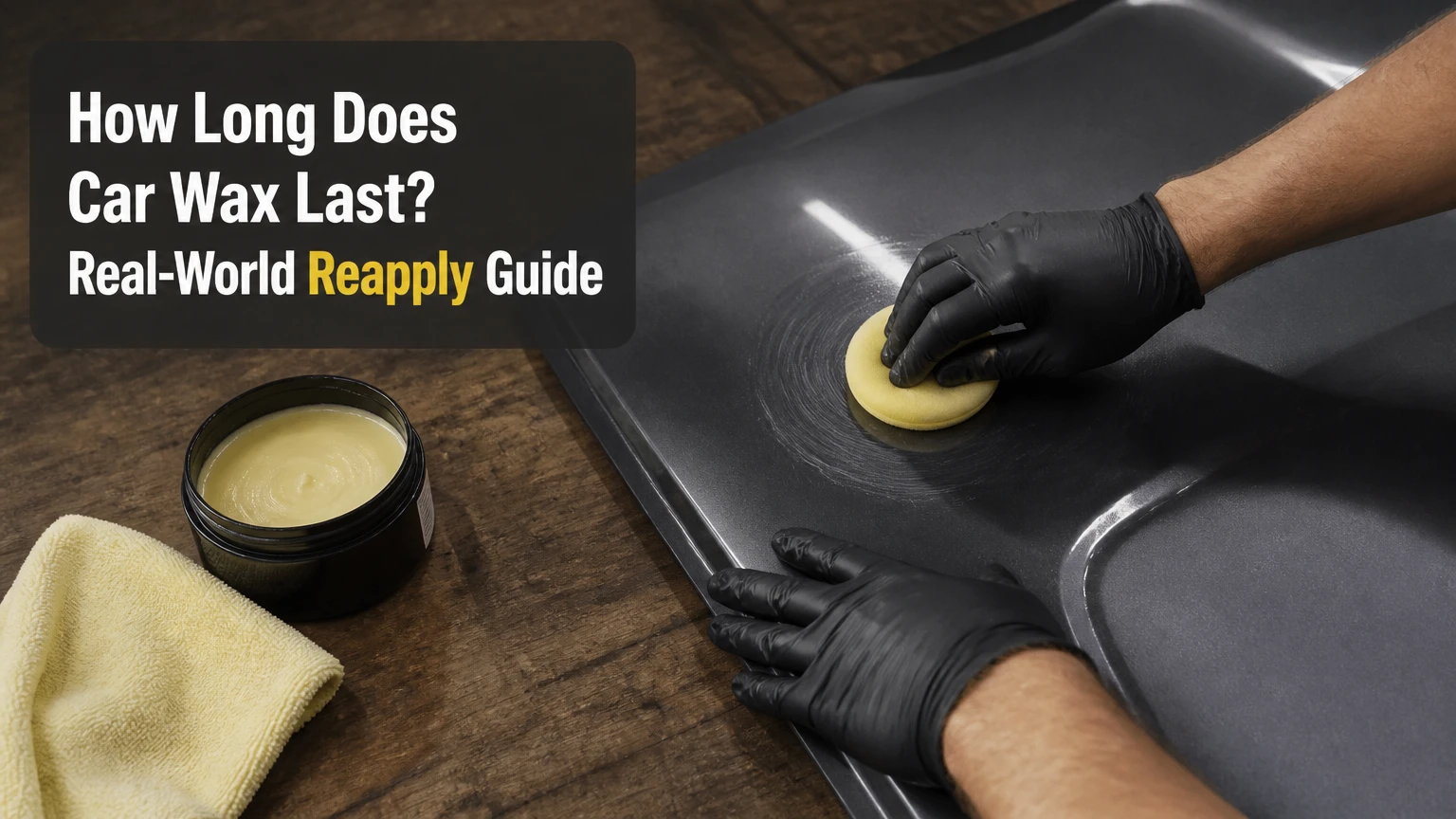
Car wax typically lasts 2-8 weeks, while synthetic sealants last about 3-6 months and ceramic-infused sprays often last 2-6 months. Actual durability depends more on surface preparation, washing chemicals, UV exposure, storage, and product formulation than on whether the wax is liquid or paste.
Key Facts at a Glance
Traditional carnauba paste or liquid wax commonly protects paint for 4-8 weeks.
Spray wax usually lasts 2-4 weeks when used as a standalone product.
Synthetic paint sealants typically last 3-6 months under moderate conditions.
Ceramic-infused sprays can last 2-6 months, but they are not equivalent to a professional ceramic coating.
Water beading alone cannot prove that a complete protective layer remains.
A clean, decontaminated surface and pH-balanced car shampoo usually extend protection more effectively than applying a thicker coat.
What Determines How Long Car Wax Lasts?
Car wax lasts longest when a thin, even film bonds to clean paint and the vehicle avoids aggressive detergents, high heat, abrasive washing, and prolonged outdoor exposure. A well-prepared daily driver may retain useful protection for 6-8 weeks, while an outdoor-parked vehicle washed weekly with harsh equipment may need attention after 2-4 weeks.
Car wax is a blend of natural waxes, synthetic polymers, oils, solvents, and gloss-enhancing ingredients. Carnauba wax contributes a warm appearance and water resistance, while synthetic polymers generally provide better chemical and heat resistance. Product labels use “wax” broadly, so two bottles with the same label can have very different durability.
Paint condition also matters. Oxidized, heavily contaminated, or oily clear coat gives the product fewer clean contact points, so the film may wash away unevenly. A polished or chemically cleaned surface usually produces more consistent longevity, although polishing removes a small amount of clear coat and should not be repeated unnecessarily.
How Does Car Wax Protect Paint?
Car wax creates a thin sacrificial film over the clear coat that changes the surface’s interaction with water and contaminants. The film can improve gloss by filling or visually masking microscopic surface irregularities, but it does not rebuild damaged clear coat or stop stone chips.
Hydrophobic behavior causes water to form droplets rather than spread into a continuous sheet. That effect can reduce the time contaminants remain in contact with paint, yet beading is not the same as complete protection. Some products continue resisting chemicals after beading declines, and some quick-detailing products create impressive beads without providing durable coverage.
A wax layer also has limits. It cannot prevent scratches from automatic brushes, remove etching from acid rain, reverse oxidation, or replace a damaged clear coat. Wax reduces exposure; it does not make paint chemically or physically invulnerable.
How Long Does Each Type of Car Wax Last?
Typical standalone durability ranges from 2 weeks for light spray waxes to 8 weeks for traditional carnauba products. Synthetic sealants and ceramic-infused products can last several months, but their preparation requirements and maintenance behavior differ from conventional wax.
| Protection type | Typical useful life | Typical retail cost | Best-fit use |
|---|---|---|---|
| Spray wax | 2-4 weeks | $10-$25 | Fast maintenance after washing |
| Liquid carnauba wax | 4-6 weeks | $15-$35 | Easy traditional waxing |
| Paste carnauba wax | 6-8 weeks | $20-$60 | Maximum warm gloss |
| Synthetic paint sealant | 3-6 months | $20-$50 | Daily drivers and outdoor storage |
| Ceramic-infused spray | 2-6 months | $15-$45 | Longer-lasting DIY maintenance |
| Professional ceramic coating | 2-5 years | $500-$2,000 installed | Long-term protection and reduced upkeep |
These are typical practitioner ranges, not product guarantees. Manufacturer testing may use controlled panels, limited washing, or favorable climate conditions that do not represent a high-mileage vehicle parked outdoors. A product advertised for 12 months may deliver a shorter practical interval when exposed to road salt, automatic washes, tropical sun, or frequent highway driving.
Which Wax Lasts Longest?
Synthetic paint sealant generally lasts longer than conventional carnauba wax, while a properly applied ceramic coating lasts longer than both. Ceramic-infused waxes occupy the middle ground, offering more chemical resistance than many traditional waxes without matching the lifespan or application discipline of a true coating.
| Product category | Finish character | Wash resistance | Application difficulty | Reapply interval |
|---|---|---|---|---|
| Carnauba paste | Warm, deep, glossy | Moderate | Low to moderate | 4-8 weeks |
| Liquid synthetic wax | Bright, reflective | Moderate to high | Low | 6-12 weeks |
| Polymer sealant | Clear, glassy | High | Moderate | 3-6 months |
| Ceramic spray | Sharp, slick, highly beaded | Moderate to high | Moderate | 2-6 months |
| Ceramic coating | Glossy, durable film | High | High | 2-5 years |
A practitioner rule of thumb is to choose the protection you will reliably maintain, not the product with the largest claim on its packaging. A sealant neglected for eight months may protect less effectively than a conventional wax refreshed every six weeks.
When Should Car Wax Be Reapplied?
Car wax should be reapplied when protection becomes inconsistent across the vehicle, not automatically because a calendar date has arrived. For most vehicles, inspect the paint every 4-6 weeks and reapply traditional wax when water behavior, slickness, and contamination resistance have noticeably declined.
Use these intervals as a starting schedule:
- Show car or garage-kept weekend vehicle: every 6-10 weeks.
- Daily driver in moderate climate: every 4-8 weeks for traditional wax.
- Vehicle parked outdoors: every 3-6 weeks for traditional wax.
- Winter road-salt exposure: before winter, then inspect every 3-4 weeks.
- Synthetic sealant: every 3-6 months, based on the product label and inspection.
- Spray wax booster: every 2-4 weeks or after several maintenance washes.
Mileage changes the interval because highway driving increases exposure to insects, dust, grit, rain, and detergents used at fuel stations or touchless washes. A vehicle driven 1,500 miles monthly may lose protection faster than a garage-kept vehicle driven 200 miles, even in identical weather.
How Can You Tell Whether Wax Is Gone?
Car wax may be failing when the surface feels less slick after washing, contaminants adhere more readily, water behavior becomes uneven, and the finish loses its clean optical clarity. No single sign proves that every molecule of wax has disappeared, so inspect several sections after a proper wash.
Check the hood, roof, trunk, and lower doors separately. Horizontal panels receive stronger UV exposure and collect more contamination, while lower panels encounter road film and traffic grime. If the roof sheds water differently from the doors, protection has degraded unevenly.
A practical test uses a clean, damp microfiber towel after washing. Lightly glide it over the paint without pressure. A protected surface often feels smoother, but bonded contamination can imitate a failed wax layer, so use an automotive clay towel or clay bar with proper lubricant before making a final judgment.
Which Habits Shorten Wax Life?
Harsh washing, outdoor exposure, neglected contamination, and poor drying shorten wax life more than normal rain does. Dish detergent does not necessarily remove every trace instantly, but repeated use can strip oils and weaken many wax films because household detergents are not formulated for automotive protection.
| Longevity factor | Higher wear condition | Lower wear condition | Practical effect |
|---|---|---|---|
| Parking | Full sun outdoors | Enclosed garage | Faster UV and heat degradation outside |
| Washing frequency | Every 3-4 days | Every 1-2 weeks | More chemical and mechanical exposure |
| Shampoo | Strong household detergent | pH-balanced car shampoo | Faster loss with aggressive detergent |
| Wash method | Brush tunnel wash | Clean microfiber mitt and rinse bucket | More marring and film removal |
| Climate | Tropical sun or salted winter roads | Mild, shaded climate | Greater chemical and thermal stress |
| Paint preparation | Oily, contaminated surface | Cleaned and decontaminated surface | Uneven bonding on neglected paint |
The most damaging mistake is often not the weather. It is washing with a dirty mitt, pressing grit into the clear coat, then trying to correct the resulting haze with more wax. Wax can hide fine defects temporarily, but it cannot remove them.
An expert maintenance rule is to rinse the vehicle thoroughly before contact washing, use separate tools for wheels and paint, and dry with low-pressure passes rather than scrubbing. Those actions protect the clear coat and help the remaining wax film stay uniform.
How Should Car Wax Be Applied?
Car wax should be applied to cool, clean, dry paint in a thin layer, one small panel section at a time. A normal application takes about 60-120 minutes, including washing and preparation, and surface preparation determines the result more than the amount of wax used.
Before You Start
| Requirement | Typical specification |
|---|---|
| Total time | 60-120 minutes |
| Working temperature | 60-80°F, or 16-27°C |
| Materials | Car shampoo, 2 buckets, wash mitt, drying towels, applicator, 2-3 buffing towels |
| Product quantity | 1-2 ounces for a midsize vehicle |
| Workspace | Shade, low wind, dry surface |
| Preparation | Remove tar, bonded grit, and old product residue as needed |
Step 1: Wash the Vehicle
Rinse loose grit from the entire vehicle, then wash from the roof downward with automotive shampoo. Use a separate bucket and tools for wheels because brake dust can scratch paint.
Checkpoint: The paint should be visibly clean without loose dust or oily streaks.
Common mistake: Washing in direct sun and allowing shampoo to dry on the panel.
Step 2: Decontaminate the Paint
Use an iron remover for embedded ferrous particles and a tar remover for asphalt deposits when necessary. A clay bar or clay towel should be used with dedicated lubricant, not dragged across dry or merely wet paint.
Checkpoint: After drying, the paint should feel substantially smoother under a thin plastic bag or clean fingertip.
Common mistake: Claying contaminated paint without lubrication, which can create marring.
Step 3: Correct or Clean the Surface
Use a pre-wax cleaner if the paint has old oils, light residue, or mild oxidation. Use polish only when defects justify the clear-coat removal and follow the product’s instructions.
Checkpoint: The panel should have an even appearance without greasy patches.
Common mistake: Applying wax over glaze or dressing residue that prevents consistent bonding.
Step 4: Apply a Thin Coat
Place a small amount, usually a dime-sized portion, on a clean foam or microfiber applicator. Spread wax across a 2-by-2-foot area using overlapping passes; circular motion is acceptable, but the direction does not determine durability.
Checkpoint: The film should be barely visible and uniform rather than thick and opaque.
Common mistake: Applying extra product to compensate for poor preparation.
Step 5: Allow the Product to Haze
Most traditional waxes need roughly 3-10 minutes before removal, although temperature, humidity, and formulation change the timing. Follow the product label instead of assuming every wax should haze.
Checkpoint: A light finger swipe should leave a clean track through the residue.
Common mistake: Allowing the product to bake in hot sun or remain on the paint overnight.
Step 6: Buff the Residue
Remove residue with a clean, plush microfiber towel, turning the towel frequently. Use a second towel for the final inspection because the first towel can become saturated with product.
Checkpoint: The surface should look clear under angled light without oily streaks or hazy patches.
Common mistake: Using one old towel across the entire vehicle.
Why Does Wax Streak or Become Difficult to Remove?
Wax streaks when the layer is too thick, the paint is hot, the surface contains oils, or the product is incompatible with existing residue. Difficult removal usually means the product dried beyond its intended wipe-off window, not that the paint has been permanently damaged.
To correct fresh streaking, use a lightly damp microfiber towel or the manufacturer’s recommended quick detailer. For hardened residue, apply a small fresh amount of the same product to reactivate the solvents, then remove it immediately with a clean towel.
Do not polish aggressively as a first response. Abrasive correction can remove clear coat when a simple panel wipe or controlled reapplication would solve the problem.
How Do You Remove Wax From Plastic Trim?
White wax marks on textured black plastic usually require a dedicated trim cleaner, mild all-purpose cleaner, or a soft detailing brush. Test the cleaner on an inconspicuous area first, because strong solvents can discolor unpainted plastic.
Prevent the problem by masking porous trim before application and using a smaller applicator near badges, seams, windshield washers, and rubber seals. Do not scrape dried wax with a metal tool.
Are Ceramic Waxes the Same as Ceramic Coatings?
Ceramic wax is not the same as a professional ceramic coating. Ceramic wax usually contains a small amount of silicon dioxide or related ceramic chemistry in a wax or polymer carrier, while a ceramic coating forms a more durable cured film after precise preparation and application.
| Feature | Traditional wax | Ceramic wax or spray | Professional ceramic coating |
|---|---|---|---|
| Main chemistry | Carnauba and oils | Polymer with SiO2 additives | Reactive coating resin |
| Typical life | 4-8 weeks | 2-6 months | 2-5 years |
| DIY difficulty | Low | Low to moderate | Moderate to high |
| Correction ability | Masks minor haze | Masks minor haze | Does not repair defects |
| Failure consequence | Easy to reapply | Usually easy to reapply | High spots may require polishing |
| Typical installed cost | $15-$60 DIY | $15-$45 DIY | $500-$2,000 |
Ceramic sprays can be a sensible choice for owners who want longer intervals without paying for professional installation. They are not suitable when the buyer expects a coating to prevent rock chips, eliminate washing, or guarantee permanent gloss.
Is Car Wax Still Worth Using?
Car wax remains worth using when the owner values low cost, easy application, and a warm gloss, especially on a well-maintained vehicle. Wax is a poor choice for someone seeking multi-year durability, strong scratch resistance, or minimal maintenance.
Wax offers three practical advantages:
- A typical $20-$50 container can cover many applications.
- Application requires common towels and no specialized curing equipment.
- Removal and replacement are straightforward when the finish becomes uneven.
Wax is less suitable for matte or satin paint unless the vehicle manufacturer specifically approves the product. Many waxes increase gloss and can alter the intended low-sheen appearance. Wax also cannot replace paint protection film on high-impact areas such as bumpers, hoods, and rocker panels.
How Does Wax Compare With Other Paint Protection?
Wax is the least durable common paint-protection option, but it is also among the cheapest and simplest to refresh. Synthetic sealants, ceramic sprays, ceramic coatings, and paint protection film each solve a different maintenance or damage problem.
| Option | Protection period | Primary protection | DIY suitability | Main limitation |
|---|---|---|---|---|
| Car wax | 1-2 months | UV exposure and contamination | High | Frequent renewal |
| Paint sealant | 3-6 months | Chemical and weather exposure | High | Less warm appearance |
| Ceramic spray | 2-6 months | Water and chemical resistance | High | Product technique matters |
| Ceramic coating | 2-5 years | Chemical exposure and easier cleaning | Moderate | Expensive preparation |
| Paint protection film | 5-10 years | Rock chips and physical impact | Low | High purchase cost |
A paint sealant is usually the best compromise for a commuter who wants twice-yearly maintenance. A ceramic coating fits owners willing to invest in preparation and maintenance. Paint protection film is the relevant alternative when impact damage, rather than water behavior, is the main concern.
Can You Wax Over a Ceramic Coating?
You can apply a coating-compatible topper or wax over some ceramic coatings, but the product may change water behavior and can interfere with the coating manufacturer’s maintenance system. Confirm compatibility before layering carnauba wax, petroleum-rich cleaners, or abrasive products.
A compatible ceramic spray detailer is usually safer than an unknown paste wax. The coating still requires gentle washing because a topper cannot prevent scratches caused by contaminated towels or brushes.
What Should Different Vehicle Owners Choose?
The best protection depends on parking, washing, climate, appearance preferences, and tolerance for reapplication. A garage-kept show car and a high-mileage outdoor commuter should not follow the same product schedule.
| Owner situation | Recommended product | Practical interval | Reason |
|---|---|---|---|
| Garage-kept show car | Paste carnauba wax | 4-8 weeks | Warm gloss outweighs frequent upkeep |
| Daily commuter | Synthetic sealant | 3-6 months | Better chemical and weather resistance |
| Outdoor parker | Ceramic spray or sealant | 2-4 months | Longer protection between applications |
| Budget owner | Liquid synthetic wax | 6-12 weeks | Low cost and simple application |
| Winter-salt region | Sealant or coating | Before winter, inspect monthly | Better resistance to salt and detergents |
| Matte-finish vehicle | Approved matte protectant | Product-specific | Standard wax may add unwanted gloss |
An honest limitation matters here: no consumer protectant eliminates the need to wash a vehicle. Protection reduces contamination adhesion and cleaning effort, but neglected bird droppings, tree sap, road salt, and mineral deposits can still etch clear coat.
Frequently Asked Questions
Does Rain Wash Car Wax Off?
Normal rain does not usually remove a properly bonded wax layer in one event. Repeated washing, detergent exposure, road grime, abrasive drying, and intense sunlight cause gradual degradation, while acidic or contaminated deposits can damage paint even when some wax remains.
Can You Wax a Car Every Week?
You can apply a compatible spray wax weekly, but weekly traditional waxing is usually unnecessary and can waste product. Wash the vehicle first, inspect the existing layer, and use a light maintenance spray only when the label allows layering without residue or smearing.
Should You Wax a Brand-New Car?
A brand-new car can receive wax once transport residue, dealer dressing, and surface contamination have been removed. Factory paint is generally cured before delivery, but confirm whether the vehicle has a dealer-applied coating or sealant before adding another product.
Does Wax Hide Scratches?
Wax can temporarily mask very fine swirls by filling microscopic irregularities, but it does not remove scratches or restore clear coat. A scratch that catches a fingernail may need paint correction or touch-up rather than additional wax.
Can You Wax in Cold Weather?
You can wax in cold weather when the paint is clean, dry, and above the product’s stated application temperature. Low temperatures slow solvent evaporation and make buffing harder, while freezing moisture can prevent an even film from forming.
Does Car Wax Protect Against Bird Droppings?
Car wax can delay contamination contact, but it cannot guarantee protection from bird-dropping etching. Remove bird droppings promptly by soaking them with lubricant or a damp microfiber towel, then lift the residue without rubbing dry material across the paint.
The Bottom Line
How long does car wax last? Traditional car wax generally lasts 4-8 weeks, spray wax lasts about 2-4 weeks, and synthetic or ceramic-infused products can last 2-6 months when applied to properly prepared paint. Reapply when protection becomes uneven, not simply when a calendar reminder appears.
For most daily drivers, a synthetic sealant or ceramic spray offers a better maintenance interval than carnauba wax. Choose traditional wax when warm gloss and inexpensive, hands-on care matter most, then preserve the finish with gentle washing, clean microfiber tools, shade, and prompt contamination removal.


