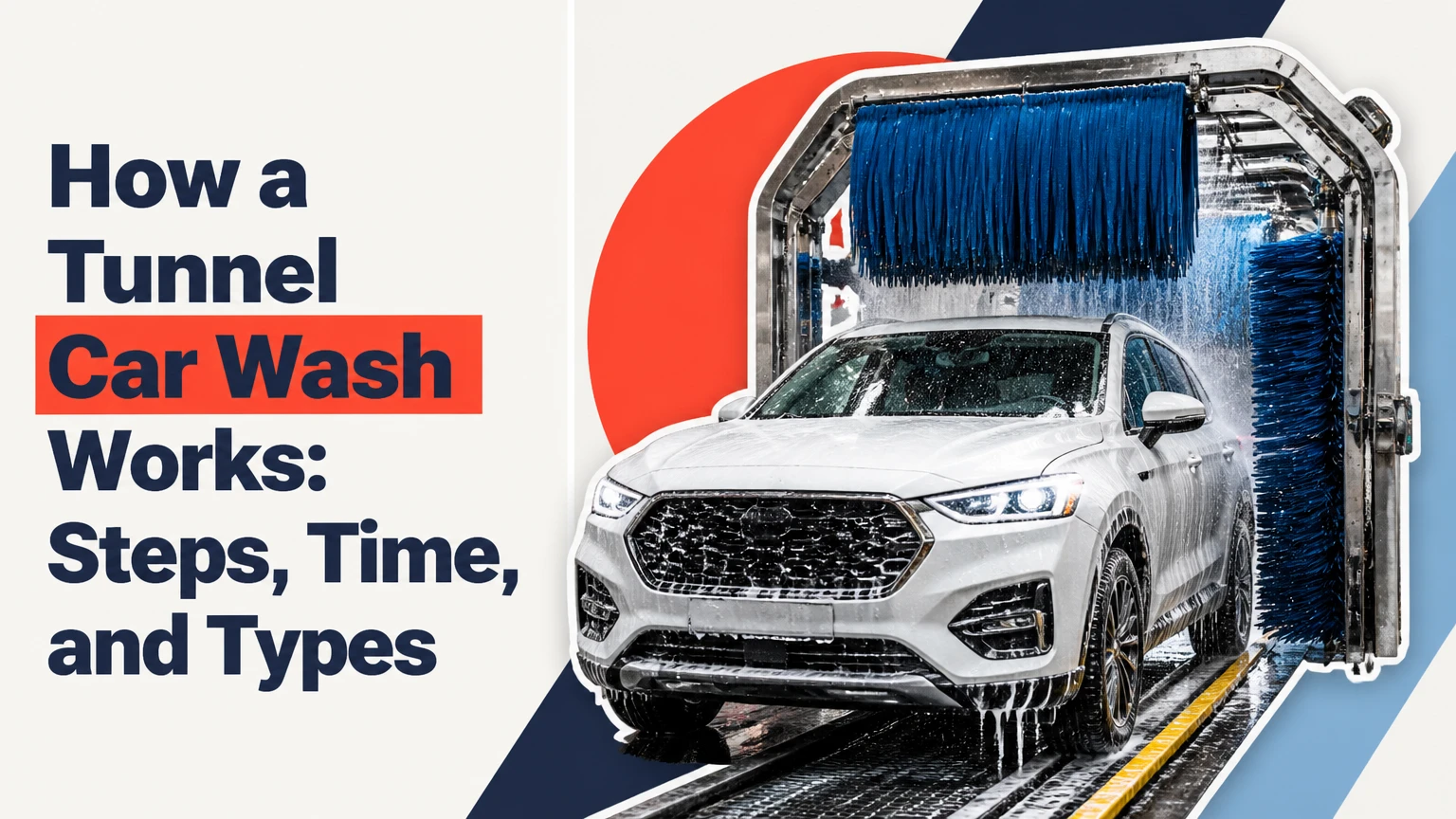
A tunnel car wash is an automated conveyor system that pulls a vehicle through stationary arches, sprayers, brushes, polishers, rinses, and dryers. The car usually moves continuously for 2-5 minutes while sensors and timed chemical applications remove loose dirt, road film, wheel grime, and rinse water from the vehicle.
Key Facts
A typical tunnel processes one vehicle in 2-5 minutes, excluding queue and payment time.
Typical conveyor speeds range from 1.5-3.5 miles per hour, or 2.4-5.6 km/h.
A conveyor tunnel moves the vehicle past equipment; an in-bay automatic moves equipment around a stationary vehicle.
Typical water consumption is 30-50 gallons, or 110-190 liters, per vehicle before site-specific recovery accounting.
Modern reclaim systems commonly reuse 60%-80% of wash water for early wash stages, while the final rinse usually uses treated fresh water.
Soft-cloth tunnels clean through controlled contact; touchless tunnels depend on chemical dwell time and high-pressure water.
What Is a Tunnel Car Wash?
A tunnel car wash is a conveyorized automatic wash in which a belt, chain, or wheel-driven track carries the vehicle through a fixed cleaning line. The line may include a wheel station, underbody jets, presoak arches, foam applicators, cloth mitters, side brushes, rinse arches, protectant applicators, and air dryers.
The conveyor creates steady spacing between vehicles. Optical, ultrasonic, or mechanical sensors detect vehicle position and adjust the timing of arches, brushes, and dryer nozzles. A longer tunnel can add more cleaning stages, but more equipment does not automatically mean a cleaner car because chemical concentration, dwell time, water quality, and maintenance control the result.
A tunnel differs from an in-bay automatic wash in one fundamental way: the vehicle travels through the tunnel while the equipment remains in assigned positions. In an in-bay system, the vehicle stays parked and a gantry moves around it. Tunnel equipment therefore prioritizes continuous throughput, while in-bay equipment prioritizes compact installation.
How is a tunnel different from a hand wash?
A tunnel wash trades manual inspection for repeatable speed. A hand wash can change tools and pressure for each panel, while a tunnel follows a programmed sequence that may miss bonded tree sap, deep brake dust, tar, and textured trim.
The International Carwash Association describes professional conveyor washing as a process built around controlled cleaning stages and water management rather than a single brush pass. That distinction matters: a tunnel is a maintenance wash, not a complete paint correction or detailing service.
How a Tunnel Car Wash Works, Step by Step
A tunnel car wash normally follows 10 functional stages: loading, position detection, presoak, wheel and underbody cleaning, detergent application, agitation, rinsing, protectant application, spot-free rinsing, and drying. A specific site may combine stages or place them in a different order, especially when it uses a touchless layout.
Step 1: Load and Align the Vehicle
The driver positions the vehicle on the conveyor according to signs and attendant instructions. In a traditional chain conveyor, a metal roller contacts or pushes a drive tire; in a modern belt conveyor, the tires rest on a moving belt that reduces wheel-guidance concerns.
Place the transmission in Neutral when the site instructs you to do so, release the brake, keep the steering wheel still, and leave the vehicle unattended only if the facility requires it. Some vehicles with electronic parking brakes or unusual drivetrains have special instructions, so the attendant’s procedure takes priority.
Success checkpoint: The vehicle moves smoothly without tire rotation, braking, or steering input.
Common mistake: Stopping with a tire partly outside the guide path can make the roller contact the sidewall instead of the tread.
Step 2: Trigger Sensors and Apply Presoak
Sensors identify the vehicle’s position and approximate length. A presoak arch applies alkaline detergent, acidic detergent, or a blended surfactant solution that loosens road film before brushes touch the paint.
Presoak is more important than colorful foam. The solution must reach the soil, remain wet for its designed dwell time, and avoid drying on the surface. Typical dwell time is about 20-60 seconds, but temperature, conveyor speed, chemical dilution, and weather change the required interval.
Success checkpoint: Water and chemical solution sheet across the body rather than beading immediately over dry contamination.
Common mistake: Entering with a heavily crusted front bumper and expecting foam alone to remove baked insects.
Step 3: Clean Wheels and the Underbody
Wheel arches, tire applicators, rotating brushes, and high-pressure nozzles target brake dust, mud, salt, and road grit. Underbody sprays direct water at the chassis, suspension components, wheel wells, and lower rocker panels.
Wheel cleaner chemistry varies. Acidic products can remove mineral deposits and brake dust effectively, while alkaline products are generally better at oily road film. Neither should remain on hot wheels or dry on clear-coated, polished, anodized, or aftermarket surfaces.
Success checkpoint: Mud disappears from wheel wells and the lower body before the main friction equipment arrives.
Common mistake: Choosing an aggressive wheel-cleaning add-on for unsealed polished aluminum without checking the manufacturer’s finish guidance.
Underbody washing is especially useful after winter driving. It removes chloride residue from accessible surfaces, but it cannot guarantee that salt has left enclosed frame cavities, seams, or electrical connectors.
Step 4: Apply Detergent and Foam
The vehicle passes through foam arches or spray manifolds that distribute detergent across horizontal and vertical panels. Some sites advertise triple foam, colored foam, or conditioner; these names describe a product package, not a standardized performance grade.
The cleaning sequence relies on chemistry plus mechanical action. Alkaline detergent attacks oily organic road film, acidic detergent helps dissolve mineral soil, and surfactants reduce water surface tension so the solution can spread beneath contamination.
Success checkpoint: The detergent layer stays wet until the next cleaning stage.
Common mistake: Assuming thicker foam means stronger cleaning. Foam volume can increase visual coverage without increasing active chemical concentration.
Step 5: Agitate the Surface or Use High-Pressure Water
Friction tunnels use soft cloth strips called mitters, horizontal top brushes, side washers, and rotating wraps. These materials contact the vehicle while motors and programmed movements control speed and pressure. The goal is to move loosened soil away from the paint, not grind dry grit across it.
Touchless tunnels replace physical agitation with high-pressure oscillating jets. Nozzle pressure is commonly in the several-hundred-to roughly 1,000-psi range, but pressure at the vehicle is lower than the pump’s advertised rating in some installations because of distance, nozzle design, flow rate, and plumbing losses.
| Wash mechanism | Vehicle contact | Typical operating characteristic | Main limitation |
|---|---|---|---|
| Soft-cloth friction | Cloth and foam contact, 2-6 major passes | Strong soil removal after presoak | Contact can mark contaminated or vulnerable surfaces |
| Touchless high-pressure | 0 mechanical contact | Several hundred to about 1,000 psi at nozzle | Chemical and jet action may leave bonded film |
| Hybrid tunnel | Contact on selected zones | Front and top jets plus side or rear cloth | Mixed maintenance requirements |
| Hand wash | Variable human contact | 30-60+ minutes per vehicle | Higher labor cost and technique variation |
Soft cloth does not mean zero risk. A poorly maintained mitter can carry abrasive particles, and a loose emblem, mirror, wiper, antenna, or molding can be pulled by any rotating contact equipment.
Touchless washing avoids brush contact, but it is not automatically gentler. Strong alkaline and acidic solutions can affect unprotected trim, wax, older clear coat, or improperly installed graphics when dilution, temperature, or rinse control is poor.
Step 6: Rinse Away Loosened Soil
Rinse arches use high-volume water to remove detergent and suspended dirt before the vehicle reaches protectants or drying equipment. Some tunnels use reclaim water during early rinses, then switch to filtered or softened water for later stages.
Water recovery tanks typically separate heavier solids and oils before recovered water returns to selected wash stages. Reclaim water is not necessarily suitable for the final finish because dissolved minerals, detergent residue, and suspended particles can produce spotting.
Success checkpoint: No visible foam remains in panel gaps, mirror housings, license-plate recesses, or door handles.
Common mistake: Confusing a short rinse with a failed wash when the real problem is insufficient presoak or brush maintenance upstream.
Step 7: Apply Wax, Sealant, or Protectant
A protectant arch may apply liquid wax, polymer sealant, drying agent, or a product marketed as ceramic. These applications improve water behavior and can add temporary gloss, but an automatic wash upgrade is not equivalent to a professionally installed ceramic coating.
A tunnel-applied ceramic product usually deposits a short-lived hydrophobic layer. Durability depends on formulation, preparation, sunlight, detergent exposure, and wash frequency. Silicon dioxide in the product name does not establish coating thickness, curing behavior, or multiyear protection.
Success checkpoint: Water forms smaller beads or sheets away more quickly during the final rinse.
Common mistake: Paying for a ceramic upgrade while expecting it to repair scratches, prevent stone chips, or replace paint decontamination.
Step 8: Perform the Spot-Free Rinse
The final rinse commonly uses reverse-osmosis water, deionized water, or another low-mineral water source. Reverse osmosis reduces dissolved solids, while deionization removes charged ions through resin; many facilities use both processes or combine treated water with a drying agent.
Water-treatment performance is measured by dissolved-solids concentration, filter condition, membrane condition, and system maintenance. A low-mineral rinse reduces white mineral spots, but it cannot remove residue already left by dirty equipment or a poorly controlled chemical application.
Success checkpoint: Drying leaves minimal circular mineral marks on dark paint and glass.
Common mistake: Blaming the RO system for every spot when road film, wax residue, or dirty drying cloth caused the mark.
Step 9: Dry the Vehicle With Air
High-velocity blowers direct air over the roof, glass, hood, sides, mirrors, and rear surfaces. Dryer power varies widely, and a horsepower rating alone does not predict performance because nozzle shape, air volume, distance, and tunnel speed also matter.
Air drying removes most free water but rarely reaches every seam. Water may remain in mirrors, badges, hatch gaps, fuel doors, roof rails, and license-plate recesses, then run onto clean paint after the vehicle exits.
Success checkpoint: The roof, glass, hood, and major side panels are free of continuous water sheets.
Common mistake: Leaving immediately without opening the hatch or checking mirrors, where trapped water commonly drains later.
Step 10: Exit and Inspect
Drive forward only when the attendant or exit signal indicates that the conveyor has released the vehicle. Check mirrors, wipers, antennae, trim, wheel covers, and glass before joining traffic.
A professional wash can remove loose contamination quickly, but inspection remains the driver’s responsibility. Photographing pre-existing damage is sensible when a vehicle has loose trim, a damaged mirror, a cracked windshield, or a recently installed accessory.
What Types of Tunnel Car Washes Exist?
The main tunnel categories are soft-cloth friction, touchless high-pressure, and hybrid systems. Package names vary by operator, but the physical distinction is whether cleaning equipment contacts the vehicle.
| Tunnel type | Typical cleaning stages | Best fit | Avoid or inspect first |
|---|---|---|---|
| Soft-cloth friction | Presoak, cloth mitters, side wraps, rinse, air | Daily drivers with ordinary factory trim | Loose badges, damaged mirrors, exposed hardware |
| Touchless | Presoak, wheel jets, high-pressure arches, rinse, air | Vehicles where physical contact is a concern | Heavy bonded film, weak clear coat, sensitive unsealed trim |
| Hybrid | Touchless front or top stages, cloth side or rear stages | Owners seeking mixed cleaning action | Cars requiring completely contact-free washing |
| Conveyor brush plus manual prep | Attendant prep, friction equipment, drying | Muddy vehicles needing wheel or bug attention | Rare accessories or fragile aftermarket parts |
Which tunnel is safest for paint?
A clean, well-maintained wash with effective presoak is generally safer than a poorly maintained wash, regardless of the label. Touchless removes brush-induced contact risk, while soft-cloth equipment can remove more road film when the wash chemistry and equipment maintenance are controlled.
For a wrapped, freshly repainted, or ceramic-coated vehicle, follow the installer’s instructions first. A touchless wash is often the lower-contact automated option, but harsh chemistry, high heat, or water pressure can still damage poorly bonded vinyl, lifting edges, and fragile graphics.
How Long Does a Tunnel Wash Take?
The active tunnel cycle typically takes 2-5 minutes, while the complete visit usually takes 5-20 minutes because queue length, payment, loading, and exit traffic add time. A high-volume site may process 50-120 vehicles per hour when equipment, staffing, spacing, and traffic flow support that rate.
| Operating metric | Typical range | Main variable |
|---|---|---|
| Active wash cycle | 2-5 minutes | Tunnel length and conveyor speed |
| Total customer visit | 5-20 minutes | Queue and payment method |
| Conveyor speed | 1.5-3.5 mph | Vehicle spacing and equipment design |
| Throughput | 50-120+ vehicles/hour | Staffing, tunnel length, and spacing |
| Water used per vehicle | 30-50 gallons | Reclaim design and wash package |
| Reclaimed-water share | 60%-80% for selected stages | Local equipment and water-quality controls |
These figures are typical operating ranges, not universal standards. A short express tunnel, a long full-service tunnel, and a site with manual prep can produce very different times and water totals.
How Much Does a Tunnel Car Wash Cost?
A single tunnel wash commonly costs about $10-$30 in the United States, while premium packages can reach $25-$40 or more in higher-cost markets. Monthly memberships often range from $20-$50 per vehicle, but local labor, rent, taxes, package design, and unlimited-use rules determine the actual price.
| Purchase type | Typical price range | Typical use case |
|---|---|---|
| Basic exterior wash | $10-$15 | Loose dirt and routine commuting |
| Wash with wheels and underbody | $15-$25 | Winter roads and visibly dirty lower panels |
| Premium wax or protectant | $20-$35 | Gloss and water-shedding add-on |
| Tunnel-applied ceramic package | $25-$40+ | Short-term hydrophobic effect |
| Monthly unlimited membership | $20-$50/month | Two or more washes monthly |
Prices quoted in Bangladeshi taka, Canadian dollars, Australian dollars, or other currencies cannot be transferred reliably between markets. Compare the included stages rather than the package name, particularly whether underbody spray, wheel cleaning, spot-free rinse, and manual pre-treatment are included.
Does a Tunnel Car Wash Scratch Cars?
A tunnel car wash can create fine marks, but the risk depends more on surface condition, equipment maintenance, wash frequency, and vehicle configuration than on the word “automatic” alone. Soft-cloth equipment can transfer abrasive soil, while touchless equipment can leave grit that later requires manual removal.
The most common risk sequence is dry or insufficiently pre-soaked contamination followed by friction. A vehicle with soft clear coat, neglected paint, black gloss trim, aftermarket graphics, or loose parts deserves more caution.
The counterintuitive rule is simple: touchless is lower contact, not necessarily lower chemical exposure. Soft cloth is higher contact, not necessarily damaging when the tunnel maintains clean media, correct detergent dilution, adequate rinse volume, and effective equipment inspections.
How Should You Prepare a Vehicle Before Entering?
Remove or secure items that the facility prohibits, close every window and sunroof, disable automatic rain-sensing wipers, retract antennas when the manufacturer permits it, and fold mirrors only when the site instructs you to do so. Confirm that roof racks, bike carriers, spoilers, running boards, and loose trim are tunnel-approved.
Follow the facility’s transmission instructions exactly. Many conveyor systems require Neutral, no braking, no steering, and no accelerator input, but some belt systems use different procedures. Vehicles with automatic hold, electronic parking brakes, adaptive braking, or unusual four-wheel-drive systems may require a manufacturer-approved wash mode.
Before entry, check these items:
- Turn off rain-sensing wipers and automatic windshield functions.
- Close windows, sunroofs, charging-port covers, and convertible tops.
- Remove hitch accessories, flags, magnetic signs, and unsecured cargo.
- Tell the attendant about a roof rack, spoiler, wide tires, or loose trim.
- Keep hands off the steering wheel and feet away from the pedals.
- Leave the vehicle in the instructed gear until the exit signal.
Electric vehicles can generally use a compatible tunnel wash. The battery pack is enclosed, but charging ports, cameras, sensors, door handles, and automatic driving functions still require normal preparation.
Tunnel Wash Versus Other Washing Methods
The right method depends on the soil, finish, accessories, and required level of control. A tunnel is usually the fastest routine-maintenance option, but a two-bucket hand wash or professional detail provides more control over delicate surfaces and bonded contamination.
| Method | Active time | Contact level | Typical price | Cleaning strength |
|---|---|---|---|---|
| Tunnel soft-cloth | 2-5 minutes | Medium to high | $10-$35 | Strong on loosened road film |
| Tunnel touchless | 2-5 minutes | None mechanically | $10-$40+ | Moderate on bonded film |
| In-bay automatic | 5-10 minutes | Varies by bay | $8-$25 | Depends on gantry and chemistry |
| Self-service bay | 10-20 minutes | Driver-controlled | $5-$15 | Variable with operator technique |
| Professional hand wash | 30-60+ minutes | Controlled | $30-$100+ | Highest panel-by-panel precision |
A tunnel wash is a poor substitute for paint decontamination, clay treatment, machine polishing, interior cleaning, or scratch repair. It is also not a reliable way to remove tar, tree sap, oxidation, or hardened insect residue without pre-treatment.
When is a hand wash the better choice?
Choose a hand wash for freshly painted vehicles, delicate vinyl wraps, exposed carbon-fiber finishes, lifting graphics, loose trim, extensive tar or sap, and vehicles requiring interior or paint correction. Hand washing still carries risk when towels, buckets, drying methods, or water sources are contaminated.
When is a tunnel wash the better choice?
Choose a tunnel for regular removal of loose dust, rain residue, light road film, and winter salt from a standard factory vehicle. Frequent light washes reduce the time contamination remains on paint, but repeated friction washing can gradually add marks if the site’s cleaning media and rinse systems are neglected.
Common Problems and Safe Responses
Tunnel problems usually arise from vehicle preparation, sensor timing, chemical control, equipment maintenance, or water treatment. Drivers should not attempt to reverse, exit a moving conveyor, or reach toward machinery.
| Problem | Likely cause | Immediate response | Prevention |
|---|---|---|---|
| Vehicle stops on conveyor | Sensor fault, spacing error, or drivetrain setting | Keep hands and feet still, follow attendant instructions | Use the posted gear and brake procedure |
| Vehicle begins braking | Automatic hold or driver input | Tell staff immediately, do not fight the conveyor | Disable automatic hold when permitted |
| Water spots remain | High dissolved solids or incomplete drying | Rinse or dry promptly with clean microfiber | Select a maintained spot-free rinse |
| White residue on trim | Chemical concentration or incomplete rinse | Flush trim with clean water | Avoid drying chemicals on hot surfaces |
| Mirror or trim is damaged | Loose or non-approved accessory | Stop safely and report before leaving | Inspect accessories before entry |
| Wipers activate | Rain sensor left on | Stop only if safely directed | Disable automatic wipers |
If a vehicle appears stuck, remain calm and wait for staff direction. Do not shift into Reverse against a moving conveyor unless an attendant specifically directs a safe procedure, because reversing can collide with equipment or the vehicle behind you.
Expert Rules for Better Results
Presoak determines more than foam color. A modest-looking chemical application with correct dwell time can outperform thick decorative foam applied immediately before the brushes. Operators should control concentration with measured dosing equipment, not visual foam volume.
The exit inspection catches delayed water damage. Water trapped in mirrors and hatch seams can drain several minutes later, carrying loosened residue onto clean panels. A microfiber towel at the exit is useful for edges, but never wipe a visibly gritty panel dry.
Reclaim water belongs in the right stage. Recycled water can efficiently handle underbody and first-rinse work, but the final finish benefits from low-mineral water. Treating every stage with the same water source increases either spotting risk or operating cost.
A membership changes behavior, not cleaning physics. Unlimited plans can make frequent maintenance washing affordable, but they do not make a friction tunnel suitable for loose graphics, damaged trim, or neglected abrasive contamination.
Underbody washing has a seasonal purpose. Winter salt removal is the strongest reason to select underbody spray. The spray reaches exposed lower components, but it cannot replace inspection of rust, drain holes, brake lines, or enclosed cavities.
FAQ
Can I use a tunnel car wash with a roof rack?
A roof rack is tunnel-compatible only when the wash operator and rack manufacturer permit it. Fixed crossbars may pass through some tunnels, but cargo boxes, bicycles, kayaks, loose straps, and tall antennas can contact arches or dryers. Ask the attendant before entry and remove detachable accessories when required.
Should I wash my car before or after rain?
Wash before rain when the vehicle has road film, bird droppings, or salt that needs removal. Rain does not clean bonded contamination, and dirty rainwater can leave minerals behind. Washing after rain is useful when runoff has carried fresh grime onto lower panels or when spotting is visible.
Can a tunnel wash remove bird droppings and bugs?
A tunnel wash can remove fresh or softened droppings and insects, but dried organic residue may need manual pre-treatment. Tell the attendant about heavy buildup so the front bumper and mirrors receive extra presoak or hand brushing. Do not scrape dried contamination with a dry towel.
Is tunnel-wash water recycled?
Many professional tunnels recycle a portion of their water, commonly 60%-80% for early wash stages. Reclaim systems filter solids and separate contaminants before reuse. Final spot-free rinses often use reverse-osmosis or deionized water because reclaimed water may contain dissolved minerals and detergent residue.
How often should I use a tunnel wash?
A typical commuter may use a tunnel wash every 1-2 weeks during dirty conditions and less often in dry, clean weather. Salt, coastal spray, construction dust, and bird droppings justify faster removal. Reduce friction washing when paint correction, wrap care, or the installer’s coating instructions require gentler maintenance.
Does a tunnel wash clean the interior?
A standard tunnel wash cleans the exterior only. Some full-service locations vacuum carpets, wipe surfaces, clean glass, or hand-dry exterior seams after the conveyor cycle. Confirm the package before paying, because interior service usually adds labor, time, and a separate price.
The Bottom Line
A tunnel car wash works by moving a vehicle through a timed sequence of chemical application, wheel and underbody cleaning, friction or high-pressure agitation, rinsing, protectant application, treated-water rinsing, and air drying. The complete cycle usually takes 2-5 minutes and is best for fast exterior maintenance.
Select a well-maintained soft-cloth tunnel for strong routine cleaning on a standard vehicle, a touchless tunnel when avoiding mechanical contact matters more than removing bonded film, and a hand wash for fragile finishes or detailed correction. Prepare the vehicle correctly, follow the conveyor instructions, and treat package names such as ceramic or triple foam as product descriptions rather than guarantees. The way a tunnel car wash works explains both its efficiency and its limits.


