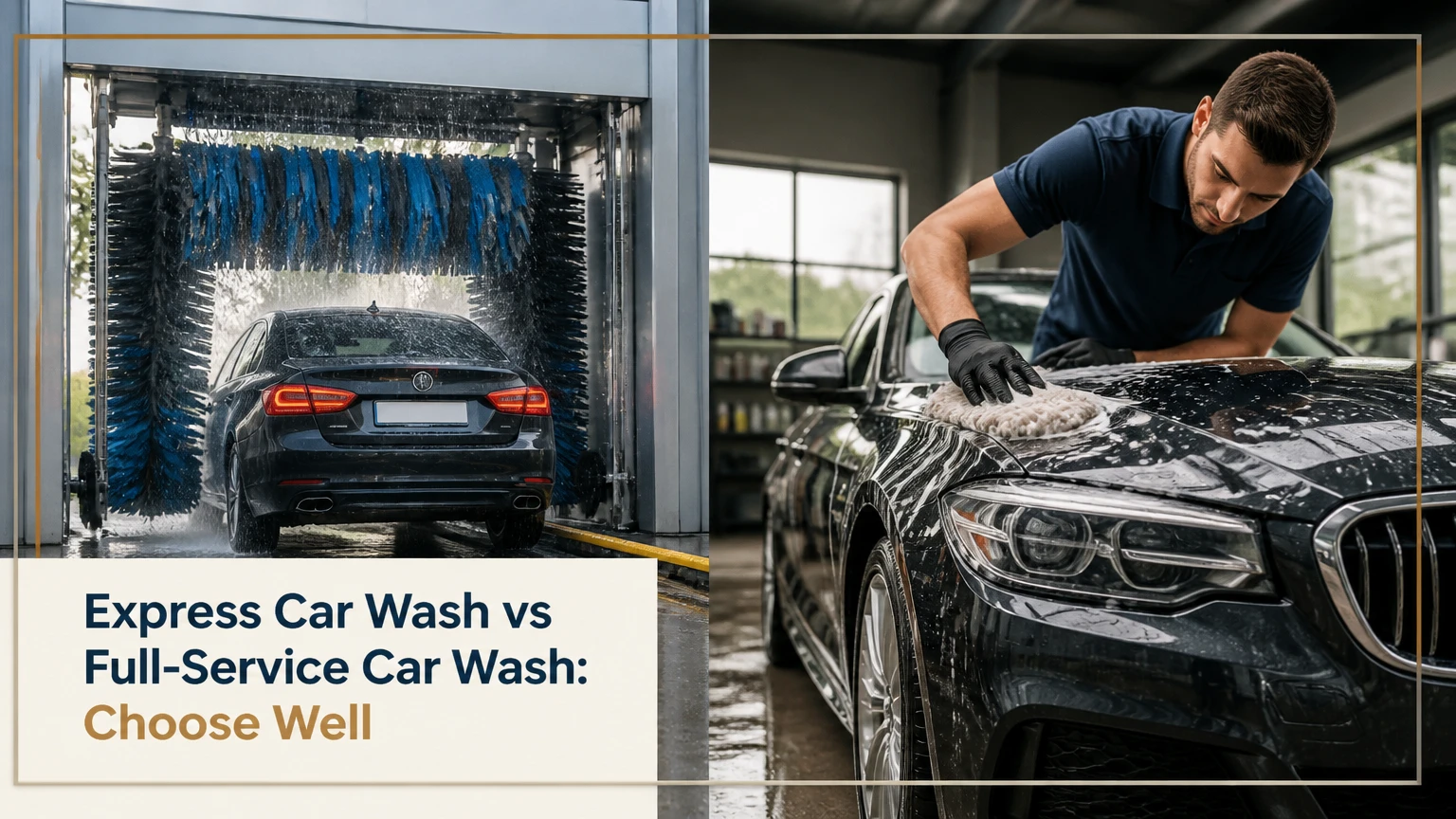
An express car wash is usually the better choice for fast, affordable exterior maintenance, while a full-service car wash is better when the cabin needs professional cleaning and the driver wants minimal effort. Choose based on the vehicle’s condition, available time, paint sensitivity, interior mess, and how often you will pay for service.
Key Facts at a Glance
- A typical express wash takes 5-15 minutes, including payment, the wash cycle, drying, and optional self-service vacuuming.
- A typical full-service wash costs $25-$45 and takes 20-45 minutes, depending mainly on the queue and interior package.
- Express washes clean the exterior; complimentary vacuums do not make the service full-service.
- Full-service attendants usually vacuum, wipe interior surfaces, clean glass, dry jambs, and dress tires, but deep extraction may cost extra.
- Touchless washing reduces physical contact with paint, but stronger detergents may be needed to remove bonded road film.
- A monthly express membership often breaks even after three or four visits, while full-service memberships require more frequent use to justify their higher price.
What Is the Difference Between Express and Full-Service Washing?
The defining difference is labor scope: express washing automates the exterior and leaves interior cleaning to the customer, whereas full-service washing adds employee-performed cabin cleaning and hand finishing. Both businesses may use an automated tunnel for the exterior, so “full-service” describes the service package rather than guaranteeing a hand wash.
Express facilities commonly use a conveyor tunnel or an in-bay automatic machine. The customer remains in the vehicle, selects a package at a kiosk, follows the attendant’s directions, and may use vacuums after exiting.
Full-service facilities normally require the driver to leave the vehicle and hand over the keys. Attendants clean the cabin, process the exterior, return the vehicle to a finishing area, and perform a visual check before delivery. The exact package matters because “full service” can mean a quick vacuum and wipe-down or a more extensive mini-detail.
A professional detail is a separate category. Detailing can include paint decontamination, machine polishing, carpet extraction, leather conditioning, odor treatment, and trim restoration. A standard full-service wash usually does not include those labor-intensive corrections.
How Does an Express Car Wash Work?
An express wash normally moves through seven stages: payment, vehicle alignment, pre-rinse, detergent application, cleaning contact or high-pressure washing, rinse and protection, and drying. The tunnel portion often lasts 2-5 minutes, but entrance queues, payment, and vacuum use determine the total visit.
- Select and pay. Choose an exterior package that states whether it includes underbody spray, wheel cleaning, wax, sealant, or tire dressing.
- Prepare the vehicle. Close windows, retract antennas, fold compatible mirrors, disable automatic wipers, and remove loose exterior accessories.
- Align with guidance. In a conveyor tunnel, place the drive tire against the track as directed. In an in-bay system, center the vehicle and stop at the marked position.
- Follow machine instructions. Conveyor systems generally require Neutral, no braking, and no steering. In-bay machines usually require Park, so the posted instructions control.
- Allow the pre-rinse to work. High-pressure water loosens mud, salt, insects, and loose grit before detergent or cloth contact.
- Receive the wash cycle. A friction tunnel uses foam curtains or closed-cell brushes. A touchless bay uses chemical dwell time and high-pressure jets instead.
- Use the finishing area. Dry remaining water from mirrors and panel gaps, then vacuum the interior if the facility provides equipment.
The key distinction is the cleaning mechanism. Friction equipment physically removes contamination more effectively in some conditions, while touchless equipment avoids contact but may leave traffic film, insect residue, or oily deposits behind.
Friction and Touchless Systems Compared
| Attribute | Friction tunnel | Touchless in-bay | Practical consequence |
|---|---|---|---|
| Physical paint contact | Foam curtains or brushes | 0 contact points | Touchless removes brush-contact risk |
| Typical wash duration | 2-5 minutes | 5-10 minutes | Touchless often needs longer dwell cycles |
| Road-film removal | Moderate to high | Moderate | Chemical strength and pressure matter |
| Swirl-mark exposure | Possible | Very low from equipment | Dirt trapped in contact media increases risk |
| Undercarriage access | Common in tunnels | Usually limited | Conveyor layouts often offer stronger underbody coverage |
| Vehicle throughput | 30-100 vehicles per hour | 6-12 vehicles per hour | Tunnels usually create shorter service queues |
Neither system is automatically superior. A poorly maintained friction tunnel can transfer abrasive grit, while an overly aggressive touchless chemical program can dull unprotected trim or weaken wax prematurely.
What Does a Full-Service Car Wash Include?
A full-service wash usually combines automated exterior washing with employee-performed vacuuming, interior wiping, glass cleaning, mat handling, towel drying, and tire dressing. The base package generally removes loose dirt and cabin debris, while extraction, leather treatment, stain removal, and odor correction are paid upgrades.
The workflow begins with check-in and a condition review. A responsible facility identifies existing dents, damaged trim, loose accessories, or personal items before taking the keys.
Attendants then remove trash, vacuum seats and carpets, clean floor mats, and wipe reachable hard surfaces. The exterior may pass through the same conveyor used by express customers, after which another team dries door jambs, trunk channels, mirrors, and visible edges.
Full-service quality varies more than express consistency because the interior result depends on staffing, training, workload, and inspection discipline. A busy Saturday service may deliver a faster, lighter wipe-down than a quiet weekday visit.
Full-Service Scope by Package
| Service element | Standard package | Premium package | Professional detail |
|---|---|---|---|
| Exterior wash | Included | Included | Included |
| Interior vacuum | 5-10 minutes | 10-20 minutes | 20-45 minutes |
| Glass cleaning | Interior and exterior | Interior, exterior, mirrors | Glass polishing possible |
| Floor-mat cleaning | Shake or vacuum | Machine scrub | Extraction or steam |
| Carpet stains | Spot treatment | Targeted shampoo | Hot-water extraction |
| Leather care | Usually excluded | Conditioner application | Clean, condition, protect |
| Paint correction | Excluded | Excluded | Machine polishing available |
| Typical price | $25-$45 | $50-$100+ | $150-$500+ |
Ask whether the service includes the trunk, third-row seating, pet hair removal, child-seat areas, and door jambs. Those boundaries explain many disagreements about whether a full-service wash was completed properly.
Which Option Costs Less Over Time?
Express washing costs less per visit, but the cheaper long-term option depends on frequency and whether the customer values paid interior labor. Typical single-visit prices range from $7-$30 for express packages and $25-$100 or more for full-service packages, with local labor rates and included services creating substantial variation.
| Purchase pattern | Express wash | Full-service wash | Break-even observation |
|---|---|---|---|
| Basic single visit | $7-$15 | $25-$45 | Express saves $18-$38 |
| Premium single visit | $20-$30 | $50-$100+ | Full service adds labor and interior scope |
| Monthly membership | $20-$45 | $50-$90+ | Express often breaks even at 3-4 visits |
| Four monthly visits | $20-$45 membership | $100-$180 per visit equivalent | Membership value favors express |
| One quarterly visit | $21-$90 annually | $75-$300 annually | Pay per visit usually beats membership |
| Interior detail upgrade | Usually unavailable | $10-$40 | Extraction and odor work cost extra |
A $35 express membership used four times monthly produces an effective cost of $8.75 per wash. A $70 full-service membership used twice monthly produces an effective cost of $35 per visit, which may be reasonable if each visit replaces 30-45 minutes of personal cleaning.
Membership arithmetic should include restrictions. Some plans limit the location, require a vehicle-specific license-plate record, exclude premium services, or impose cancellation terms. A membership is poor value if weather, travel, or work-from-home habits reduce usage below two visits monthly.
Which Wash Is Faster?
Express washing is faster in the vehicle, but full-service washing can be competitive during a quiet period and much slower during staffed-service peaks. Express customers typically spend 5-15 minutes on the complete visit, while full-service customers usually spend 20-45 minutes and may wait longer on weekends.
| Visit stage | Express typical time | Full-service typical time |
|---|---|---|
| Queue before entry | 0-10 minutes | 5-20 minutes |
| Payment and check-in | 1-3 minutes | 3-7 minutes |
| Machine exterior wash | 2-10 minutes | 2-10 minutes |
| Interior labor | 0 minutes | 10-25 minutes |
| Final inspection | 1-3 minutes | 2-5 minutes |
| Total visit | 5-15 minutes | 20-45+ minutes |
The important comparison is total elapsed time, not tunnel time. Both models may use the same exterior equipment, but full-service adds key transfer, staging, cleaning, and quality-control steps.
Express is the practical choice for a lunch break, commute, or post-road-trip rinse. Full service fits appointments where the vehicle can remain at the facility while attendants handle the cabin.
Which Service Cleans the Vehicle Better?
Full service cleans more of the vehicle because attendants work inside the cabin, but express washing can provide equal or better exterior consistency when the goal is frequent removal of loose road grime. Neither package replaces paint correction, deep stain removal, or a carefully performed hand wash.
| Cleaning target | Express result | Full-service result | Best choice |
|---|---|---|---|
| Loose exterior dust | Automated rinse and detergent | Automated rinse and detergent | Either |
| Heavy mud in wheel wells | Depends on underbody pressure | Depends on package | Facility with underbody spray |
| Crumbs and dust | Customer vacuum only | Attendant vacuum and wipe | Full service |
| Pet hair | Usually customer labor | Light removal if included | Detail upgrade |
| Dried insects | Pre-soak and machine wash | Same exterior process | Pre-treatment quality matters |
| Door jamb water | Often remains | Usually towel dried | Full service |
| Carpet stains | Not treated | Spot treatment at best | Extraction detail |
| Odor source | Not treated | Surface cleaning only | Odor-specific detail |
Frequent light washing can protect appearance better than infrequent intensive washing because salt, bird droppings, and insect residue remain on paint for less time. However, frequent friction washing with neglected media can create visible micro-marring, especially on soft black paint.
Full-service cleaning also has limits. A quick vacuum cannot remove embedded sand from carpet fibers, and a scented spray does not eliminate a moisture source, smoke residue, or animal contamination.
Is an Express Wash Safe for Paint?
An express wash is generally safe for routine exterior maintenance when the facility maintains its equipment and the vehicle has standard factory paint, but friction systems can contribute to micro-scratches and touchless systems cannot eliminate chemical or drying risks. Coated, repainted, wrapped, or modified vehicles require closer inspection of the facility’s process.
Paint damage risk comes from several mechanisms:
- Grit trapped in cloth or brush material can drag across clear coat.
- Automatic dryers can move loose debris across wet panels.
- Strong alkaline or acidic detergents can stain neglected trim.
- Water left in mirrors, badges, and seams can create spotting.
- Improperly mounted roof accessories can catch equipment.
Touchless washing eliminates direct brush contact, not every risk. High-pressure nozzles can expose loose trim, while powerful chemistry may shorten the life of inexpensive wax or degrade unprotected plastic.
A ceramic coating does not make a vehicle scratch-proof. The coating may improve chemical resistance and washing behavior, but an abrasive contact medium can still mark the coating or the clear coat beneath it.
Paint-Safety Rules for Higher-Risk Vehicles
Use a touchless bay or hand wash for fresh repaint work, matte finishes, vinyl wraps, fragile decals, low-clearance body kits, exposed carbon fiber, or aftermarket parts that the facility excludes. Confirm the vehicle’s cure period with the body shop before washing a newly painted panel.
For an ordinary daily driver, choose a clean, busy facility with well-maintained media, a strong pre-rinse, and a clear damage policy. Extremely low traffic can indicate infrequent media replacement, while extreme volume can increase queue pressure and reduce finishing attention.
Which Vehicles Need Full Service?
Families, pet owners, rideshare drivers, smokers, and vehicles returning from long trips benefit most from full service because cabin contamination accumulates where an exterior-only package cannot reach. Full service is also useful before lease return, a private sale, or a professional appointment when presentation matters.
Busy Commuter
Choose express washing with a monthly plan when exterior grime is the main problem and the cabin needs only weekly vacuuming. Use the vacuums immediately after the wash, because dry crumbs and loose dust are easier to remove before they are ground into carpet.
Family Vehicle
Choose full service every two to four weeks if children create food debris, sticky cupholders, seat-back marks, or floor-mat buildup. Request trunk and third-row cleaning specifically, since many standard packages focus on the front cabin.
Pet Vehicle
Choose full service only if the facility confirms pet-hair removal. Ordinary vacuums often leave hair embedded in upholstery, and enzyme treatment or extraction may cost extra.
Luxury or Repainted Vehicle
Choose a reputable hand wash or touchless express wash after confirming clearance and accessory limits. Avoid a friction tunnel when preserving a high-gloss finish matters more than the lowest price.
Leased or Sale-Ready Vehicle
Choose full service for presentation, then add a detail package if stains, odors, scratches, or paint contamination remain. A wash can improve appearance but cannot repair clear-coat failure, curb rash, cracked leather, or permanent staining.
What Should You Do Before Entering Either Wash?
Vehicle preparation reduces equipment damage, lost property, and failed cleaning. Before an express wash, close openings, disable automatic wipers, remove loose accessories, and follow the machine’s gear instructions; before full service, remove valuables and document existing damage.
Express Wash Checklist
- Close windows, sunroofs, and the liftgate.
- Remove roof-mounted cargo, magnetic signs, and loose hitch accessories.
- Fold mirrors only if the facility permits it.
- Turn off automatic rain-sensing wipers.
- Keep hands off the steering wheel in a conveyor.
- Use Neutral only when the conveyor instructions require Neutral.
- Remove coins, sunglasses, electronics, and child-seat debris before vacuuming.
- Photograph unusual trim, a loose spoiler, or an existing scratch.
Never assume every automatic wash uses the same transmission setting. Conveyor systems commonly require Neutral, while in-bay automatic systems commonly require Park. Posted instructions and staff directions override general advice.
Full-Service Handoff Checklist
- Remove cash, cards, medications, electronics, firearms, and documents.
- Empty cupholders and door pockets if you want those areas cleaned.
- Photograph existing dents, wheel damage, and windshield chips.
- Confirm whether attendants clean the trunk and third row.
- Ask whether pet hair, stains, leather, and odor treatment cost extra.
- Keep the receipt and note the vehicle’s mileage.
- Inspect glass, jambs, mats, and wheel faces before leaving.
A facility should not require unrestricted access to personal items. Locking valuables in a secured home location is safer than leaving them in the glovebox.
What Are the Most Common Problems?
The most common express-wash problems are incomplete soil removal, water remaining in crevices, equipment incompatibility, and swirl marks from contaminated contact media. The most common full-service problems are missed interior areas, unclear package boundaries, misplaced belongings, and rushed finishing during peak demand.
| Problem | Likely cause | Immediate response | Prevention |
|---|---|---|---|
| Vehicle leaves with road film | Short chemical dwell or weak pre-soak | Request a rewash before drying | Select a stronger package |
| Water drips after exit | Mirrors, badges, or jambs retain water | Carry a clean drying towel | Open and close mirrors after drying |
| Swirl marks appear | Dirty friction media or poor hand drying | Photograph under direct light | Use touchless or hand wash |
| Interior still has crumbs | Vacuum-only package or rushed labor | Request supervisor touch-up | Confirm cabin scope at check-in |
| Pet hair remains | Hair embedded in fabric | Buy hair-removal upgrade | Use a detailer with extraction tools |
| Trim is damaged | Loose accessory or low clearance | File a documented claim promptly | Confirm vehicle exclusions |
| Belonging is missing | Item left in an accessible cabin | Contact manager with receipt | Remove valuables before handoff |
Inspect under direct sunlight or a bright white light, not only beneath the facility’s dim finishing lights. Swirl marks and glass streaks can remain invisible in shaded bays.
What Are the Best Alternatives?
A hand wash offers the greatest control over paint contact, a self-service bay gives the owner control at a low hourly cost, and a professional detailer handles defects that ordinary wash packages cannot correct. The right alternative depends on whether the priority is control, price, convenience, or restoration.
| Alternative | Typical price | Typical time | Best use |
|---|---|---|---|
| Self-service pressure bay | $5-$15 | 20-40 minutes | Owner-controlled rinse and wash |
| Professional hand wash | $30-$80 | 30-90 minutes | Sensitive paint or valuable vehicle |
| Mobile maintenance wash | $50-$120 | 45-120 minutes | Home or workplace convenience |
| Interior detail | $75-$250 | 2-5 hours | Stains, hair, and cabin restoration |
| Full exterior detail | $150-$500 | 4-8 hours | Decontamination and paint correction |
| Express membership | $20-$45 monthly | 5-15 minutes each | Frequent exterior maintenance |
Self-service bays require careful tool selection. The facility’s shared brush may contain grit, so a pressure rinse and personal wash mitt are safer when the rules permit personal equipment. Never use a high-pressure nozzle close to damaged paint, failing decals, or exposed wiring.
A professional detailer is the correct alternative when the desired result involves correction rather than cleaning. Washing removes contamination; polishing changes the surface condition, and extraction changes the condition of fabric fibers.
How Often Should You Wash Your Vehicle?
Most daily drivers need an exterior wash every two to four weeks, with shorter intervals after road salt, coastal exposure, construction dust, bird droppings, or long highway trips. Interior cleaning typically ranges from weekly owner vacuuming to professional full service every two to eight weeks, depending on occupants and use.
| Vehicle condition | Exterior interval | Interior interval | Recommended service |
|---|---|---|---|
| Light-use garage vehicle | 4-6 weeks | 6-8 weeks | Express or hand wash |
| Daily commuter | 1-3 weeks | 2-4 weeks | Express membership |
| Coastal or salted winter roads | 1-2 weeks | 3-4 weeks | Underbody-capable wash |
| Children and food debris | 2-3 weeks | 1-2 weeks | Full service |
| Frequent pet transport | 1-2 weeks | 1-2 weeks | Full service or detail |
| Ceramic-coated vehicle | 2-4 weeks | 3-6 weeks | Touchless or coating-safe wash |
Bird droppings, insect remains, and tree sap deserve prompt removal because their chemistry can etch or stain clear coat. Waiting for the next scheduled wash is a poor strategy when contamination sits in direct sun.
Expert Rules of Thumb
- Pay for labor when the cabin is the bottleneck. If interior cleaning takes 45 minutes at home, a $30-$45 full-service premium may be economically sensible even when the exterior wash is identical.
- Choose touchless for risk reduction, not guaranteed cleanliness. Touchless minimizes contact marks, but friction or hand agitation may remove bonded contamination more completely.
- Use the cheapest adequate service repeatedly. A $10 wash every two weeks usually protects daily-driver appearance better than a $60 service twice a year.
- Separate maintenance from correction. A wash cannot reverse oxidation, deep scratches, embedded rail dust, or permanent upholstery stains.
Which Should You Choose?
Choose an express car wash when exterior cleanliness, speed, privacy, and low recurring cost matter most. Choose a full-service car wash when interior labor, cabin presentation, or hands-free convenience justifies spending an additional $15-$60 per visit.
Choose Express for Routine Exterior Maintenance
Express is the better fit for commuters, fleet drivers, and owners who already vacuum at home. A $20-$45 unlimited plan can be efficient when used at least three times monthly, particularly in regions with winter salt or frequent rain.
Select touchless when the vehicle has delicate paint, a fresh finish, vinyl graphics, or costly aftermarket trim. Select a well-maintained friction tunnel when stronger physical cleaning is more important and the vehicle has conventional factory paint.
Choose Full Service for Interior Work
Full service is the better fit for families, pet owners, rideshare vehicles, and sale preparation. Confirm the package’s actual labor because a basic full-service wash may not include carpet extraction, pet-hair removal, third-row seats, or odor treatment.
Full service also saves time only when queue conditions are acceptable. During a crowded weekend, express may return the vehicle faster even after the owner performs vacuuming.
Choose a Detailer for Restoration
Choose a detailer when the request includes machine polishing, clay-bar decontamination, hot-water extraction, leather repair, mold treatment, or persistent odor removal. A full-service wash is maintenance cleaning, not surface restoration, and paying for the wrong category produces disappointing results.
FAQ
Does an express car wash clean the inside?
An express car wash normally does not clean the interior professionally. Customers may receive access to free vacuums, mat cleaners, towels, or compressed air after the exterior cycle, but wiping, stain treatment, pet-hair removal, and glass cleaning remain the customer’s responsibility.
Can I take a ceramic-coated car through an automatic wash?
A ceramic-coated car can usually use an automatic wash, but touchless or coating-safe hand washing reduces contact and chemical concerns. Ceramic coating resists contamination and improves water behavior; it does not make paint immune to swirl marks, harsh detergents, poor drying, or abrasive equipment.
Is full service the same as detailing?
Full service is not the same as detailing. Full-service washing usually provides vacuuming, surface wiping, glass cleaning, towel drying, and tire dressing, while detailing may add extraction, leather conditioning, paint polishing, decontamination, odor treatment, and defect correction.
How much should I tip full-service car wash attendants?
A typical tip is $3-$10 for a standard full-service wash and $10-$20 when attendants perform extensive interior work, pet-hair removal, or hand finishing. Tip according to documented effort and result, then request corrections before leaving rather than treating a tip as a substitute for quality control.
Should I wash a car after driving on salted roads?
Wash a car soon after driving on salted roads, ideally within several days when conditions allow, and choose a package with underbody rinsing. Salt residue can remain in wheel wells, suspension areas, seams, and lower body panels even when the visible exterior appears clean.
Do automatic car washes damage windshield wipers?
Automatic car washes do not normally damage intact windshield wipers when the vehicle follows the posted process, but automatic rain-sensing wipers can activate unexpectedly during a wash. Turn the automatic setting off, replace cracked blades, and follow instructions about antennas, mirrors, and accessories.
The Bottom Line
The best choice in an express car wash vs full-service car wash comparison is express for frequent exterior upkeep and full service for professional interior labor. Use an express membership when three or more monthly visits fit your routine, choose touchless for higher paint-risk vehicles, and select full service or detailing when crumbs, stains, pet hair, odors, or sale preparation determine the result.


