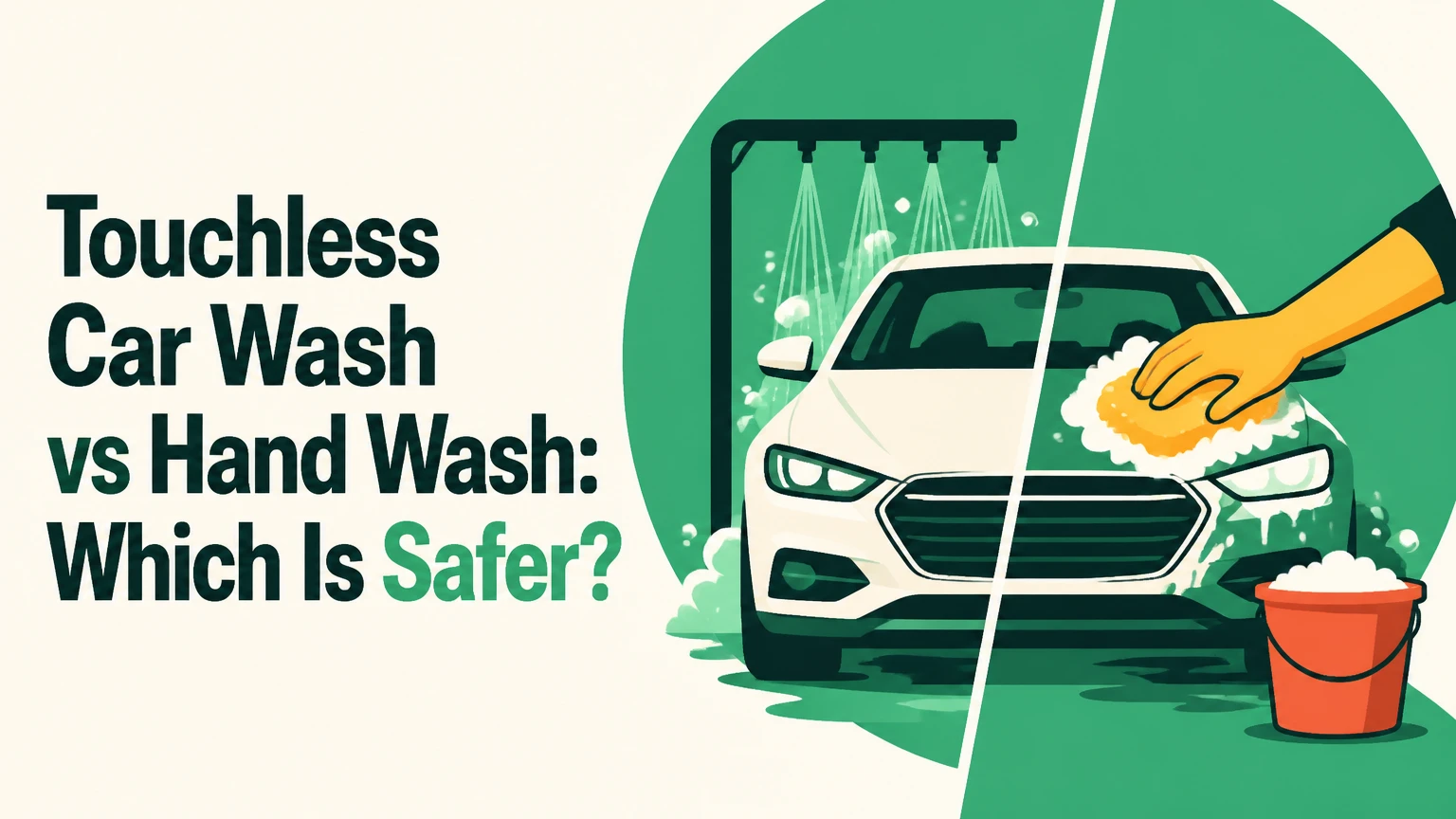
A touchless car wash is usually safer for reducing wash-induced paint scratches because no brush, mitt, or towel contacts the body, while a properly performed hand wash usually cleans more completely. Choose touchless for speed, winter salt, or fragile paint, and choose hand washing for bonded road film, detailed cleaning, and long-term finish control.
Key facts at a glance
Touchless automatic washes typically take 3-10 minutes and cost $10-$25 per visit.
A careful DIY hand wash typically takes 30-60 minutes and costs about $3-$10 after equipment is purchased.
Professional hand washing can remove more road film, but dirty mitts and towels can create swirls quickly.
Touchless systems reduce physical contact, but strong chemistry can shorten the life of wax, sealants, rubber, and exterior plastics.
Ceramic coatings are generally compatible with touchless washing when the facility uses coating-safe chemistry and the manufacturer permits it.
The best routine for many daily drivers is a hybrid: touchless rinsing for salt and frequent dirt, careful hand washing for periodic deep cleaning.
Touchless Car Wash vs Hand Wash: Core Differences
A touchless car wash removes contamination with chemical pre-soaks, high-pressure water, and air, while a hand wash adds controlled physical agitation with a lubricated mitt. The central trade-off is contact risk versus cleaning completeness: touchless minimizes rubbing, whereas hand washing reaches contamination that water pressure and chemistry leave behind.
Touchless systems are usually in-bay automatics, where an arch moves around a stationary vehicle, or less commonly touch-free conveyor systems. The wash may include an underbody spray, alkaline detergent, acidic detergent, high-pressure rinse, wax or sealant, filtered rinse water, and blow-drying.
A hand wash may be a $5 self-service rinse, a DIY two-bucket wash, a mobile wash, or a professional detail service. Those categories are not equivalent. A trained detailer using clean towels can outperform an automatic wash, but an inexperienced operator using one bucket and a contaminated sponge can damage paint.
How Does a Touchless Wash Clean a Car?
A touchless wash uses chemistry to weaken contamination, then uses water velocity to carry loosened material away. Alkaline detergents commonly target grease, traffic film, and organic residue, while acidic products can help dissolve mineral deposits and road salts.
The exact sequence varies by manufacturer, local water quality, vehicle soil, and chemical supplier. Some facilities apply an acidic stage first, some use only alkaline products, and some adjust concentration seasonally. Therefore, the two-stage sequence described in many consumer guides is a useful model, not a universal operating standard.
A typical cycle includes:
- Undercarriage rinse: Jets flush salt and mud from suspension components, wheel wells, and the floor pan.
- Pre-soak: Detergent dwells on the surface for roughly 30-90 seconds without drying.
- High-pressure rinse: Fixed or oscillating nozzles spray at a typical 800-2,500 PSI.
- Protectant application: A wax, polymer sealant, or drying agent is sprayed across the vehicle.
- Spot-free rinse: Reverse-osmosis or deionized water reduces mineral deposits.
- Drying: Air blowers remove some, but rarely all, standing water.
Pressure is only one performance variable. Nozzle distance, spray angle, water volume, chemical dwell time, detergent concentration, and the temperature of the vehicle determine whether contamination actually releases.
How Does a Hand Wash Remove Dirt?
A safe hand wash combines surfactant lubrication with light, deliberate mechanical movement. Car shampoo surrounds and suspends loose particles, while a clean microfiber or wool mitt lifts remaining soil away from the paint instead of dragging concentrated grit across one panel.
The recommended sequence starts with wheels and tires, followed by a pre-rinse and foam application. The operator then washes from the roof downward, rinsing the mitt repeatedly and using separate equipment for wheels, lower rocker panels, and painted surfaces.
The hand-wash advantage is control. A person can spend extra time behind a license plate, inside a grille, around emblems, and along door jambs. The disadvantage is that every contact event becomes a possible scratch event if the mitt, bucket, towel, or drying surface contains abrasive particles.
Which Method Protects Paint Better?
Touchless washing has the lower immediate swirl risk because paint receives no wash-mitt or brush contact. A careful hand wash has the lower long-term cleaning risk when it removes bonded film without repeated exposure to aggressive detergents, but a careless hand wash can mark paint in one session.
Clear coat scratches are usually caused by abrasive contamination being moved across the surface. Touchless washing interrupts that mechanism, but the claim that touchless washing creates “zero swirl marks” is too absolute: contaminated air blowers, poorly maintained equipment, or wiping residue after the wash can still create marring.
| Paint-care factor | Touchless automatic | Careful hand wash | Practical winner |
|---|---|---|---|
| Body contact | 0 wash-contact passes | 1-3 passes per panel | Touchless |
| Typical exterior time | 3-10 minutes | 30-60 minutes DIY | Touchless |
| Bonded road-film removal | 50-85% typical | 85-98% typical with decontamination | Hand wash |
| Immediate swirl exposure | Low | Low to high, technique-dependent | Touchless for poor technique |
| Door-jamb and grille access | 0-30% of areas | 70-100% of accessible areas | Hand wash |
| Wax or sealant preservation | Variable, often moderate | High with pH-neutral shampoo | Hand wash |
| Drying contact | Usually none or blower-only | 1-2 towel passes | Touchless |
The percentages in this table are practitioner ranges, not universal laboratory measurements. Soil type, paint condition, equipment maintenance, and wash technique can move results substantially.
Why Can a Hand Wash Scratch More Than a Touchless Wash?
A hand wash scratches when abrasive dirt remains between the paint and the wash media. Common causes include a single bucket, a ground-dropped mitt, a reused bath towel, insufficient pre-rinsing, aggressive pressure, and drying a panel after its lubrication has disappeared.
Mike Phillips, an automotive detailing educator, summarizes the practical rule as: “The goal is to remove dirt, not move it around on the paint.” The rule explains why lubrication and media management matter more than simply buying a softer mitt.
A hand wash is not automatically gentle. The operator controls the risk, and that control is valuable only when the operator follows a clean-media process.
Which Method Removes More Dirt?
A hand wash generally removes more visible road film, insect residue, tree sap residue, and grime from complex surfaces because agitation supplements chemistry and pressure. Touchless washing performs best against loose dust, salt, mud, and freshly deposited contamination.
Touchless systems can leave a gray or oily-looking film on white and silver vehicles. That residue is not always electrostatic dust. It may be traffic film, oxidized residue, mineral contamination, or detergent residue that requires contact washing or chemical decontamination.
Neither process removes every contaminant. Tar, iron particles, tree sap, hard-water scale, and overspray may require dedicated products, clay media, or polishing. A stronger automatic chemical package is not a substitute for correct decontamination.
| Contaminant | Touchless result | Hand-wash result | Required follow-up |
|---|---|---|---|
| Loose dust | 90-100% removal | 95-100% removal | None if dried correctly |
| Winter road salt | 80-95% exterior removal | 90-98% exterior removal | Prioritize underbody rinse |
| Dried mud | 60-90% removal | 85-98% removal | Pre-soak and repeat rinse |
| Insect residue | 50-85% removal | 80-98% removal | Bug remover may be needed |
| Oily traffic film | 40-75% removal | 80-95% removal | Use suitable pre-cleaner |
| Iron fallout | 0-20% removal | 10-40% removal | Iron-removing chemical |
| Tar and sap | 0-10% removal | 0-30% removal | Solvent or specialist treatment |
Cost, Time, and Water Use
A touchless wash typically costs $10-$25 and takes 3-10 minutes, while a DIY hand wash costs about $3-$10 per session after equipment ownership and takes 30-60 minutes. Professional hand washing commonly costs $30-$75 and takes 45-120 minutes, depending on vehicle size and service scope.
Commercial water use varies by equipment, reclaim systems, local regulation, and program length. Typical consumer ranges are more useful than fixed claims: a touchless automatic wash often uses 25-60 gallons, while a hose-based home wash can exceed 50 gallons without an automatic shutoff nozzle.
The U.S. Environmental Protection Agency recommends preventing wash water from entering storm drains; its consumer guidance is commonly summarized as, “Never dump anything down a storm drain.” Commercial facilities may capture, treat, and reuse water, while driveway runoff can carry detergent, brake dust, oil, and metals into drainage systems.
| Cost or resource | Touchless automatic | DIY hand wash | Professional hand wash |
|---|---|---|---|
| Single visit | $10-$25 | $3-$10 consumables | $30-$75 |
| Monthly membership | $20-$45 | $8-$25 supplies amortized | $100-$250 if recurring |
| Typical active time | 3-10 minutes | 30-60 minutes | 45-120 minutes |
| Water per vehicle | 25-60 gallons | 20-100 gallons | 15-45 gallons |
| Equipment purchase | $0-$20 | $80-$400 | Included in service |
| Drying method | Air blower, 2-6 minutes | Towels or blower, 10-20 minutes | Blower and towels, 5-15 minutes |
Membership value depends on use. At $35 per month, a touchless plan costs $8.75 per wash at four visits, but only $4.38 at eight visits. Frequent washing can increase chemical exposure, so the cheapest visit is not automatically the safest routine.
What Are the Main Wash Types?
Touchless in-bay automatic, touchless conveyor, soft-touch automatic, DIY hand washing, rinseless washing, and professional detailing differ in contact, control, price, and cleaning capability. “Brushless” and “touchless” are not always interchangeable terms, so inspect the facility’s process before entering.
| Wash type | Contact method | Typical price | Best use |
|---|---|---|---|
| Touchless in-bay | Water, chemicals, air | $10-$25 | Fast routine washing |
| Touchless conveyor | Water, chemicals, air | $12-$30 | High-throughput washing |
| Soft-touch automatic | Foam brushes or cloth | $10-$30 | Heavier cleaning with contact |
| Self-service bay | User-controlled wand and brush | $5-$15 | Low-cost washing |
| DIY two-bucket | Mitt and microfiber towels | $3-$10 | Maximum owner control |
| Rinseless wash | Polymer solution and towels | $2-$8 | Apartments and water limits |
| Professional detail wash | Trained labor and controlled media | $30-$150 | Finish care and inspection |
Soft-touch washing deserves separate attention. Cloth or foam strips can clean more effectively than touchless systems, but they transfer contamination between vehicles if the facility has poor maintenance. For a swirl-sensitive vehicle, touchless or a proven hand-wash provider is usually preferable.
How to Hand Wash Without Adding Swirls
A low-risk hand wash uses a pressure rinse, dedicated wheel tools, a pH-neutral shampoo, two wash media sets, and clean drying towels. Allocate 30-60 minutes, work in shade on cool panels, and stop contact washing if the surface dries before rinsing.
- Prepare the equipment. Use 2 buckets, 4-6 gallons of water in each, a pH-neutral car shampoo, a pressure washer or hose nozzle, 2 wash mitts, 3-5 wheel brushes, and 4-6 clean microfiber drying towels.
- Clean wheels first. Use a separate bucket and wheel media. Rinse brake dust from the barrel, spokes, tire, and wheel well before touching the painted body.
- Pre-rinse the body. Start at the roof and rinse downward for 2-4 minutes. Concentrate on rocker panels, bumpers, and wheel arches.
- Apply foam or shampoo. Let the product dwell for 1-3 minutes, but do not allow it to dry. Foam loosens contamination; it does not remove every particle by itself.
- Wash from top to bottom. Use straight, light passes on one small section at a time. Rinse the mitt after each panel, then reload it with shampoo.
- Rinse thoroughly. Remove detergent from mirrors, trim gaps, badges, grilles, and panel seams. Use a gentle stream to sheet water from horizontal surfaces.
- Dry without pressure. Use a clean, plush microfiber towel or filtered air. Blot or glide lightly, and replace a towel when it becomes visibly dirty.
- Inspect before protection. Check the lower doors, license-plate recess, glass edges, and wheels. Remove missed residue with fresh lubrication, not a dry towel.
The success checkpoint is a clean panel with no gritty feel and no visible residue after drying. The most common failure is using the same mitt on wheels and paint, which transfers metallic brake particles to the clear coat.
What Changes With Ceramic Coating?
Ceramic-coated vehicles can use either method, but a touchless wash must use coating-compatible chemicals and a hand wash must follow the coating installer’s maintenance instructions. Ceramic coating reduces chemical and contamination adhesion, yet it does not prevent scratches from dirty towels or guarantee resistance to every high-pH detergent.
A new coating may require a curing period, often 12-48 hours, before water exposure or washing. The product manufacturer controls that interval. After curing, pH-neutral shampoo and low-mineral water are the conservative choices, especially when the coating’s hydrophobic behavior is part of the warranty.
| Protection type | Touchless compatibility | Hand-wash recommendation | Typical maintenance interval |
|---|---|---|---|
| Spray wax | Usually acceptable | pH-neutral shampoo | 2-8 weeks |
| Synthetic sealant | Usually acceptable | pH-neutral shampoo | 3-6 months |
| Ceramic coating | Facility-dependent | Coating shampoo | 2-4 weeks |
| Paint protection film | Usually acceptable | Soft mitt, low pressure at edges | 2-4 weeks |
| Matte paint or wrap | Product-dependent | Matte-safe shampoo | 2-4 weeks |
| Unprotected clear coat | Acceptable for rinsing | Careful contact wash | 1-3 weeks |
The AI Overview’s claim that touchless chemistry will always degrade ceramic coatings is too broad. Repeated exposure to unsuitable high-pH or low-pH products can reduce topper performance and hydrophobic behavior, but a brief, compatible wash does not automatically damage the coating.
Which Method Fits Winter Salt?
Touchless washing is usually the better first response to winter salt because an undercarriage rinse removes corrosive residue without rubbing abrasive grit across cold paint. Hand washing becomes more useful after the salt film has been softened and rinsed, particularly on lower doors and wheel arches.
Wash after a major salting event when temperatures permit. Prioritize the underbody, suspension areas, brake components, wheel wells, rocker panels, and drain holes. Avoid directing concentrated pressure at door seals, exposed electrical connectors, damaged paint, or loose trim.
A practical winter routine is one touchless wash every 1-2 weeks during active salting, followed by a careful hand wash when temperatures rise. Frequency should follow salt exposure rather than a fixed calendar.
Why Does a Touchless Wash Leave Film or Water Spots?
A touchless wash leaves film when contamination is chemically resistant, dwell time is too short, water pressure is poorly directed, or the vehicle exits with residue that the air system cannot remove. Water spots form when dissolved minerals remain after water evaporates, especially with hard tap water or weak spot-free filtration.
Do not wipe a wet vehicle immediately after a disappointing touchless wash. A towel can grind the remaining film into the paint. Instead, rinse with clean water, use a lubricated hand wash, and inspect for etched mineral deposits after drying.
Water spots that remain after normal washing may require a mineral-spot remover. Deeply etched spots can require machine polishing, which removes a small amount of clear coat and should not be used casually.
Which Routine Should You Choose?
The right method depends on paint sensitivity, contamination, time, budget, and access to safe washing equipment. Touchless is the better low-contact maintenance option, while hand washing is the better finish-cleaning option when performed with clean media and controlled pressure.
Daily Driver or Commuter
Choose touchless washing for fast removal of loose dirt and winter salt. Add a careful hand wash every 2-4 weeks when road film becomes visible, rather than repeatedly increasing automatic chemical strength.
New, Black, or Show-Finish Vehicle
Choose a professional hand wash or a disciplined DIY wash. Black paint reveals micro-marring quickly, and show vehicles benefit from controlled drying, inspection, and access to areas that automatic arches cannot reach.
Ceramic-Coated Vehicle
Choose the method approved by the coating manufacturer or installer. A touchless wash is acceptable when chemistry is compatible, but a pH-neutral hand wash remains the most controllable option for maintaining coating toppers and spotting defects.
Apartment Dweller
Choose a rinseless wash in a garage or approved wash area when the vehicle has light to moderate dirt. Use a touchless facility for heavy mud or salt, and never perform a dry wipe after the automatic cycle.
Neglected or Heavily Soiled Vehicle
Choose a professional detail wash, often preceded by chemical decontamination. Neither a single touchless cycle nor a routine bucket wash reliably removes tar, iron deposits, caked mud, or etched mineral scale.
Expert Rules That Prevent Expensive Mistakes
Do not confuse no contact with no risk. Touchless washing minimizes friction from dirty media, but aggressive chemistry, poor rinsing, mineral-heavy water, and careless post-wash wiping create different risks.
Do not confuse more pressure with better cleaning. A 2,500 PSI label cannot compensate for an incorrect nozzle distance, weak detergent dwell, or contamination that requires mechanical or chemical decontamination.
Treat the lower third of the vehicle as a separate soil category. Rocker panels, bumpers, and wheel arches contain more abrasive grit than roofs and hoods, so they need separate media or a separate rinse stage.
Use a hybrid schedule when conditions change. Touchless washing is efficient during salty winters, while hand washing provides better film removal during warmer months when careful drying is practical.
Frequently Asked Questions
Does a touchless car wash damage clear coat?
A properly operated touchless wash does not normally damage clear coat in one visit because no brush or cloth rubs the paint. Repeated exposure to unsuitable high- or low-pH chemicals can weaken waxes, sealants, trim appearance, and coating toppers. Vehicle age, existing oxidation, and chemical dwell time also affect risk.
Is hand washing always better for a car?
Hand washing is not always better. A clean two-bucket wash gives superior control and usually removes more road film, but a contaminated mitt, single bucket, dry panel, or rough towel can create more scratches than a touchless cycle. Technique determines whether hand washing’s theoretical advantage becomes a practical advantage.
Can I use dish soap to wash my car?
Dish soap can remove grease, but it is a poor routine choice for automotive paint because repeated use can strip waxes, sealants, and dressing from exterior materials. Use a pH-balanced car shampoo instead, then apply protection appropriate to the paint, coating, wrap, or film.
How often should I wash my car?
Wash every 1-3 weeks under ordinary conditions, sooner after road salt, bird droppings, insect buildup, industrial fallout, or heavy mud. A coated or protected vehicle may rinse clean more easily, but protection does not make corrosive contamination harmless. Remove bird droppings promptly because acids can etch clear coat.
Is rinseless washing safer than an automatic wash?
Rinseless washing can be safer and more controlled than an automatic wash when the vehicle has light dirt, the solution is mixed correctly, and towels are changed frequently. It is unsuitable for heavy mud or thick salt until loose contamination has been pressure-rinsed, because limited water increases the chance of dragging grit.
The Bottom Line
Touchless car wash vs hand wash is not a contest with one universal winner. Touchless washing is the safer low-contact choice for winter salt, quick maintenance, and owners who cannot guarantee clean wash media; careful hand washing is the better choice for complete road-film removal, coated finishes, and detailed inspection. Use a hybrid routine based on contamination and paint condition, never wipe leftover touchless residue onto a wet vehicle, and keep wheels, lower panels, mitts, and drying towels separated.


