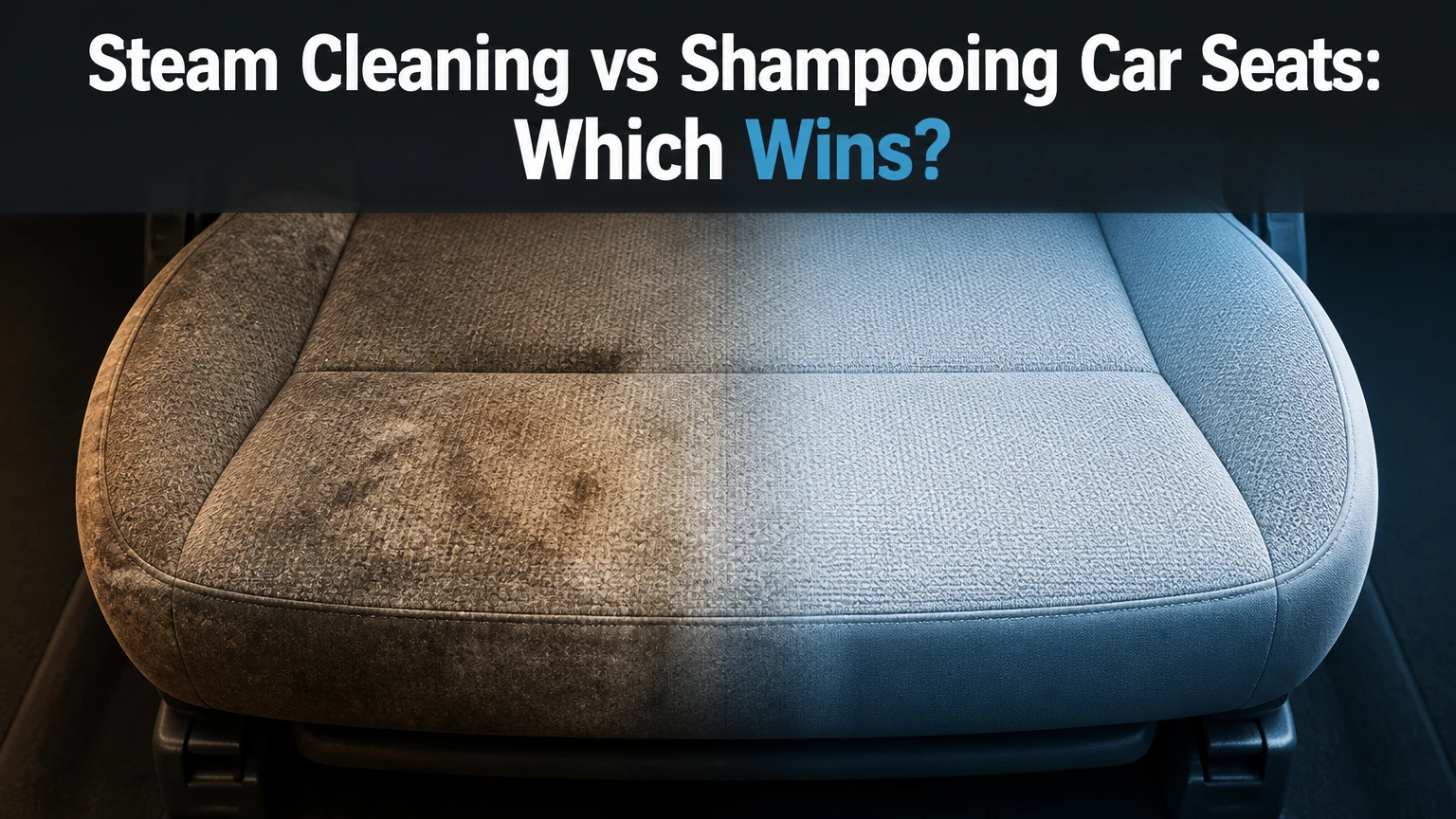
Steam cleaning is better for lightly soiled seats, grease films, odor reduction, and fast drying, while shampooing with water extraction is better for embedded mud, food, salt, and liquid stains. For most neglected cloth interiors, extraction provides the deeper soil removal; steam is the lower-moisture maintenance method when heat-sensitive materials permit it.
Key Facts
Steam cleaning typically leaves cloth seats ready in 15-60 minutes, while shampoo extraction commonly requires 4-24 hours of drying.
Shampooing removes suspended soil by flushing detergent and contaminated water from the upholstery and foam.
Steam loosens oily contamination with heat but cannot physically extract large amounts of sand, clay, or crystallized salt.
Steam is not automatically safe for leather, vinyl, Alcantara, seat adhesives, or electronic seat components.
Typical professional seat-only pricing is about $50-$150 for light cleaning and $100-$250 for deeper extraction, depending on location and vehicle size.
The safest sequence for heavily soiled cloth seats is usually vacuuming, targeted detergent, extraction, complete drying, and limited steam only where the material manufacturer allows it.
What Is the Difference Between Steam Cleaning and Shampooing?
Steam cleaning uses heated water vapor and a towel-wrapped tool to loosen contamination with minimal liquid application. Shampooing uses a fabric detergent, mechanical agitation, and an extractor or wet vacuum to suspend and remove soil with substantially more water.
The terms are often used inaccurately by detailers and equipment manufacturers. A “steam cleaner” may produce vapor, while a hot-water extractor sprays liquid solution and vacuums it back; those machines perform different jobs. Likewise, automotive “shampooing” should mean detergent cleaning followed by recovery, not simply soaking upholstery and leaving soap inside the cushion.
Steam is a transfer-and-wipe process. Heat softens oily films, and the towel captures what the vapor and agitation release. Shampoo extraction is a recovery process: surfactants separate soil from fibers, brushing moves it into solution, and vacuum lift carries the contaminated liquid away.
How Does Each Method Affect the Seat?
A car seat has more than a surface layer. Cloth upholstery may contain a backing fabric, foam cushion, adhesive, seat heater, occupancy sensor, and metal frame. Shampoo extraction can reach farther into the textile and foam because liquid transports detergent and soil downward, but excessive moisture also increases drying risk.
Steam mainly affects the exposed face, seams, stitching, and crevices. It can reduce surface microbes when the nozzle maintains adequate heat and contact, but a quick pass cannot guarantee sterilization throughout a cushion. The EPA states, “The key to mold control is moisture control,” which applies directly to seats that remain damp inside their foam.
Which Method Wins on Cleaning Performance?
Shampoo extraction wins for heavy physical contamination, while steam wins for light oily residue and rapid surface refreshes. The correct choice depends on the contaminant, because soil removal and sanitation are separate outcomes.
| Contaminant or condition | Better first method | Why it works | Main limitation |
|---|---|---|---|
| Dry sand and grit | Vacuum, then extraction | Vacuum removes loose particles; flushing recovers embedded grit | Steam alone cannot lift large particle loads |
| Clay or construction mud | Shampoo extraction | Detergent and water suspend mineral soil | Over-wetting can trap dirty water |
| Milk or sugary drink | Shampoo extraction | Rinsing removes dissolved sugars and proteins | Residual liquid can sour inside foam |
| Greasy food film | Steam with towel, then cleaner | Heat softens oil; microfiber captures surface residue | Thick grease may need detergent |
| Road salt | Light rinse extraction | Water dissolves salt crystals for recovery | Steam can redistribute dissolved salt |
| Pet urine | Enzyme treatment and extraction | Chemistry targets odor compounds; extraction removes residue | Steam can set some protein odors |
| Light body oil | Steam or low-moisture cleaner | Heat and surfactant both address surface film | Repeated heat can stress synthetic fabric |
| Mold-like odor | Source diagnosis and extraction | Removes moisture-associated contamination where reachable | Surface steam cannot remediate hidden mold |
Shampoo does not automatically clean better. A poorly operated extractor can leave detergent, dirty water, and wet foam behind, whereas a towel-assisted steamer can produce a cleaner-looking result on a lightly soiled driver’s seat in less time.
Does Steam Sanitize Car Seats?
Steam can reduce microorganisms on exposed surfaces, but no universal “99.9%” sanitation result applies to every car seat. Reduction depends on the machine’s actual temperature at the fabric, nozzle distance, dwell time, organism, surface coverage, and whether the towel absorbs heat before contact.
Commercial boilers may reach approximately 250-320°F internally, and consumer units often advertise tip temperatures around 200-220°F. Those figures describe the machine, not the temperature maintained across upholstery. A moving wrapped tool also transfers less heat than an exposed nozzle held stationary.
Steam should therefore be described as a decontamination aid, not a guaranteed disinfectant. Use an EPA-registered disinfectant only when its label permits the specific upholstery and application, and never mix disinfectants with upholstery detergents.
Master Comparison: Steam Cleaning vs Shampooing Car Seats
| Decision criterion | Steam cleaning | Shampoo extraction |
|---|---|---|
| Typical liquid exposure | Low, often 5-10% liquid water by output claim | Moderate to high, commonly 0.5-2 liters per seat during full work |
| Typical seat-only labor | 30-45 minutes | 60-120 minutes |
| Typical drying time | 15-60 minutes | 4-24 hours |
| Best contamination type | Light oil, odor sources, surface grime | Mud, salt, food, drink, embedded soil |
| Typical DIY equipment cost | $100-$900 | $120-$1,500 |
| Typical professional seat price | $50-$150 light service | $100-$250 deeper extraction |
| Primary failure risk | Heat damage or moisture condensation | Over-saturation, residue, mildew odor |
| Required recovery tool | Microfiber towels and dry vacuum | Extractor or wet vacuum plus air movement |
These are typical practitioner ranges, not laboratory specifications. Vehicle fabric, ambient humidity, cushion thickness, extractor suction, and the technician’s water volume can move the result far outside the range.
Which Method Dries Faster?
Steam cleaning usually dries faster because it applies far less liquid than shampoo extraction. A cloth seat may feel dry within 15-60 minutes after a controlled steam pass, while an extracted cushion commonly needs 4-24 hours with windows open and active air movement.
“Dry” must mean dry below the surface, not merely dry to the touch. Foam can retain water after the upholstery face feels normal. A moisture meter is useful for professional work, but a practical home check is to press a dry white towel firmly into the seat and inspect it after 30 minutes.
High humidity, cold weather, dense foam, and weak extraction extend drying time. A fan pointed across the seat improves evaporation more safely than applying more heat. Do not close the vehicle overnight when the cushion still feels cool, clammy, or smells of detergent.
When Should You Choose Steam Cleaning?
Choose steam for light-to-moderate surface soil, oily fingerprints, seat seams, cup-holder grime, and interiors that must return to service quickly. Steam is also useful as a targeted follow-up after a cloth seat has been properly extracted and dried.
A steamer is a poor substitute for physical recovery. It does not remove a cupful of beach sand, dissolve a salt load without wiping, or pull contaminated liquid out of foam. Steam also redistributes loosened soil if the operator does not use a clean towel and change it frequently.
Professional steamers commonly advertise 40-90 PSI, but pressure alone does not determine cleaning quality. Tip design, vapor volume, towel absorption, operator speed, and fabric tolerance matter more than the highest boiler number.
How Do You Steam Clean Cloth Car Seats?
- Vacuum the seat completely. Use a crevice tool around rails and stitching, then brush the fabric pile. Removing dry grit first prevents it from becoming wet abrasive sludge.
- Inspect the material. Confirm that the seat is cloth rather than Alcantara, coated leather, vinyl, or a mixed textile. Test a hidden area for dye transfer.
- Apply a light pre-spray only where needed. Use approximately 2-4 sprays on a small stain, following the product label. Do not flood the cushion.
- Purge condensed water. Discharge the steamer into a sink or towel for about 5 seconds before approaching the seat.
- Wrap the head with microfiber. Keep the towel tight and use a clean face for each section.
- Move continuously. Work in overlapping vertical and horizontal passes, spending roughly 1-2 seconds per 10-inch section.
- Wipe immediately. Follow each steamed section with a dry towel to capture softened oil and suspended soil.
- Finish with a dry vacuum pass. Align the fabric pile and remove loose residue.
You will know the process worked when the towel shows transferred soil, the fabric feels only slightly warm, and no dark moisture halo appears around the cleaned section. The common mistake is holding the nozzle still to chase a stain; concentrated heat can shrink fabric, soften adhesive, discolor trim, or create a shiny patch.
When Is Shampooing and Extraction Better?
Shampooing is better when contamination is particulate, water-soluble, embedded, or present in a large quantity. Mud, road salt, spilled drinks, food residue, sunscreen, and ground-in grime generally need detergent, agitation, rinsing, and physical recovery.
A fabric cleaner is not a magic solvent. Product pH, surfactant type, dilution, dwell time, and agitation must match the fiber and stain. High-foaming household shampoo can overload a small extractor and leave residue, so use an automotive upholstery product according to its label.
How Do You Shampoo and Extract Cloth Seats?
- Dry vacuum first. Remove loose debris from the seat, seams, and floor around it.
- Protect electronics. Avoid spraying seat controls, buckles, wiring, occupancy-sensor areas, and side-airbag seams.
- Pre-test the cleaner. Apply diluted product to a hidden area, wait 5 minutes, and check for dye transfer or texture change.
- Apply a measured mist. A practical starting point is 100-200 milliliters of diluted solution per seat section, not a saturated cushion.
- Agitate briefly. Use a soft upholstery brush or drill brush at low speed for 30-60 seconds. Let the chemical work for 2-3 minutes without drying.
- Rinse and extract. Use a light spray of clean water while pulling the extractor slowly. Avoid repeated wet passes.
- Make vacuum-only passes. Complete 3-6 slow recovery passes until the nozzle collects little visible liquid.
- Dry with air movement. Open doors or windows and direct a fan across the cushion for at least 1-2 hours.
The success checkpoint is a visibly cleaner fabric with no slick feel, foam, or detergent smell after drying. The common mistake is creating lather instead of recovery: excessive soap makes the seat appear clean while leaving sticky surfactant that attracts new soil.
Is Shampooing Safe for Seat Foam, Heaters, and Airbags?
Shampoo extraction is safe only when liquid is controlled and electronic components are protected. Modern seats may contain occupancy sensors, heating elements, ventilation channels, wiring, and side airbags, so flooding the cushion can create faults or delayed corrosion.
Never spray directly into seat-belt buckles, electrical switches, airbag covers, or gaps at the seat base. Do not disconnect or probe yellow airbag connectors unless the vehicle service procedure specifies how to disable the restraint system. A warning light after cleaning requires diagnosis, not repeated vacuuming.
Deep extraction also has a material limit. If the foam remains wet after overnight ventilation, stop using the vehicle for prolonged periods and increase air movement. A sour smell several days later usually indicates retained moisture or organic residue, not a need for more fragrance.
Is Steam Safe for Leather, Vinyl, and Alcantara?
Steam is not universally safe for leather, vinyl, or Alcantara. Heat and moisture can strip leather finishes, swell unsealed edges, soften vinyl texture, loosen bonded laminates, and flatten or mark microfiber suede.
| Seat material | Preferred routine | Steam position | Avoid |
|---|---|---|---|
| Coated leather | pH-balanced leather cleaner and towel | Short, indirect spot use only after testing | Stationary nozzle and heavy moisture |
| Vinyl or synthetic leather | Mild interior cleaner and microfiber | Limited low-moisture use on seams | High heat near grain, stitching, or adhesive |
| Alcantara or microfiber suede | Manufacturer-approved cleaner and soft brush | Usually avoid unless manufacturer permits | Saturation, aggressive brushing, steam heat |
| Polyester cloth | Fabric cleaner and controlled extraction | Suitable for light soil after testing | Prolonged stationary heat |
| Wool-blend upholstery | Low-moisture specialist cleaning | Only with material approval | High alkalinity and rapid heat |
| Heated or ventilated seat | Minimal liquid, careful surface cleaning | Keep vapor away from seams and controls | Wetting cushion depth |
Test a hidden area and read the vehicle or material manufacturer’s care guidance before choosing a machine. “Delicate” does not mean steam-proof.
What Removes Odors More Reliably?
Extraction removes odor sources more reliably when the smell comes from milk, urine, vomit, sweat, food, or another liquid that entered the cushion. Steam can reduce surface odor and bacteria, but heat alone does not remove the organic material causing a persistent smell.
Odor treatment follows a source-removal sequence. First identify the spill path, then remove solids, apply the correct cleaner or enzyme product, extract carefully, and dry the foam completely. Ozone should not be used as a substitute for cleaning, and people and animals must not occupy a vehicle during ozone treatment.
For vomit or milk, use gloves, remove solids, rinse in controlled amounts, and extract several vacuum-only passes. For pet urine, an enzyme product must remain wet for its label-specified dwell time before extraction. Steam applied first can make some protein-based odors more difficult to diagnose.
Can You Combine Steam and Shampooing?
A combined method works when extraction removes bulk soil first and limited steam addresses remaining surface grime afterward. The safest sequence is dry vacuuming, targeted detergent, controlled extraction, complete drying, and then a brief towel-wrapped steam pass if the material allows it.
Do not steam a wet seat immediately after shampooing. Heat can drive moisture deeper, and the operator cannot tell whether a dark patch is soil, dye bleed, or condensation. Wait until the upholstery and foam are dry enough to clean without creating a hot, damp enclosure.
Combination cleaning is useful for a used-car reconditioning job with both embedded stains and greasy touch points. It is unnecessary for a lightly dusty seat, where steam or low-moisture cleaning alone reduces time and moisture exposure.
How Much Do the Methods Cost?
Typical DIY steam equipment costs $100-$900, while a compact extractor costs approximately $120-$400 and professional-grade extraction systems can exceed $1,500. Professional pricing varies by city, number of seats, vehicle size, stain severity, and whether the service includes the entire interior.
| Service or equipment | Typical low range | Typical high range | Main cost driver |
|---|---|---|---|
| Consumer steamer | $100 | $250 | Boiler size and attachments |
| Prosumer steamer | $250 | $900 | Continuous refill and vapor output |
| Compact extractor | $120 | $400 | Tank capacity and suction |
| Professional extractor | $700 | $1,500+ | Water lift, pump, durability |
| Light professional steam service | $50 per seat | $150 per vehicle | Surface soil and access |
| Deep professional extraction | $100 per vehicle | $250 per vehicle | Stains, drying, and labor |
A cheap machine can produce an expensive result if it cannot recover water or maintain useful heat. For occasional home cleaning, renting an extractor may cost less than buying one, but rental machines often have unfamiliar wands and less controlled suction.
What Are the Most Common Failure Modes?
The most common steam failure is heat concentration. The most common shampoo failure is moisture and residue retention. Both methods also fail when the operator skips dry vacuuming and treats the visible stain without identifying the contaminant.
| Failure mode | Likely cause | Recovery action |
|---|---|---|
| Sour smell after extraction | Wet foam or organic residue | Re-extract with controlled rinse and use air movers |
| Crunchy fabric | Dried detergent residue | Perform a light clean-water rinse and several dry passes |
| Brown stain returns | Wicking from foam or backing | Blot, extract the source, and dry slowly with airflow |
| Shiny steam patch | Excessive heat or pressure | Stop heating; brush gently after cooling |
| Dye transfers to towel | Unstable upholstery dye | Stop, rinse minimally, and seek professional testing |
| Seat warning light appears | Moisture near sensor or connector | Stop cleaning and obtain vehicle-specific diagnosis |
| Odor remains after cleaning | Contamination extends beneath cushion | Remove and treat the source, not only the seat surface |
A counterintuitive practitioner rule is that more extraction water does not always produce a cleaner seat. Once the detergent has suspended soil, additional water can move contamination into foam faster than the vacuum can recover it.
Another rule is to clean the entire visible panel when a stain has a tide mark. Spot cleaning only the center often creates a clean island surrounded by a darker ring. Use the least moisture that can blend the boundary.
Which Method Should Each Driver Choose?
Choose Steam for a Daily Driver
Choose steam when the seat has light grime, body-oil sheen, or seam contamination and must dry within an hour. A towel-wrapped steamer and dry vacuum are sufficient for maintenance cleaning, provided the fabric passes a hidden-area test.
Choose Extraction for a Family Vehicle
Choose shampoo extraction when children have spilled drinks, food, sunscreen, or muddy water. Remove solids first, use a low-foam fabric cleaner, and prioritize recovery and ventilation over aggressive brushing.
Choose Professional Cleaning for a Used-Car Buyer
Choose professional assessment when the vehicle has unknown odors, extensive staining, mold-like growth, seat electronics, or Alcantara upholstery. A professional can measure moisture, identify fabric construction, and remove cushions when surface treatment cannot reach the source.
Choose a Low-Moisture Alternative for Delicate Seats
Choose a low-moisture encapsulation cleaner when the seat cannot tolerate saturation and has moderate dry soil. The polymer-based product is agitated, allowed to dry, and vacuumed, but it is not the right choice for deep liquid contamination.
FAQ
Can I use a carpet shampooer on car seats?
A carpet extractor can clean compatible cloth seats when the spray is controlled and the recovery passes are thorough. Do not use excessive solution, and protect seat electronics, side-airbag seams, and occupancy sensors. Carpet chemicals may be too alkaline or foamy, so automotive upholstery dilution and a hidden-area test are safer.
How long should car seats stay wet after cleaning?
Car seats should not remain visibly wet beyond several hours. A typical extracted cloth seat dries in 4-24 hours, depending on humidity, foam density, airflow, and machine suction. If the cushion is damp or smells sour the next day, continue ventilation and inspect for retained water or organic residue.
Does steam remove cigarette smoke from upholstery?
Steam may reduce smoke film on exposed fabric, but it will not remove all smoke odor from foam, headliners, carpets, plastics, and ventilation ducts. A complete treatment requires vacuuming, appropriate interior cleaning, HVAC inspection, and thorough drying. Persistent odor usually means contamination exists beyond the seat surface.
Should I shampoo seats before selling a car?
Shampoo seats before selling when cloth upholstery contains visible dirt, drink marks, salt, or embedded odors. Extraction can improve appearance more than steam alone, but the vehicle must dry fully before photographs, handover, or closed storage. A damp interior can create a stronger odor than the original stain.
Can steam remove water stains from cloth seats?
Steam can soften and blend some surface rings, but water stains often result from dissolved soil wicking from the cushion. A controlled fabric-cleaner rinse followed by extraction is more reliable when the ring contains embedded residue. Test for dye stability first, because repeated wetting can enlarge the mark.
Is professional steam cleaning worth the price?
Professional steam cleaning is worth the price for rapid maintenance, tight crevices, and vehicles with light surface soil. Professional extraction is usually better value for severe stains or liquid spills because it removes contaminated solution rather than only loosening it. Ask the provider which machine, detergent, drying plan, and material tests are included.
The Bottom Line
Steam cleaning vs shampooing car seats is not a universal contest. Use steam for low-moisture maintenance, light oily soil, and quick turnaround; use shampoo extraction for mud, salt, food, drinks, and contamination that must be physically flushed from cloth.
For a heavily soiled fabric interior, extraction is the stronger primary method, followed by complete drying and selective steam only when the upholstery manufacturer permits heat. For leather, vinyl, Alcantara, heated seats, or seats with unexplained odors, material testing and electronic protection matter more than choosing the hottest machine.


