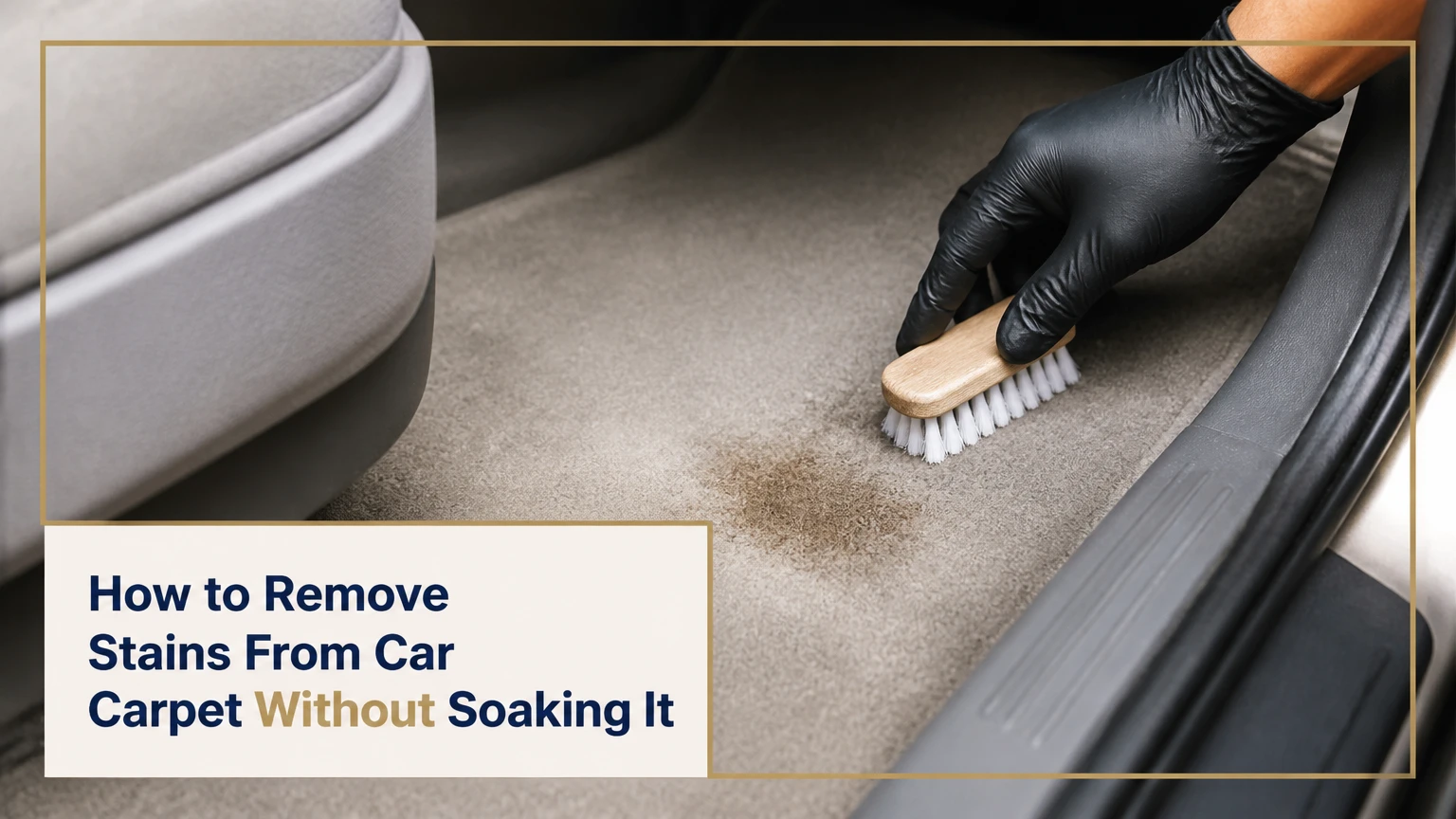
To remove stains from car carpet, first vacuum and dry-brush loose soil, then test a diluted carpet cleaner, apply only enough solution to wet the fibers, agitate gently, and extract the residue with towels or a wet-dry vacuum. Most fresh stains take 20-40 minutes to treat, but complete drying usually requires 4-24 hours.
Key Facts / At a Glance
A wet-dry vacuum removes substantially more contaminated moisture than towel blotting alone.
Fresh liquid stains should be blotted before cleaning; scrubbing can drive liquid into the underlay.
Dried mud should be vacuumed and brushed while dry before any water-based cleaner is applied.
Enzyme cleaners are appropriate for milk, vomit, urine, and other organic residues, but they require longer dwell time.
Never mix bleach, ammonia, vinegar, or commercial cleaners in the same container.
A stain that returns after drying usually indicates wicking from the carpet backing or underlay.
Before You Start: Time, Cost, and Materials
Car carpet stain removal is easiest when the carpet is only lightly dampened and the contamination is identified before choosing a cleaner. The job normally takes 30-60 minutes of active work, followed by several hours of drying; old oil, milk, and mold can require repeated treatment or professional extraction.
Preparation checklist
| Requirement | Typical amount or specification | Why it matters |
|---|---|---|
| Active cleaning time | 30-60 minutes | Covers vacuuming, treatment, extraction, and inspection |
| Drying time | 4-24 hours | Depends on humidity, pad thickness, and airflow |
| Microfiber towels | 6-10 towels, 300-500 GSM | Provides clean surfaces for repeated blotting |
| Carpet cleaner | 100-250 ml diluted solution | Limits saturation and soap residue |
| Nylon detailing brush | 10-20 mm soft or medium bristles | Agitates fibers without cutting them |
| Wet-dry vacuum | 1.0-3.0 gallon portable unit | Removes liquid from the pile and backing |
| Protective equipment | Nitrile gloves and ventilation | Reduces skin and fume exposure |
Remove floor mats, open the doors, and move objects away from the affected area. Inspect beneath the carpet edge if practical, especially after a drink spill, flood, or wet pet accident. Modern vehicles may have wiring, seat-occupancy sensors, airbag connectors, or electronic modules beneath the floor, so flooding the carpet can create a more expensive fault than the stain itself.
Test the cleaner first
Apply one drop of the chosen product to a hidden carpet edge, then press a white towel against it after five minutes. Do not proceed if the towel picks up dye, the fibers become sticky, or the backing softens.
How Does Car Carpet Stain Removal Work?
Carpet cleaning works through four linked actions: separation, emulsification, agitation, and extraction. Surfactants reduce the bond between soil and fiber, solvents dissolve compatible oily material, mechanical agitation moves residue into the cleaning liquid, and extraction removes both contamination and cleaner from the vehicle.
Carpet fibers do not all respond identically. Nylon generally tolerates more mechanical cleaning than delicate wool, while polypropylene can resist many water-based stains but may retain oily residues. Automotive carpeting often includes a synthetic face fiber bonded to latex, polypropylene, or recycled-fiber backing, so excessive water can remain below the visible pile.
The practical rule is simple: use the least aggressive chemistry and the least moisture that can remove the stain. A stronger product cannot compensate for poor extraction, and additional scrubbing often spreads pigment or damages the pile.
Choose chemistry by stain type
| Stain category | Suitable first treatment | Typical dwell time | Main risk |
|---|---|---|---|
| Coffee, tea, juice | Neutral carpet cleaner or 1:10 vinegar-water test solution | 3-5 minutes | Color reappearing through wicking |
| Oil, grease, sunscreen | Carpet-safe degreaser or diluted dish detergent | 5-10 minutes | Oily residue spreading |
| Milk, vomit, urine | Enzyme cleaner labeled for upholstery | 10-30 minutes | Odor remaining in underlay |
| Mud and road soil | Dry brushing followed by low-moisture cleaner | 3-5 minutes | Making dry soil into slurry |
| Winter salt | 1:1 white vinegar and water, followed by water extraction | 3-5 minutes | Acid residue or backing saturation |
| Ink or dye | Isopropyl alcohol spot test or specialist solvent | 1-3 minutes | Bleeding and permanent color loss |
| Rust | Fabric-safe rust remover | Product label | Fiber or backing discoloration |
Vinegar is not a universal cleaner. A mild acetic-acid solution can dissolve alkaline road salt, but it is weak against heavy grease and may leave odor if it is not extracted. Baking soda absorbs some surface oil and odor, but it does not chemically remove every stain and should be vacuumed thoroughly before wet cleaning.
How to Remove Stains From Car Carpet: Core Method
The reliable process has six stages: remove dry soil, blot liquid, apply a measured cleaner, agitate, extract, and dry. The stain type determines the product, but low moisture, controlled dwell time, and complete residue removal determine whether the result lasts.
Step 1: Remove mats and vacuum the carpet
Take the floor mats out of the vehicle and vacuum the carpet in two directions. Use a crevice tool around seat rails, door sills, pedal mounts, and the carpet seam where dry debris collects.
For dried mud, use a stiff nylon brush while the area remains dry, then vacuum again. Do not add water until loose grit has been removed, because water turns mineral soil into a paste that penetrates the pile.
Success checkpoint: The carpet surface should feel dry and gritty-free when rubbed lightly with a gloved hand.
Common mistake: Wet-cleaning visible mud before removing the dry crust.
Step 2: Blot fresh liquid immediately
Place a dry microfiber towel over a fresh spill and press straight down for 10-15 seconds. Lift the towel, rotate to a clean section, and repeat until the towel absorbs little or no liquid.
Do not rub outward from the center. Rubbing pushes liquid laterally and downward, while repeated pressure transfers the spill into the towel. If the liquid has reached the padding, press from above and use a wet-dry vacuum as soon as possible.
Success checkpoint: The towel shows a progressively smaller damp area after each press.
Common mistake: Using heat or a hair dryer before the contaminant has been extracted.
Step 3: Apply a measured cleaning solution
Spray cleaner onto a towel or directly onto the stain in short bursts, using approximately 10-20 ml for a palm-sized area. Keep the solution on the carpet face rather than flooding the backing, and follow the product label for dilution.
Allow a neutral cleaner to dwell for 3-5 minutes. Enzyme products commonly need 10-30 minutes, because the biological reaction requires contact time. Covering an enzyme-treated spot with plastic can slow drying and trap odor, so follow the label rather than improvising.
Success checkpoint: The fibers are evenly damp, not wet enough to form a puddle or soak through the backing.
Common mistake: Adding more product when the first application has not yet had time to work.
Step 4: Agitate from the outside inward
Use a soft or medium nylon brush and make short straight passes from the outside edge toward the center. Work in sections no larger than 10 by 10 cm, particularly when treating a dark liquid stain or colored food residue.
For automotive carpet, 10-20 light passes are usually safer than hard scrubbing. Circular scrubbing can create a visible texture difference and may spread loosened pigment beyond the original boundary.
Success checkpoint: The stain becomes lighter without a larger wet halo forming around it.
Common mistake: Using a stiff household brush that roughens or pulls carpet fibers.
Step 5: Extract cleaner and suspended soil
Press a clean towel onto the treated area, or place the nozzle of a wet-dry vacuum over the spot and make slow passes. For towel extraction, use a fresh section after every press; for machine extraction, make one slow wet pass followed by two or three suction-only passes.
Rinse only when residue remains, using 10-20 ml of clean water for a palm-sized section. Extract that water immediately. Soap left in the fibers attracts new soil and often causes a stiff, sticky patch.
Success checkpoint: The extraction towel becomes nearly clean and the carpet no longer feels slippery.
Common mistake: Stopping after the stain fades while leaving detergent and dissolved soil below the surface.
Step 6: Dry the carpet completely
Open at least two doors or windows and direct a portable fan across the carpet, not straight down into it. Drying commonly takes 4-8 hours in warm, low-humidity conditions and 12-24 hours when the underlay is damp or cabin ventilation is poor.
Avoid closing the vehicle overnight if the carpet still feels cool or damp. The U.S. Environmental Protection Agency identifies moisture control as the central measure for limiting indoor mold growth, and a closed vehicle provides poor evaporation when humidity remains high.
Success checkpoint: The carpet feels the same temperature as adjacent dry carpet and has no cool, damp backing.
Common mistake: Reinstalling wet floor mats, which trap moisture against the carpet.
Which Cleaning Method Should You Use?
A towel and carpet-safe cleaner suit fresh, small stains; a portable extractor is better when liquid reached the underlay; and professional hot-water extraction is appropriate for extensive contamination, persistent odor, or mold. Steam alone is not automatically superior because heat without adequate extraction can leave moisture below the carpet.
| Method | Typical cost | Active time | Drying time | Best application |
|---|---|---|---|---|
| Towels plus diluted cleaner | $5-$20 | 20-40 minutes | 4-8 hours | Fresh drink or food spot |
| Commercial upholstery spray | $8-$25 | 15-30 minutes | 4-12 hours | Targeted grease or organic residue |
| Portable spot extractor | $80-$180 purchase, $20-$40 rental | 30-60 minutes | 6-18 hours | Several stains or soaked padding |
| Professional interior extraction | $100-$300 per vehicle | 1-3 hours | 6-24 hours | Whole cabin, severe odor, repeated failure |
| Steam-assisted detailing | $120-$350 | 1-3 hours | 6-24 hours | Sanitization of compatible surfaces |
“Steam cleaning” describes heat delivery, not the complete removal process. A machine must recover the suspended soil and water; otherwise, heat may move contamination deeper or set some protein-based residues.
What tools provide the best value?
For occasional maintenance, buy microfiber towels, a soft nylon brush, a neutral automotive carpet cleaner, and nitrile gloves. A wet-dry vacuum provides the largest practical improvement because extraction controls residue, drying time, and the likelihood of wicking.
A household carpet machine can work, but its wide head may deliver too much water into a vehicle floor. A small upholstery nozzle gives better control around seat rails and seams.
How Do You Treat Different Car Carpet Stains?
The correct stain-removal method depends on whether the residue is water-based, oil-based, protein-based, mineral, or a transferred dye. Identify the source before choosing a product, because vinegar, enzymes, solvents, and degreasers solve different chemical problems.
Coffee, tea, juice, and soft drinks
Blot the liquid, apply a neutral carpet cleaner, agitate lightly, and extract with clean water. A 1:10 mixture of white vinegar and water may help with alkaline beverage residue or mineral content, but test dye stability first and never combine vinegar with bleach or ammonia.
Sugar-containing drinks require thorough rinsing because residual sugar remains sticky after the color disappears. Treat the visible area plus a 2-5 cm perimeter if a halo has formed.
Grease, oil, sunscreen, and food fat
Cover a fresh oily spot with cornstarch for 20-30 minutes, then vacuum it. Apply a small amount of carpet-safe degreaser or diluted dish detergent to a towel, work from the edge inward, and extract with clean water.
Baking soda may absorb surface oil, but it is less reliable on old lubricants. Do not pour solvent directly onto the carpet, because the liquid can spread beneath the visible stain and loosen adhesive.
Milk, vomit, urine, and other organic messes
Remove solids with a disposable scraper, blot liquid, and apply an enzyme cleaner labeled for automotive upholstery. Keep the product wet for the label’s stated dwell period, then extract and dry thoroughly.
Enzymes reduce odor-causing organic residue but do not repair discoloration caused by dyes or bleaching. If odor returns after two complete treatments, contamination probably reached the foam or underlay.
Mud, dirt, and road grime
Allow wet mud to dry, brush the crust loose, and vacuum twice. Only then apply a low-moisture carpet cleaner to the remaining gray film.
The dry-first rule prevents a small dirty patch from becoming a large muddy slurry. Salt mixed with road soil needs separate treatment after the bulk soil has been removed.
Winter salt and white mineral rings
Mix equal parts white vinegar and water, test the carpet, and apply enough to dissolve the crystals without wetting the backing. Agitate with a nylon brush, then extract with clean water and dry with airflow.
Vinegar can help dissolve alkaline salt deposits, but it does not remove oily road film. Treat grease separately rather than increasing vinegar concentration.
Ink, dye transfer, and paint
Ink and dye stains require a solvent compatible with the carpet fiber, usually after a hidden-area test. Isopropyl alcohol can help with some inks, but it can also mobilize dye and enlarge the mark.
Paint type matters. Water-based latex paint may soften with water and detergent, while cured enamel or lacquer can require a specialist solvent. Professional treatment is safer when the stain covers more than 10 cm or the carpet color begins transferring.
Rust and mold
Use a fabric-labeled rust remover for orange metal stains and follow its neutralization instructions. Rust chemistry differs from ordinary dirt, so vinegar alone may spread the discoloration rather than remove it.
Visible mold, repeated dampness, or a strong musty smell warrants professional inspection. Mold on the carpet face may indicate moisture beneath the carpet, a leaking door seal, blocked drain, windshield leak, or heater-core problem.
What Mistakes Make Car Carpet Stains Worse?
The most damaging errors are excess water, incompatible chemicals, aggressive brushing, and incomplete extraction. Correcting those errors requires removing residue and moisture, not applying a stronger cleaner.
| Mistake | Result | Recovery action | Escalation point |
|---|---|---|---|
| Flooding the carpet | Damp underlay, odor, corrosion risk | Extract repeatedly and ventilate 12-24 hours | Odor or dampness remains |
| Scrubbing a fresh spill | Larger stain and crushed pile | Blot, then clean the expanded area | Color has visibly spread |
| Using bleach | Permanent dye loss and fiber damage | Rinse and stop chemical treatment | Carpet remains discolored |
| Heating protein stains | Possible protein bonding and odor | Cool-water extraction | Milk or vomit odor persists |
| Mixing products | Fumes or chemical reaction | Ventilate and rinse with clean water | Eye, breathing, or skin irritation |
| Leaving soap behind | Sticky fibers and rapid resoiling | Extract with small water applications | Patch stays tacky after drying |
Never use a household steam iron on automotive carpet. Localized high heat can distort synthetic fibers, damage adhesive, and transfer melted backing to the floor.
Why does the stain reappear after drying?
A returning stain is usually wicking, which occurs when dissolved soil in the backing travels upward as water evaporates. Lightly rewet the entire affected boundary with clean water, cover it with several absorbent towels, apply even pressure for 10-20 minutes, and dry with strong airflow.
Spot-cleaning only the center can leave a concentration gradient that creates a ring. Treating the full visible boundary and extracting from the outside inward reduces that effect.
Why does the car still smell after cleaning?
Persistent odor usually means organic residue or moisture remains below the carpet face. Check the underlay, seat rail channels, spare-wheel well, door seals, sunroof drains, and air-conditioning condensate drain before repeating surface cleaning.
Do not mask the smell with fragrance. Fragrance changes the cabin odor but does not remove milk proteins, urine salts, or mold contamination.
How do you remove sticky residue?
Apply 10-20 ml of clean water to a small section, agitate lightly, and extract immediately. Repeat once if necessary, then dry the carpet completely.
Sticky residue is usually concentrated detergent or dissolved sugar. Adding more cleaner compounds the problem.
When Should You Stop DIY Cleaning?
Stop home treatment when the carpet has dye transfer, widespread mold, a soaked underlay, persistent odor after two treatments, or contamination beneath electronic components. Professional detailers have stronger extraction equipment, controlled chemicals, and the ability to lift trim or carpet where necessary.
A professional service is also sensible after floodwater, sewage, gasoline, or unknown chemical exposure. Gasoline and solvent contamination create fire and health hazards that ordinary carpet cleaners do not neutralize.
Typical cost and time by situation
| Situation | DIY material cost | Professional cost | Likely total time |
|---|---|---|---|
| One fresh beverage spot | $5-$15 | $75-$150 | 30 minutes plus drying |
| Two to five food or grease stains | $10-$30 | $100-$200 | 1-2 hours plus drying |
| Milk or vomit odor | $15-$40 | $125-$300 | 1-3 hours plus drying |
| Whole-car dirty carpet | $30-$180 | $150-$350 | 2-5 hours plus drying |
| Mold or flood contamination | Not recommended | $200-$600 or more | 1-3 days, depending on repair |
Prices are typical consumer-market ranges in the United States, not fixed service rates. Regional labor costs, vehicle size, carpet removal, and contamination severity change the final price.
How Can You Prevent New Carpet Stains?
Prevention works best when it limits liquid contact and shortens response time. Use fitted rubber or thermoplastic floor liners, secure drink containers, and blot spills before they reach the carpet backing.
Keep a small emergency kit in the trunk containing four microfiber towels, nitrile gloves, a sealed 100 ml spray bottle of diluted neutral cleaner, disposable scraper, and a plastic bag. Do not store a leaking bottle or premixed chemical in a hot cabin.
Vacuum the carpet every 2-4 weeks and clean floor mats separately. Apply a fabric protectant only after the carpet is clean and fully dry, and verify that the product is labeled for automotive synthetic fibers.
FAQ
Can I use baking soda and vinegar on car carpet?
Use baking soda as a dry absorbent for a fresh oily spot, then vacuum it before applying any liquid. Do not combine baking soda and vinegar in the same container because the reaction neutralizes much of the acidity and produces foam without improving extraction. Test both products on hidden carpet first.
Is dish soap safe for automotive carpet?
A small amount of diluted, grease-cutting dish soap can treat oil, sunscreen, and food fat when applied to a towel rather than poured onto the carpet. Rinse and extract afterward because dish soap can leave surfactant residue that attracts soil. Avoid it on large areas or delicate, dye-sensitive carpet.
Can I remove an old stain completely?
Old stains may lighten substantially but cannot always be removed completely, especially when dye has chemically altered the fiber or sunlight has faded surrounding carpet. Two controlled treatments, with complete extraction between them, are safer than one aggressive treatment. Professional solvent selection may improve results for ink, paint, or rust.
How long should I leave carpet cleaner in a car?
Leave a neutral carpet cleaner for about 3-5 minutes and an enzyme cleaner for the label’s stated 10-30-minute period. Longer dwell time does not automatically improve cleaning and can increase residue, dye bleeding, or backing saturation. Keep the carpet damp during enzyme dwell but never allow a puddle to form.
Can I drive the car while the carpet is damp?
Drive only when the carpet surface is nearly dry and windows can remain open safely, because closed-cabin humidity slows evaporation. Do not reinstall wet floor mats or leave the vehicle closed overnight. A damp underlay can remain wet for 12-24 hours even when the visible fibers feel dry.
Why does my cleaned carpet have a water ring?
A water ring forms when cleaning moisture moves soil from the center or edge and deposits it during evaporation. Lightly treat the whole ring, extract from the outside toward the center, and dry it quickly with airflow. If the ring returns twice, contamination is likely present in the backing or underlay.
The Bottom Line
The safest way to remove stains from car carpet is to vacuum dry soil, blot fresh liquid, use a stain-appropriate cleaner in a small quantity, agitate gently, extract thoroughly, and dry the backing completely. Low moisture and effective extraction matter more than aggressive chemicals. If milk, mold, floodwater, or odor has penetrated below the carpet, professional extraction or carpet removal is the appropriate next step.


