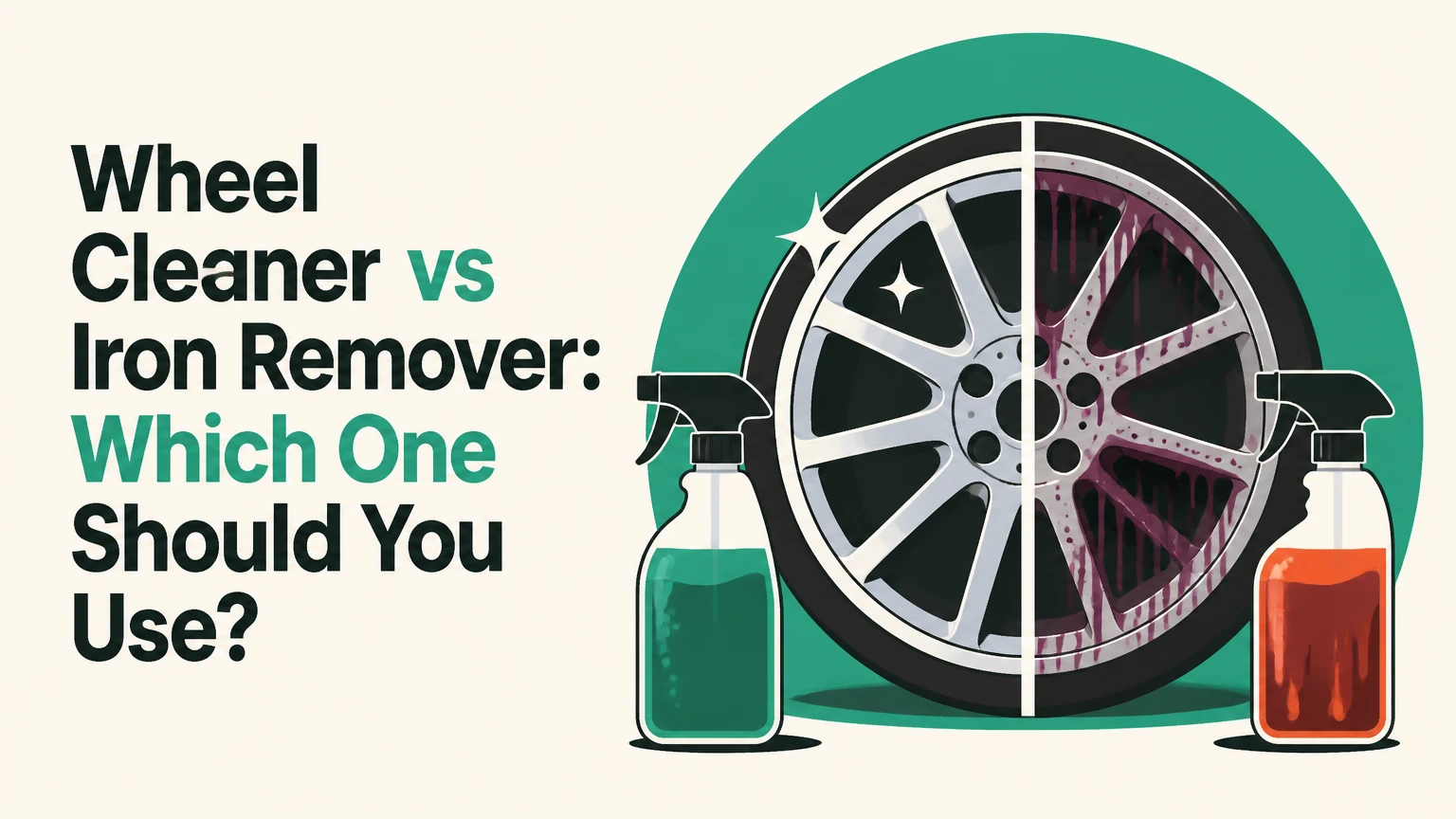
Wheel cleaner removes surface grime, grease, tire residue, mud, and loose brake dust from wheels and tires. Iron remover chemically decontaminates bonded ferrous particles on compatible wheels and vehicle paint. For routine washing, choose wheel cleaner; for embedded metallic fallout or preparation for polishing and coating, use iron remover, often after normal cleaning.
Key Facts at a Glance
- Wheel cleaner is a maintenance detergent, while iron remover is a ferrous-contamination treatment.
- Iron remover does not replace wheel cleaner because it performs poorly against mud, grease, tire blooming, and oily road film.
- A purple or red reaction indicates that a thioglycolate-based product is reacting with accessible iron, not that the surface is fully clean.
- Wheel cleaner chemistry ranges from pH-neutral surfactants to alkaline builders and aggressive acids, so “wheel cleaner” is not one safety category.
- Typical wheel-cleaning dwell time is 1-3 minutes; typical iron-remover dwell time is 3-7 minutes without allowing either product to dry.
- Product labels, wheel finish, surface temperature, and coating condition determine safe use more reliably than product color or marketing language.
What Is the Difference Between Wheel Cleaner and Iron Remover?
Wheel cleaner separates and suspends ordinary road contamination, while iron remover binds chemically to ferrous particles that remain attached after washing. The products overlap on brake-dust removal, but they solve different layers of the problem: detergent handles the carrier grime, and iron remover targets metallic fallout that detergent cannot dissolve.
A wheel cleaner is formulated for repeated wheel and tire maintenance. Surfactants loosen dirt, alkaline builders attack oily soil, and selected acids dissolve mineral or metallic deposits. Some products combine several mechanisms, but the label may still restrict use to wheels and tires because the formula can affect paint protection, trim, or polished metal.
An iron remover is a decontamination product based commonly on sodium thioglycolate or ammonium thioglycolate. The active ingredient complexes with exposed iron and produces a red, purple, or magenta color. The reaction makes the contaminant easier to rinse away; it does not literally melt the wheel or make every particle disappear without rinsing.
What Does Each Product Remove?
| Contaminant | Wheel cleaner | Iron remover | More suitable follow-up |
|---|---|---|---|
| Road film | High effectiveness in 1-3 minutes | Low effectiveness | Wheel brush and rinse |
| Oily grease | High with alkaline formula | Low | Degreaser or alkaline cleaner |
| Loose brake dust | High with agitation | Moderate to high | Rinse, then iron treatment |
| Bonded iron fallout | Low to moderate | High on compatible surfaces | Iron remover and rinse |
| Tire blooming | High with tire cleaner | None | Tire cleaner and stiff rubber brush |
| Tar and asphalt | Low | None | Solvent-based tar remover |
| Tree sap | Low | None | Sap remover or controlled solvent |
| Mineral water spots | Low | None | Mineral-deposit remover or polish |
Wheel cleaner is the correct first choice when a wheel looks brown, muddy, greasy, or black from accumulated road film. Iron remover becomes useful when washed wheels still show tiny orange-brown specks, roughness, or brake-dust staining.
How Do Wheel Cleaner and Iron Remover Work?
Wheel cleaner uses surfactants, pH modifiers, solvents, or acids to loosen contamination from the surface. Iron remover uses a chelating reaction that complexes accessible iron, after which water and light agitation carry the residue away. Neither product eliminates the need for a thorough rinse, and neither should dry on the finish.
Wheel Cleaner Chemistry
pH-neutral cleaners depend primarily on surfactants and lubrication. They are usually the safest starting point for painted, powder-coated, clear-coated, and ceramic-coated wheels, although “pH-neutral” does not guarantee compatibility with every finish.
Alkaline cleaners are effective against grease, tire residue, and heavy road film. Concentrates may be diluted, often around 4:1 to 8:1 for maintenance work, but the correct ratio depends on the manufacturer’s instructions and contamination level.
Acidic wheel cleaners dissolve mineral deposits and some baked-on brake residues quickly. Hydrofluoric acid presents severe health and material hazards, while phosphoric or sulfamic acid products can still etch susceptible metal if misused. A professional should treat acid as a specialized option, not a default upgrade.
Iron Remover Chemistry
Thioglycolate-based iron removers react with exposed ferrous material and often create the familiar bleeding color. The odor comes from sulfur-containing chemistry, so ventilation, gloves, eye protection, and careful overspray control are appropriate.
The reaction is selective rather than universal. Iron remover does not dissolve aluminum, carbon deposits, rubber blooming, road grease, tar, or organic dirt. If those materials cover the iron, washing first improves contact and makes the later chemical step more meaningful.
Which Wheel Cleaner Type Fits the Wheel?
pH-neutral wheel cleaner is the safest default for unknown finishes, alkaline cleaner is usually more efficient for greasy maintenance soil, and acid cleaner belongs only on confirmed compatible surfaces with strict dwell-time control. Wheel finish matters more than the apparent severity of dirt.
| Wheel or finish | Starting product | Typical dwell | Main caution |
|---|---|---|---|
| Clear-coated alloy | pH-neutral cleaner | 1-3 minutes | Do not let product dry |
| Powder-coated wheel | pH-neutral or mild alkaline | 1-3 minutes | Test an inconspicuous area |
| Chrome-plated wheel | Label-approved neutral cleaner | 1-2 minutes | Avoid unapproved acids |
| Polished bare aluminum | Neutral cleaner | 1-2 minutes | Acid can stain or haze metal |
| Anodized aluminum | Neutral cleaner | 1-2 minutes | Strong alkaline chemistry may discolor |
| Ceramic-coated wheel | Coating-safe neutral cleaner | 30-120 seconds | Reduced dwell may be sufficient |
| Heavily soiled commercial wheel | Approved alkaline product | 1-3 minutes | Confirm dilution and finish |
A ceramic coating changes the maintenance strategy but does not make a wheel chemically indestructible. Coated surfaces often release dirt more easily, so aggressive chemistry and long dwell times add risk without adding cleaning performance.
Can Iron Remover Replace Wheel Cleaner?
Iron remover cannot replace wheel cleaner for routine washing because it has little ability to remove oily road film, mud, tire blooming, and non-metallic grime. Iron remover can replace a separate wheel cleaner only for a lightly soiled wheel during a narrow decontamination step, and even then the result is usually incomplete.
Hybrid bleeding wheel cleaners combine detergent with an iron-reactive ingredient. They are convenient for a lightly or moderately contaminated wheel, but the hybrid formula may sacrifice either deep cleaning strength or economical dilution compared with dedicated products.
A hybrid product is reasonable for a commuter who wants one bottle and accepts periodic manual brushing. Separate products are more controllable for a heavily dusty vehicle, a professional detail, or a coated wheel where minimizing chemical exposure matters.
What Does the Purple Reaction Mean?
The purple reaction means an iron-reactive ingredient has contacted accessible ferrous contamination and formed a colored complex. The intensity depends on particle quantity, chemical concentration, temperature, surface wetness, and contact, so color intensity cannot rank cleaning quality by itself.
A strong reaction commonly appears around brake dust deposits, wheel barrels, lower door panels, rear bumpers, and areas exposed to rail or industrial fallout. A clean-looking wheel can still bleed because microscopic particles are bonded to the surface.
No visible reaction does not prove that no iron exists. Contamination may be absent, covered by grease, too sparse to see, chemically inaccessible, or located on a surface where the product has been diluted by heavy water. Conversely, a purple reaction does not mean the wheel is clean of tar or carbon.
What Does Each Product Cost?
Typical retail pricing is about $15-$25 for a 16-ounce ready-to-use iron remover and $25-$35 for a concentrated gallon of economical wheel cleaner. Cost per application depends on dilution, spray volume, wheel size, and whether the product is used on four wheels or the entire vehicle.
| Product category | Typical package | Typical price | Typical use economics |
|---|---|---|---|
| pH-neutral wheel cleaner | 16 ounces RTU | $10-$18 | $2-$5 per four-wheel wash |
| Alkaline wheel concentrate | 1 gallon | $25-$45 | Often under $2 per wash when diluted |
| Acidic wheel cleaner | 1 gallon | $25-$60 | Low unit cost, higher damage risk |
| Dedicated iron remover | 16 ounces RTU | $15-$25 | $8-$20 per full-wheel treatment |
| Dedicated iron remover | 1 gallon RTU | $65-$90 | Lower cost per ounce, limited shelf economy |
| Hybrid bleeding wheel cleaner | 24-32 ounces RTU | $15-$25 | Moderate cost with one-step convenience |
These are typical retail ranges, not fixed market prices. A gallon of iron remover can reduce unit cost for a mobile detailer, but its storage, odor, and slower turnover still make it less economical than diluted detergent for weekly maintenance.
How Should You Use Both Products?
Use wheel cleaner first, rinse it completely, then apply iron remover to the clean, cool wheel when bonded ferrous contamination remains. A complete four-wheel process usually takes 25-45 minutes for moderate soil, with success determined by preventing drying and using the least aggressive chemistry that works.
Before You Start
| Requirement | Typical specification |
|---|---|
| Working temperature | Cool wheel, ideally below 100°F surface temperature |
| Location | Shade, ventilation, no direct hot sunlight |
| Products | 1 wheel cleaner, 1 iron remover, 1 pH-neutral soap |
| Tools | Tire brush, soft wheel brush, barrel brush, pressure nozzle |
| Protection | Nitrile gloves, eye protection, closed footwear |
| Water | At least 10-15 gallons for a careful four-wheel rinse |
| Time | 25-45 minutes for moderate contamination |
| Test area | 1 small hidden section before full application |
Step 1: Cool and Pre-Rinse the Wheels
Park away from direct sun and wait until the wheel, rotor, and caliper are cool to the touch. Rinse from the top down, directing water into the spokes and barrel to remove sand that could scratch during brushing.
The success checkpoint is a visibly reduced layer of loose dirt before chemical application. The common mistake is washing immediately after driving, when hot brake hardware can flash-dry product and increase staining risk.
Step 2: Apply the Wheel Cleaner
Apply the wheel cleaner to one wheel at a time, following the label’s dilution and surface instructions. Use a separate tire product or the cleaner’s approved tire dilution on rubber, because tire soil often needs different agitation than painted metal.
Allow approximately 1-3 minutes of dwell, but keep the surface visibly wet. The product should soften road film rather than dry into a concentrated residue.
Step 3: Agitate and Rinse Completely
Agitate the tire sidewall with a dedicated tire brush and the wheel face with a soft wheel brush. Use a barrel brush only when its construction cannot contact the wheel lip or trap abrasive grit against the finish.
Rinse the wheel, spokes, lug recesses, barrel, caliper, and nearby suspension components until runoff is free of visible cleaner. The checkpoint is a clean but possibly rough-feeling surface. Roughness after washing indicates bonded contamination, not necessarily failed cleaning.
Step 4: Apply Iron Remover
Apply iron remover to the cool, cleaned wheel according to the product label. Many formulas work on a damp surface, while some manufacturers specify a dry surface for maximum concentration; do not assume that wet application is universally correct.
Wait 3-7 minutes while monitoring the surface. A purple reaction can develop immediately or gradually, and heavy contamination may require light agitation with a soft brush.
Step 5: Rinse and Inspect
Rinse thoroughly before the product dries, including the back of the spokes and the wheel barrel. Inspect under bright light, then feel the surface through a clean plastic bag if necessary.
The checkpoint is a smooth surface with no chemical residue or active color. If roughness remains, identify whether it is iron, tar, mineral scale, pitting, or clear-coat damage before repeating a chemical treatment.
How Often Should You Use Each Product?
Use wheel cleaner at every weekly or bi-weekly wash when the wheel finish and product label allow it. Use iron remover approximately every 3-6 months for many street vehicles, but shorten the interval after winter salt exposure, industrial driving, or high-brake-dust use.
| Driving situation | Wheel cleaner interval | Iron-remover interval | Reason |
|---|---|---|---|
| Low-mileage commuter | Every 2-4 weeks | Every 6-12 months | Limited contamination accumulation |
| Typical daily driver | Every 1-2 weeks | Every 3-6 months | Normal road and brake exposure |
| Performance vehicle | Weekly | Every 4-8 weeks | High brake-dust output |
| Winter salt climate | Weekly during winter | At spring decontamination | Salt and fallout increase bonding |
| Industrial or rail-adjacent route | Weekly | Every 1-3 months | Elevated airborne ferrous fallout |
| Ceramic-coated wheels | Every 1-2 weeks | When inspection shows bonded fallout | Coating reduces soil adhesion |
Frequent iron-remover use is not automatically better. Repeated chemical treatment consumes product and can stress surrounding trim, coatings, and sealants without improving a wheel that only has ordinary road grime.
Can You Use Wheel Cleaner on Vehicle Paint?
Most wheel cleaners should not be used on vehicle paint unless the manufacturer explicitly approves paintwork use. Wheel-specific detergents, strong alkalinity, solvents, or acids can stain trim, reduce wax or sealant durability, and leave uneven residue on clear coat.
Use a paint-safe iron remover for ferrous fallout on doors, fenders, and horizontal panels. Wash the vehicle first, keep the product wet for the labeled dwell period, and rinse panel by panel. Avoid spraying into open windows, convertible fabric, damaged clear coat, or unprotected porous trim.
An iron remover approved for paint is not automatically safe for every automotive surface. Product labels may exclude matte paint, PPF, vinyl, anodized trim, or exposed carbon fiber, so a hidden-area test is necessary when the surface is unfamiliar.
What Can Go Wrong During Decontamination?
The most common failures come from heat, drying, excessive concentration, and incorrect diagnosis. Chemical products rarely fix pitting or clear-coat failure, and stronger chemistry can make those defects more visible.
Product Dried on the Finish
Re-wet the area with fresh water or the same product, allow roughly 30 seconds of reactivation, and rinse immediately. Do not scrub a dry chemical film with a stiff brush because embedded grit can create scratches.
Acid Etched Bare Aluminum
White haze, dark staining, or a cloudy polished surface may indicate acid attack rather than remaining dirt. Stop chemical cleaning, rinse thoroughly, and use a metal-specific polishing process only after confirming that the finish is mechanically restorable.
Purple Reaction Appears Weak
A weak reaction may result from low contamination, poor contact, a diluted surface, or product age. Wash first, inspect under strong light, and avoid extending dwell beyond the label merely to force a darker color.
Roughness Remains After Iron Removal
Remaining roughness may be tar, tree sap, mineral scale, carbon, or pitting. Use the appropriate tar remover, mineral-deposit remover, clay media, or polish instead of repeatedly applying iron remover.
Coating Looks Less Hydrophobic
A wheel cleaner or iron remover may leave residue, alter a weak topper, or expose an already failing coating. Rinse thoroughly, wash with a coating-safe shampoo, and reassess beading before applying more chemistry.
Brake Components Stay Wet
Do not spray a hot brake assembly. After rinsing, drive slowly and apply the brakes several times in a safe area to restore normal pad contact and dry the components.
What Removes Contaminants Neither Product Handles?
Tar remover handles asphalt and grease-like bitumen, mineral-deposit remover handles calcium and water spotting, and clay or synthetic decontamination media handles residual bonded particles after chemical cleaning. Polishing is required when the defect is etching, oxidation, pitting, or permanent clear-coat damage.
A practical diagnosis prevents wasted product:
- Black, sticky spots: use a labeled tar or adhesive remover.
- White or chalky rings: use a mineral-deposit product after confirming finish compatibility.
- Orange specks: use iron remover, then rinse and inspect.
- Brown tire sidewalls: use a tire cleaner and rubber-safe brush.
- Permanent dullness or pits: evaluate polishing or refinishing.
- Texture after chemical treatment: use controlled mechanical decontamination only after identifying the residue.
Mechanical clay can mar soft paint if used aggressively. Lubrication, light pressure, and a clean surface matter more than forcing a perfectly smooth result in one pass.
Which Should You Choose?
Choose wheel cleaner for routine maintenance, iron remover for bonded ferrous contamination, and both products for a full wheel or paint decontamination. The correct choice depends on the contaminant, surface finish, cleaning frequency, and whether the vehicle is being prepared for polishing or coating.
Daily Commuter
Choose a pH-neutral or mild alkaline wheel cleaner for weekly or bi-weekly washing. Add an iron remover every 3-6 months if orange specks or roughness remain after normal cleaning.
A hybrid bleeding wheel cleaner can suit owners who value fewer bottles and accept higher per-use cost. It does not eliminate the need for agitation or a separate tar treatment.
High-Brake-Dust Performance Car
Use a finish-approved wheel cleaner at each wash because carbon, grease, and loose dust accumulate quickly. Apply dedicated iron remover every 4-8 weeks when inspection shows bonded metallic contamination, particularly behind large steel-brake rotors.
Ceramic brakes may create less conventional iron dust, but they still produce other particulate contamination. Do not assume a high-performance vehicle always needs iron remover at every wash.
Ceramic-Coated Wheels
Start with a coating-safe neutral cleaner at reduced dwell time, usually 30-120 seconds if the manufacturer permits. Use iron remover only when the surface remains rough or shows bonded fallout after washing.
Avoid strong acids and unnecessary brushes. Coating maintenance should preserve the coating’s low-friction behavior, not repeatedly challenge it with aggressive chemistry.
Mobile Detailer
Use a dilutable wheel-cleaner concentrate for predictable maintenance cost and reserve ready-to-use iron remover for decontamination, paint correction, and ceramic-coating packages. Record dilution, dwell time, surface type, and customer approval for unusual finishes.
Bulk purchasing reduces unit cost, but poor storage, inaccurate dilution, and overspray can erase the savings. A controlled process is more profitable than a stronger chemical.
Expert Rules That Prevent Damage
A purple wheel is not a clean wheel. The color only reports accessible iron. A wheel can bleed heavily while retaining grease, tar, carbon, and mineral deposits.
Clean before you decontaminate. Iron remover performs more consistently after detergent has removed the oily film that blocks contact. Applying it to a dirty wheel wastes chemistry and complicates inspection.
Choose the least aggressive effective product. Start with a neutral cleaner, increase dwell or agitation, then change chemistry only when the contaminant diagnosis supports it. Strong acid is not a substitute for identifying the soil.
Never judge compatibility by pH alone. A nominally neutral product can contain solvents or surfactants that affect a sensitive coating, while a labeled alkaline cleaner may be acceptable on a durable powder coat. The label and a spot test provide better evidence.
FAQ
Is iron remover safe for alloy wheels?
Iron remover is generally suitable for painted, clear-coated, and many powder-coated alloy wheels when the label approves those surfaces. It may be unsuitable for bare polished aluminum, anodized finishes, damaged coatings, or unsealed metal. Test a hidden area, keep the wheel cool, prevent drying, and rinse all residue thoroughly.
Should wheels be wet or dry before iron remover?
Use the surface condition specified by the product manufacturer. A damp wheel reduces concentration but can improve spread and rinsing, while a dry wheel may produce a stronger reaction. Neither method is universally correct, and applying iron remover to a hot or sun-heated wheel is unsafe.
Why does iron remover smell like rotten eggs?
Thioglycolate chemistry produces a sulfurous odor as it reacts with ferrous contamination. The smell does not prove that the product is unusually strong or that the wheel is being damaged. Ventilation, gloves, eye protection, and avoidance of enclosed spaces reduce exposure during application.
Can wheel cleaner remove baked-on brake dust?
Wheel cleaner can remove loose and surface-bonded brake dust, especially with appropriate dwell and agitation. Carbonized deposits, iron particles, and damaged or pitted finishes may remain after washing. Use iron remover for ferrous fallout, then consider mechanical polishing or refinishing when the wheel surface is permanently etched.
Can I mix wheel cleaner and iron remover?
Do not mix wheel cleaner and iron remover in a bottle or apply them simultaneously unless the manufacturer specifically formulates them as a hybrid product. Use separate steps, rinse the wheel completely between chemicals, and follow each label’s dilution, dwell, and surface restrictions.
Do I need iron remover before ceramic coating?
Iron remover is advisable when inspection finds bonded ferrous contamination before a ceramic coating is installed. A smooth, residue-free surface improves preparation, but iron remover alone does not remove tar, mineral deposits, oxidation, or polishing oils. Complete the required wash, decontamination, polishing, and panel preparation steps.
The Bottom Line
Wheel cleaner vs iron remover is not a contest between interchangeable products. Wheel cleaner is the correct maintenance chemical for road film, grease, mud, tire residue, and loose brake dust; iron remover is the specialized treatment for bonded ferrous particles on approved surfaces. Use wheel cleaner routinely, add iron remover when inspection identifies metallic fallout, and use both in sequence for a thorough decontamination.


