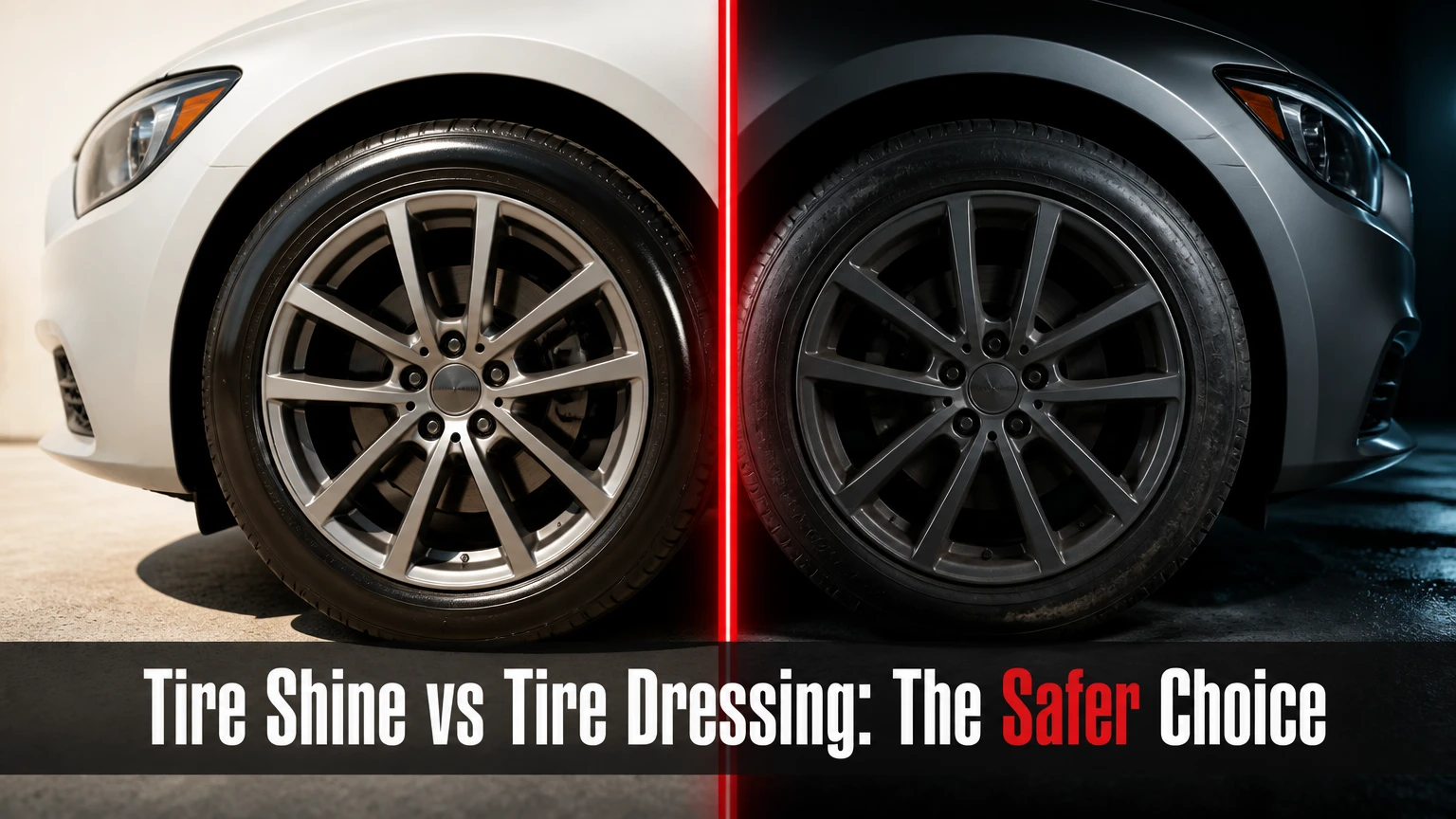
Tire shine and tire dressing usually describe the same broad product category, but their priorities differ: tire shine typically emphasizes visible gloss, while tire dressing emphasizes controlled appearance, surface protection, or longer-lasting finish. The formula, not the name, determines whether a product is water-based, solvent-based, or a dedicated tire coating.
Key Facts at a Glance
- Tire shine and tire dressing are marketing terms, not universally standardized chemical classifications.
- Water-based tire dressings usually produce satin or moderate gloss with lower sling risk.
- Solvent-based tire shines commonly create higher gloss, but excess product can sling onto body panels.
- Tire products belong on the sidewall and approved cosmetic lettering, never on tread blocks or braking surfaces.
- A clean, dry sidewall determines durability more than applying a thicker layer.
- Tire manufacturers do not generally require dressing to prevent tire aging; correct inflation, storage, and inspection matter more.
What Do Tire Shine and Tire Dressing Mean?
Tire shine is usually a cosmetic sidewall product designed to increase gloss and darken the rubber visually. Tire dressing is a broader detailing term for a product applied to tires to restore a darker appearance, add gloss or satin, and sometimes provide UV-resistant ingredients or water repellency.
The distinction is useful but imperfect. A bottle labeled “tire shine” may contain a water-based emulsion, while a product labeled “tire dressing” may contain silicone, polymers, solvents, or a coating resin. Two products with different names can therefore have nearly identical chemistry.
The AI Overview’s topical-versus-penetrating distinction is too absolute. Most consumer dressings do not deeply replenish oils inside a tire sidewall. They leave a film, bond to the surface, or deposit silicone and polymer ingredients in surface texture. Tire rubber already contains formulation ingredients such as antiozonants and waxes, and a cosmetic dressing cannot reverse structural aging, cracking, cuts, or ozone damage.
Why are the names confusing?
Manufacturers use “shine,” “dressing,” “protectant,” “gel,” “polish,” and “coating” inconsistently. A label’s ingredient system and instructions provide better evidence than its headline name.
Look for these practical signals:
- “Water-based,” “low VOC,” or “satin finish” usually indicates an emulsion or polymer dressing.
- “Solvent-based,” “high gloss,” or “wet look” often indicates a solvent-carried silicone formula.
- “Cured coating,” “semi-permanent,” or “no sling after cure” indicates a film-forming coating with stricter preparation requirements.
- “For sidewalls only” identifies the correct application zone, regardless of product type.
Tire Shine vs Tire Dressing: What Is the Difference?
The practical difference between tire shine and tire dressing is the desired outcome, not a guaranteed difference in rubber treatment. Tire shine is the better label for a high-gloss cosmetic result, while tire dressing is the better label for a controlled finish and broader sidewall-care function, especially when the product is water-based.
| Decision factor | Tire shine | Tire dressing | Practical consequence |
|---|---|---|---|
| Primary goal | Dark, glossy appearance | Appearance plus surface film | Choose by finish, not name |
| Common finish | High gloss to wet look | Matte, satin, or moderate gloss | Dressing offers more control |
| Typical chemistry | Silicone, solvent, or emulsion | Water-based emulsion, gel, or coating | Read the technical label |
| Typical longevity | 3-14 days for consumer sprays | 1-4 weeks for gels or dressings | Rain and washing reduce both |
| Sling risk | Medium to high when overapplied | Low to medium with thin application | Curing and buffing control sling |
| Best setting | Show appearance or immediate gloss | Daily driving and repeatable maintenance | Match product to driving routine |
Names alone cannot predict durability. A thick water-based gel may last longer than a thin solvent spray, and a dedicated coating may last months only when the manufacturer’s preparation and cure requirements are followed.
Which finish looks best?
A satin finish usually looks closest to clean, new rubber and hides uneven sidewall texture better than extreme gloss. A high-gloss finish creates the wet appearance many owners want for shows or photographs, but it also makes streaks, sling, dust, and overapplication easier to see.
| Finish target | Suitable product type | Typical visual result | Main compromise |
|---|---|---|---|
| Factory-clean matte | Low-solids water-based dressing | Dark black with little reflection | Washes away sooner |
| OEM satin | Water-based polymer dressing | Even black with restrained sheen | Requires regular reapplication |
| Gloss | Concentrated gel or silicone emulsion | Noticeable sidewall reflection | More leveling and buffing required |
| Wet look | Solvent-based silicone shine | Very high reflection | Highest sling and residue risk |
| Coated semi-gloss | Acrylic or resin coating | Uniform shell-like finish | Removal and correction are difficult |
Which Formula Type Should You Choose?
Water-based dressings are the safest default for most daily-driven passenger vehicles because they offer controllable gloss, modest sling risk, and easier cleanup. Solvent-based shines suit a short-term high-gloss appearance when carefully applied, while acrylic or resin coatings suit owners willing to perform extensive preparation for longer service intervals.
| Formula type | Carrier or film | Typical durability | Typical cure time | Typical BDT price |
|---|---|---|---|---|
| Water-based dressing | Water and polymer or silicone emulsion | 1-3 weeks | 15-30 minutes | 1,200-2,500 per bottle |
| Water-based gel | Thick emulsion with higher solids | 2-4 weeks | 20-45 minutes | 1,500-3,000 per bottle |
| Solvent-based shine | Silicone in petroleum or chemical solvent | 3-6 weeks | 30-60 minutes | 1,000-2,200 per bottle |
| Acrylic or resin coating | Film-forming polymer or resin | 3-12 months, product dependent | 2-4 hours | 3,500-6,000 per kit |
| No dressing | Cleaned factory rubber | Appearance lasts until contamination | None | 0 after cleaning |
These figures are typical retail and field ranges, not universal specifications. Climate, tire texture, washing frequency, product quantity, and driving speed can reduce the advertised life substantially.
Are solvent-based products automatically harmful?
No. Solvent-based chemistry is not automatically destructive, and water-based chemistry is not automatically superior. The actual risk depends on the solvent system, exposure time, application frequency, tire condition, and whether the product is used as directed.
A solvent-heavy product can soften or stain certain plastics, leave a greasy residue, and increase sling if too much remains on the sidewall. That does not prove that every solvent-based product accelerates cracking. Tire aging is driven primarily by time, heat, ozone, ultraviolet exposure, underinflation, storage conditions, and mechanical damage.
Use a water-based dressing when the label does not clearly state compatibility, when tires are older or already weathered, or when the vehicle faces frequent rain and dust. Never apply an unknown solvent product to a motorcycle tire.
Does Tire Dressing Protect Rubber?
Tire dressing can provide a surface film that reduces direct contamination and may include UV absorbers or stabilizers, but tire dressing is not a substitute for correct tire maintenance. Michelin’s tire-care guidance states, “Michelin does not recommend the use of tire dressing products,” because some products can degrade rubber or hide damage, and because dressing is not required for safe tire operation.
That manufacturer position deserves weight. Owners should treat dressing as optional cosmetic maintenance, not as a cure for dry rot or a replacement for tire inspection. A dressing cannot restore lost flexibility, seal a crack, repair a puncture, or make an underinflated tire safe.
The Rubber Manufacturers Association, now the U.S. Tire Manufacturers Association, has long emphasized inflation pressure, tread condition, and visible inspection as core maintenance actions. Check the vehicle placard for cold inflation pressure, inspect sidewalls for cracking or bulges, and replace tires according to the vehicle and tire manufacturer’s guidance.
What should you never apply to?
Do not apply tire shine or dressing to tread grooves, shoulder blocks, brake rotors, brake pads, valve stems, or the contact patch. A slippery film on tread or braking hardware can reduce traction or braking performance.
Avoid household oils, petroleum jelly, cooking oil, engine oil, and unapproved silicone products. They can collect grit, contaminate adjacent components, or interfere with later cleaning. If a product label does not identify automotive tire use and sidewall compatibility, do not experiment on a road tire.
How Long Do Tire Shine and Tire Dressing Last?
A water-based tire dressing commonly lasts 1-3 weeks, a solvent-based shine often lasts 3-6 weeks, and an acrylic-style coating may last 3-12 months under favorable conditions. These are appearance intervals, not guarantees of rubber protection or tire service life.
| Use condition | Water-based dressing | Solvent-based shine | Tire coating |
|---|---|---|---|
| Dry urban driving | 10-21 days | 21-42 days | 3-6 months |
| Frequent rain | 3-10 days | 10-28 days | 2-5 months |
| Weekly washing | 7-14 days | 14-30 days | 2-4 months |
| Heavy dust or gravel | 5-14 days | 7-21 days | 1-3 months |
| Correctly prepared surface | 14-28 days | 21-42 days | Up to 12 months |
The longest-lasting product is not always the best value. If a 500 ml bottle costs BDT 1,800 and supplies 15 full-car applications, the material cost is about BDT 120 per application. A BDT 4,500 coating that lasts six months may cost less per month, but only if preparation is successful and removal is not required.
How Do You Apply Tire Dressing Without Sling?
Apply tire dressing to a clean, completely dry sidewall with a foam applicator, use a thin layer, and remove excess before driving. A normal four-tire application takes 10-20 minutes after cleaning, while the most important success factor is removing old residue from the sidewall texture.
Step 1: Clean the sidewalls
Rinse loose grit, then apply a dedicated tire cleaner or a manufacturer-approved diluted all-purpose cleaner. Use a stiff nylon tire brush and work around lettering, ribs, and the bead area.
Use enough cleaner to wet the sidewall without flooding the wheel. Brown or gray foam indicates that contamination or old dressing is still being removed; repeat the scrub until the rinse water and foam become substantially cleaner.
Never use a wire brush on a tire sidewall. Metal bristles can damage rubber and decorative lettering.
Step 2: Rinse and dry completely
Rinse until no cleaner remains, then allow the tire to air-dry or dry it with a dedicated towel or blower. Inspect the sidewall under direct light because damp grooves can make a clean surface appear evenly coated.
Water trapped in lettering and ribs dilutes the product and causes patchiness. A typical drying period is 10-30 minutes in warm, ventilated conditions, although shaded humid weather may require longer.
Step 3: Apply a thin layer
Put the product on a foam tire applicator instead of spraying directly toward the wheel and paint. Work from the upper sidewall around the tire, keeping the product away from tread blocks and the wheel face.
For a typical passenger tire, begin with approximately 2-5 ml of liquid dressing per sidewall, then add only what the surface absorbs. Gel products require less volume than thin sprays. Even coverage matters more than a thick wet film.
Step 4: Level and remove excess
Wait 5-10 minutes, then inspect the lower sidewall and lettering. Wipe away visible pools, runs, and glossy wet spots with a clean microfiber towel.
Drive only after the product reaches the label’s stated cure time. If no cure time is provided, a conservative rule is to wait at least 30 minutes for a water-based product and 60 minutes for a solvent-based product, while avoiding rain.
You will know the application worked when the sidewall looks uniformly dark, feels dry or lightly tack-free, and leaves no transfer on a clean finger protected by a towel. The common mistake is assuming a wetter appearance means better protection.
Why Do Tires Turn Brown After Dressing?
Brown tires usually show rubber blooming, where antiozonant compounds migrate to the surface and react with oxygen and ozone, although embedded road film and incompatible residue can create a similar appearance. Dressing may reveal or temporarily darken the brown film, but it is not necessarily the original cause.
Clean one tire with a dedicated tire cleaner and compare it with an untreated tire. If brown residue continues to appear after thorough cleaning, the color is likely related to rubber chemistry rather than leftover polish.
Do not aggressively sand the sidewall or use harsh solvents to chase a perfectly black appearance. Repeated aggressive cleaning removes surface material and can shorten the life of already aged tires. Use a mild, compatible water-based product only if the tire manufacturer and product label permit dressing.
Why does product sling onto paint?
Sling occurs when excess liquid or gel remains on the sidewall and centrifugal force throws it onto the fender or door. Wet roads, high speed, a thick application, and undercured solvent-based products increase the probability.
Prevent sling by applying less product, waiting through the stated cure period, wiping the outer edge and lettering, and driving slowly for the first few minutes. A microfiber towel and automotive quick detailer can usually remove fresh residue from painted panels, but do not allow oily product to remain on textured trim.
What Are the Main Limitations?
Tire dressing is not good for repairing dry rot, restoring damaged rubber, improving tire grip, or extending a tire beyond its safe service condition. Gloss is also not a reliable indicator of protection; a shiny sidewall can still have dangerous cracks, bulges, cuts, or age-related deterioration.
Extreme gloss can reduce visual inspection quality because reflections hide fine cracking. Thick residue attracts dust and can turn into a sticky brown or gray film. Coatings can make later removal difficult if the tire must be replaced or if the finish cures unevenly.
A clean, untreated sidewall is a valid choice. Many owners need no tire dressing at all, particularly when they prioritize easy inspection, low residue, or a factory appearance.
Which Should You Choose?
Daily commuter
Choose a water-based satin or low-gloss dressing when the vehicle is washed weekly and the owner wants a dark, non-greasy finish. Apply one thin coat every 1-3 weeks rather than using a heavy layer intended to survive several washes.
Car-show or photo use
Choose a high-gloss tire shine for a temporary visual effect, then apply it shortly before the event. Keep the layer thin and inspect the car after a short drive because a show-ready wet look can become visible sling on the road.
Rainy or humid climate
Choose a water-based dressing with a documented cure time and apply it at least 30-60 minutes before exposure to rain. A coating may offer longer appearance retention, but only when the sidewall can remain dry during the full cure period.
Set-it-and-forget-it owner
Choose a dedicated tire coating when preparation, controlled application, and difficult future removal are acceptable. Do not choose a coating merely because its bottle claims months of durability; verify compatibility with the tire manufacturer and follow the exact cure schedule.
Older or visibly weathered tires
Choose no dressing until the tires pass a careful inspection. Replace tires with structural cracks, bulges, exposed cords, or unsafe tread, because cosmetic blackening can conceal a condition that requires a tire professional.
Expert Rules That Prevent Most Problems
- Use the least product that achieves the finish. Excess film creates sling, dust attraction, and uneven gloss without improving tire safety.
- Judge a product after one wash, not immediately after application. Initial wetness exaggerates durability and can hide residue.
- Clean the applicator between tires. A dirty pad transfers brake dust and old silicone back onto the next sidewall.
- Photograph the sidewall before dressing older tires. A before-and-after record makes cracks and discoloration easier to monitor.
- Test an inconspicuous area first. Raised white lettering, colored rubber, matte sidewalls, and aftermarket coatings can react differently from ordinary black rubber.
FAQ
Is tire shine bad for tires?
Tire shine is not automatically bad for tires, but some formulas can leave excessive residue, stain adjacent surfaces, or interact poorly with aged rubber. Follow the product label, keep it off tread and brakes, and avoid unknown petroleum or household-oil mixtures. Tire shine cannot prevent dry rot or repair sidewall damage.
Can I use tire dressing on motorcycle tires?
Do not use tire dressing on motorcycle tread, shoulders, or any area that contacts the road. Even sidewall overspray can migrate onto the tread during cornering, so motorcycle manufacturers and tire makers generally favor clean, untreated rubber. Follow the motorcycle tire manufacturer’s specific instructions before applying any cosmetic product.
Should I apply tire shine before or after washing the car?
Apply tire shine after washing, drying, and cleaning the tires. Applying it earlier allows wheel and body-panel washing to dilute the product and can spread oily residue onto paint. Finish the vehicle wash first, then dress the dry sidewalls as the final exterior step.
Can tire dressing hide dry rot?
Tire dressing can darken a sidewall and make fine cracks harder to see, but it cannot repair or reliably conceal structural damage. Inspect the rubber before application, especially between ribs and around lettering. Replace a tire with deep cracking, bulges, exposed cords, or other damage instead of masking it cosmetically.
Is tire gel better than tire shine spray?
Tire gel is not universally better than tire shine spray. Gel usually provides more placement control and can reduce overspray, while spray applies faster but requires careful aiming and leveling. Choose gel for precise satin or gloss control, and choose spray for speed when the sidewall can be thoroughly wiped afterward.
How can I remove old tire dressing?
Remove old tire dressing with a dedicated tire cleaner, a compatible diluted all-purpose cleaner, and a nylon brush. Scrub in multiple directions, rinse thoroughly, and repeat until the rinse water is clean. Avoid gasoline, aggressive solvents, wire brushes, and abrasive sanding, which can damage rubber or surrounding surfaces.
The Bottom Line
Tire shine vs tire dressing is primarily a choice between finish and maintenance style, not a strict chemical separation. Choose a thin, water-based satin dressing for most daily vehicles, a carefully controlled high-gloss shine for temporary appearance, or a tire coating only when long preparation and difficult removal are acceptable. Inspect and maintain the tire first; cosmetic treatment remains optional.
Title tag: Tire Shine vs Tire Dressing: Which Should You Choose?
Meta description: Compare water-based, solvent, and coating options, then choose the right finish for rain, daily driving, shows, and tire safety.


