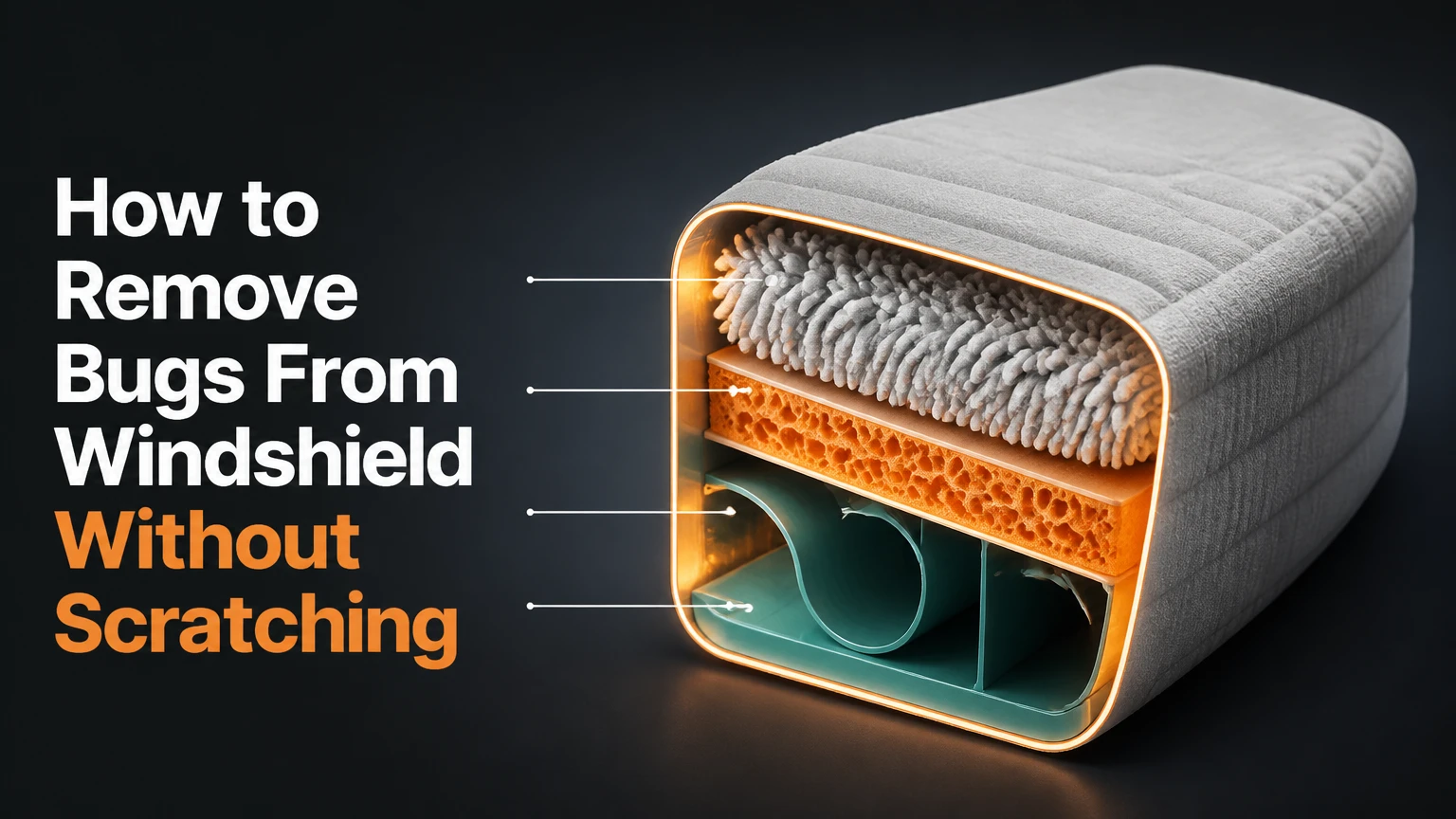
To remove bugs from a windshield, cool the glass, saturate the splatter with automotive bug remover or warm soapy water for 3-5 minutes, then wipe with a clean microfiber towel using light overlapping passes. Rinse completely, dry with a dedicated glass towel, and repeat the soak instead of applying abrasive pressure to hardened residue.
Key Facts / At a Glance
A cool, shaded windshield gives cleaning chemicals more dwell time and reduces water-spot risk.
Fresh bug residue usually needs soaking; baked-on residue may need a second chemical application or lubricated clay.
Automotive glass is hard but can scratch from trapped grit, abrasive pads, damaged wipers, or contaminated towels.
Dedicated bug removers typically cost $7-$15 and work in about 5-10 minutes.
Vinegar can help with mild residue and mineral deposits, but it is weaker than a purpose-made insect remover.
Never run dry wipers across dry splatter because insect shells and road grit can abrade the glass.
What makes bug splatter difficult to remove?
Dried bug splatter contains proteins, lipids, sugars, body fluids, and fragments of the insect’s chitin shell. Heat, airflow, and sunlight remove water from that mixture, leaving a concentrated film that adheres strongly to the windshield and becomes harder to wipe away.
Automotive glass is smooth and nonporous compared with paint, so bug residue does not normally chemically bond to “glass pores.” The residue can lodge in microscopic surface defects, remain around chips and wiper-swept wear, or leave an outline after acidic organic material sits for a long period. That distinction matters because chemical softening usually solves residue, while actual etching requires polishing or professional glass repair.
The windshield’s lower edge deserves extra attention. Bugs collect where airflow changes near the hood, and that area often receives less direct wiper pressure. Dried material also gathers along the ceramic frit border, where a towel can miss the outer few millimeters.
What do you need before cleaning the windshield?
A basic windshield bug-removal job needs a spray bottle, clean water, two or three microfiber towels, a pH-neutral automotive shampoo or dedicated bug remover, and a hose or bucket for rinsing. Typical cost is $5-$20 if supplies are already available, or $10-$30 for a new dedicated kit.
Before You Start
| Requirement | Typical specification | Why it matters |
|---|---|---|
| Working temperature | Cool to the touch, preferably below 90°F | Prevents premature drying |
| Dwell time | 3-5 minutes per application | Rehydrates hardened residue |
| Towels | 2-3 clean, short-pile or waffle-weave microfiber towels | Separates dirty wiping from final drying |
| Cleaner quantity | 6-10 sprays per windshield section | Keeps residue lubricated |
| Total time | 10-20 minutes | Includes soaking, wiping, rinsing, and inspection |
| Difficulty | Easy, but contamination-sensitive | Grit causes most avoidable scratches |
Park in shade, close the doors, and raise the windshield wipers only if the vehicle manufacturer permits it. Do not clean immediately after driving if the glass feels hot. Heat causes water and cleaner to evaporate before the proteins soften.
Keep a separate towel for the windshield. A towel used on wheels, rocker panels, or the ground can carry metallic particles and sand that mark glass during wiping.
How to remove bugs from windshield safely
The safest process has six stages: cool the glass, remove loose grit, soak the splatter, wipe with lubrication, rinse thoroughly, and inspect under angled light. The factor that determines success most often is dwell time, not stronger scrubbing.
Step 1: Cool the glass and rinse off loose grit
Move the vehicle into shade and wait until the windshield is cool. Rinse the entire glass surface with clean water from a hose or low-pressure nozzle, working from the roof toward the hood so loose grit flows downward.
Do not blast a concentrated jet directly at a damaged chip. High-pressure water can force contamination into a damaged area or spread cleaner onto nearby trim. A normal hose stream is sufficient.
Success checkpoint: Water should carry away dust, leaves, and loose insect fragments before any towel touches the glass.
Common mistake: Starting with a dry towel. Dry wiping drags abrasive road dust across the surface and may create fine wiper-sweep scratches.
Step 2: Apply a bug-removal solution
Spray a dedicated automotive bug remover over one windshield section at a time. A typical section is one-quarter of the glass. Apply enough product to keep the surface visibly wet, usually 6-10 sprays depending on the bottle nozzle.
For a household alternative, mix a small amount of pH-neutral car shampoo into warm water. A practical dilution is approximately 1 ounce of shampoo per 1 gallon of water, although the product label should take precedence. Apply the solution with a spray bottle or soaked microfiber towel.
Avoid household dish detergent as a routine choice. Dish soap can remove wax and leave a high-foaming film around paint and rubber, while automotive shampoo is designed for vehicle finishes.
Success checkpoint: Bug spots should look swollen, darker, or visibly softened rather than dry and crusted.
Common mistake: Using too little liquid. A thin mist evaporates quickly and provides insufficient lubrication.
Step 3: Cover the heaviest spots and wait
Place a clean microfiber towel soaked in warm water over dense bug areas. Let the cleaner dwell for 3-5 minutes, but do not allow the surface to dry. In warm weather, re-spray once during the dwell period.
A towel blanket works because it extends contact time and slows evaporation. It is particularly useful for the upper windshield, where dried splatter can resist a quick spray-and-wipe cycle.
Do not use boiling water. A sudden temperature change can stress chipped or previously repaired glass. Warm tap water is adequate.
Success checkpoint: A fingernail should move through softened residue with minimal resistance, but do not scrape the glass with the nail.
Common mistake: Leaving a strong cleaner on surrounding paint or plastic trim for 10-15 minutes. Rinse overspray promptly, especially with alkaline products.
Step 4: Wipe with a clean, lubricated towel
Remove the soaked towel and wipe with light pressure in straight, overlapping lines. Fold the microfiber into quarters and rotate to a clean face as residue transfers into the fabric.
Use a dedicated bug sponge only when the product manufacturer describes it as safe for glass. A soft microfiber mesh or nonabrasive bug pad can increase agitation, but the pad must remain wet and free of grit. Circular rubbing does not automatically scratch glass, yet straight passes make it easier to control contamination and identify missed areas.
Work from the top down. The lower glass generally contains more runoff and grit, so cleaning it last reduces cross-contamination.
Success checkpoint: The residue should lift into the towel rather than smear into a transparent greasy film.
Common mistake: Increasing pressure when a spot resists. Reapply cleaner, cover it again, and wait another 3 minutes.
Step 5: Rinse the windshield and adjacent panels
Flush the glass thoroughly with clean water. Rinse the hood, roof edge, A-pillars, and mirrors if bug remover reached them. Chemical residue left at panel edges can dry into streaks or affect wax and sealants.
Pay attention to the area beneath the wiper arms. Cleaner and softened insect material can collect there, then return to the glass during the next wipe cycle.
Success checkpoint: Water should sheet or run away without carrying visible brown residue from the windshield.
Common mistake: Drying before rinsing. A towel can spread concentrated cleaner and insect material over a much larger area.
Step 6: Dry, inspect, and clean the wiper blades
Dry the windshield with a clean waffle-weave or short-pile glass towel. Inspect from the driver’s seat and from outside while looking across the glass at a shallow angle. Direct sunlight or a bright garage light exposes haze that is invisible in flat lighting.
Clean the rubber wiper blades with a damp microfiber towel. If the towel picks up black streaks, repeat until the blade leaves minimal transfer. Replace blades that are cracked, split, hardened, or continue to chatter after the glass is clean.
Success checkpoint: The windshield should appear clear through the driver’s viewing zone, with no greasy rainbow film when the glass is viewed against light.
Common mistake: Testing the wipers on dry glass. Spray washer fluid first, then run the blades briefly.
Which windshield bug-removal method works best?
A dedicated bug remover is the best choice for heavy, baked-on splatter because its surfactants and solvents are formulated to loosen organic residue without requiring aggressive abrasion. Warm car-shampoo solution is the safest low-cost option for fresh bugs, while clay is a finishing step for bonded contamination rather than a first-line cleaner.
| Method | Typical cost | Working time | Best use | Main limitation |
|---|---|---|---|---|
| Dedicated bug remover | $7-$15 per bottle | 5-10 minutes | Baked-on highway splatter | May strip nearby wax |
| Car shampoo solution | $1-$3 per wash | 10-15 minutes | Fresh or moderate residue | Requires longer soaking |
| Diluted APC | $10-$25 per gallon | 5-10 minutes | Heavy exterior contamination | Must follow label dilution |
| White vinegar and water | $1-$3 | 10-15 minutes | Mild residue or mineral film | Weak against thick proteins |
| Lubricated clay bar | $15-$30 per kit | 15-20 minutes | Remaining bonded particles | Can mar paint if contaminated |
| Wet dryer sheet | $2-$5 per box | 10-15 minutes | Emergency cleaning only | Often leaves a greasy film |
Is vinegar safe for bug splatter?
A 1:1 mixture of white vinegar and water is generally suitable for short contact with exterior glass, provided the surface is cool and the solution is rinsed promptly. Vinegar helps with mild organic residue and mineral deposits, but it usually cannot dissolve thick, sun-baked insect material as efficiently as a dedicated cleaner.
Do not let vinegar dry on paint, natural stone, unprotected metal, or sensitive trim. Vinegar is acidic, and repeated exposure can affect some waxes and coatings. Use distilled water if local tap water leaves heavy mineral spots.
Vinegar should not be confused with a glass polish. It removes soluble residue; it does not restore glass that has been physically scratched or chemically etched.
Can you use a dryer sheet?
A wet dryer sheet can loosen some bug residue because its surfactants transfer into the water and provide mild mechanical agitation. The method is acceptable as an emergency option on uncoated exterior glass, but it is less predictable than microfiber and often leaves fragrance, softener, or oily residue that causes wiper chatter.
If using one, wet the sheet thoroughly, test a small corner, keep the surface lubricated, and follow with automotive glass cleaner and a clean microfiber towel. Do not use a dry sheet. The dry fibers can drag grit across the windshield.
Should you use a clay bar on glass?
Use a fine-grade automotive clay bar only after chemical cleaning and rinsing fail to remove a rough, gritty sensation. Apply dedicated clay lubricant generously, glide the clay with almost no downward pressure, and discard it if it touches the ground.
Clay removes bonded particles. It does not repair scratches, deep water spots, chips, or true acid etching. A clay bar also should not be the first tool for thick bug deposits because the residue can quickly contaminate the clay and increase marring risk.
What should you avoid when removing bugs?
Household abrasives, dry wipers, and aggressive scraping create more lasting damage than the original splatter. Automotive glass can develop visible scratches, especially in the wiper-swept viewing area, when grit becomes trapped between a hard tool and the surface.
Avoid these methods and behaviors:
- Green abrasive pads, scouring powder, and steel wool.
- Razor blades used without professional technique or a suitable glass-safe procedure.
- Pure isopropyl alcohol on hot glass, because it flashes off before soaking and can affect rubber.
- Undiluted APC, degreaser, or solvent on paint, trim, tint, or coatings.
- Reusing a towel that touched wheels, tires, the floor, or engine-bay components.
- Scrubbing a dry spot because the first pass did not remove it.
- Allowing cleaner to dry in direct sun.
- Running contaminated wipers over dry residue.
A common professional rule is simple: increase lubrication and dwell time before increasing mechanical force. Most failed bug-removal attempts reverse that order.
How do coatings, tint, and sensors change the process?
Windshield coatings and interior tint require product compatibility checks before using bug remover, APC, clay lubricant, or vinegar. Exterior glass coatings can lose water-repellent performance when exposed repeatedly to strong cleaners, while interior tint must never be treated with exterior chemicals from the cabin side.
| Surface or feature | Safe starting approach | Avoid | Inspection point |
|---|---|---|---|
| Bare exterior glass | Bug remover, microfiber, full rinse | Abrasive household pads | Haze and wiper sweep |
| Rain-repellent coating | Coating-safe glass cleaner | Strong APC and repeated vinegar | Beading remains uniform |
| Ceramic glass coating | Manufacturer-approved cleaner | Solvent-heavy degreasers | Water behavior stays consistent |
| Tinted windshield band | Clean exterior only | Ammonia near tint edges | No edge lifting or discoloration |
| Camera or sensor area | Spray towel, not sensor housing | Flooding mounts and seams | Driver-assistance warnings absent |
| Heated windshield | Cool surface, mild cleaner | Thermal shock from very hot or cold water | No new chip or stress line |
Spray onto the towel when working close to camera housings, rain sensors, and mirror mounts. Do not flood electrical seams or allow chemical liquid to run behind trim.
If a glass coating is important, test the cleaner on a lower corner and compare water behavior before and after. A visibly changed bead pattern indicates that the product may be removing or altering the protection.
How do you remove fresh bugs during a road trip?
At a fuel stop, remove fresh bugs with washer fluid and a clean microfiber towel before sunlight bakes them onto the glass. Keep a small towel, a 4-8 ounce spray bottle, and a second dry towel in the vehicle, but never use a contaminated gas-station squeegee on the windshield.
For an emergency process:
- Spray washer fluid heavily over one section.
- Wait 30-60 seconds.
- Wipe with a clean microfiber towel using light straight passes.
- Turn the towel to a dry face.
- Repeat before moving to the next section.
- Clean the wiper blades before driving away.
Do not wipe immediately after a long highway run if the glass is extremely hot. A short cooling period reduces rapid evaporation and thermal stress around chips.
How do you fix haze, streaks, or wiper chatter?
A greasy film after bug removal usually comes from cleaner residue, dryer-sheet softener, APC overspray, or dirty wiper blades. Clean the glass again with a dedicated automotive glass cleaner, buff it with two clean towels, and wipe the blades separately.
Use a glass-safe diluted isopropyl alcohol solution only on cool, exterior bare glass, and follow the label guidance for the glass cleaner and any coating. A practical detailing mixture is 1 part 70% isopropyl alcohol to 1 part water, but coated glass may require a manufacturer-approved product instead.
| Symptom | Likely cause | First correction | Escalation |
|---|---|---|---|
| Brown smear | Softened bug residue | Re-soak for 3-5 minutes | Clay with lubricant |
| Rainbow haze | Oily cleaner film | Glass cleaner and two towels | Coating-safe panel wipe |
| Wiper chatter | Film or damaged blade | Clean glass and rubber | Replace blades |
| Faint bug outline | Residue or etching | Repeat chemical cleaning | Glass polish or technician |
| Fine parallel lines | Wiper abrasion or grit | Stop dry wiping | Automotive glass inspection |
| White mineral spots | Hard-water deposits | Vinegar solution on bare glass | Glass-water-spot polish |
A faint outline that remains after repeated cleaning may be etching rather than residue. Hand-applied glass polish can reduce mild deposits, but deep scratches and optical distortion in the driver’s viewing area warrant an automotive glass professional.
Do not polish aggressively near camera calibration zones. Any windshield replacement or substantial optical correction can require recalibration of advanced driver-assistance systems according to the vehicle manufacturer’s procedure.
How much does windshield bug removal cost?
DIY windshield bug removal typically costs $0-$30, depending on whether the owner already has towels and shampoo. Professional exterior detailing commonly adds approximately $20-$75 for a basic glass and exterior wash, while polishing or correction costs more because it requires machine work and inspection.
| Service or purchase | Typical price | Typical duration | Suitable condition |
|---|---|---|---|
| Existing shampoo and towels | $0-$5 | 10-20 minutes | Fresh residue |
| New microfiber towels | $8-$20 | Reusable | Any routine cleaning |
| Dedicated bug remover | $7-$15 | 5-10 minutes | Heavy splatter |
| Clay and lubricant kit | $15-$30 | 15-20 minutes | Rough bonded residue |
| Basic professional wash | $20-$75 | 30-90 minutes | Vehicle-wide contamination |
| Glass polishing service | $75-$200+ | 1-3 hours | Stubborn film or water spots |
Prices vary by region, vehicle size, product concentration, and whether paint decontamination is included. A replacement windshield is not a normal bug-removal solution and should be considered only for damage, severe scratching, or optical distortion.
How can you prevent bugs from sticking?
Prompt cleaning is the most effective prevention because fresh insect residue needs less chemical dwell time and almost no agitation. Apply a compatible exterior glass sealant or ceramic coating if you want easier future cleaning, then use coating-safe maintenance products.
Use washer fluid rated for the season and keep the wiper blades flexible and clean. A windshield with worn blades spreads insect oils into a wide film, reducing visibility even after the original spots disappear.
A practical maintenance schedule is:
- During bug season, rinse or clean the windshield at each fuel stop on long trips.
- After highway travel, remove splatter the same day.
- At every wash, clean the blade edges with a damp microfiber towel.
- Replace wipers when they skip, split, smear, or chatter.
- Reapply a glass sealant according to its label, commonly every 3-6 months.
Prevention does not make the windshield bug-proof. It reduces adhesion and shortens the next cleaning cycle.
The Bottom Line
The safest way to remove bugs from windshield glass is to rinse loose grit, apply a dedicated bug remover or warm automotive shampoo solution, keep the surface wet for 3-5 minutes, and wipe with clean microfiber using light overlapping passes. Rinse the surrounding vehicle, dry the glass, and clean the wiper blades before testing visibility.
Use clay only for small amounts of bonded residue after chemical cleaning. Avoid steel wool, abrasive pads, dry wiping, hot glass, and undiluted cleaners. If haze remains after the residue is gone, diagnose the surface as film, mineral deposits, scratches, or etching before choosing polish or professional repair.
Frequently Asked Questions
Can bugs permanently damage a windshield?
Bug residue usually does not permanently damage clean automotive glass when removed promptly, but long exposure can leave difficult organic film, mineral-like deposits, or localized etching around existing surface defects. Paint and clear coat are more vulnerable than glass, so splatter should be removed from the hood and mirrors at the same time.
Can I use dish soap to clean bug splatter?
A small amount of dish soap diluted in water can remove emergency residue, but automotive shampoo is a better routine choice. Dish soap may strip wax or sealants from nearby paint and can leave a film if rinsing is incomplete. Keep the solution off rubber and trim, then rinse the vehicle thoroughly.
Is WD-40 safe for windshield bugs?
WD-40 can loosen some organic and tar-like residue, but it leaves an oily film that can impair visibility and cause wiper chatter. It is not the preferred windshield cleaner. If it is used on surrounding paint for a specific contaminant, keep it away from glass coatings, rubber, and wiper blades, then degrease and rinse completely.
Can I use a razor blade on the windshield?
A razor blade can scratch or chip automotive glass when used at the wrong angle, over a damaged area, or with insufficient lubrication. Professional glass technicians may use specialized blades for controlled deposits, but most drivers should use soaking, microfiber, and a glass-safe clay bar instead.
Why do bugs keep returning after I clean the windshield?
Bugs can return because residue remains at the wiper edges, lower windshield seal, hood line, or blade rubber. Clean those areas separately and rinse them before the final glass wipe. A damaged blade can also redistribute oils across the windshield, creating the appearance of recurring bugs.
When should a windshield be professionally inspected?
Arrange an inspection when scratches affect the driver’s viewing area, haze remains after chemical cleaning and gentle polishing, a chip spreads, or advanced driver-assistance warnings appear after windshield work. Optical distortion and camera-calibration problems are safety issues that ordinary bug-removal products cannot correct.


