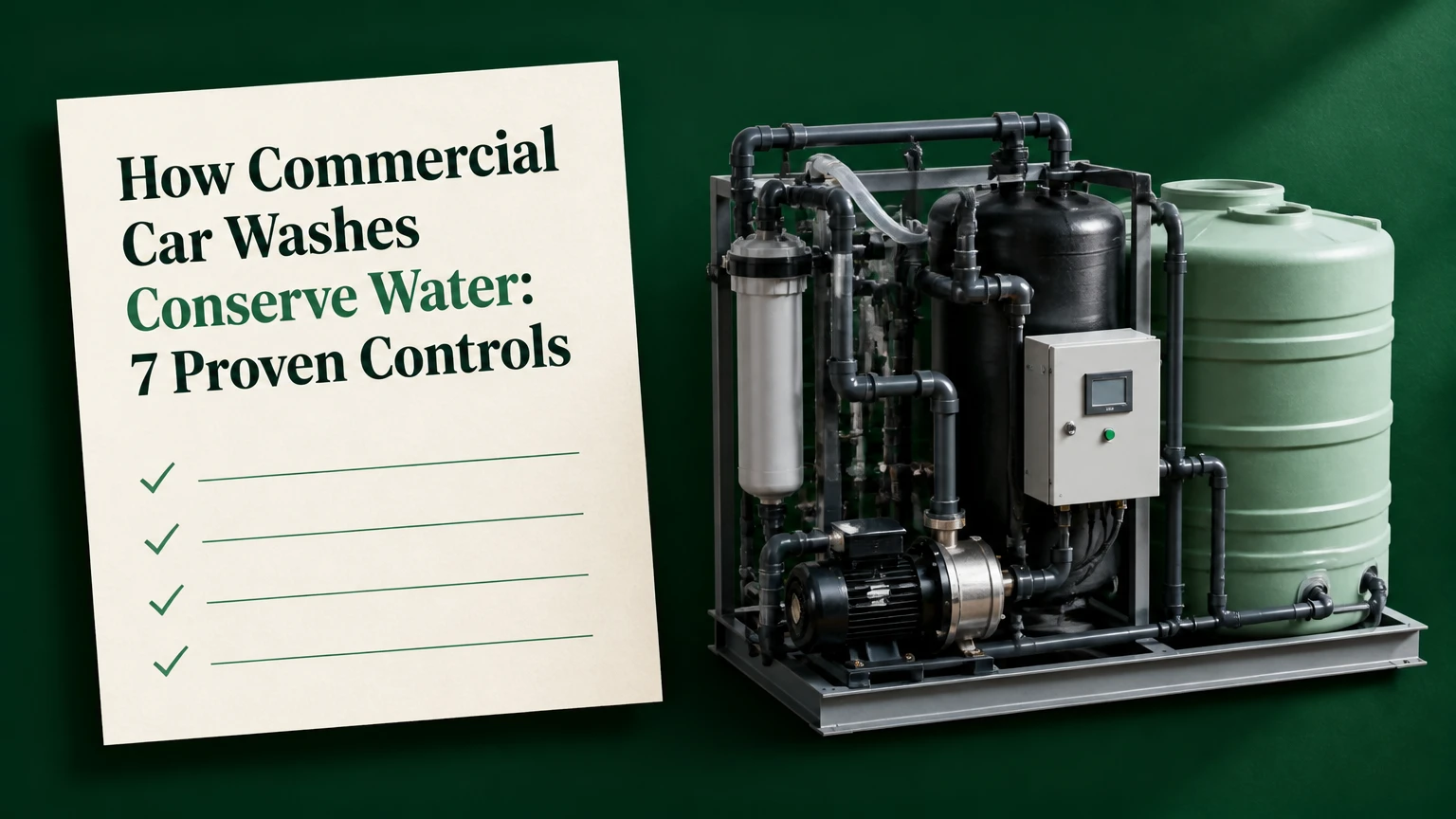
Commercial car washes conserve water by capturing wastewater, separating solids and oils, filtering and treating reusable water, and applying high-pressure spray only where needed. Modern facilities commonly consume about 35-75 litres of fresh water per vehicle, although total water circulated through the equipment can be much higher because the same water is reused.
Key Facts at a Glance
- A commercial car wash can use approximately 35-75 litres of fresh water per vehicle under typical operating conditions.
- A driveway wash can consume roughly 300-500 litres because hose water usually flows directly to the ground or drain.
- Water reclamation removes grit, suspended solids, oils, detergents, and odour-causing contaminants before reuse.
- High-pressure pumps and accurately aimed nozzles reduce the volume required for rinsing and cleaning.
- Reverse osmosis usually supplies the final spot-free rinse rather than the entire wash cycle.
- Water efficiency depends on equipment settings, wash format, local rules, maintenance, vehicle size, and the definition of “water used.”
How Commercial Car Washes Conserve Water
Commercial car washes conserve water through three linked controls: reuse, precision, and pressure. Reclamation systems return treated process water to earlier wash stages, vehicle sensors prevent spray when no body panel is present, and high-pressure pumps remove dirt with less flow than an ordinary hose.
The largest saving usually comes from replacing one-pass water use with controlled recirculation. A tunnel may collect water from dozens or hundreds of vehicles, treat it in a holding system, and reuse it for wheel, underbody, presoak, or wash applications. The final rinse normally receives cleaner water because mineral residue is visible on glass and paint.
Commercial operators also meter incoming water and inspect equipment for leaks, blocked nozzles, excessive conveyor dwell time, and malfunctioning valves. The International Carwash Association’s WaterSavers programme has used a threshold of 40 gallons, approximately 151 litres, or less of fresh water per vehicle for qualifying facilities, demonstrating why published figures must distinguish fresh intake from total circulation.
Which conservation controls matter most?
Water reclamation usually produces the largest reduction in fresh-water demand, while precision spray controls determine whether the reclaimed supply is used efficiently. High pressure helps, but pressure alone does not conserve water if pumps run continuously or nozzles are oversized.
A practical operator rule is to measure litres of fresh water per vehicle at the meter, then compare that figure with conveyor counts or point-of-sale transactions. A facility that advertises a 90% recycle rate without publishing fresh-water intake may be describing internal circulation rather than actual water savings.
How Does Commercial Car Wash Water Recycling Work?
Commercial car wash water recycling follows a treatment sequence: capture, settling, separation, filtration, optional biological or ozone treatment, storage, and controlled reuse. Recycled water normally supplies dirtier early stages, while softened or reverse-osmosis water is reserved for waxing, rinsing, and spot prevention.
Wash-floor drains direct wastewater to a contained trench, pit, or interceptor rather than an ordinary stormwater outlet. The first treatment stage reduces the load on pumps and fine filters by allowing sand, mud, and heavier solids to settle.
Floating hydrocarbons may be removed by an oil-water separator or skimming arrangement, although separator performance depends on flow rate, maintenance, detergent chemistry, and the physical design. Treated water then passes through screens, cartridge filters, sand or multimedia filters, activated carbon, membrane systems, or combinations of those technologies.
The seven-stage flow
- Capture: Floor channels collect wash water from the conveyor, bay, wheel area, and underbody equipment.
- Primary settling: Mud, sand, and heavier grit fall into a sludge zone or settling tank.
- Oil separation: Floating oil and grease are skimmed or retained in an interceptor.
- Equalization: A holding tank smooths changes in flow, temperature, chemical concentration, and vehicle volume.
- Filtration: Screens and multimedia or cartridge filters remove progressively smaller suspended particles.
- Treatment and storage: Aeration, ozone, biological treatment, carbon, or other processes control odour and dissolved contaminants.
- Reuse and discharge: Reclaimed water returns to compatible wash stages, while excess or unsuitable water goes to an approved sanitary sewer or treatment route.
The final stage is not always a closed loop. Evaporation, sludge removal, drag-out on vehicles, filter backwashing, leaks, and permitted discharge create losses that must be replaced with fresh water.
What Equipment Does a Reclamation System Need?
A functional reclamation system needs containment, solids removal, pumping, filtration, storage, controls, and a compliant discharge path. Ozone, biological treatment, hydrocyclones, carbon, softeners, and reverse osmosis are optional or site-specific technologies rather than mandatory components in every car wash.
| Component | Primary function | Typical operating issue | Maintenance interval |
|---|---|---|---|
| Trench drains and screens | Capture runoff and retain large debris | Hair, leaves, towels, and stones block flow | Inspect daily; clean 1-7 days |
| Settling or interceptor tank | Remove mud, sand, grit, and floating oil | Sludge reduces retention volume | Inspect weekly; pump typically 3-6 months |
| Transfer pump | Move water between tanks and filters | Abrasive grit damages seals and impellers | Inspect monthly; service by manufacturer |
| Multimedia filter | Remove suspended particles | High pressure drop indicates loading | Backwash by pressure trigger or schedule |
| Cartridge or bag filter | Polish water before sensitive equipment | Media blinds when solids accumulate | Replace according to pressure differential |
| Ozone or aeration unit | Reduce odour and support oxidation | Failed generators allow anaerobic conditions | Check daily; service monthly or quarterly |
| RO membrane system | Remove dissolved minerals for spot-free rinse | Scaling and low recovery increase cost | Test conductivity daily; sanitize as scheduled |
A small self-serve site may use settling tanks and cartridge filtration, whereas a high-volume express tunnel may add hydrocyclones, automated backwashing, ozone, carbon, conductivity monitoring, and a separate RO skid. System sizing must follow peak flow, not average daily volume.
Why are settling tanks necessary?
Settling tanks protect pumps and filters by removing dense particles before water reaches mechanical equipment. A tank that holds too much sludge loses effective volume, shortens retention time, and pushes grit into filters where it increases pressure drop and maintenance cost.
Three-chamber interceptors are common because they provide sequential settling and separation. Cyclonic or hydrocyclone equipment accelerates particle removal by using centrifugal force, but it does not eliminate the need for sludge disposal or fine filtration.
Which Technologies Are Used in Commercial Car Washes?
Commercial car wash treatment technologies differ by the contaminant they target. Gravity tanks remove dense solids, hydrocyclones accelerate solids separation, ozone and aeration address biological conditions and odour, carbon adsorbs some dissolved compounds, and RO removes dissolved minerals that cause water spots.
| Technology | Removes or controls | Typical placement | Main limitation |
|---|---|---|---|
| Gravity settling | Mud, sand, and heavy grit | First treatment stage | Requires space and scheduled pumping |
| Oil-water separation | Floating hydrocarbons and grease | Interceptor or separator tank | Poor performance with emulsified oils |
| Hydrocyclone | Fine-to-medium suspended solids | After coarse settling or before filters | Needs adequate flow and pressure |
| Ozone oxidation | Odour-causing compounds and some organics | Holding or treatment tank | Does not replace solids filtration |
| Activated carbon | Some dissolved organics, colour, and odour | Polishing stage | Media eventually saturates |
| Reverse osmosis | Dissolved salts and minerals | Final-rinse supply | Produces reject water and needs pretreatment |
A common technical error is treating ozone as a complete purification method. Ozone can oxidize selected compounds and improve odour control, but it does not reliably remove all suspended grit, dissolved salts, or every detergent component.
Reverse osmosis has a different job. RO produces low-mineral water for a spot-free finish, but membrane recovery is incomplete, so a portion becomes concentrate or reject water. Operators must account for that reject stream when calculating total site water use.
How Much Water Does a Commercial Car Wash Use?
A commercial car wash typically uses 35-75 litres of fresh water per vehicle, while total water circulated through the wash may range from about 115-300 litres depending on format and equipment. Touchless systems often use more water per vehicle because they compensate for the absence of brushes with longer high-pressure spray cycles.
| Wash format | Total water circulated per vehicle | Fresh water per vehicle | Typical cycle time |
|---|---|---|---|
| Express conveyor tunnel | 115-170 L | 35-60 L | 2-3 minutes |
| In-bay friction automatic | 115-150 L | 45-70 L | 4-5 minutes |
| Touchless automatic | 220-300 L | 75-110 L | 4-6 minutes |
| Self-serve bay | 100-250 L | 100-250 L | 10-20 minutes |
| Driveway hose wash | 300-500 L | 300-500 L | 30-45 minutes |
These are typical planning ranges, not universal limits. A high-volume tunnel with weak reclamation maintenance can exceed them, while a carefully calibrated low-flow bay can perform below them.
Published comparisons also vary because some count rinse water, some count only municipal intake, some include RO reject, and some calculate water per paid wash rather than per vehicle. The most useful metric for a business is fresh litres per vehicle, supported by a meter reading and a reliable vehicle count.
Which Commercial Wash Format Uses the Least Fresh Water?
Express conveyor tunnels generally use the least fresh water per vehicle when they operate a well-maintained reclamation system, because high throughput spreads treatment and storage capacity across many washes. Touchless automatics usually consume more fresh water because their cleaning method requires extended high-pressure applications.
| Decision factor | Conveyor tunnel | Touchless automatic | In-bay friction | Driveway wash |
|---|---|---|---|---|
| Fresh-water range | 35-60 L | 75-110 L | 45-70 L | 300-500 L |
| Reclamation potential | 70-85% typical | 50-65% typical | 60-75% typical | Usually none |
| Paint contact | Cloth or brush contact | No brush contact | Cloth or brush contact | User-controlled |
| Best operating speed | 2-3 minutes | 4-6 minutes | 4-5 minutes | 30-45 minutes |
| Main water risk | Poor reclaim maintenance | Long spray cycles | Repeated rinse use | Uncontained runoff |
| Best fit | Routine fleet or family washing | Sensitive trim and no-contact preference | Moderate regular washing | Occasional spot cleaning |
A tunnel is not automatically the most efficient choice. Reclamation percentage, nozzle calibration, conveyor loading, and leak control matter more than the building label alone.
Does Recycled Water Touch the Vehicle?
Recycled water commonly touches the vehicle during presoak, wheel cleaning, underbody washing, and initial rinsing. Many operators use softened, filtered, or reclaimed water for those stages and reserve fresh, deionized, or RO-treated water for the final rinse.
Reclaimed water can contain residual hardness, surfactants, suspended particles, and dissolved organic material even after treatment. Those characteristics are acceptable for soil removal when the system is properly managed, but they can leave spots or create odour if used as the final rinse.
RO water removes many dissolved minerals, including calcium and magnesium, that remain after ordinary filtration. RO does not replace a settling tank, oil separator, or particle filter because membranes require clean feed water and can foul rapidly when exposed to grit or heavy organic loads.
Is recycled water safe for automotive paint?
Properly treated reclaimed water is generally suitable for routine wash stages, but poorly maintained systems can carry fine grit that increases the risk of micro-abrasion. The risk depends on particle size, concentration, spray pressure, nozzle condition, and whether cloth media traps or drags contamination across the surface.
A useful facility question is whether the operator monitors filter pressure, turbidity, conductivity, and final-rinse quality. A clear-looking reclaim tank is not proof that microscopic particles or dissolved salts have been removed.
What Does a Commercial Water-Recycling System Cost?
A commercial water-recycling system can cost from tens of thousands to well over one hundred thousand dollars, depending on flow capacity, excavation, automation, membrane treatment, local construction, and wastewater requirements. Equipment pricing alone is not a project price because tanks, plumbing, electrical work, permits, installation, and civil works can equal a substantial share of capital cost.
| Project element | Typical planning range | Cost driver | Budget question |
|---|---|---|---|
| Basic settling and filtration retrofit | $20,000-$60,000 | Existing tanks and drainage | Can existing containment be reused? |
| Automated reclaim package | $50,000-$150,000 | Flow rate and controls | What peak litres per minute must it handle? |
| RO final-rinse package | $10,000-$40,000 | Membrane capacity and pretreatment | Where will reject water go? |
| Tank excavation and civil work | $15,000-$100,000 | Soil, access, and local construction | Is excavation possible without closing the site? |
| Annual service and consumables | $5,000-$25,000 | Wash volume and treatment complexity | Who pumps sludge and changes media? |
Payback depends on water and sewer tariffs, daily vehicle volume, discharge charges, chemical use, drought restrictions, and the cost of downtime. A site washing 300 vehicles daily can justify more automation than a 40-vehicle operation, even when both use similar treatment principles.
Operators should request a water balance showing fresh intake, reuse, evaporation, sludge, RO reject, vehicle drag-out, permitted discharge, and unexplained loss. A vendor cannot credibly promise savings without that baseline.
How Should Operators Maintain Reclaimed Water?
Operators should inspect drains and screens daily, monitor filter pressure and water quality, remove sludge before tanks lose capacity, and calibrate chemical pumps on a documented schedule. Preventive maintenance protects both water savings and vehicle finish because overloaded treatment equipment transfers its failure into the wash process.
Maintenance controls that prevent avoidable losses
- Daily: Check tank levels, pump noise, spray patterns, leaks, odour, chemical feed, and final-rinse conductivity.
- Weekly: Clean trench screens, inspect float switches, review fresh-water meter readings, and compare litres per vehicle.
- Monthly: Test backwash operation, inspect nozzles, calibrate dosing pumps, and check ozone or aeration output.
- Every 3-6 months: Vacuum settled sludge according to wash volume and tank capacity.
- Annually: Inspect tanks, membranes, separator components, electrical controls, backflow protection, and discharge documentation.
The most common maintenance mistake is waiting for visible dirty water. Filter pressure, turbidity, conductivity, and odour usually reveal deterioration earlier than appearance does.
Chemical overdosing creates foam, increases treatment demand, and can interfere with filtration or biological balance. Automated dosing should be tied to flow, detergent concentration, and manufacturer instructions rather than adjusted by visual foam level.
What Problems Reduce Water Savings?
The main causes of poor water performance are overfilled sludge tanks, leaking plumbing, excessive spray duration, misaligned nozzles, chemical overdosing, failed aeration, and unmeasured RO reject. Each problem either increases fresh-water intake or reduces the amount of reclaimed water that can return safely to service.
| Failure mode | Observable symptom | Likely cause | Corrective action |
|---|---|---|---|
| Rising fresh-water use | Litres per vehicle increase for two weeks | Leak, poor reclaim, or extra rinse time | Audit meter, valves, and cycle settings |
| Rotten-egg odour | Smell from tanks or drains | Anaerobic conditions or failed aeration | Restore aeration; remove excess sludge |
| Cloudy final rinse | Spots or haze on paint and glass | High conductivity or membrane breakthrough | Test RO, carbon, resin, and feed filters |
| Filter blockage | Pump pressure rises quickly | Sludge bypass or excessive solids load | Pump tanks and replace overloaded media |
| Paint micro-marring | Fine swirls after repeated washes | Grit in reclaim water or contaminated media | Isolate reclaim, test particles, clean media |
| Excessive foam | Foam persists in holding tanks | Chemical overdosing or incompatible products | Recalibrate pumps and verify chemistry |
| Low RO output | Slow or weak spot-free rinse | Scaling, fouling, or low feed pressure | Pretreat, clean, and test membrane performance |
Ozone cannot cure a tank that is physically full of sludge. Similarly, a new membrane cannot compensate for a failed separator upstream.
Can Commercial Wash Water Enter a Storm Drain?
Commercial wash water should not enter a storm drain unless a local authority explicitly permits that discharge, which is uncommon because storm systems often flow untreated to waterways. Commercial facilities normally contain wash water and send permitted wastewater to a sanitary sewer, onsite treatment system, or licensed waste contractor.
Requirements vary by country, state, municipality, sewer authority, and site design. Some jurisdictions require pretreatment, discharge sampling, backflow protection, oil separation, spill controls, records, or approval before a connection is made.
Driveway washing can also create a pollution problem when detergent, oil, brake dust, and metals flow into a storm drain. A commercial wash may therefore conserve water while also reducing uncontrolled runoff, provided the facility follows its permit and disposes of sludge and concentrates correctly.
What happens to sludge and RO reject?
Settled sludge is removed by vacuum pumping and transported or disposed of according to local waste rules. Sludge may contain petroleum residues, metals, road salts, and concentrated cleaning chemicals, so it should not be treated as ordinary soil.
RO reject contains the minerals and contaminants retained by the membrane. Some facilities send it to an approved sanitary drain, blend it into compatible process use, or manage it under local discharge limits. Counting only permeate and ignoring reject overstates water efficiency.
How Can Customers Identify a Water-Efficient Car Wash?
Customers can identify a water-efficient car wash by asking for fresh-water use per vehicle, checking whether the site contains and reuses process water, and choosing a facility with a recognized water-efficiency programme or transparent operating data. A claim such as “eco-friendly” has little value without a measurement boundary.
Ask these questions before choosing a facility:
- How many litres of fresh water do you use per vehicle?
- Does the figure include RO reject and backwash water?
- Which wash stages use reclaimed water?
- How often are settling tanks pumped?
- Is wastewater connected to a sanitary sewer or storm drain?
- Is the final rinse softened, deionized, or RO-treated?
- Which certification or local permit supports the environmental claim?
For routine washing, a maintained conveyor tunnel with documented fresh-water use is often the strongest water-saving choice. Owners of heavily modified, delicate, or show vehicles may prefer a careful hand-detailing facility, but hand washing is not automatically more water-efficient because labour-intensive rinsing can use large volumes.
What Is the Best Water Strategy for a New Car Wash?
A new car wash should begin with a measured water balance, correctly sized settling capacity, reliable solids separation, staged filtration, automated dosing, and a separate high-quality final-rinse loop. Hydrocyclones, ozone, and RO should be selected after flow, contaminant, discharge, and maintenance requirements are defined.
A practical design sequence is:
- Measure expected vehicles per hour, peak flow, vehicle mix, and operating hours.
- Separate process-water reuse from final-rinse water.
- Size tanks for peak inflow and required retention time.
- Provide safe access for sludge pumping and filter replacement.
- Install meters on fresh intake, reclaim return, RO feed, RO permeate, and reject.
- Add alarms for high tank level, pump failure, filter pressure, and conductivity.
- Confirm sewer, stormwater, chemical-storage, and waste rules before construction.
- Commission the system with baseline readings rather than vendor estimates alone.
The lowest-maintenance system is not always the most economical. A hydrocyclone can reduce solids loading, but it still needs a downstream treatment train and a plan for concentrated waste.
What Are the Limits of Water Recycling?
Water recycling does not make a car wash water-neutral, eliminate all wastewater, or guarantee paint-safe performance without maintenance. Fresh water remains necessary for evaporation losses, chemical dilution, final rinsing, membrane operation, tank cleaning, and replacement of water that becomes too contaminated for reuse.
Water reclamation also does not remove every environmental concern. Detergent ingredients, oils, tire residues, metals, biocides, and persistent chemicals still require appropriate product selection and wastewater management.
The strongest sustainability decision is therefore operational rather than purely technological: measure every major water stream, prevent contamination at the source, reuse water only where its quality is suitable, and discharge residual water legally. A complex system operated without monitoring can perform worse than a simpler system that receives consistent maintenance.
Frequently Asked Questions
Is a commercial car wash more water-efficient than washing at home?
Usually, yes. A commercial facility typically uses about 35-75 litres of fresh water per vehicle, while a driveway wash can use approximately 300-500 litres from a running hose. The comparison changes when a homeowner uses a measured bucket, shuts off the hose, captures runoff, and washes a small vehicle carefully.
Do commercial car washes recycle all their water?
No. Commercial car washes usually recycle a portion of process water, not every litre. Water leaves through evaporation, sludge, vehicle drag-out, filter backwash, leaks, RO reject, and permitted discharge. A credible recycle claim should state whether it measures total circulation or fresh-water replacement.
Does a touchless wash save more water than a brush wash?
Usually, no. Touchless systems commonly use about 75-110 litres of fresh water per vehicle because they rely on longer high-pressure spray cycles. Friction or conveyor systems may use about 35-70 litres when reclamation, nozzles, and conveyor timing are well maintained.
Why does recycled wash water sometimes smell bad?
Recycled wash water develops bad odours when organic residue and detergent remain in stagnant, oxygen-poor tanks. Overfilled sludge compartments and failed aeration make the problem worse. Operators normally correct the condition by restoring circulation or aeration, removing sludge, checking chemistry, and cleaning affected tanks.
Is RO water necessary for every wash stage?
No. RO water is usually unnecessary for presoak, wheel cleaning, and initial washing, where reclaimed or softened water can perform adequately. RO is most valuable for the final rinse because its low mineral content reduces spots, although membrane reject and pretreatment add operating costs.
How often should a car wash pump out its settling tank?
A typical commercial interval is every 3-6 months, but high-volume sites may need more frequent pumping. The correct schedule depends on vehicle count, soil load, tank capacity, retention volume, and sludge depth. Waiting until filters clog is a poor substitute for measuring and removing accumulated solids.
The Bottom Line
Commercial car washes conserve water through reclamation, containment, high-pressure cleaning, accurate spray control, chemical dosing, and selective use of RO water. The typical fresh-water advantage is substantial, with commercial systems often using 35-75 litres per vehicle compared with roughly 300-500 litres for an uncontrolled driveway wash.
The exact result depends on wash format and operating discipline. For customers, choose a facility that publishes fresh litres per vehicle and manages wastewater legally. For operators, measure every water stream, maintain settling tanks and filters, and treat recycling as a complete process rather than a single piece of equipment. That is how commercial car washes conserve water without transferring the pollution problem elsewhere.


