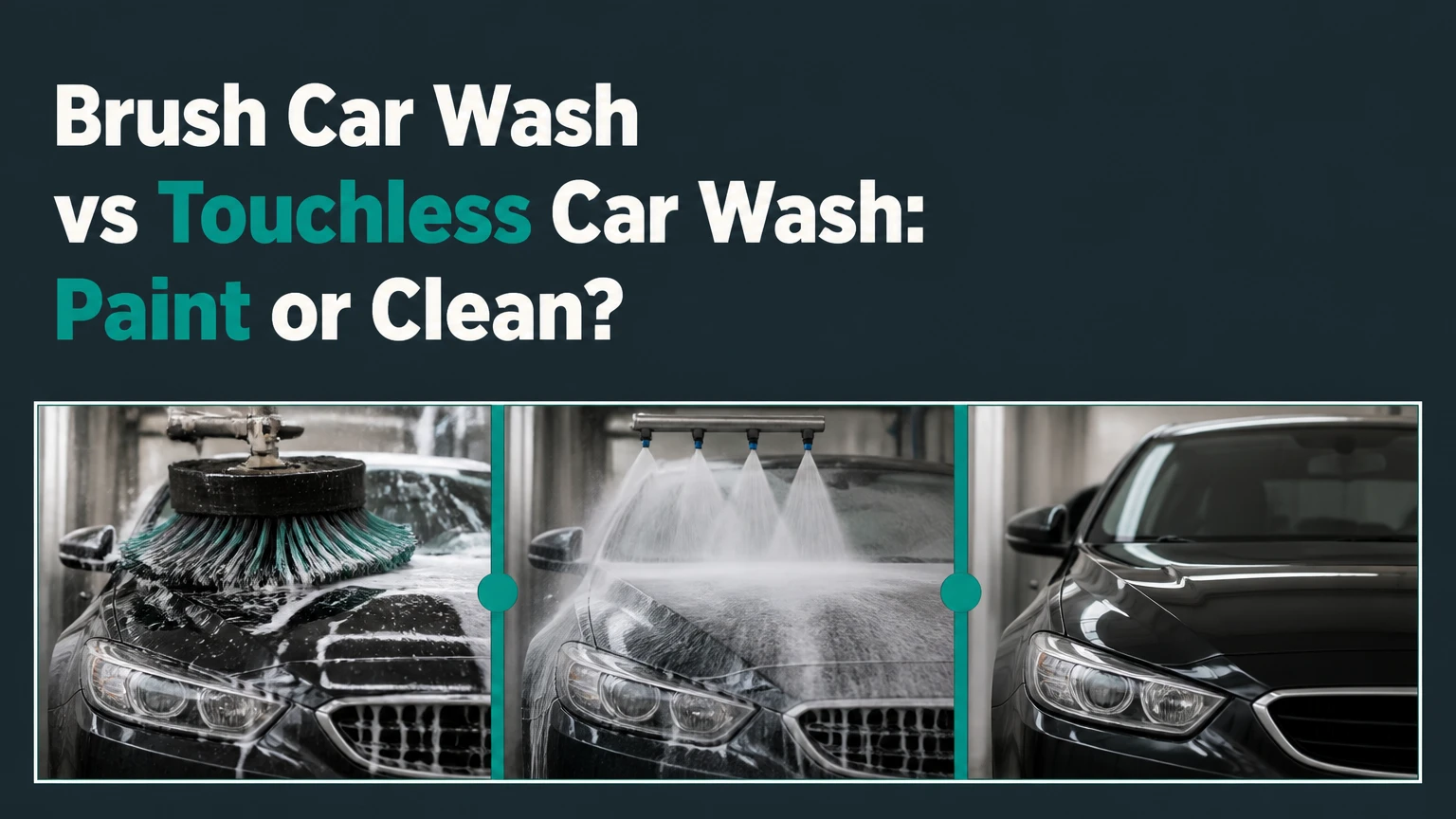
A brush car wash cleans with lubricated physical contact, while a touchless car wash uses detergents and high-pressure water without touching the vehicle. Touchless is usually safer for delicate paint, ceramic coatings, loose trim, and paint protection film, but a well-maintained soft-touch wash removes bonded road film and heavy grime more effectively.
Key Facts at a Glance
- A soft-touch wash uses closed-cell foam or microfiber media; older nylon brushes present a higher abrasion risk.
- A touchless wash cannot create brush-induced swirls, but strong chemicals and poor spray coverage can still damage neglected trim or leave residue.
- Typical automatic wash cycles take 2-4 minutes for a conveyor soft-touch system and 4-7 minutes for an in-bay touchless system.
- Soft-touch systems commonly use about 110-150 liters of water per vehicle; touchless systems often use about 150-260 liters.
- Heavy mud should be removed with a pressure rinse before any friction wash.
- Ceramic coatings reduce dirt adhesion, but they do not make a vehicle immune to chemical misuse or automatic-wash damage.
Brush Car Wash vs Touchless Car Wash: What Is the Difference?
A brush car wash removes contamination through friction, whereas a touchless car wash removes contamination through chemical loosening and pressurized water. The decisive difference is whether a cleaning material physically contacts the paint, not whether the wash is automatic.
Modern soft-touch equipment generally uses foam curtains, closed-cell polyethylene, or microfiber-like fabric rather than the stiff nylon bristles used in older systems. Those materials reduce abrasion when the wash has adequate detergent, water, and clean equipment. They do not eliminate contact risk because the media can still drag abrasive grit across the clear coat.
Touchless equipment substitutes chemistry and water velocity for mechanical scrubbing. Alkaline presoak commonly attacks oily organic contamination, while acidic chemistry helps dissolve mineral deposits and road-salt residues. Actual performance depends on chemical concentration, surface temperature, dwell time, nozzle distance, pressure, and whether the spray reaches recesses.
The International Carwash Association advises that professional washing can reduce environmental contamination compared with washing on a driveway because wash water is collected and treated rather than discharged directly into storm drains. That environmental advantage applies to both automatic formats, not exclusively to touchless equipment.
How Does Each Automatic Wash Work?
A brush car wash follows a pre-rinse, detergent, friction, rinse, optional protection, and drying sequence. A touchless car wash follows a similar sequence but replaces the friction stage with chemical presoak and high-pressure spray arms.
Brush Wash Sequence
- Pre-rinse: Water arches remove loose sand, dust, and surface grit before contact.
- Foam application: Detergent lubricates the paint and helps suspend loosened contamination.
- Soft-touch pass: Top and side media contact the roof, glass, doors, wheels, and lower panels.
- Rinse: Clean water flushes away detergent and suspended soil.
- Optional protectant: Spray wax or sealant improves short-term water behavior.
- Drying: Air blowers remove water from horizontal panels, mirrors, lamps, and trim.
The pre-rinse is the most important protection step. A dirty brush can transfer grit, but even a clean brush can create friction when a thick layer of sand remains on the vehicle.
Touchless Wash Sequence
- Undercarriage rinse: Upward jets target salt, mud, and debris beneath the vehicle.
- Alkaline presoak: The first chemical stage usually targets oily, protein-based, or organic soils.
- Acidic presoak: The second stage can attack mineral scale, salt, and inorganic deposits.
- High-pressure wash: Robotic arms direct water around the vehicle, often at approximately 1,000-1,500 PSI inside the equipment.
- Spot-free rinse: Reverse-osmosis water reduces mineral spotting.
- Drying: Blowers push water from glass, body seams, mirrors, and trim.
Pressure alone does not guarantee cleanliness. A touchless wash with short chemical dwell time may perform worse than a lower-pressure system that applies the right detergent at the correct temperature.
Which Wash Cleans Better?
A brush car wash usually cleans better when dirt is tightly bonded to the paint, while a touchless car wash performs better for routine dust, loose grime, and maintenance washing. Neither method is universally superior because cleaning depends on soil type, chemical dwell time, equipment maintenance, and the vehicle’s surface condition.
| Contamination type | Better automatic option | Reason | Recommended preparation |
|---|---|---|---|
| Loose dust below 24 hours old | Touchless | High-pressure rinse removes low-adhesion particles | Select a pre-rinse and spot-free rinse |
| Dried bird droppings | Touchless first | Alkaline presoak softens organic residue without contact | Allow full chemical dwell time |
| Oily road film | Touchless or soft-touch | Chemistry dissolves film; media removes remaining residue | Use a quality presoak |
| Dried mineral spots | Touchless with acid stage | Acid chemistry targets inorganic deposits | Avoid leaving chemicals to dry |
| Thick clay or mud | Soft-touch after pre-rinse | Contact removes deposits that spray may leave behind | Pressure-rinse until large clods are gone |
| Winter salt underbody buildup | Either with undercarriage cycle | Water access matters more than contact method | Choose an underbody spray |
| Brake dust on wheels | Soft-touch usually | Wheel media reaches more surfaces | Confirm wheel compatibility |
| Sand-heavy lower panels | Neither without pre-rinse | Contact can drag grit; pressure alone may leave film | Use self-serve pressure rinse first |
A practitioner rule of thumb is simple: if a fingernail can feel a raised layer after the touchless cycle, the remaining contamination needs controlled mechanical removal. Repeating the same touchless wash may add chemical exposure without removing the bonded film.
Which Is Safer for Paint?
Touchless washing is safer for preserving a high-gloss finish because it removes mechanical contact from the cleaning process. Soft-touch washing can be acceptable on a daily driver when the equipment is clean, the presoak is effective, and the vehicle receives a thorough pre-rinse.
Swirl marks are fine, curved scratches in the clear coat that become visible under direct sunlight or a point light. They result from repeated abrasive contact, and the abrasive material may be road grit trapped in wash media rather than the foam or microfiber material itself.
Touchless washing removes that particular risk, but it introduces other variables. High-pH or low-pH chemicals can reduce the life of carnauba wax, weaken inexpensive sealants, fade neglected exterior plastics, or leave white residue if the chemical dries. Properly formulated products used within the equipment manufacturer’s instructions are less concerning than uncontrolled chemical concentration or poor rinsing.
A soft-touch wash is a poor choice for fresh paint, soft single-stage paint, heavily contaminated vehicles without pre-rinsing, and cars with loose decals or failing trim. A touchless wash is a poor choice when the owner expects professional-detailing results from a heavily neglected surface.
Paint Protection Comparison
| Vehicle surface | Preferred wash | Main risk | Practical limit |
|---|---|---|---|
| Bare clear coat, daily driver | Clean soft-touch or touchless | Swirls from grit or chemical residue | Inspect the wash media and pre-rinse |
| Freshly repainted panel | Touchless after cure | Solvent or water exposure before full cure | Follow the body shop’s cure period |
| Ceramic coating | Touchless | Strong chemistry or poor drying | Use coating-safe detergent when available |
| Paint protection film | Touchless or clean soft-touch | Lifted edges, especially at seams | Avoid direct high-pressure spray at edges |
| Matte or satin paint | Touchless | Gloss change from polishing or residue | Never use a wax program unless approved |
| Vinyl wrap | Touchless | Edge lifting and chemical staining | Keep spray away from damaged edges |
| Soft convertible top | Neither automatic option preferred | Brush snagging and chemical saturation | Use a controlled hand wash |
Ceramic coating does not mean “chemical-proof.” Coating manufacturers differ in recommended pH ranges, and a touchless operator may not disclose detergent concentration. The safest routine is a coating-compatible wash followed by periodic inspection of water behavior and surface feel.
What Do Brush and Touchless Washes Cost and Use?
Typical single-wash pricing is about $10-$20 for a conveyor soft-touch wash and $12-$30 for an in-bay touchless wash in North American-equivalent pricing. Water use commonly falls near 110-150 liters for soft-touch equipment and 150-260 liters for touchless equipment, although reclamation systems can materially change fresh-water consumption.
| Attribute | Soft-touch conveyor | Touchless in-bay | Decision meaning |
|---|---|---|---|
| Typical cycle time | 2-4 minutes | 4-7 minutes | Soft-touch usually moves more vehicles per hour |
| Typical water volume | 110-150 L | 150-260 L | Touchless often needs more spray time |
| Typical single-wash price | $10-$20 | $12-$30 | Local pricing varies by package |
| Typical operating pressure | 60-300 PSI at wash media or low-pressure stages | 1,000-1,500+ PSI at spray equipment | Pressure does not equal cleaning quality |
| Typical format | Conveyor tunnel | Robotic in-bay automatic | The vehicle moves in one, stays still in the other |
| Typical throughput | 60-100 vehicles per hour | 8-12 vehicles per hour | In-bay systems create longer queues |
These ranges are typical industry figures, not universal specifications. Equipment manufacturer, wash package, reclaim system, local labor cost, and the inclusion of underbody spray or protectant can move the final price substantially.
Water reclamation also complicates comparisons. A system may consume a high gross volume while using less fresh municipal water because rinse water is filtered and reused. Ask the operator whether its published number means total process water or fresh-water intake.
Which Equipment Format Is Better?
Conveyor tunnels are faster and better suited to high-volume routine washing, while in-bay automatic systems offer a stationary vehicle platform and are commonly used for touchless cleaning. The equipment format affects throughput, access, wheel guidance, and compatibility with vehicle dimensions.
| Equipment format | Vehicle movement | Typical capacity | Common configuration | Main limitation |
|---|---|---|---|---|
| Soft-touch conveyor tunnel | Motorized track pulls vehicle | 60-100 vehicles/hour | Foam or cloth contact wash | Wheel and body-clearance requirements |
| Touchless conveyor tunnel | Track moves vehicle past spray zones | 40-70 vehicles/hour | High-pressure robotic arches | Less common than in-bay touchless |
| Touchless in-bay automatic | Vehicle remains stationary | 8-12 vehicles/hour | Robotic gantry and spray arms | Longer cycle and fixed spray angles |
| Self-serve pressure bay | Driver operates wand | 4-8 vehicles/hour per bay | Rinse, soap, rinse, wax | Results depend on user technique |
Check the posted dimensions before entering. Roof racks, dually rear wheels, very wide tires, low splitters, long antennas, loose wipers, and aftermarket mirrors can create equipment or vehicle-clearance problems even when the wash is nominally touchless.
Which Wash Fits Each Driver?
The best choice depends on paint priorities, contamination, vehicle accessories, and washing frequency. Touchless is the default for finish preservation, while soft-touch earns its place when bonded contamination remains after a proper chemical wash.
New, Luxury, or Exotic Vehicles
Choose touchless washing or a careful hand wash when preserving an expensive finish matters more than removing every trace of road film. Exotic paint, fresh correction work, delicate trim, low splitters, and exposed carbon-fiber surfaces justify avoiding unnecessary mechanical contact.
Use a touchless wash for maintenance, then schedule a professional hand wash when the surface needs decontamination. Do not use a brush tunnel merely because its premium package includes wax.
Daily Commuter Vehicles
Choose touchless washing weekly or every two weeks, then use a clean soft-touch wash when a visible bonded film remains. A monthly friction wash can be reasonable for a high-mileage commuter if the operator maintains its media and the vehicle receives a strong pre-rinse.
A better routine is frequent low-contamination washing. Allowing road film to harden for months makes both automatic methods less effective and increases the contact required for removal.
Trucks, Off-Road Vehicles, and Muddy Cars
Choose a pressure rinse first and a soft-touch wash second when the vehicle carries thick mud, clay, or dried salt. Never send a vehicle covered in loose abrasive clods directly into a friction tunnel.
For serious off-road contamination, neither automatic option matches a self-serve pressure bay followed by a controlled hand wash. Wheel wells, frame rails, running boards, and underbody cavities often need spray angles that automatic equipment cannot provide.
Ceramic-Coated Vehicles
Choose a coating-compatible touchless wash for routine cleaning, because ceramic coatings lower dirt adhesion and eliminate the need for repeated brush contact. Use a soft-touch system only when the coating manufacturer permits it and touchless washing leaves a measurable film.
A coating that no longer sheets or beads water may be contaminated, chemically degraded, or simply dirty. Water behavior alone does not prove coating failure.
Vehicles With PPF, Wraps, or Loose Trim
Choose touchless washing when edges, decals, wraps, or trim are vulnerable to snagging. High-pressure spray can still lift a damaged PPF edge, so avoid directing a close nozzle at exposed seams or existing failures.
Remove detachable whip antennas and confirm that automatic equipment permits roof racks. Rear wipers and loose license-plate surrounds deserve the same caution.
What Should You Do Before Entering a Wash?
Preparation reduces both paint damage and incomplete cleaning. A driver should inspect the vehicle, remove vulnerable accessories, rinse heavy debris, close openings, and select a cycle that matches the surface protection.
- Remove loose accessories. Unscrew whip antennas, fold approved mirrors, and remove hitch-mounted items when the operator requires it.
- Rinse heavy grit. Use a pressure bay or garden hose on mud, sand, salt clumps, and gravel before a soft-touch cycle.
- Close every opening. Check windows, sunroofs, tailgates, fuel doors, and convertible-top latches.
- Inspect fragile areas. Look at PPF edges, loose molding, wipers, decals, and damaged clear coat.
- Select the least aggressive useful program. Skip brush contact for delicate finishes and skip wax on matte surfaces.
- Complete the drying cycle. Blowers reduce trapped water in mirrors, door handles, emblems, and seams.
Do not use a household dish detergent as a substitute for automotive shampoo or presume that a “premium” wash uses clean media. Package labels describe services, not equipment sanitation.
Why Does a Touchless Wash Leave a Film?
A touchless wash leaves a gray or oily film when the chemical stage fails to dissolve the contamination or the spray stage fails to remove it. Common causes include short dwell time, cold panels, excessive road film, weak nozzles, blocked spray arms, or detergent that has been diluted beyond its working range.
White powder on black trim usually comes from dried detergent or hard-water minerals. Wipe the residue promptly with clean water and a microfiber towel; a trim-safe cleaner may be needed after the surface is dry.
Do not repeatedly increase chemical strength without identifying the cause. Excess alkalinity or acidity can age rubber, stain uncoated plastics, and strip wax while leaving the same film if spray coverage is poor.
Fine circular scratches after a soft-touch wash indicate mechanical marring, but one wash is not proof that the media caused every mark. Compare affected panels with protected areas, inspect the media for embedded debris, and document the vehicle before and after future washes. Light marring generally requires machine polishing, not additional washing.
Is a Hand Wash Better Than Both Automatic Options?
A careful two-bucket hand wash is better than either automatic method for maximum finish control, but it requires correct tools, time, and technique. Hand washing becomes the wrong choice when the operator uses one dirty sponge, skips the pre-rinse, or works on hot paint in direct sun.
| Method | Typical time | Typical cost | Contact level | Best use |
|---|---|---|---|---|
| Touchless automatic | 4-7 minutes | $12-$30 | Zero machine contact | Frequent maintenance washing |
| Soft-touch automatic | 2-4 minutes | $10-$20 | Repeated media contact | Bonded film on ordinary vehicles |
| Self-serve pressure bay | 10-20 minutes | $5-$12 | Driver-controlled contact | Mud and underbody preparation |
| Two-bucket hand wash | 45-90 minutes | $5-$15 in consumables | Controlled mitt contact | Coated, luxury, or delicate vehicles |
A rinse-only self-serve cycle followed by a home hand wash often gives the best compromise for heavily soiled vehicles. It removes abrasive material before the wash mitt touches the paint.
Common Mistakes and Their Fixes
- Sending a muddy vehicle directly into a brush tunnel: Pressure-rinse clods and sand first.
- Using a brush wash after a neglected winter: Choose an underbody rinse, then remove bonded salt with controlled contact.
- Repeating touchless cycles to remove stubborn film: Use a proper hand wash or carefully maintained soft-touch wash.
- Letting touchless chemicals dry: Leave the bay promptly and avoid washing on hot panels in direct sun.
- Leaving an antenna or loose wiper installed: Remove or secure the part before the conveyor starts.
- Skipping the dryer: Use the full blower cycle, then towel-dry trapped water if spotting is visible.
- Assuming ceramic coating permits any detergent: Verify the coating maker’s chemical guidance and inspect water behavior afterward.
The most counterintuitive rule is that frequent touchless washing can be less protective than occasional hand washing if harsh chemistry repeatedly contacts neglected trim. Zero brush contact removes one risk, not every risk.
Which Wash Should You Choose?
Choose touchless when paint preservation, ceramic coating, PPF, matte paint, or fragile accessories rank first. Choose a well-maintained soft-touch wash when bonded road film, dried mud, or wheel contamination ranks first and the vehicle has been pre-rinsed.
| Your priority | Recommended method | Frequency or condition | Avoid when |
|---|---|---|---|
| Minimize swirl risk | Touchless | Weekly or biweekly maintenance | Heavy bonded film needs removal |
| Remove baked-on road film | Soft-touch | Monthly or as needed after pre-rinse | Media appears dirty or damaged |
| Protect ceramic coating | Coating-safe touchless | According to coating maker | Chemicals dry on the surface |
| Clean thick mud | Pressure rinse, then soft-touch or hand wash | Immediately after off-road use | Mud remains in large clumps |
| Preserve matte paint | Touchless or hand wash | Use approved non-wax products | Wax or polishing program is selected |
| Protect loose trim and racks | Touchless | Inspect edges beforehand | Spray targets damaged PPF edges |
For most ordinary commuter cars, touchless is the safer default and soft-touch is the corrective option when contamination remains. For maximum gloss retention, hand washing with clean equipment remains the strongest method.
FAQ
Can a brush car wash scratch a new car?
A brush car wash can create fine marring on a new car if abrasive grit is trapped in the media or the vehicle enters with heavy sand and mud. Modern closed-cell foam and microfiber systems reduce the risk compared with old nylon brushes, but they do not remove friction from the process.
Does a touchless wash remove wax?
A touchless wash can shorten the life of carnauba wax and some low-durability sealants when its detergent is strongly alkaline or acidic. A pH-balanced or manufacturer-approved maintenance wash is less aggressive. The wash package label does not reveal the operator’s actual chemical concentration.
Can I use a touchless wash in winter?
A touchless wash is useful in winter because its undercarriage cycle can remove salt without brush contact. Wash when temperatures permit safe drying, select the underbody option, and inspect door seals and mirrors afterward. A pressure rinse may still be necessary for thick salt deposits.
Is soft-touch safe for ceramic coating?
Soft-touch can be safe for a ceramic coating when the coating manufacturer allows contact washing and the operator uses clean media, effective lubrication, and a strong pre-rinse. Touchless washing remains the lower-contact routine choice, but unsuitable chemicals can still reduce coating performance.
Why does my car look clean but feel rough after washing?
A rough surface usually contains bonded contamination such as iron particles, mineral deposits, tar, or road film that automatic washing did not remove. Do not increase brush pressure or chemical strength repeatedly. Use a controlled decontamination process appropriate for the paint protection.
Should I wash my car by hand instead?
Hand washing is preferable when the vehicle has delicate paint, matte finish, expensive protection, or contamination that requires inspection panel by panel. Automatic washing is more practical for frequent maintenance, provided the selected method matches the soil and the equipment is maintained.
The right brush car wash vs touchless car wash decision is therefore conditional, not absolute: select touchless for low-contact maintenance and sensitive finishes, and select soft-touch after pre-rinsing when physical removal is necessary. Frequently washing with the least aggressive effective method protects both the paint and the cleaning result.


