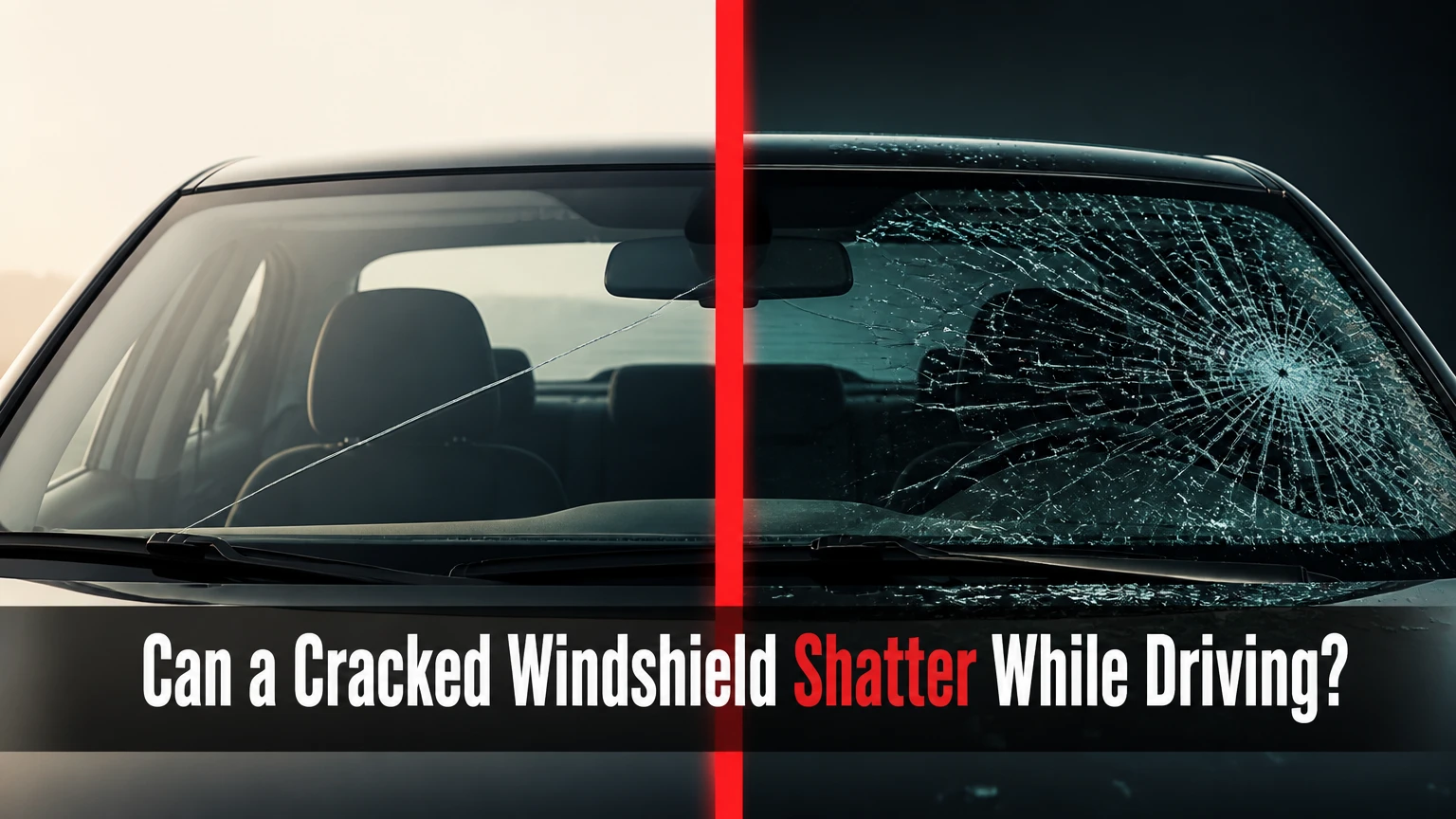
A cracked vehicle windshield will not shatter or explode into free-flying glass shards over occupants while driving. Modern auto windshields are constructed from laminated safety glass featuring a flexible polyvinyl butyral plastic interlayer sandwiched between two glass sheets. This structural layer holds broken fragments firmly in place, even during severe impacts or extensive spiderweb cracking.
At a Glance
- Modern windshields use laminated safety glass, ensuring broken pieces remain bonded to an internal plastic layer.
- Cracks exceeding 6 inches, touching the glass edge, or penetrating both layers require full windshield replacement.
- A compromised windshield reduces structural cabin strength by up to 30% in general impacts and 60% in rollovers.
- Rapid thermal shock from defrosters or air conditioning can instantly expand a minor rock chip across the entire glass span.
- Passenger airbag deployment can blow a cracked windshield out of its frame, nullifying airbag cushion protection.
How Is Auto Glass Built to Prevent Complete Shattering?
Auto glass prevents shattering through a three-layer laminated design consisting of two 2.1 mm annealed glass sheets permanently bonded to a central 0.76 mm Polyvinyl Butyral (PVB) plastic interlayer. When an object strikes the outer glass, the energy fractures the glass sheet, but the sticky PVB core retains the shattered pieces. The total 5 mm assembly absorbs kinetic energy without detaching fragments into the cabin interior.
+-------------------------------------------------------+
|  Outer Glass Layer (2.1 mm)                           |
+-------------------------------------------------------+
|  Polyvinyl Butyral (PVB) Sticky Core Layer (0.76 mm)   |  <-- Holds glass fragments
+-------------------------------------------------------+
|  Inner Glass Layer (2.1 mm)                           |
+-------------------------------------------------------+
Because the PVB interlayer remains flexible under ambient temperatures, glass fragments stay mechanically anchored even under severe deformation. This construction allows the glass to fracture into spiderweb patterns without separating from the vehicle frame.
Why Do Side Windows Shatter into Tiny Cubes When Windshields Do Not?
Side and rear vehicle windows shatter into tiny, dull cubes because they are made from tempered glass rather than laminated glass. Tempered glass undergoes rapid thermal quenching during manufacturing, creating extreme compressive surface stress and tensile interior stress. When punctured, this stored kinetic energy releases simultaneously across the entire sheet, instantly fracturing the panel into small, relatively harmless granular pieces designed for emergency egress.
In contrast, front windshields require continuous structural retention during high-speed debris impacts. Applying tempered glass to front windshields would allow airborne rocks to penetrate directly into the passenger cabin.
When Is a Windshield Crack Repairable vs. Requiring Full Replacement?
A windshield crack is repairable using optical resin if it is less than 6 inches long, restricted to the outer glass layer, and located away from sensors or outer edges. A full windshield replacement is mandatory if the crack touches any perimeter edge, penetrates both glass layers, interferes with ADAS camera zones, or exceeds 6 inches.
| Condition | Resin Repair Eligible | Full Replacement Mandatory |
|---|---|---|
| Crack Length | Under 6 inches (size of a dollar bill) | Over 6 inches long |
| Depth | Outer glass layer only | Both outer and inner glass layers breached |
| Location | Center zone, away from driver line of sight | Within 2 inches of outer frame or camera mount |
| Contamination | Fresh crack, free of dirt and moisture | Embedded debris or PVB delamination present |
Can High Highway Speeds Force a Compromised Windshield Inward?
High highway speeds can force a compromised windshield to collapse inward if both the outer and inner glass layers are fractured simultaneously. Aerodynamic drag generates significant dynamic air pressure against the glass at speeds above 55 mph (88 km/h). When the structural integrity of both glass layers and the central PVB core is severed, wind resistance overcomes the remaining surface tension, driving the central damaged section into the cabin.
Single-layer outer cracks rarely cave in under wind pressure alone because the undamaged inner sheet maintains structural rigidity. However, multi-layer fractures or widespread water delamination render the glass structurally inert under highway air resistance.
Why Do Temperature Swings Cause Windshield Cracks to Spread Instantly?
Rapid temperature changes expand or contract glass unevenly, creating severe localized thermal stress along existing stress fractures. Glass expands when heated and contracts when cooled; blasting a frozen windshield with high heat from a defroster causes the interior glass surface to expand rapidly while the colder outer surface remains contracted.
Cold Outside (-10°C) ---> [ Cold Outer Glass ]
                           [ PVB Plastic Core ]
Hot Inside (+25°C)  ---> [ Hot Inner Glass (Expands) ]  <-- Shear stress cracks glass
This sudden thermal differential (thermal shock) concentrates force at the micro-fissure at the tip of an existing crack, causing it to snap instantly across the entire length of the panel within seconds.
Why Are Edge Cracks More Dangerous Than Center Cracks?
Edge cracks are structurally more dangerous because the outer 2 inches of a windshield are bonded directly to the vehicle frame with high-modulus polyurethane adhesive. The perimeter of the auto glass absorbs raw mechanical torsion, chassis flexing, and cornering forces directly from the vehicle body.
A center crack isolated in the middle of the pane experiences far lower structural pressure. Conversely, an edge crack sits directly in the highest strain zone; minor road vibrations or dropping a wheel into a shallow pothole will instantly drive an edge crack deep into the central field of vision.
How Does Freezing Moisture Cause Windshield Delamination?
Freezing moisture causes delamination when water seeps through an open glass crack and settles directly against the Polyvinyl Butyral (PVB) plastic layer. As ambient temperatures drop below 0°C (32°F), trapped water freezes and expands in volume by 9%.
1. Water Intrusion ---> 2. Sub-Zero Temp ---> 3. Water Freezes & Expands (9%) ---> 4. PVB Separates
   (Crack opens)          (Moisture trapped)    (Drives glass away from PVB)       (Delamination)
This expansion acts as a wedge, forcing the outer glass sheet to peel away from the sticky internal plastic core. Once delaminated, the glass loses its shatter-proof retention properties and white, foggy patches form around the crack edge, signaling permanent structural breakdown.
How Does a Cracked Windshield Compromise Rollover Safety?
A compromised windshield degrades rollover crash protection because auto glass serves as a load-bearing structural pillar, supporting up to 30% of a vehicle’s cabin strength and up to 60% of roof crush resistance in a rollover.
When a vehicle flips, the roof frame relies on the rigid perimeter of the bonded windshield glass to prevent the A-pillars from buckling under the vehicle’s weight. If the glass contains deep or edge-touching cracks, its compressive resistance collapses instantly, causing the roof frame to cave directly into the occupant seating area.
Can an Inflating Airbag Force a Cracked Windshield Out of Its Frame?
An inflating passenger-side airbag can blow a cracked windshield entirely out of its frame during a collision. Modern passenger airbags deploy upward at speeds approaching 200 mph (320 km/h), slamming deliberately against the inner surface of the windshield, using the glass as a backstop to direct the expanding cushion toward the occupant.
Airbag Deploys Upward (200 mph) ---> Strikes Inner Glass ---> Glass Backstop holds (Normal)
Airbag Deploys Upward (200 mph) ---> Strikes Cracked Glass -> Glass blows out frame (Failure)
If the windshield’s structural integrity is compromised by deep cracks, the force of the deploying airbag fractures the glass completely away from the polyurethane frame bond. Without a solid glass backstop, the airbag inflates through the opening into the engine compartment, offering zero restraint to the passenger.
How Does a Cracked Windshield Disrupt ADAS Safety Cameras?
A windshield crack disrupts Advanced Driver Assistance Systems (ADAS) by bending, scattering, or refracting light rays entering forward-facing optical cameras mounted behind the top-center glass. Autonomous emergency braking, lane-keeping assist, and adaptive cruise control depend on clear camera vision to calculate accurate object distances.
When a crack or chip passes through the camera window sweep, incoming light distorts before reaching the sensor lens. This optical interference leads to false distance calculations, unexpected error codes, or dangerous phantom braking events on highways.
What Causes a Windshield Crack to Suddenly Expand Overnight?
A windshield crack expands overnight due to thermal contraction driven by rapid drop in ambient nighttime temperatures combined with residual mechanical chassis tension. As air temperature falls, the glass sheet contracts; because the perimeter is glued solidly to the rigid steel frame, contraction tension concentrates at the sharpest tip of the pre-existing crack.
Additionally, parked vehicles experience subtle pressure changes from closing doors or settling suspension. The combination of cooling contraction forces and mechanical stress overnight causes the micro-fracture to suddenly propagate across the glass face without physical impact.
Can Superglue or Clear Tape Temporarily Stop a Crack from Spreading?
Superglue cannot stop a windshield crack from spreading because it lacks the tensile strength, flexibility, UV stability, and refractive index of automotive resin. Applying superglue fills the crack with rigid cyanoacrylate, which turns cloudy and prevents professional resin from penetrating the fracture later.
Conversely, placing clear packing tape over the outside of a fresh crack is an effective temporary contamination barrier. Tape provides zero structural support, but it prevents dirt, washer fluid, and rainwater from entering the crack and corrupting the internal PVB plastic layer before a technician can inject repair resin.
How Long Can You Safely Drive With a Cracked Windshield?
You can safely drive with a cracked windshield for a maximum of 24 to 48 hours only if the crack is less than 3 inches long, restricted to the outer layer, and isolated away from the glass edges and ADAS sensor zones.
Driving beyond this timeframe introduces progressive risks from humidity, chassis flex, and temperature shifts. If a crack penetrates both glass layers, blocks the driver’s direct field of view, or touches the frame boundary, the vehicle should not be driven until professional glass repair or replacement is completed.
Will a Vehicle Pass State Safety Inspection With a Cracked Windshield?
A vehicle will fail state safety inspection if a windshield crack exceeds 3/4 inch in diameter within the driver’s direct line of sight (swept area of the driver-side wiper blade) or if any crack extends over 6 inches anywhere on the glass assembly.
Inspectors reject vehicles with cracks that intersect perimeter edges, feature spiderweb cracking patterns, or obstruct forward-facing ADAS camera modules. Specific state regulations vary, but any fracture that hinders clear visual sightlines or compromises cabin structural integrity triggers an automatic inspection failure.
Does Car Insurance Cover Windshield Repair or Replacement Without a Deductible?
Comprehensive auto insurance coverage typically pays for full windshield repair or replacement, and many states mandate zero-deductible glass coverage by law. In states with full glass endorsements (such as Florida, South Carolina, and Kentucky), insurers are required to repair or replace damaged auto glass without requiring policyholders to pay an out-of-pocket deductible.
Standard insurance policies elsewhere cover glass under comprehensive claims; minor resin repairs are almost universally covered with zero deductible because insurers prefer spending $70 to repair a chip over paying $1,000+ for full glass replacement and ADAS recalibration.
The Bottom Line
A cracked vehicle windshield will not explode or scatter dangerous shards onto occupants due to its structural laminated PVB core. However, driving with an unaddressed crack severely compromises vehicle safety by reducing cabin rollover strength, causing passenger airbag blowout failures, and disabling ADAS safety cameras. Small rock chips under 6 inches should be sealed immediately with professional resin before edge stress or thermal expansion forces a complete glass replacement.


