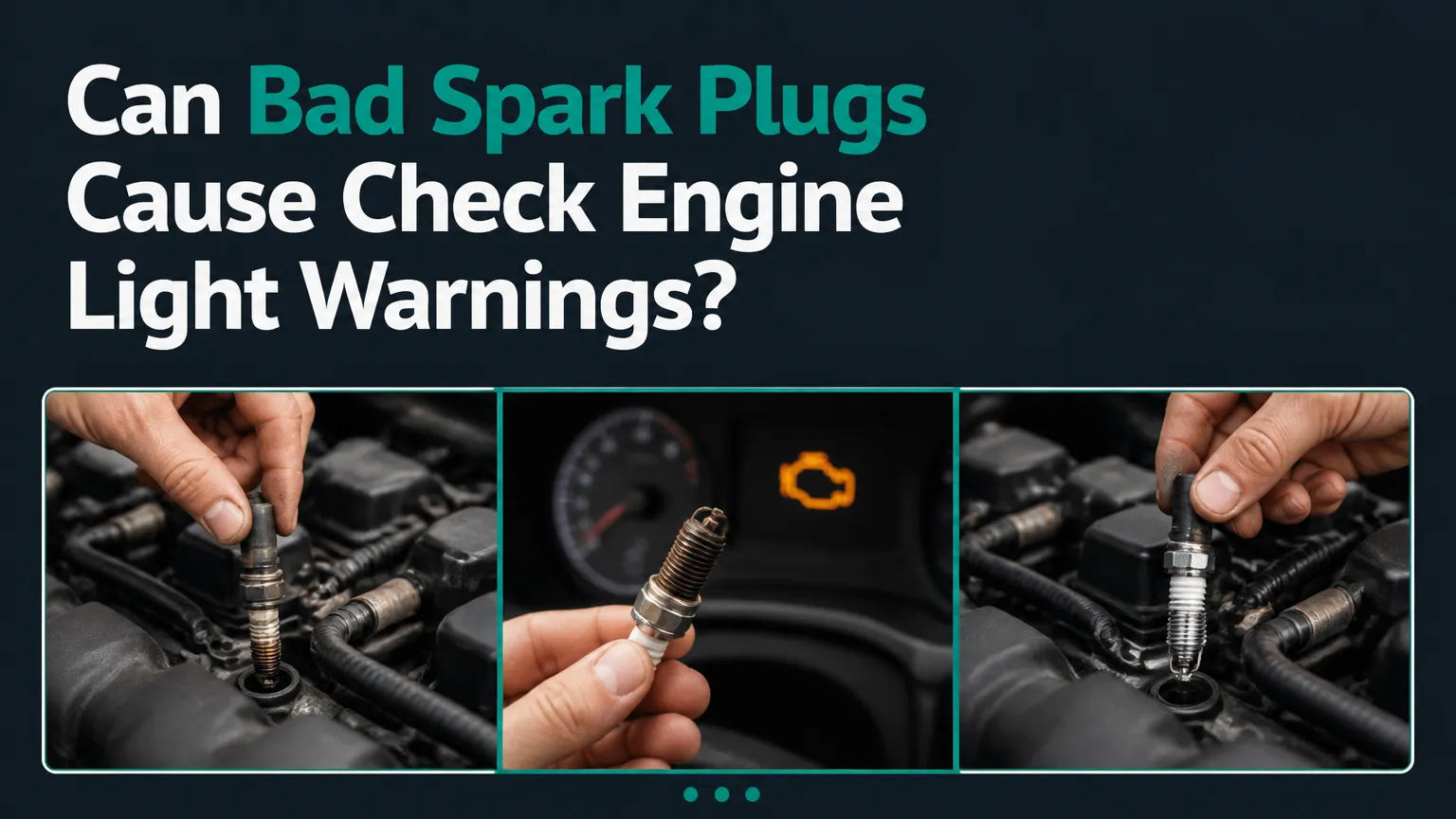
Yes, bad spark plugs absolutely cause a check engine light to illuminate on your dashboard. When a spark plug degrades, it fails to ignite the air-fuel mixture reliably. This creates an engine misfire that dumps unburned oxygen into the exhaust system, forcing the engine control unit to trigger the warning light.
Key Facts / At a Glance
- A single failing spark plug will trigger an immediate dashboard warning light.
- Diagnostic scanners will typically display codes ranging from P0300 to P0308.
- A flashing check engine light indicates an active, severe misfire that can melt your catalytic converter.
- Modern iridium spark plugs last 80,000 to 120,000 miles, while copper plugs require replacement every 30,000 miles.
- Professional replacement costs range from $100 to $350, while DIY parts cost between $10 and $80 total.
Why Do Failing Spark Plugs Trigger the Engine Computer?
Failing spark plugs trigger the engine control unit (ECU) because they disrupt the strict air-to-fuel ratio required for efficient combustion. The ignition coil sends between 20,000 and 40,000 volts of electricity to the plug. This electricity must jump a precise gap between the center electrode and the ground electrode. When the plug wears down, that gap widens beyond the ignition system’s voltage capacity. The electrical arc fails, the fuel does not ignite, and the cylinder misfires.
The engine computer does not monitor the spark plug directly. Instead, it relies on the oxygen sensors (O2 sensors) located in the exhaust manifold. When a misfire occurs, all the unburned oxygen from that cylinder gets pumped directly into the exhaust pipe. The upstream O2 sensor detects this sudden spike in oxygen concentration. It immediately signals the ECU that the combustion cycle failed.
The ECU then registers a misfire event. Automotive software requires a specific threshold of misfire events within a set number of engine revolutions before it alerts the driver. Once the misfire count exceeds this factory-programmed threshold, the ECU permanently stores a diagnostic trouble code (DTC) in its memory and illuminates the dashboard warning light. This entire detection cycle happens in milliseconds.
Which OBD-II Codes Indicate a Spark Plug Issue?
An onboard diagnostic scanner will display a P0300-series trouble code when bad spark plugs cause a misfire. The engine computer monitors the rotational speed of the crankshaft to identify exactly which cylinder failed to fire. When the crankshaft hesitates slightly during a specific cylinder’s power stroke, the ECU logs a code ending in that cylinder’s exact numerical designation.
You must plug an OBD-II scanner into the port located under your driver-side dashboard to read these codes. An engine misfire will always generate a code between P0300 and P0308. However, worn spark plugs heavily strain the ignition coils attached to them. This means you will frequently see coil circuit codes alongside your primary misfire codes. The table below outlines the exact codes you will encounter, what component the computer suspects, and the standard repair action.
| DTC Code | Technical Definition | Primary Component Suspect | Typical Repair Action |
|---|---|---|---|
| P0300 | Random or Multiple Cylinder Misfire | Vacuum leak, fuel pressure, or multiple worn plugs | Inspect fuel trim data and replace entire spark plug set |
| P0301 – P0308 | Cylinder 1 through 8 Misfire Detected | Spark plug or ignition coil on the specific cylinder | Swap coil to another cylinder, replace plug if misfire stays |
| P0351 – P0358 | Ignition Coil A through H Primary Circuit | Ignition coil pack or coil wiring harness | Test coil resistance, replace damaged coil and attached plug |
| P0420 | Catalyst System Efficiency Below Threshold | Catalytic converter (often damaged by raw fuel from misfires) | Fix the misfire first, then clear code to retest converter |
Is a Flashing Check Engine Light More Dangerous?
A flashing check engine light is significantly more dangerous than a solid light because it indicates a severe, continuous misfire actively destroying your engine components. When you see the light blinking, you must pull over and shut off the engine immediately. A solid light means the ECU detected a fault that affects emissions. A flashing light means the fault is currently pushing raw, unburned fuel directly into the catalytic converter.
The catalytic converter uses precious metals to scrub exhaust gases at operating temperatures around 1,200 degrees Fahrenheit. When a spark plug fails completely, the unburned fuel travels into the hot converter and ignites inside the exhaust piping. A 2021 study by SAE International demonstrated that active engine misfires can drive internal catalytic converter temperatures above 1,600 degrees Fahrenheit within two minutes. At this temperature, the internal ceramic honeycomb structure melts into a solid block.
This melted blockage restricts the exhaust flow completely. The engine will choke on its own exhaust gases, lose all power, and stall. Replacing a set of spark plugs costs less than $50 in parts. Replacing a thermally destroyed catalytic converter costs between $1,500 and $3,000. Never ignore a flashing dashboard warning.
Which Spark Plug Material Prevents Misfires Best?
Iridium spark plugs prevent misfires better than any other material because they require the lowest firing voltage and resist gap erosion the longest. The central electrode material determines the plug’s lifespan and its electrical efficiency. Automakers specify different materials based on the ignition system design and the engine’s internal combustion temperatures. You should always use the material specified in your owner’s manual.
Older vehicles with distributors utilize copper plugs. Copper offers the highest thermal conductivity of any automotive metal, pulling heat out of the combustion chamber rapidly. However, copper is a soft metal. The high voltage arc physically erodes the electrode material with every spark. Modern high-compression engines and turbocharged vehicles require harder metals like platinum, iridium, or ruthenium to survive the 100,000-mile service intervals demanded by consumers today.
Vehicles equipped with waste-spark ignition systems require double platinum plugs. These systems fire two spark plugs simultaneously: one on the compression stroke and one on the exhaust stroke. The electrical current travels forward across one plug and backward across its partner. A single platinum plug will wear out backward in this system. The table below compares the specific lifespans, conductivity, and retail costs of modern spark plug materials.
| Material Type | Average Mileage Lifespan | Thermal Conductivity Rating | Average Retail Cost Per Plug |
|---|---|---|---|
| Standard Copper | 30,000 Miles | Excellent (385 W/m K) | $2.00 to $4.00 |
| Single Platinum | 60,000 Miles | Moderate (71 W/m K) | $4.00 to $8.00 |
| Double Platinum | 80,000 Miles | Moderate (71 W/m K) | $6.00 to $12.00 |
| Fine-Wire Iridium | 100,000 to 120,000 Miles | Low (147 W/m K) | $8.00 to $18.00 |
| Ruthenium HX | 120,000+ Miles | Moderate (117 W/m K) | $12.00 to $22.00 |
How Much Does It Cost to Fix a Spark Plug Check Engine Light?
Fixing a spark plug check engine light costs between $100 and $350 total when performed by a professional mechanic. The exact price depends entirely on the engine layout and the local labor rates. According to the AAA 2023 Repair Cost Index, the average independent repair shop charges $130 per hour for labor. Dealerships typically charge between $180 and $220 per hour.
For a standard inline-four cylinder engine, the labor takes roughly 45 minutes. The mechanic sits the parts directly on top of the engine block, making access simple. A V6 or V8 engine mounted transversely in a front-wheel-drive vehicle represents the most expensive scenario. The rear bank of spark plugs sits trapped against the firewall, often requiring the technician to unbolt and remove the entire intake manifold just to access the ignition coils. This turns a simple procedure into a three-hour labor charge.
If you perform the work yourself, you only pay for the parts. A full set of premium iridium spark plugs for a four-cylinder car costs roughly $40 at an auto parts store. You will also need a specialized 5/8-inch or 14mm spark plug socket, a locking extension bar, and a torque wrench. These tools cost an additional $50 if you do not already own them.
How Do You Diagnose and Replace Misfiring Spark Plugs?
You diagnose a misfiring spark plug by moving the ignition coil to a different cylinder and watching if the OBD-II trouble code follows the coil or stays with the plug. If cylinder 3 reports a P0303 code, swap the ignition coil from cylinder 3 with the coil from cylinder 1. Clear the computer codes and drive the vehicle. If the code returns as P0301, the coil is dead. If the code returns as P0303, the spark plug is the primary failure point.
When replacing the plugs, torque specifications dictate your success or failure. An under-torqued plug will vibrate loose, allowing hot combustion gases to escape and melt the ignition coil. An over-torqued plug will stretch the metal threads and permanently damage the cylinder head. Always use a calibrated torque wrench. The exact torque required depends on the thread diameter, the seating style (flat with a crush washer or tapered), and whether your engine has an aluminum or cast-iron cylinder head.
| Thread Size | Cylinder Head Material | Seating Type | Recommended Torque Specification |
|---|---|---|---|
| 14mm | Aluminum Head | Flat with Gasket | 18 to 22 lb-ft (25 to 30 Nm) |
| 14mm | Cast Iron Head | Flat with Gasket | 26 to 30 lb-ft (35 to 40 Nm) |
| 14mm | Aluminum Head | Tapered Seat | 11 to 15 lb-ft (15 to 20 Nm) |
| 12mm | Aluminum Head | Flat with Gasket | 11 to 18 lb-ft (15 to 25 Nm) |
Begin by disconnecting the negative battery terminal. Remove the plastic engine cover and unbolt the ignition coil holding bolts. Pull the coils straight up and out. Use compressed air to blow any dirt out of the spark plug tubes before removing the old plugs. If debris falls into the open cylinder, it will score the cylinder walls upon startup. Use a dedicated spark plug socket with a rubber internal grommet to gently unscrew and extract the old plug. Hand-thread the new plug perfectly straight into the hole until it seats, then apply the final torque with your wrench.
What Are the Expert Rules for Spark Plug Maintenance?
Experienced automotive technicians follow strict procedural rules that amateur mechanics often ignore. The ignition system requires clinical cleanliness and exact measurements to function flawlessly over a 100,000-mile lifespan. Ignoring these baseline practices leads to stripped threads, phantom misfire codes, and premature part failure.
- Never use anti-seize on modern zinc-plated plugs. Major manufacturers like NGK and Denso apply a special trivalent metal plating to their threads at the factory. Adding wet anti-seize acts as a lubricant, causing you to over-torque the plug by up to 20 percent and snap the metal shell inside the engine block.
- Always verify the gap out of the box. Do not trust the factory gap on the cardboard packaging. Plugs get dropped during shipping, which bends the ground electrode inward. Use a wire-style feeler gauge to measure the gap against your under-hood emissions sticker specifications.
- Apply dielectric grease to the ceramic insulator. Smear a tiny pea-sized amount of silicone dielectric grease inside the rubber boot of the ignition coil. This prevents voltage from leaking down the side of the ceramic plug (known as carbon tracking) and stops the rubber boot from welding itself to the plug over the next five years.
- Change the whole set at once. Never replace a single spark plug. The electrical resistance across the ignition system must remain balanced. A new plug has lower electrical resistance than three old plugs. The engine computer will struggle to adjust fuel trims evenly across mismatched cylinders.
Frequently Asked Questions
How long can you drive with a bad spark plug? You should not drive more than a few miles with a failing spark plug. Driving with an active misfire forces raw fuel into the exhaust system. This will permanently destroy your catalytic converter in a matter of days, turning a cheap maintenance item into a multi-thousand-dollar repair.
Does a check engine light reset itself after changing spark plugs? The check engine light will usually reset itself after you complete three consecutive, successful drive cycles without a misfire. However, the computer stores the historical trouble code in its permanent memory. You should manually clear the codes with an OBD-II scanner immediately after the repair to verify your fix worked.
Can a bad spark plug cause the car to shake? Yes, a bad spark plug causes noticeable engine shaking and rough idling. The internal combustion engine relies on a perfectly balanced rotational rhythm. When a cylinder goes dead, that side of the engine loses its power stroke, causing the entire engine block to jerk violently on its rubber mounts.
Can a loose spark plug cause a check engine light? A loose spark plug will cause a check engine light by triggering a misfire. When the plug is not torqued down, the cylinder loses compression through the thread gaps. This loss of compression prevents the fuel mixture from reaching the correct pressure for ignition, resulting in a misfire code.
Do you have to replace ignition coils when replacing spark plugs? You do not have to replace ignition coils every time you change the plugs. Ignition coils generally last twice as long as standard platinum spark plugs. You should only replace the coils if they fail an electrical resistance test, if the rubber boots show visible cracks, or if the vehicle has surpassed 150,000 miles.
The Bottom Line
Drivers frequently ask if they can bad spark plugs cause check engine light warnings, and the automotive data provides a definitive yes. The engine computer relies on precise combustion to manage emissions. Whenever a worn electrode fails to bridge the electrical gap, the resulting misfire triggers immediate dashboard warnings. By diagnosing the specific OBD-II trouble codes and adhering strictly to factory torque specifications, you can resolve the misfire quickly and protect your exhaust system from catastrophic thermal damage.


